

TMU
Owner
Tarbiat Modares University (TMU) is the owner of HEHP.

0.8
Cite Score 2025
Volume 14, Issue 1 (2026)
Health Educ Health Promot 2026, 14(1): 61-67 |
Back to browse issues page
Article Type:




History
Received: 2025/12/28 | Accepted: 2026/02/2 | Published: 2026/01/29
Received: 2025/12/28 | Accepted: 2026/02/2 | Published: 2026/01/29
How to cite this article
Hosseini F, Hashemi F, Shafiei A, Salavatian A. Effect of COVID-19 Pandemic-Related Post-Traumatic Stress Disorder on the Quality of Nurses’ Work Life. Health Educ Health Promot 2026; 14 (1) :61-67
URL: http://hehp.daneshafarand.org/article-4-83077-en.html
URL: http://hehp.daneshafarand.org/article-4-83077-en.html
Download citation:
BibTeX | RIS | EndNote | Medlars | ProCite | Reference Manager | RefWorks
Send citation to:


Rights and permissions
BibTeX | RIS | EndNote | Medlars | ProCite | Reference Manager | RefWorks
Send citation to:


Keywords:
COVID-19 [MeSH], Quality of Life [MeSH], Post-Traumatic Stress Disorder [MeSH], Nurses [MeSH], Iran [MeSH]
| Abstract (HTML) (834 Views)
Full-Text: (117 Views)
Introduction
The World Health Organization designated the coronavirus as an acute respiratory illness and a public health emergency of international concern in 2019 due to its rapid spread [1]. While symptoms of anxiety, depression, and distress are found at high levels in the general population, certain groups may be more vulnerable than others to the psychosocial impacts of pandemics. Healthcare workers, particularly nurses, were among the most vulnerable groups, facing the psychological and social issues brought on by the coronavirus pandemic at that time [2, 3].
The outbreak of an unknown infection, such as COVID-19, without a vaccine or effective medical treatments, can be defined as a traumatic experience due to its acute and chronic consequences at both individual and societal levels. In addition to the immediate danger presented by the dread of infection and the possibility of death for themselves and their loved ones, the pandemic’s indirect effects appear to be linked to mood disorders, psychiatric illnesses, sleep difficulties, and feelings of instability [4]. Consequently, this population is susceptible to developing psychiatric problems [5].
Reducing the psychological effects of chronic illness on medical personnel is viewed by policymakers and healthcare system planners globally as a significant and unique challenge [6, 7].
Post-traumatic stress disorder (PTSD) is a notable example of the adverse psychological consequences experienced by healthcare professionals as a result of pandemics and epidemics caused by diseases [8]. PTSD is a psychological disorder that can affect individuals directly or indirectly. It may be induced by extreme threats or severe stress-inducing events, such as accidents, severe injuries, threats to physical security, death, natural disasters, or war [8].
Intrusive memories of the incident, nightmares, sleep disturbances, irritability, wrath, inattentiveness, hypervigilance, and involuntary reflexes are among the recognized symptoms of PTSD. Research conducted by Dutheil et al. [5, 9] suggests that the Coronavirus pandemic is expected to induce stress disorders in healthcare workers, potentially progressing to chronic PTSD, as observed in previous epidemics. An unprecedented number of healthcare personnel were afflicted by these disorders during the Ebola epidemic [10]. Furthermore, mental health issues and severe emotional symptoms were experienced by 18 to 57% of health professionals during and after the SARS outbreak [11].
The quality of work life is a complex and multifaceted concept that encapsulates workers’ perceptions and emotions about their occupations. Moreover, the quality of work life influences the standard of labor and services provided by workers [12]. Healthcare organizations play a crucial role in safeguarding public health and are regarded as essential entities for preserving community health [13].
A higher quality of work life for nurses is associated with lower healthcare costs, greater organizational commitment, increased patient satisfaction, and a higher quality of service. Furthermore, improving the quality of work life for nurses in healthcare settings can positively impact their morale, job satisfaction, productivity, quality of care, and job performance [12]. In this context, it is essential to focus on the work-life quality of healthcare professionals, especially nurses, who provide direct patient services and substantially enhance the quality of organizational services [14].
The concept of the quality of nurses’ professional life was first presented by Attridge & Callahan. They posited that the quality of work-life integration among nurses is enhanced when they can satisfy their personal and fundamental needs through employment in healthcare organizations [15]. Brooks & Anderson ultimately delineated the concept of the quality of nurses’ work life (QNWL) across four dimensions: the work life/home life dimension, the job design dimension, the work context dimension, and the work world dimension [16].
Nurses form the most substantial cohort of healthcare professionals directly interacting with patients in healthcare facilities. The nursing profession is considered one of the largest and most demanding sectors involving direct patient care. Therefore, it is crucial to assess and maintain the mental health of nurses in relation to the effects of the coronavirus pandemic. This research aimed to examine the impact of PTSD, induced by the coronavirus pandemic, on the quality of working life among nurses.
Instrument and Methods
Design and participants
This cross-sectional descriptive-analytical study was conducted from September 2022 to March 2023 among nurses employed in hospitals affiliated with Qazvin University of Medical Sciences in northern Iran.
The sample size was determined using the Cochran method, accounting for a margin of error of 0.05, yielding approximately 278 individuals. Data from 261 of these participants were finally processed. The inclusion criteria comprised employment at one of the hospitals affiliated with Qazvin University of Medical Sciences (Quds, Velayat, Shahid Rajaei, Kowsar, and Bouali hospitals), a willingness to participate in the research, possession of a bachelor’s degree or higher, and a minimum of six months of work experience in hospital departments. The exclusion criteria encompassed individuals who withdrew from completing the questionnaire and those with incomplete questionnaire submissions.
Procedure
Prior to inclusion, written informed consent was obtained from all participants. All participants were informed of their right to withdraw from the study at any stage without adverse consequences. Anonymity and confidentiality of the data were strictly maintained throughout the process, with the removal of all personal identifiers from the dataset. The nurses received information about the self-assessment procedure for completing the surveys. After obtaining informed consent, they were instructed to answer all questions properly and truthfully.
Instrument
Three questionnaires were employed to capture data, including the Professional Quality of Life Questionnaire, the Impact of Event Scale-Revised (IES-R), and a questionnaire for demographic and professional information.
The demographic and professional information questionnaire collected data on age, gender, marital status, number of children, educational degree, employment status, work shift, work experience in the COVID-19 department, history of COVID-19 infection, and work history.
The standard IES-R includes 22 questions related specifically to COVID-19; 8 questions related to avoidance symptoms, 8 questions related to intrusive thoughts, and 6 questions related to hyperarousal symptoms. The respondents were asked to specify the frequency with which they experienced each symptom over the previous seven days. The questionnaire was self-completed by the respondents. The questionnaire is divided into the three subscales.
1- Symptoms of intrusive thoughts: This includes distressing, recurrent, and intrusive memories; repetitive dreams of the event; behaving and feeling as though the event is recurring; significant psychological distress when confronted with internal or external cues associated with the event; and the onset of physical reactions when encountering internal or external cues related to COVID-19 (for example, the statement: “Every reminder would evoke my emotions regarding COVID-19”).
2- Symptoms of avoidance: Attempts to evade thoughts, emotions, or discussions pertaining to the trauma, endeavors to steer clear of activities, locations, or individuals that evoke memories of the trauma, Inability to recollect a significant facet of the trauma, pronounced disinterest in vital activities, sensations of detachment or alienation from others, limited emotional expression, perception that positive experiences are improbable (for instance, the statement “Even when I did not intend to contemplate COVID-19, it persistently occupied my thoughts”).
3- Symptoms of hyper arousal: Challenges in initiating or maintaining sleep; Irritability or episodes of wrath; Impaired concentration; Heightened alertness; Pronounced startle reflex [9] (for instance, the expression “I had heightened attentiveness and awareness”). All statements were evaluated using a five-point Likert scale: never (0 points), seldom (1 point), sometimes (2 points), frequently (3 points), always (4 points). The questionnaire's overall score varied from 0 to 88, with higher scores indicating increased PTSD levels among nurses. The Persian version of this questionnaire was verified in Iran by Panaghi et al., with a reported Cronbach’s αvalue ranging from 0.67 to 0.87 [17]. A reliability coefficient of 0.80 was achieved in this investigation.
The QNWL Scale, developed by Brooks & Anderson, was employed to evaluate the quality of working life. This scale consists of 42 questions distributed across four subscales: quality of the work-home interface (7 questions), work schedule (10 questions), work environment (20 questions), and the broader work world (5 questions). It utilizes a 6-point Likert scale, where each item is scored from 1 (very low quality) to 6 (very high quality). The total score ranges from 42 to 252 [16]. Saber et al. validated the Persian version of this questionnaire in Iran, estimating its reliability coefficient using Cronbach’s α [18] at 0.83. In the current study, the reliability coefficient of the QNWL was determined to be 0.86.
Data analysis
Data were analyzed using SPSS 20 software. Mann-Whitney and Kruskal-Wallis tests were utilized for mean comparisons, along with ANOVA and the Spearman correlation coefficient.
Findings
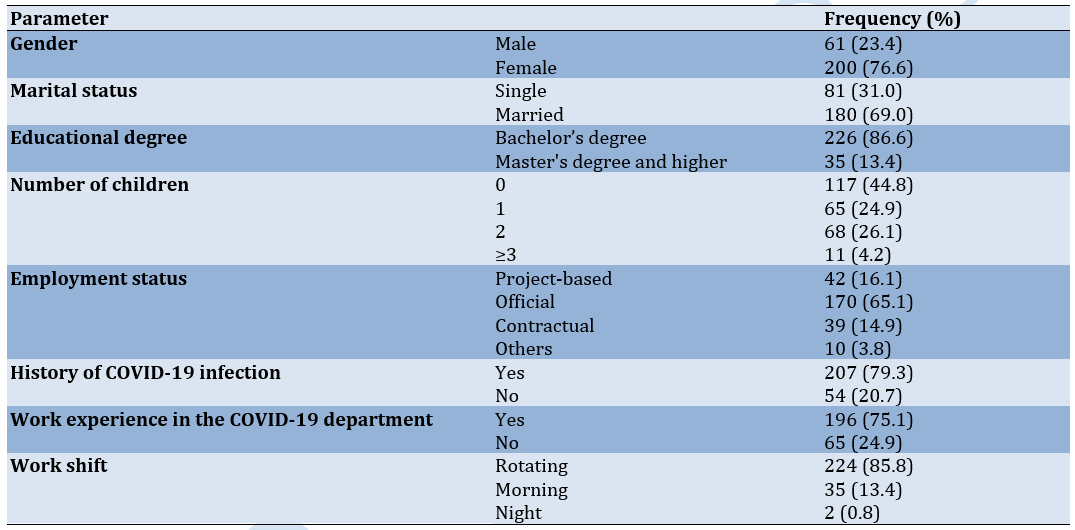
Among the 261 participants, the average age and work experience of the nurses were 35.19±7.75 and 11.61±7.53 years, respectively. Approximately 76.6% were female, 69% were married, and 75.1% had experience working in COVID-19 patient wards (Table 1).
Table 1. Partcipants’ characteristics (n=261)
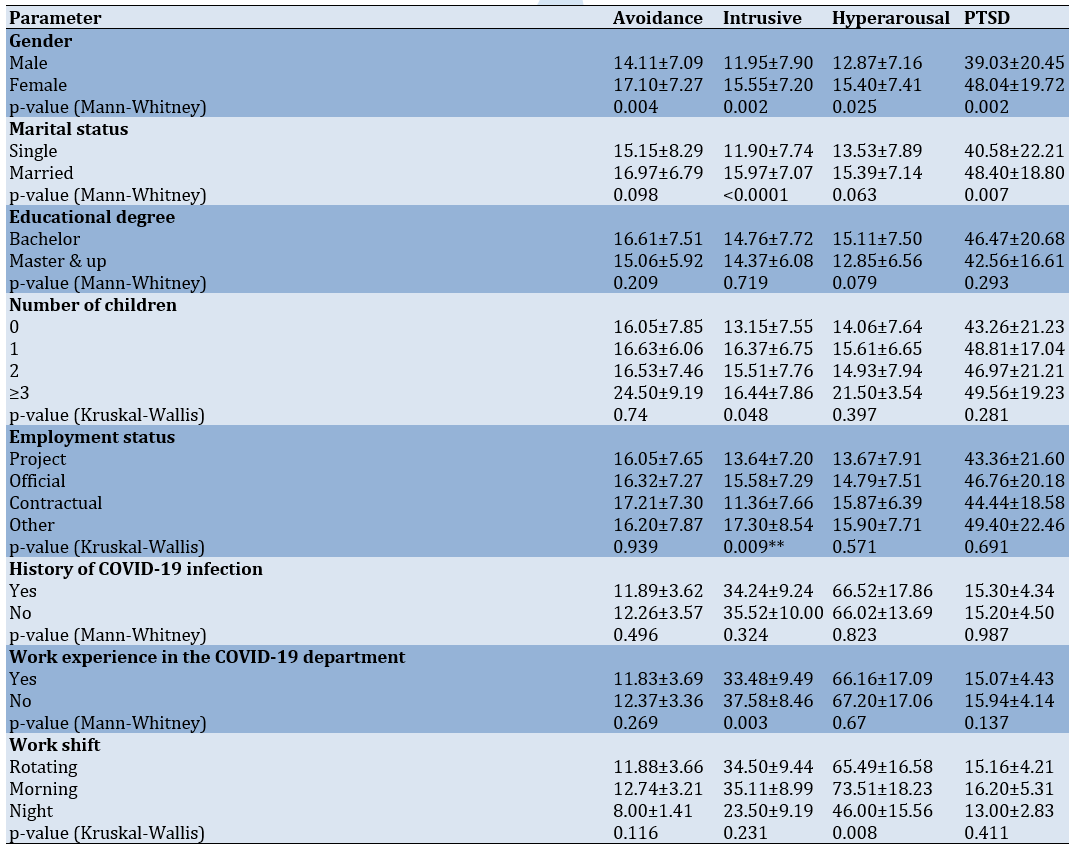
Avoidance, intrusive thoughts, and hyperarousal were significantly correlated with gender (p < 0.05). Furthermore, a significant correlation (p<0.05) was found between PTSD and gender (p=0.002), and marital status (p=0.007). Work history and intrusive thoughts showed a significant positive correlation according to the Spearman correlation test (p<0.05; Table 2).
Table 2. Relationship between post-traumatic stress disorder (PTSD) and its dimensions and demographic characteristics (n=261)
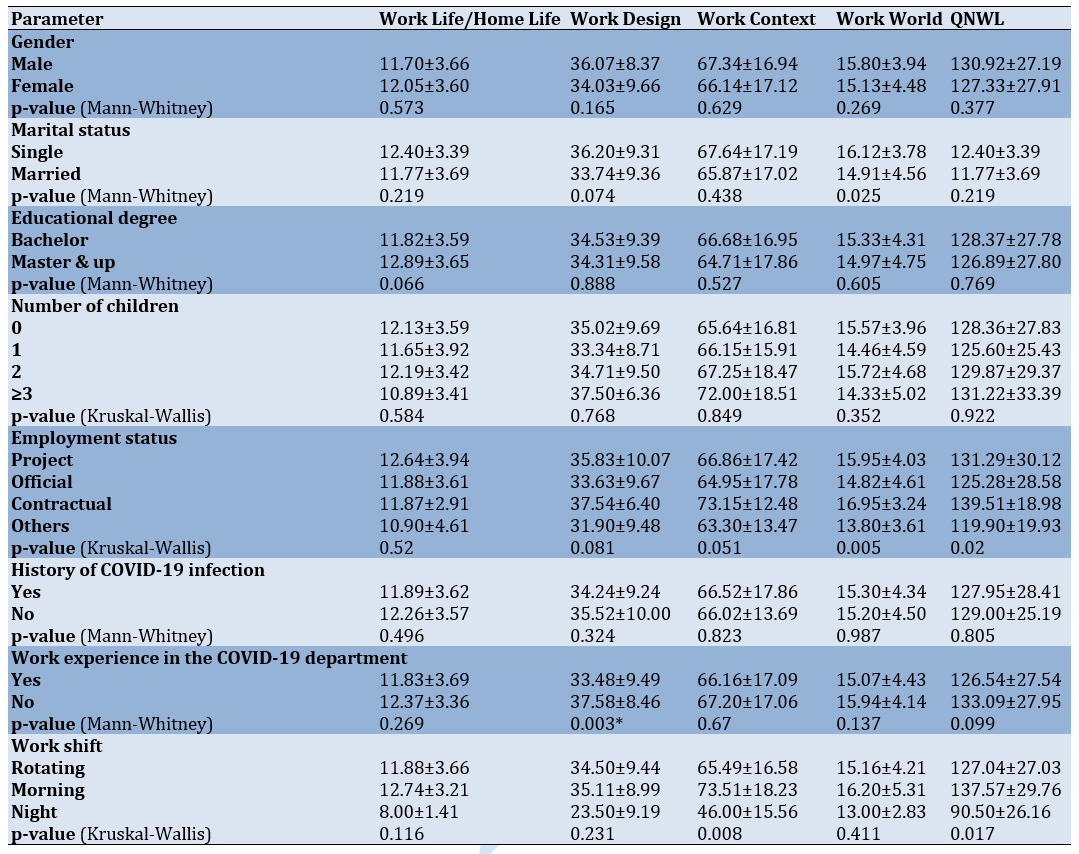
There was a significant correlation (p<0.05) between the QNWL Scale scores and employment status (p=0.020) and work shifts (p=0.017; Table 3).
Table 3. Relationship between quality of nurses’ work life (QNWL) and its dimensions and demographic characteristics (N=261)
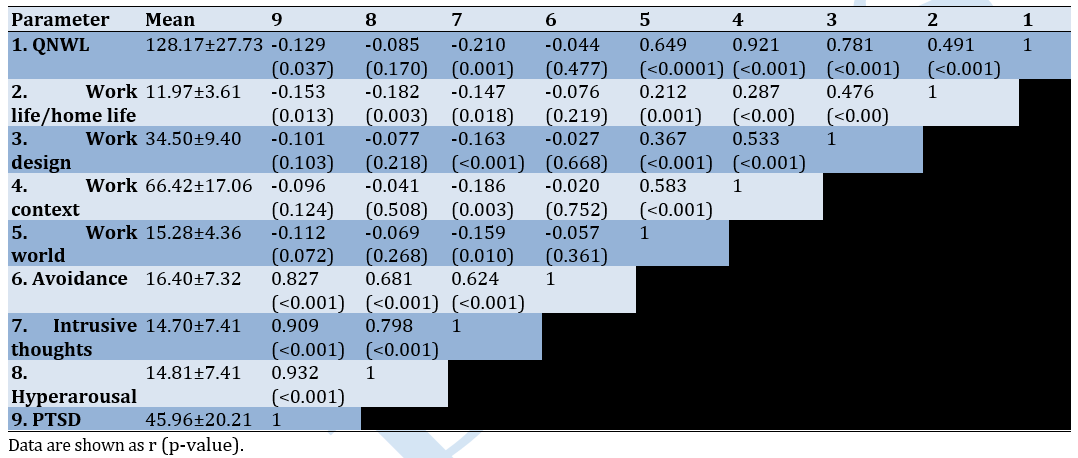
Nurses’ average PTSD score was 45.96±20.21, with the avoidance dimension showing the highest score at 16.40±7.32. Additionally, the QNWL has an average score of 128.17±27.73, with the work environment dimension having the highest value at 66.42±17.06. The Spearman correlation coefficient revealed a significant and positive relationship (p<0.001) between PTSD scores and all of its dimensions. Furthermore, all dimensions of the QNWL demonstrated a substantial and positive relationship with one another (p<0.05; Table 4).
Table 4. Relationship between quality of nursing work life (QNWL) and post-traumatic stress disorder (PTSD) scores and their dimensions (n=261)
Discussion
This study aimed to examine the impact of PTSD, induced by the coronavirus pandemic, on the quality of working life among nurses. The nurses exhibited moderate levels of PTSD and QNWL. A certain proportion of the target population reported mild to severe PTSD. According to research by Iranmanesh et al. [19], 94% of emergency medical workers in Iran report having moderate PTSD. Furthermore, Wang et al.'s revealed that 16.83% of individuals have PTSD [20], and Si et al.'s research reports 42.2% [21].
Only a small percentage of nurses in the research by Abadi et al. [22] assess their quality of working life as desirable, with the majority rating it at a moderate level. This finding is consistent with the current study’s QNWL results. This suggests that the nursing profession is inherently stressful, primarily because nurses are constantly exposed to very unpleasant situations, such as those experienced during the COVID-19 epidemic. This underscores the critical importance of attending to nurses’ mental and emotional health. However, variations in the frequency of this disorder across different cultures may be attributable to cultural differences, the prevalence of COVID-19 in different nations during that time, the number of participants investigated, and the availability of personal protective equipment. There was a strong inverse relationship between PTSD and QNWL, indicating that as PTSD scores increase, QNWL scores decrease. This research suggests that nurses in Iran, similar to those in other COVID-19-affected nations, are experiencing compromised mental and emotional health while on the front lines of patient care. It is not surprising that nurses faced significant physical, psychological, and ethical challenges during the critical conditions of the COVID-19 pandemic, given that PTSD manifests after a severe, threatening event. These challenges included feelings of inadequate social support, heavy workloads, long shifts, threats to their lives, and the ongoing increase in COVID-19 cases and resulting higher mortality rates [1].
These factors increase the probability of psychological disorders in this demographic; conversely, the successful fulfillment of all job obligations by these individuals is contingent upon their overall mental well-being. The decline in QNWL is influenced by various factors, including an insufficient number of nurses relative to patients and excessive duties, particularly in specific conditions like the COVID-19 pandemic, as indicated by the results of a systematic review study. This leads to a high level of tension and occupational fatigue, which negatively affects job performance and reduces the quality of working life. It is imperative to recognize that QNWL is a critical component of the healthcare system that must be taken into account [23].
Consequently, nursing supervisors should be aware of this imbalance and develop strategies to prevent its occurrence. A substantial correlation was identified among gender, marital status, work hour preferences, and PTSD. In line with these results, several studies have shown that women exposed to stressful experiences are more predisposed to developing PTSD than men [24]. Nonetheless, multiple studies [25, 26] have indicated contrary results. This discrepancy may be explained by the observation that men demonstrate elevated baseline cortisol levels (during reproductive years), correlating with a reduced incidence of psychological disorders [27].
Additionally, another distinction arises from the greater number of women examined in comparison to men. There was a statistically significant correlation between marital status and the dimensions of intrusive thoughts and post-traumatic stress, as well as between childlessness and having one child. Hosseini et al. [28] indicated that married individuals have a higher propensity for PTSD compared to their single counterparts. The circumstances of married individuals, characterized by their professional obligations and personal lives, may contribute to heightened sensitivity and anxiety. They face pressures, including the apprehension of transmitting the virus to their families and the potential deprivation of familial interactions due to extended working hours and shifts, in contrast to single individuals. The results in the domain of QNWL revealed that the highest score pertaining to the work setting of nurses was 66.42±17.06. There was a substantial correlation between work shifts and QNWL, with follow-up tests revealing a statistically significant difference in quality of life between day and night shifts. These findings align with those of Naz et al. [29], as nursing is a profession that offers continuous services in hospitals, necessitating shift work for nurses. Nurses engaged in rotating shifts, particularly night hours, have decreased QNWL scores relative to their counterparts in alternative shifts. Temporal factors, work hours, and heightened weariness correlate to decreased QNWL scores. These results underscore the significance of evaluating shift features and their influence on nurses’ well-being when addressing QNWL in healthcare environments [23].
Our results may not apply to other nurses, as it was conducted with nurses employed at educational hospitals affiliated with Qazvin University of Medical Sciences. According to previous research, nurses’ levels of stress and burnout might differ across hospitals and units, which can impact QNWL [23]. For instance, compared to nurses at non-educational hospitals, nurses in advanced and educational hospitals report higher levels of stress. This may be linked to increased workloads and longer working hours in educational hospitals, in addition to other workplace demands. Another limitation of the study is the use of a self-reporting method to evaluate symptoms, which might introduce bias and result in misleading findings. Therefore, it is recommended to employ clinical tests to quantify the incidence of PTSD symptoms to improve the validity and accuracy of the results, and to make the findings comparable with certain clinical research in this field.
Conclusion
Both PTSD symptoms and the QNWL are at moderate levels among the nurses and there is a correlation between PTSD symptoms and QNWL.
Acknowledgments: The authors are grateful to the nurses who participated in the research.
Ethical Permissions: Ethical approval was secured from the Research Ethics Committee of Qazvin University of Medical Sciences (Approval No.: IR.QUMS.REC.1402.062).
Conflicts of Interests: The authors declared no conflicts of interest.
Authors' Contribution: Hosseini F (First Author), Introduction Writer/Methodologist/Statistical Analyst (30%); Hashemi F (Second Author), Methodologist/Assistant Researcher (20%); Shafei A (Third Author), Introduction Writer/Methodologist (20%); Salavatian A (Fourth Author), Methodologist/Main Researcher/Discussion Writer (30%)
Funding/Support: This study was conducted with the financial support of the Deputy of Research and Technology of Qazvin University of Medical Sciences.
The World Health Organization designated the coronavirus as an acute respiratory illness and a public health emergency of international concern in 2019 due to its rapid spread [1]. While symptoms of anxiety, depression, and distress are found at high levels in the general population, certain groups may be more vulnerable than others to the psychosocial impacts of pandemics. Healthcare workers, particularly nurses, were among the most vulnerable groups, facing the psychological and social issues brought on by the coronavirus pandemic at that time [2, 3].
The outbreak of an unknown infection, such as COVID-19, without a vaccine or effective medical treatments, can be defined as a traumatic experience due to its acute and chronic consequences at both individual and societal levels. In addition to the immediate danger presented by the dread of infection and the possibility of death for themselves and their loved ones, the pandemic’s indirect effects appear to be linked to mood disorders, psychiatric illnesses, sleep difficulties, and feelings of instability [4]. Consequently, this population is susceptible to developing psychiatric problems [5].
Reducing the psychological effects of chronic illness on medical personnel is viewed by policymakers and healthcare system planners globally as a significant and unique challenge [6, 7].
Post-traumatic stress disorder (PTSD) is a notable example of the adverse psychological consequences experienced by healthcare professionals as a result of pandemics and epidemics caused by diseases [8]. PTSD is a psychological disorder that can affect individuals directly or indirectly. It may be induced by extreme threats or severe stress-inducing events, such as accidents, severe injuries, threats to physical security, death, natural disasters, or war [8].
Intrusive memories of the incident, nightmares, sleep disturbances, irritability, wrath, inattentiveness, hypervigilance, and involuntary reflexes are among the recognized symptoms of PTSD. Research conducted by Dutheil et al. [5, 9] suggests that the Coronavirus pandemic is expected to induce stress disorders in healthcare workers, potentially progressing to chronic PTSD, as observed in previous epidemics. An unprecedented number of healthcare personnel were afflicted by these disorders during the Ebola epidemic [10]. Furthermore, mental health issues and severe emotional symptoms were experienced by 18 to 57% of health professionals during and after the SARS outbreak [11].
The quality of work life is a complex and multifaceted concept that encapsulates workers’ perceptions and emotions about their occupations. Moreover, the quality of work life influences the standard of labor and services provided by workers [12]. Healthcare organizations play a crucial role in safeguarding public health and are regarded as essential entities for preserving community health [13].
A higher quality of work life for nurses is associated with lower healthcare costs, greater organizational commitment, increased patient satisfaction, and a higher quality of service. Furthermore, improving the quality of work life for nurses in healthcare settings can positively impact their morale, job satisfaction, productivity, quality of care, and job performance [12]. In this context, it is essential to focus on the work-life quality of healthcare professionals, especially nurses, who provide direct patient services and substantially enhance the quality of organizational services [14].
The concept of the quality of nurses’ professional life was first presented by Attridge & Callahan. They posited that the quality of work-life integration among nurses is enhanced when they can satisfy their personal and fundamental needs through employment in healthcare organizations [15]. Brooks & Anderson ultimately delineated the concept of the quality of nurses’ work life (QNWL) across four dimensions: the work life/home life dimension, the job design dimension, the work context dimension, and the work world dimension [16].
Nurses form the most substantial cohort of healthcare professionals directly interacting with patients in healthcare facilities. The nursing profession is considered one of the largest and most demanding sectors involving direct patient care. Therefore, it is crucial to assess and maintain the mental health of nurses in relation to the effects of the coronavirus pandemic. This research aimed to examine the impact of PTSD, induced by the coronavirus pandemic, on the quality of working life among nurses.
Instrument and Methods
Design and participants
This cross-sectional descriptive-analytical study was conducted from September 2022 to March 2023 among nurses employed in hospitals affiliated with Qazvin University of Medical Sciences in northern Iran.
The sample size was determined using the Cochran method, accounting for a margin of error of 0.05, yielding approximately 278 individuals. Data from 261 of these participants were finally processed. The inclusion criteria comprised employment at one of the hospitals affiliated with Qazvin University of Medical Sciences (Quds, Velayat, Shahid Rajaei, Kowsar, and Bouali hospitals), a willingness to participate in the research, possession of a bachelor’s degree or higher, and a minimum of six months of work experience in hospital departments. The exclusion criteria encompassed individuals who withdrew from completing the questionnaire and those with incomplete questionnaire submissions.
Procedure
Prior to inclusion, written informed consent was obtained from all participants. All participants were informed of their right to withdraw from the study at any stage without adverse consequences. Anonymity and confidentiality of the data were strictly maintained throughout the process, with the removal of all personal identifiers from the dataset. The nurses received information about the self-assessment procedure for completing the surveys. After obtaining informed consent, they were instructed to answer all questions properly and truthfully.
Instrument
Three questionnaires were employed to capture data, including the Professional Quality of Life Questionnaire, the Impact of Event Scale-Revised (IES-R), and a questionnaire for demographic and professional information.
The demographic and professional information questionnaire collected data on age, gender, marital status, number of children, educational degree, employment status, work shift, work experience in the COVID-19 department, history of COVID-19 infection, and work history.
The standard IES-R includes 22 questions related specifically to COVID-19; 8 questions related to avoidance symptoms, 8 questions related to intrusive thoughts, and 6 questions related to hyperarousal symptoms. The respondents were asked to specify the frequency with which they experienced each symptom over the previous seven days. The questionnaire was self-completed by the respondents. The questionnaire is divided into the three subscales.
1- Symptoms of intrusive thoughts: This includes distressing, recurrent, and intrusive memories; repetitive dreams of the event; behaving and feeling as though the event is recurring; significant psychological distress when confronted with internal or external cues associated with the event; and the onset of physical reactions when encountering internal or external cues related to COVID-19 (for example, the statement: “Every reminder would evoke my emotions regarding COVID-19”).
2- Symptoms of avoidance: Attempts to evade thoughts, emotions, or discussions pertaining to the trauma, endeavors to steer clear of activities, locations, or individuals that evoke memories of the trauma, Inability to recollect a significant facet of the trauma, pronounced disinterest in vital activities, sensations of detachment or alienation from others, limited emotional expression, perception that positive experiences are improbable (for instance, the statement “Even when I did not intend to contemplate COVID-19, it persistently occupied my thoughts”).
3- Symptoms of hyper arousal: Challenges in initiating or maintaining sleep; Irritability or episodes of wrath; Impaired concentration; Heightened alertness; Pronounced startle reflex [9] (for instance, the expression “I had heightened attentiveness and awareness”). All statements were evaluated using a five-point Likert scale: never (0 points), seldom (1 point), sometimes (2 points), frequently (3 points), always (4 points). The questionnaire's overall score varied from 0 to 88, with higher scores indicating increased PTSD levels among nurses. The Persian version of this questionnaire was verified in Iran by Panaghi et al., with a reported Cronbach’s αvalue ranging from 0.67 to 0.87 [17]. A reliability coefficient of 0.80 was achieved in this investigation.
The QNWL Scale, developed by Brooks & Anderson, was employed to evaluate the quality of working life. This scale consists of 42 questions distributed across four subscales: quality of the work-home interface (7 questions), work schedule (10 questions), work environment (20 questions), and the broader work world (5 questions). It utilizes a 6-point Likert scale, where each item is scored from 1 (very low quality) to 6 (very high quality). The total score ranges from 42 to 252 [16]. Saber et al. validated the Persian version of this questionnaire in Iran, estimating its reliability coefficient using Cronbach’s α [18] at 0.83. In the current study, the reliability coefficient of the QNWL was determined to be 0.86.
Data analysis
Data were analyzed using SPSS 20 software. Mann-Whitney and Kruskal-Wallis tests were utilized for mean comparisons, along with ANOVA and the Spearman correlation coefficient.
Findings
Among the 261 participants, the average age and work experience of the nurses were 35.19±7.75 and 11.61±7.53 years, respectively. Approximately 76.6% were female, 69% were married, and 75.1% had experience working in COVID-19 patient wards (Table 1).
Table 1. Partcipants’ characteristics (n=261)
Avoidance, intrusive thoughts, and hyperarousal were significantly correlated with gender (p < 0.05). Furthermore, a significant correlation (p<0.05) was found between PTSD and gender (p=0.002), and marital status (p=0.007). Work history and intrusive thoughts showed a significant positive correlation according to the Spearman correlation test (p<0.05; Table 2).
Table 2. Relationship between post-traumatic stress disorder (PTSD) and its dimensions and demographic characteristics (n=261)
There was a significant correlation (p<0.05) between the QNWL Scale scores and employment status (p=0.020) and work shifts (p=0.017; Table 3).
Table 3. Relationship between quality of nurses’ work life (QNWL) and its dimensions and demographic characteristics (N=261)
Nurses’ average PTSD score was 45.96±20.21, with the avoidance dimension showing the highest score at 16.40±7.32. Additionally, the QNWL has an average score of 128.17±27.73, with the work environment dimension having the highest value at 66.42±17.06. The Spearman correlation coefficient revealed a significant and positive relationship (p<0.001) between PTSD scores and all of its dimensions. Furthermore, all dimensions of the QNWL demonstrated a substantial and positive relationship with one another (p<0.05; Table 4).
Table 4. Relationship between quality of nursing work life (QNWL) and post-traumatic stress disorder (PTSD) scores and their dimensions (n=261)
Discussion
This study aimed to examine the impact of PTSD, induced by the coronavirus pandemic, on the quality of working life among nurses. The nurses exhibited moderate levels of PTSD and QNWL. A certain proportion of the target population reported mild to severe PTSD. According to research by Iranmanesh et al. [19], 94% of emergency medical workers in Iran report having moderate PTSD. Furthermore, Wang et al.'s revealed that 16.83% of individuals have PTSD [20], and Si et al.'s research reports 42.2% [21].
Only a small percentage of nurses in the research by Abadi et al. [22] assess their quality of working life as desirable, with the majority rating it at a moderate level. This finding is consistent with the current study’s QNWL results. This suggests that the nursing profession is inherently stressful, primarily because nurses are constantly exposed to very unpleasant situations, such as those experienced during the COVID-19 epidemic. This underscores the critical importance of attending to nurses’ mental and emotional health. However, variations in the frequency of this disorder across different cultures may be attributable to cultural differences, the prevalence of COVID-19 in different nations during that time, the number of participants investigated, and the availability of personal protective equipment. There was a strong inverse relationship between PTSD and QNWL, indicating that as PTSD scores increase, QNWL scores decrease. This research suggests that nurses in Iran, similar to those in other COVID-19-affected nations, are experiencing compromised mental and emotional health while on the front lines of patient care. It is not surprising that nurses faced significant physical, psychological, and ethical challenges during the critical conditions of the COVID-19 pandemic, given that PTSD manifests after a severe, threatening event. These challenges included feelings of inadequate social support, heavy workloads, long shifts, threats to their lives, and the ongoing increase in COVID-19 cases and resulting higher mortality rates [1].
These factors increase the probability of psychological disorders in this demographic; conversely, the successful fulfillment of all job obligations by these individuals is contingent upon their overall mental well-being. The decline in QNWL is influenced by various factors, including an insufficient number of nurses relative to patients and excessive duties, particularly in specific conditions like the COVID-19 pandemic, as indicated by the results of a systematic review study. This leads to a high level of tension and occupational fatigue, which negatively affects job performance and reduces the quality of working life. It is imperative to recognize that QNWL is a critical component of the healthcare system that must be taken into account [23].
Consequently, nursing supervisors should be aware of this imbalance and develop strategies to prevent its occurrence. A substantial correlation was identified among gender, marital status, work hour preferences, and PTSD. In line with these results, several studies have shown that women exposed to stressful experiences are more predisposed to developing PTSD than men [24]. Nonetheless, multiple studies [25, 26] have indicated contrary results. This discrepancy may be explained by the observation that men demonstrate elevated baseline cortisol levels (during reproductive years), correlating with a reduced incidence of psychological disorders [27].
Additionally, another distinction arises from the greater number of women examined in comparison to men. There was a statistically significant correlation between marital status and the dimensions of intrusive thoughts and post-traumatic stress, as well as between childlessness and having one child. Hosseini et al. [28] indicated that married individuals have a higher propensity for PTSD compared to their single counterparts. The circumstances of married individuals, characterized by their professional obligations and personal lives, may contribute to heightened sensitivity and anxiety. They face pressures, including the apprehension of transmitting the virus to their families and the potential deprivation of familial interactions due to extended working hours and shifts, in contrast to single individuals. The results in the domain of QNWL revealed that the highest score pertaining to the work setting of nurses was 66.42±17.06. There was a substantial correlation between work shifts and QNWL, with follow-up tests revealing a statistically significant difference in quality of life between day and night shifts. These findings align with those of Naz et al. [29], as nursing is a profession that offers continuous services in hospitals, necessitating shift work for nurses. Nurses engaged in rotating shifts, particularly night hours, have decreased QNWL scores relative to their counterparts in alternative shifts. Temporal factors, work hours, and heightened weariness correlate to decreased QNWL scores. These results underscore the significance of evaluating shift features and their influence on nurses’ well-being when addressing QNWL in healthcare environments [23].
Our results may not apply to other nurses, as it was conducted with nurses employed at educational hospitals affiliated with Qazvin University of Medical Sciences. According to previous research, nurses’ levels of stress and burnout might differ across hospitals and units, which can impact QNWL [23]. For instance, compared to nurses at non-educational hospitals, nurses in advanced and educational hospitals report higher levels of stress. This may be linked to increased workloads and longer working hours in educational hospitals, in addition to other workplace demands. Another limitation of the study is the use of a self-reporting method to evaluate symptoms, which might introduce bias and result in misleading findings. Therefore, it is recommended to employ clinical tests to quantify the incidence of PTSD symptoms to improve the validity and accuracy of the results, and to make the findings comparable with certain clinical research in this field.
Conclusion
Both PTSD symptoms and the QNWL are at moderate levels among the nurses and there is a correlation between PTSD symptoms and QNWL.
Acknowledgments: The authors are grateful to the nurses who participated in the research.
Ethical Permissions: Ethical approval was secured from the Research Ethics Committee of Qazvin University of Medical Sciences (Approval No.: IR.QUMS.REC.1402.062).
Conflicts of Interests: The authors declared no conflicts of interest.
Authors' Contribution: Hosseini F (First Author), Introduction Writer/Methodologist/Statistical Analyst (30%); Hashemi F (Second Author), Methodologist/Assistant Researcher (20%); Shafei A (Third Author), Introduction Writer/Methodologist (20%); Salavatian A (Fourth Author), Methodologist/Main Researcher/Discussion Writer (30%)
Funding/Support: This study was conducted with the financial support of the Deputy of Research and Technology of Qazvin University of Medical Sciences.
References
1. Vizheh M, Qorbani M, Arzaghi SM, Muhidin S, Javanmard Z, Esmaeili M. The mental health of healthcare workers in the COVID-19 pandemic: A systematic review. J Diabetes Metab Disord. 2020;19:1967-78. [Link] [DOI:10.1007/s40200-020-00643-9]
2. Velavan TP, Meyer CG. The COVID‐19 epidemic. Trop Med Int Health. 2020;25(3):278-80. [Link] [DOI:10.1111/tmi.13383]
3. Rodríguez BO, Sánchez TL. The psychosocial impact of COVID-19 on health care workers. Int Braz J Urol. 2020;46(Suppl 1):195-200. [Link] [DOI:10.1590/s1677-5538.ibju.2020.s124]
4. Forte G, Favieri F, Tambelli R, Casagrande M. COVID-19 pandemic in the Italian population: Validation of a post-traumatic stress disorder questionnaire and prevalence of PTSD symptomatology. Int J Environ Res Public Health. 2020;17(11):4151. [Link] [DOI:10.3390/ijerph17114151]
5. d'Ettorre G, Ceccarelli G, Santinelli L, Vassalini P, Innocenti GP, Alessandri F, et al. Post-traumatic stress symptoms in healthcare workers dealing with the COVID-19 pandemic: A systematic review. Int J Environ Res Public Health. 2021;18(2):601. [Link] [DOI:10.3390/ijerph18020601]
6. Garzaro G, Clari M, Ciocan C, Grillo E, Mansour I, Godono A, et al. COVID-19 infection and diffusion among the healthcare workforce in a large university-hospital in northwest Italy. LA MEDICINA DEL LAVORO. 2020;111(3):184-94. [Link] [DOI:10.23749/mdl.v111i3.9767]
7. Ying Y, Ruan L, Kong F, Zhu B, Ji Y, Lou Z. Mental health status among family members of health care workers in Ningbo, China, during the coronavirus disease 2019 (COVID-19) outbreak: A cross-sectional study. BMC Psychiatry. 2020;20(1):379. [Link] [DOI:10.1186/s12888-020-02784-w]
8. Peters L, Slade T, Andrews G. A comparison of ICD10 and DSM‐IV criteria for posttraumatic stress disorder. J Trauma Stress. 1999;12(2):335-43. [Link] [DOI:10.1023/A:1024732727414]
9. Dutheil F, Mondillon L, Navel V. PTSD as the second tsunami of the SARS-Cov-2 pandemic. Psychol Med. 2021;51(10):1773-4. [Link] [DOI:10.1017/S0033291720001336]
10. Fischer WA, Hynes NA, Perl TM. Protecting health care workers from Ebola: Personal protective equipment is critical but is not enough. Ann Intern Med. 2014;161(10):753-4. [Link] [DOI:10.7326/M14-1953]
11. Ornell F, Halpern SC, Kessler FHP, Narvaez JCdM. The impact of the COVID-19 pandemic on the mental health of healthcare professionals. CADERNOS DE SAUDE PUBLICA. 2020;36(4):e00063520. [Link] [DOI:10.1590/0102-311x00063520]
12. Nasirizade M, Amouzeshi Z, Unesi Z, Vagharseyyedin SA, Biabani F, Bahrami M. The relationship between quality of work life and organizational effectiveness among hospital nurses. Mod Care J. 2017;14(1):e63815. [Link] [DOI:10.5812/modernc.63815]
13. Bakhshi E, Kalantari R. Investigation of quality of work life and its relationship with job performance in health care workers. J Occup Hyg Eng. 2017;3(4):31-7. [Persian] [Link] [DOI:10.21859/johe-03044]
14. Abbasi M, Safarpour Khotbesara N, Shokraneh Kivaj N, Biabani A. Investigating the relationship between work-related quality of life and workload among intensive care unit nurses in Tehran Hospitals. J Occup Hyg Eng. 2022; 9(4):277-86. [Persian] [Link] [DOI:10.52547/johe.9.4.277]
15. Attridge C, Callahan M. Nurses' perspectives of quality work environments. Can J Nurs Adm. 1990;3(3):18-24. [Link]
16. Brooks BA, Anderson MA. Defining quality of nursing work life. Nurs Econ. 2005;23(6):319-26. [Link]
17. Panaghi L, Mogadam JA, Atari Mogadam J. Persian version validation in impact of event scale-revised. Tehran Univ Med Sci J. 2006;64(3):52-60. [Persian] [Link]
18. Saber S, Borhani F, Navidian A, Ramezani T, Amin MR, Kianian T. Related quality of work life and productivity of hospitals in Kerman University of Medical Sciences. Bioeth J. 2013;3(9):143-66. [Persian] [Link]
19. Iranmanesh S, Tirgari B, Bardsiri HS. Post-traumatic stress disorder among paramedic and hospital emergency personnel in south-east Iran. World J Emerg Med. 2013;4(1):26-31. [Link] [DOI:10.5847/wjem.j.issn.1920-8642.2013.01.005]
20. Wang YX, Guo HT, Du XW, Song W, Lu C, Hao WN. Factors associated with post-traumatic stress disorder of nurses exposed to corona virus disease 2019 in China. Medicine. 2020;99(26):e20965. [Link] [DOI:10.1097/MD.0000000000020965]
21. Si MY, Su XY, Jiang Y, Wang WJ, Gu XF, Ma L, et al. Psychological impact of COVID-19 on medical care workers in China. Infect Dis Poverty. 2020;9(1):113. [Link] [DOI:10.1186/s40249-020-00724-0]
22. Abadi F, Abadi F, Nouhi E. Survey factors affecting of quality of work life in the clinical nurses. Nurs Midwifery J. 2019;16(11):832-40. [Link]
23. Sibuea ZM, Sulastiana M, Fitriana E. Factor affecting the quality of work life among nurses: A systematic review. J Multidiscip Healthc. 2024;17:491-503. [Link] [DOI:10.2147/JMDH.S446459]
24. Tang L, Pan L, Yuan L, Zha L. Prevalence and related factors of post-traumatic stress disorder among medical staff members exposed to H7N9 patients. Int J Nurs Sci. 2016;4(1):63-7. [Link] [DOI:10.1016/j.ijnss.2016.12.002]
25. Shi L, Wang L, Jia X, Li Z, Mu H, Liu X, et al. Prevalence and correlates of symptoms of post-traumatic stress disorder among Chinese healthcare workers exposed to physical violence: A cross-sectional study. BMJ Open. 2017;7(7):e016810. [Link] [DOI:10.1136/bmjopen-2017-016810]
26. Freedman SA, Gluck N, Tuval-Mashiach R, Brandes D, Peri T, Shalev AY. Gender differences in responses to traumatic events: A prospective study. J Trauma Stress. 2002;15(5):407-13. [Link] [DOI:10.1023/A:1020189425935]
27. Lai J, Ma S, Wang Y, Cai Z, Hu J, Wei N, et al. Factors associated with mental health outcomes among health care workers exposed to coronavirus disease 2019. JAMA Netw Open. 2020;3(3):e203976. [Link] [DOI:10.1001/jamanetworkopen.2020.3976]
28. Hosseini F, Ghobadi K, Ghaffari M, Rakhshanderou S. Post-traumatic stress disorder in Iranian healthcare workers dealing with COVID-19 pandemic. Health Educ Health Promot. 2022;10(3):443-9. [Link]
29. Naz S, Hashmi AM, Asif A. Burnout and quality of life in nurses of a tertiary care hospital in Pakistan. J Pak Med Assoc. 2016;66(5):532-6. [Link]
Send email to the article author