

TMU
Owner
Tarbiat Modares University (TMU) is the owner of HEHP.

0.8
Cite Score 2025
Volume 14, Issue 1 (2026)
Health Educ Health Promot 2026, 14(1): 107-113 |
Back to browse issues page
Article Type:




History
Received: 2025/08/4 | Accepted: 2026/01/5 | Published: 2026/01/29
Received: 2025/08/4 | Accepted: 2026/01/5 | Published: 2026/01/29
How to cite this article
Amirah A, Suharto T, Aini N, Jaka Desy R, Ekowati N, Dona BR Sembiring K, et al . Effect of Life Skills Education on Preventing Household Tuberculosis Transmission in North Sumatra. Health Educ Health Promot 2026; 14 (1) :107-113
URL: http://hehp.daneshafarand.org/article-4-82193-en.html
URL: http://hehp.daneshafarand.org/article-4-82193-en.html
Download citation:
BibTeX | RIS | EndNote | Medlars | ProCite | Reference Manager | RefWorks
Send citation to:


Rights and permissions
BibTeX | RIS | EndNote | Medlars | ProCite | Reference Manager | RefWorks
Send citation to:

Authors
Asriwati Amirah *1 
 , Teguh Suharto , Nur Aini , Rara Jaka Desy , Neni Ekowati , Krisna Dona BR Sembiring , Azniah Syam , Melyana Malik
, Teguh Suharto , Nur Aini , Rara Jaka Desy , Neni Ekowati , Krisna Dona BR Sembiring , Azniah Syam , Melyana Malik
Keywords:
| Abstract (HTML) (1034 Views)
Full-Text: (137 Views)
Introduction
Indonesia has set a target within the 2030 Sustainable Development Goals (SDGs) Program in the health sector, focusing on improving the quality of life for individuals affected by infectious diseases and strengthening prevention efforts [1]. Achieving the SDGs requires immediate initiation through coordinated, cross-sectoral endeavors. Globally, the management of tuberculosis (TB)-related challenges has progressed slowly over the past two decades, attributable to numerous factors, including non-compliance with government-programmed medication. The treatment rate for TB sufferers has stagnated, showing a mere annual decrease of 0.6% since 1999 [2].
Preventing and mitigating the spread of infectious diseases among humans is a crucial function of community health. Over the last four to five decades, extending into the late 20th century, infectious diseases were generally not considered a primary cause of mortality in developed countries. While deaths from acute infections are limited in these nations, infections continue to be a significant cause of costly morbidity in affluent countries [3]. TB ranks among the top 10 leading causes of death globally and is the foremost cause of death from infectious diseases [4]. Worldwide, an estimated 10.6 million people (ranging from 9.8 to 11.3 million) suffer from TB. This includes 1.4 million (ranging from 1.3 to 1.5 million) TB deaths among those who are HIV-negative and 187,000 deaths (ranging from 158,000 to 218,000) among those who are HIV-positive [5]. Global targets and milestones to reduce TB incidence and mortality have been set as part of the SDGs and the End TB Strategy, with completion targets by 2030. Specifically, these goals include a 90% reduction in deaths and an 80% reduction in incidence (defined as new and relapse cases per 100,000 population per year) between 2015 and 2030 [6].
The global commitment to eradicating TB is outlined in the End TB Strategy, which aims to achieve an 80% reduction in incidence and a 90% reduction in deaths by 2030 [7]. In alignment with this, the Indonesian Ministry of Health has developed an Elimination Roadmap that also targets 2030. This roadmap seeks to decrease TB incidence by 80% to 65 cases per 100,000 population and deaths to 6 per 100,000 population. Key strategies include expanding TB detection and treatment coverage to at least 90%. Furthermore, the targets for successful TB treatment are set at a minimum of 90%, and for tuberculosis preventive therapy (TPT), at a minimum of 80% [8].
The Indonesian government’s initiatives to eliminate TB by 2030 are articulated in the 2020-2024 RPJM (National Medium-Term Development Plan), the 2020-2024 National Tuberculosis Control Strategy, and the 2025-2026 Interim Plan. These strategies prioritize implementing the elimination agenda by augmenting the involvement of communities, partners, and diverse multisectoral stakeholders, and by reinforcing program management through enhancements to the health system.
Individuals with pulmonary TB can transmit the disease by expelling germ-laden droplet nuclei into the air through coughing or sneezing; a single cough can generate approximately 3,000 phlegm droplets. These droplets, containing infectious agents, can remain airborne at room temperature for several hours. Infection can occur when these droplets are inhaled into the respiratory tract [9]. A single patient with sputum smear-positive pulmonary TB (BTA +) has the potential to infect 10-15 people annually, suggesting a significant possibility of infection for every contact with the sufferer. Approximately 10-15% of infected individuals develop active TB, with a yearly rate of up to 10% [10]. A survey conducted in Indonesia indicated that the incidence of TB remains high, and a considerable number of patients undergoing treatment through the Directly Observed Treatment, Short-course (DOTS) program do not achieve recovery. One primary reason for this is patients' failure to complete their treatment for the duration prescribed by the program [11].
A significant challenge persists: despite extensive TB treatment through the DOTS strategy, which is widely considered effective, the prevalence of the disease remains high [8]. This issue is compounded by the fact that the core program for patients is not yet sufficient to break the chain of transmission from infected individuals to those at risk of continuing the cycle, specifically household contacts [12-17]. Studies by Tostmann et al. [18] and Soepandi [19] on multidrug-resistant TB (MDR TB) therapy indicate a favorable conversion rate of approximately 80% by the second and third months. This finding offers optimism for the effectiveness of incidence reduction by interrupting transmission chains or minimizing the duration of Mycobacterium tuberculosis (BTA) transfer from infected individuals to their household contacts [13, 14].
According to the Global TB Report 2022, Indonesia ranks second globally in TB burden, following India. The World Health Organization (WHO) estimates 969,000 TB cases in Indonesia, with the current reported notification figure standing at 717,941 cases [10]. Data from the North Sumatra Health Service Profile in 2024 reveals that 10,568 TB cases were recorded in the province. Medan City reports the highest number of cases, with 3,775, followed by Deli Serdang Regency with 1,051. Other regions with significant case numbers include Simalungun Regency (517 cases), Langkat Regency (447 cases), and Binjai City (431 cases). The notification figure for 2023 was 49,999 cases, underscoring that the number of TB sufferers in North Sumatra remains substantial [20-29].
This study aimed to develop a life skills education (LSE) model for TB patients to prevent transmission among household contacts.
Materials and Methods
This study employed a quantitative, quasi-experimental method utilizing a two-group pre-test and post-test design. The target population comprised all individuals with TB in the areas of North Sumatra experiencing the highest case burdens. The sample consisted of 127 patients from urban areas and 126 patients from rural areas.
The LSE intervention was developed by the researchers, drawing on existing life skills education frameworks, and adapted to the context of tuberculosis prevention among household contacts. It consisted of a structured educational program delivered through lectures and guided discussions using a specifically designed module. The module covered key topics, including prevention of tuberculosis transmission, treatment adherence, cough etiquette, and personal hygiene practices. The intervention was delivered by trained health workers in several sessions over a defined period. To assess the outcomes, a structured questionnaire was used to measure knowledge, attitudes, and practices (KAP). The instrument consisted of multiple items using ordinal scales (including Likert-type responses for attitudes and practices). The questionnaire was developed based on previous literature and public health guidelines, and was tested for validity and reliability prior to data collection. Data collection was conducted in several stages, including a baseline (pre-test) and post-intervention assessments at one week (T1), one month (T2), and three months (T3).
Statistical analysis was conducted using SPSS 25. Due to non-normal data distribution, non-parametric tests, including the Friedman test (to analyze repeated measurements of respondents’ knowledge, attitudes, and practices (KAP) across different time intervals) and the Mann–Whitney U test (to compare differences between the intervention and control groups), were used.
Findings
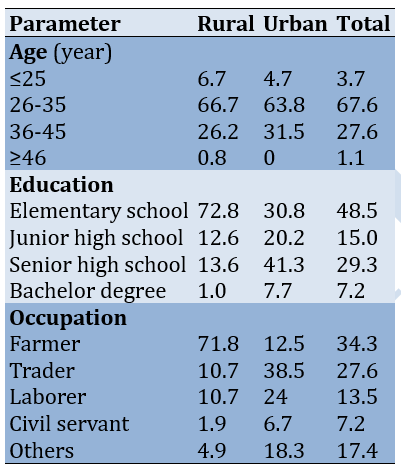
The 26-35-year age group constituted 67.6% of the sample, while the 36-45-year age group represented 27.6%. These figures indicate a higher likelihood of TB occurrence within the productive age range (Table 1).
Table 1. The frequency of rural (n=126) and urban (n=127) samples' demographic characteristics
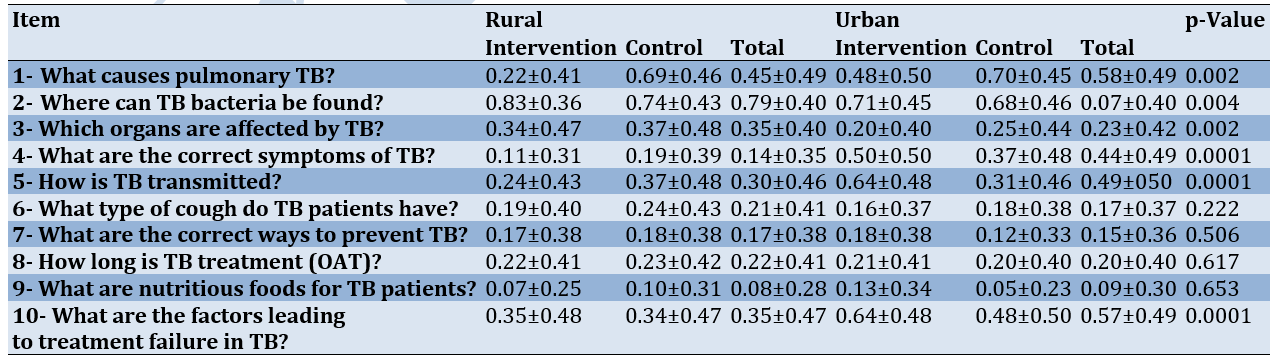
There was no statistically significant difference in the mean knowledge score between the intervention and control groups before the intervention. For questions 6, 7, 8, and 9, the frequency distribution between rural and urban areas showed no significant difference (p>0.05; Table 2).
Table 2. Respondents’ mean knowledge score based on the area before the intervention
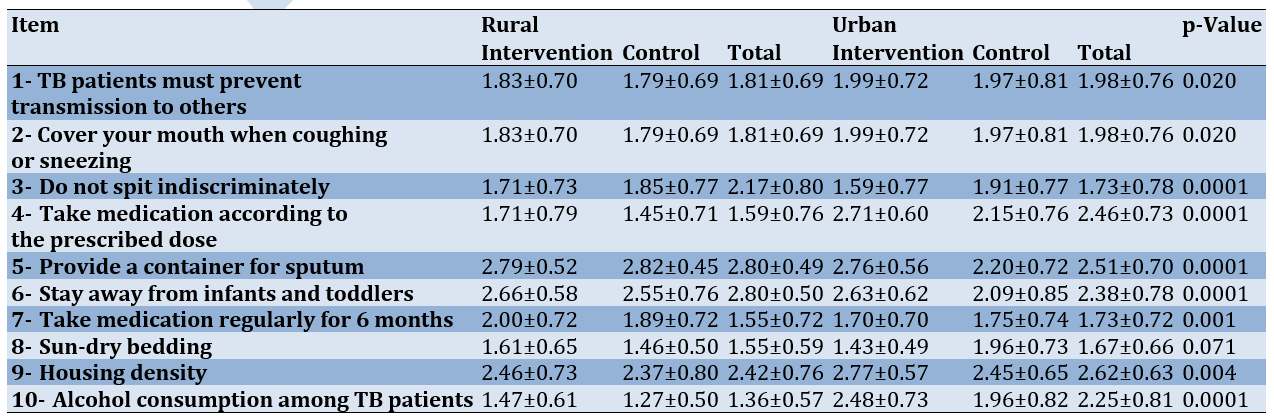
Prior to the intervention, significant differences in attitude scores between the rural and urban groups were observed for most questions (p<0.05), except for question 8 (p=0.071; Table 3).
Table 3. Respondents' attitude score based on area before the intervention
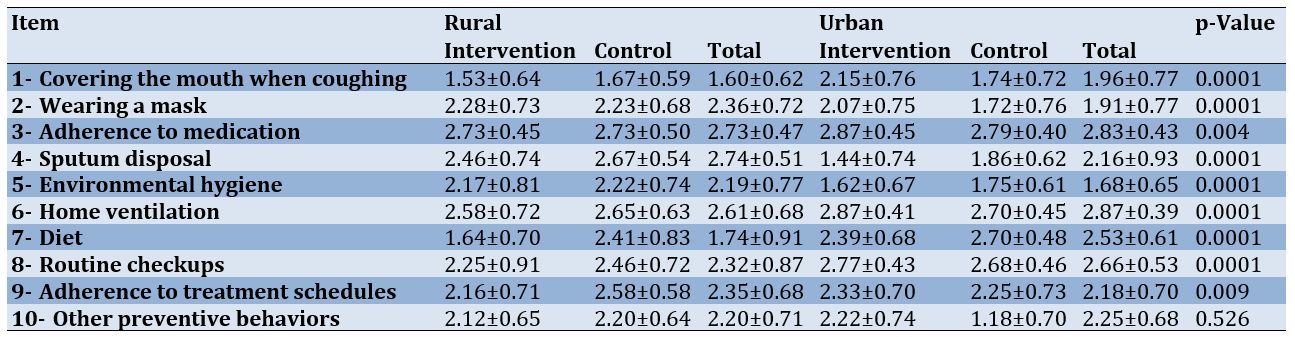
A statistically significant difference in practice scores between the rural and urban groups was observed before the intervention for most questions (p<0.05), except for question 10 (p=0.526; Table 4).
Table 4. Comparison of respondents' practice score based on the area before the intervention
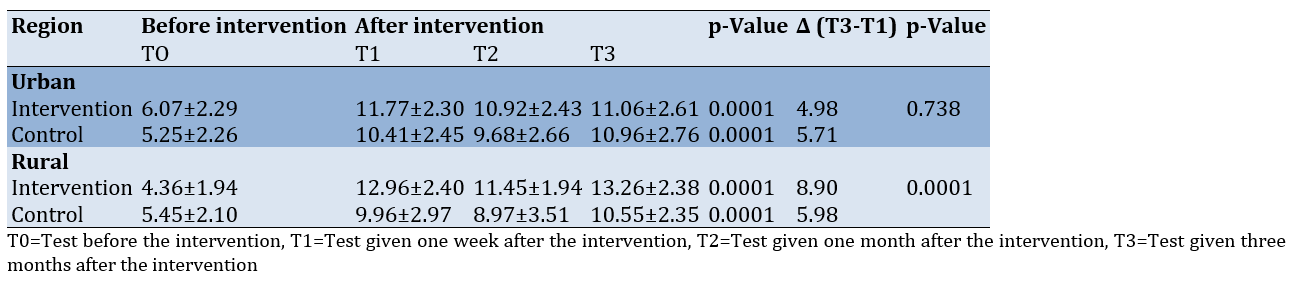
A statistically significant difference in knowledge scores was found between urban and rural areas (p=0.0001). Furthermore, when examining the differences within rural and urban areas across all groups following interventions (the first and third tests: T3-T1), the urban area showed no significant difference (p>0.05). In contrast, the rural area exhibited a significant difference between the intervention and control groups (p=0.0001; Table 5).
Table 5. Comparison of respondents' knowledge mean score before and after the intervention
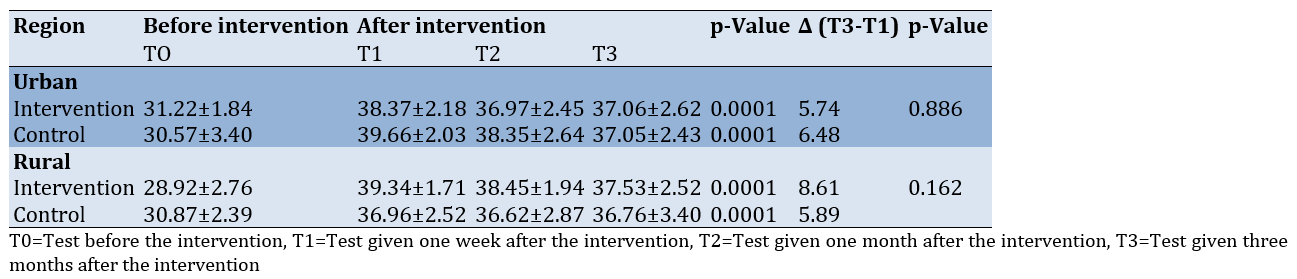
The changes in respondents’ attitudes in both urban and rural areas from the pre-test to the post-test, conducted three months after the intervention, were statistically significant (p=0.0001). However, no significant difference was found in the magnitude of these attitude changes between the urban and rural areas across all groups (p>0.05; Table 6).
Table 6. Comparison of respondents' attitude score before and after the intervention
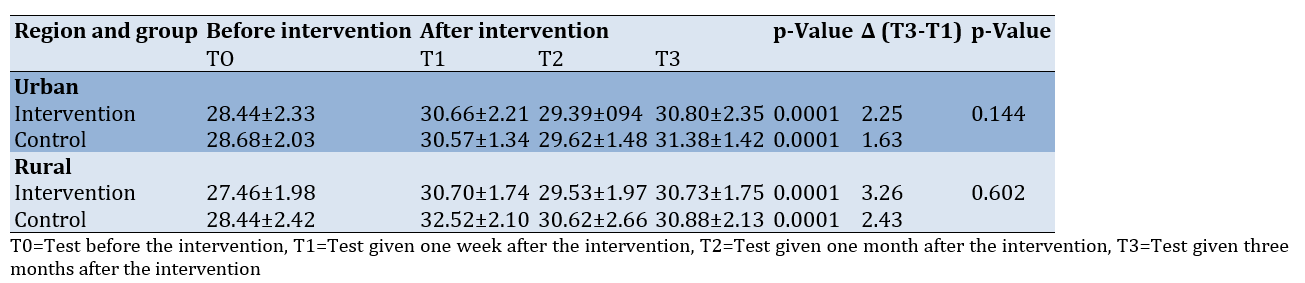
There was a significant improvement in respondents’ practice score following the intervention (p<0.05). Conversely, when comparing the first and third tests (T3-T1), no significant difference in practice score was observed between the rural and urban areas (p>0.05; Table 7).
Table 7. Respondents' practice mean score before and after the intervention
Discussion
This study aimed to develop an LSE model for TB patients to prevent transmission among household contacts. The use of nonparametric statistical tests, specifically the Friedman and Mann-Whitney U tests, enhanced the credibility of the findings regarding changes in KAP among pulmonary TB patients. The significant improvement observed following the implementation of the LSE intervention indicated that a structured educational approach can effectively alter health-related behaviors, even when the data do not conform to a normal distribution. Similar findings were also reported by Alipour et al. [30] and Ghosh et al. [31], who found that behavioral interventions centered on self-management and problem-solving lead to significant improvements in adherence to TB treatment and a reduction in the risk of transmission within households.
The non-normal distribution of the data suggested heterogeneity in the participants’ baseline knowledge levels and behavioral patterns. This heterogeneity is frequently encountered in public health research involving diverse populations, particularly when comparing urban and rural areas. The LSE module’s capacity to elicit significant behavioral improvements in both urban and rural settings demonstrates its adaptability across diverse sociocultural contexts [32]. Drawing upon Bandura’s Social Cognitive Theory [33], these results reflect the synergistic impact of individual self-efficacy, environmental support, and observational learning in shaping health-related actions.
Accurate knowledge or information about a subject is a critical factor in forming a concept, ensuring that the process of sequential behavioral change can be optimally developed. Knowledge can be acquired through an individual’s own experiences and those of others, including influences from teachers, family, friends, officials, and the media.
An individual’s mental attitude is essentially a psychological state encompassing feelings and desires that influence daily actions or behavior. This mental attitude develops alongside the individual’s inner growth, shaped by experience, education, or social interactions. Attitude is described as a latent reaction or response from an individual to a stimulus or object. It can also be defined as an individual’s response to an object, which can fundamentally change according to the stimulus and the information obtained. Furthermore, attitudes possess motivational and emotional aspects, natural characteristics that distinguish them from an individual’s skills or knowledge.
Knowledge, thoughts, beliefs, and emotions play a significant role in the formation of a complete attitude. This is further supported by factors that can influence attitude formation, including personal experience, the influence of other individuals considered important, and the impact of culture, education, religion, and mass media.
Prior to the intervention, the respondents’ actions regarding TB disease were sufficient, as evidenced by their answers in the pre-test. However, after the intervention was administered to all groups, a statistically significant increase was observed. This suggests that the LSE method could enhance respondents’ knowledge and attitudes toward preventing TB transmission among household contacts of sufferers. Based on the changes in respondents’ actions, no significant difference was found between urban and rural areas. This suggests that actions are influenced by behavior, which is shaped by factors beyond education. To effectively change behavior, it is crucial to strengthen other elements, such as social norms, local government policies, and, most importantly, the intention to change, which serves as the strongest predictor of actions. Additionally, individuals exhibit varying willingness to change even when faced with identical conditions.
Behavior occurs when an individual has progressed through the stages of knowledge and developed strong attitudes, leading to the adoption of new actions or ideas. Environmental factors also significantly support the emergence of new changes. Life skills are the abilities required to address the challenges faced by individuals with infectious or other diseases. The fundamental principle of LSE is to foster learning outcomes that are closely linked to real-life situations, the surrounding environment, and personal experiences within family and social contexts.
These skills are particularly focused on enhancing interactions with others in the community. Personal skills include self-awareness and thinking. More specifically, self-awareness encompasses skills related to responding to pulmonary TB, including adherence to treatment and care to support healing. Additionally, thinking skills are essential, which involve the ability to explore and find information, process and make decisions, and solve problems that may arise if not handled properly.
Furthermore, our results highlight the importance of integrating psychosocial and behavioral dimensions into TB control programs. While medical treatment remains a key component, the sustainability of TB elimination efforts also heavily relies on patient behavioral adherence, awareness, and self-regulation skills. Pefura-Yone et al. [34] and Kigozi et al. [35] demonstrate that patient education, when combined with community support, can improve treatment success rates and reduce relapses.
The choice of non-parametric analysis not only aligns with the characteristics of the data but also reflects the realistic complexity of community-based public health interventions, where strict statistical assumptions are rarely met. By applying appropriate analytical methods, this study provides reliable evidence that the LSE approach can enhance individual capacity and behavior towards TB prevention. This supports Indonesia’s national TB elimination roadmap by 2030 [36].
Overall, our findings underscore that statistical rigor and contextual relevance are equally important in health research. Methodological consistency—through the use of non-parametric tests for ordinal data—and the effectiveness of the LSE method collectively strengthen this study’s contribution to behavioral health promotion and TB control strategies in resource-limited settings.
Our findings offer a significant contribution to understanding the effectiveness of a life skills-based educational approach in TB control. Through the application of participatory and contextual learning methods, TB patients demonstrated improvement in their cognitive, affective, and psychomotor skills related to preventing transmission within the household. However, this study is subject to several limitations, including the absence of an analysis of contextual factors such as family support, socioeconomic conditions, and the quality of health services, all of which may influence intervention outcomes.
To enhance the life skills of individuals with TB, it is essential to implement the LSE strategy as a guideline and to engage in self-training to improve individual coping mechanisms when dealing with the disease. This includes complying with recommended treatment therapy, both in interactions with others and with household contacts, to prevent TB transmission. Therefore, further research is recommended to adopt a mixed-methods approach to explore the social and cultural factors influencing the effectiveness of LSE strategies. It is thus hoped that the research findings can serve as a foundation for developing more comprehensive policies and interventions in national TB elimination efforts.
Conclusion
The health education strategy using the LSE method enhances the knowledge, attitudes, and practices of individuals with TB.
Acknowledgments: The author extends deepest gratitude to all parties who provided support in conducting this research. Special thanks are due to the North Sumatra Provincial Health Office, the hospitals/health centers where the research was conducted, and the respondents with pulmonary tuberculosis who willingly participated. Gratitude is also expressed to colleagues and family members who offered motivation and support throughout the research process.
Ethical Permissions: This study received ethical approval from the Health Research Ethics Committee of the Faculty of Public Health, Helvetia Health Institute, Medan (No. 279/EXT/LPPM/IKH/VI/2024).
Conflicts of Interest: The authors declared no conflicts of interest.
Authors' Contribution: Amirah A (First Author), Methodologist/Main Researcher (20%); Suharto T (Second Author), Methodologist/Assistant Researcher (15%); Nur’aini N (Third Author), Assistant Researcher/Statistical Analyst (15%); Ekowati N (Fourth Author), Assistant Researcher/Statistical Analyst (10%); Desy RJ (Fifth Author), Assistant Researcher (10%); Sembiring KDB (Sixth Author), Introduction Writer/Discussion Writer (10%); Syam A (Seventh Author), Assistant Researcher (10%); Malik M (Eighth Author), Introduction Writer/Assistant Researcher/Discussion Writer (10%)
Funding/Support: This research was independently funded by the researchers and authors. There was no financial support from sponsors or specific institutions that could influence the research outcomes.
Indonesia has set a target within the 2030 Sustainable Development Goals (SDGs) Program in the health sector, focusing on improving the quality of life for individuals affected by infectious diseases and strengthening prevention efforts [1]. Achieving the SDGs requires immediate initiation through coordinated, cross-sectoral endeavors. Globally, the management of tuberculosis (TB)-related challenges has progressed slowly over the past two decades, attributable to numerous factors, including non-compliance with government-programmed medication. The treatment rate for TB sufferers has stagnated, showing a mere annual decrease of 0.6% since 1999 [2].
Preventing and mitigating the spread of infectious diseases among humans is a crucial function of community health. Over the last four to five decades, extending into the late 20th century, infectious diseases were generally not considered a primary cause of mortality in developed countries. While deaths from acute infections are limited in these nations, infections continue to be a significant cause of costly morbidity in affluent countries [3]. TB ranks among the top 10 leading causes of death globally and is the foremost cause of death from infectious diseases [4]. Worldwide, an estimated 10.6 million people (ranging from 9.8 to 11.3 million) suffer from TB. This includes 1.4 million (ranging from 1.3 to 1.5 million) TB deaths among those who are HIV-negative and 187,000 deaths (ranging from 158,000 to 218,000) among those who are HIV-positive [5]. Global targets and milestones to reduce TB incidence and mortality have been set as part of the SDGs and the End TB Strategy, with completion targets by 2030. Specifically, these goals include a 90% reduction in deaths and an 80% reduction in incidence (defined as new and relapse cases per 100,000 population per year) between 2015 and 2030 [6].
The global commitment to eradicating TB is outlined in the End TB Strategy, which aims to achieve an 80% reduction in incidence and a 90% reduction in deaths by 2030 [7]. In alignment with this, the Indonesian Ministry of Health has developed an Elimination Roadmap that also targets 2030. This roadmap seeks to decrease TB incidence by 80% to 65 cases per 100,000 population and deaths to 6 per 100,000 population. Key strategies include expanding TB detection and treatment coverage to at least 90%. Furthermore, the targets for successful TB treatment are set at a minimum of 90%, and for tuberculosis preventive therapy (TPT), at a minimum of 80% [8].
The Indonesian government’s initiatives to eliminate TB by 2030 are articulated in the 2020-2024 RPJM (National Medium-Term Development Plan), the 2020-2024 National Tuberculosis Control Strategy, and the 2025-2026 Interim Plan. These strategies prioritize implementing the elimination agenda by augmenting the involvement of communities, partners, and diverse multisectoral stakeholders, and by reinforcing program management through enhancements to the health system.
Individuals with pulmonary TB can transmit the disease by expelling germ-laden droplet nuclei into the air through coughing or sneezing; a single cough can generate approximately 3,000 phlegm droplets. These droplets, containing infectious agents, can remain airborne at room temperature for several hours. Infection can occur when these droplets are inhaled into the respiratory tract [9]. A single patient with sputum smear-positive pulmonary TB (BTA +) has the potential to infect 10-15 people annually, suggesting a significant possibility of infection for every contact with the sufferer. Approximately 10-15% of infected individuals develop active TB, with a yearly rate of up to 10% [10]. A survey conducted in Indonesia indicated that the incidence of TB remains high, and a considerable number of patients undergoing treatment through the Directly Observed Treatment, Short-course (DOTS) program do not achieve recovery. One primary reason for this is patients' failure to complete their treatment for the duration prescribed by the program [11].
A significant challenge persists: despite extensive TB treatment through the DOTS strategy, which is widely considered effective, the prevalence of the disease remains high [8]. This issue is compounded by the fact that the core program for patients is not yet sufficient to break the chain of transmission from infected individuals to those at risk of continuing the cycle, specifically household contacts [12-17]. Studies by Tostmann et al. [18] and Soepandi [19] on multidrug-resistant TB (MDR TB) therapy indicate a favorable conversion rate of approximately 80% by the second and third months. This finding offers optimism for the effectiveness of incidence reduction by interrupting transmission chains or minimizing the duration of Mycobacterium tuberculosis (BTA) transfer from infected individuals to their household contacts [13, 14].
According to the Global TB Report 2022, Indonesia ranks second globally in TB burden, following India. The World Health Organization (WHO) estimates 969,000 TB cases in Indonesia, with the current reported notification figure standing at 717,941 cases [10]. Data from the North Sumatra Health Service Profile in 2024 reveals that 10,568 TB cases were recorded in the province. Medan City reports the highest number of cases, with 3,775, followed by Deli Serdang Regency with 1,051. Other regions with significant case numbers include Simalungun Regency (517 cases), Langkat Regency (447 cases), and Binjai City (431 cases). The notification figure for 2023 was 49,999 cases, underscoring that the number of TB sufferers in North Sumatra remains substantial [20-29].
This study aimed to develop a life skills education (LSE) model for TB patients to prevent transmission among household contacts.
Materials and Methods
This study employed a quantitative, quasi-experimental method utilizing a two-group pre-test and post-test design. The target population comprised all individuals with TB in the areas of North Sumatra experiencing the highest case burdens. The sample consisted of 127 patients from urban areas and 126 patients from rural areas.
The LSE intervention was developed by the researchers, drawing on existing life skills education frameworks, and adapted to the context of tuberculosis prevention among household contacts. It consisted of a structured educational program delivered through lectures and guided discussions using a specifically designed module. The module covered key topics, including prevention of tuberculosis transmission, treatment adherence, cough etiquette, and personal hygiene practices. The intervention was delivered by trained health workers in several sessions over a defined period. To assess the outcomes, a structured questionnaire was used to measure knowledge, attitudes, and practices (KAP). The instrument consisted of multiple items using ordinal scales (including Likert-type responses for attitudes and practices). The questionnaire was developed based on previous literature and public health guidelines, and was tested for validity and reliability prior to data collection. Data collection was conducted in several stages, including a baseline (pre-test) and post-intervention assessments at one week (T1), one month (T2), and three months (T3).
Statistical analysis was conducted using SPSS 25. Due to non-normal data distribution, non-parametric tests, including the Friedman test (to analyze repeated measurements of respondents’ knowledge, attitudes, and practices (KAP) across different time intervals) and the Mann–Whitney U test (to compare differences between the intervention and control groups), were used.
Findings
The 26-35-year age group constituted 67.6% of the sample, while the 36-45-year age group represented 27.6%. These figures indicate a higher likelihood of TB occurrence within the productive age range (Table 1).
Table 1. The frequency of rural (n=126) and urban (n=127) samples' demographic characteristics
There was no statistically significant difference in the mean knowledge score between the intervention and control groups before the intervention. For questions 6, 7, 8, and 9, the frequency distribution between rural and urban areas showed no significant difference (p>0.05; Table 2).
Table 2. Respondents’ mean knowledge score based on the area before the intervention
Prior to the intervention, significant differences in attitude scores between the rural and urban groups were observed for most questions (p<0.05), except for question 8 (p=0.071; Table 3).
Table 3. Respondents' attitude score based on area before the intervention
A statistically significant difference in practice scores between the rural and urban groups was observed before the intervention for most questions (p<0.05), except for question 10 (p=0.526; Table 4).
Table 4. Comparison of respondents' practice score based on the area before the intervention
A statistically significant difference in knowledge scores was found between urban and rural areas (p=0.0001). Furthermore, when examining the differences within rural and urban areas across all groups following interventions (the first and third tests: T3-T1), the urban area showed no significant difference (p>0.05). In contrast, the rural area exhibited a significant difference between the intervention and control groups (p=0.0001; Table 5).
Table 5. Comparison of respondents' knowledge mean score before and after the intervention
The changes in respondents’ attitudes in both urban and rural areas from the pre-test to the post-test, conducted three months after the intervention, were statistically significant (p=0.0001). However, no significant difference was found in the magnitude of these attitude changes between the urban and rural areas across all groups (p>0.05; Table 6).
Table 6. Comparison of respondents' attitude score before and after the intervention
There was a significant improvement in respondents’ practice score following the intervention (p<0.05). Conversely, when comparing the first and third tests (T3-T1), no significant difference in practice score was observed between the rural and urban areas (p>0.05; Table 7).
Table 7. Respondents' practice mean score before and after the intervention
Discussion
This study aimed to develop an LSE model for TB patients to prevent transmission among household contacts. The use of nonparametric statistical tests, specifically the Friedman and Mann-Whitney U tests, enhanced the credibility of the findings regarding changes in KAP among pulmonary TB patients. The significant improvement observed following the implementation of the LSE intervention indicated that a structured educational approach can effectively alter health-related behaviors, even when the data do not conform to a normal distribution. Similar findings were also reported by Alipour et al. [30] and Ghosh et al. [31], who found that behavioral interventions centered on self-management and problem-solving lead to significant improvements in adherence to TB treatment and a reduction in the risk of transmission within households.
The non-normal distribution of the data suggested heterogeneity in the participants’ baseline knowledge levels and behavioral patterns. This heterogeneity is frequently encountered in public health research involving diverse populations, particularly when comparing urban and rural areas. The LSE module’s capacity to elicit significant behavioral improvements in both urban and rural settings demonstrates its adaptability across diverse sociocultural contexts [32]. Drawing upon Bandura’s Social Cognitive Theory [33], these results reflect the synergistic impact of individual self-efficacy, environmental support, and observational learning in shaping health-related actions.
Accurate knowledge or information about a subject is a critical factor in forming a concept, ensuring that the process of sequential behavioral change can be optimally developed. Knowledge can be acquired through an individual’s own experiences and those of others, including influences from teachers, family, friends, officials, and the media.
An individual’s mental attitude is essentially a psychological state encompassing feelings and desires that influence daily actions or behavior. This mental attitude develops alongside the individual’s inner growth, shaped by experience, education, or social interactions. Attitude is described as a latent reaction or response from an individual to a stimulus or object. It can also be defined as an individual’s response to an object, which can fundamentally change according to the stimulus and the information obtained. Furthermore, attitudes possess motivational and emotional aspects, natural characteristics that distinguish them from an individual’s skills or knowledge.
Knowledge, thoughts, beliefs, and emotions play a significant role in the formation of a complete attitude. This is further supported by factors that can influence attitude formation, including personal experience, the influence of other individuals considered important, and the impact of culture, education, religion, and mass media.
Prior to the intervention, the respondents’ actions regarding TB disease were sufficient, as evidenced by their answers in the pre-test. However, after the intervention was administered to all groups, a statistically significant increase was observed. This suggests that the LSE method could enhance respondents’ knowledge and attitudes toward preventing TB transmission among household contacts of sufferers. Based on the changes in respondents’ actions, no significant difference was found between urban and rural areas. This suggests that actions are influenced by behavior, which is shaped by factors beyond education. To effectively change behavior, it is crucial to strengthen other elements, such as social norms, local government policies, and, most importantly, the intention to change, which serves as the strongest predictor of actions. Additionally, individuals exhibit varying willingness to change even when faced with identical conditions.
Behavior occurs when an individual has progressed through the stages of knowledge and developed strong attitudes, leading to the adoption of new actions or ideas. Environmental factors also significantly support the emergence of new changes. Life skills are the abilities required to address the challenges faced by individuals with infectious or other diseases. The fundamental principle of LSE is to foster learning outcomes that are closely linked to real-life situations, the surrounding environment, and personal experiences within family and social contexts.
These skills are particularly focused on enhancing interactions with others in the community. Personal skills include self-awareness and thinking. More specifically, self-awareness encompasses skills related to responding to pulmonary TB, including adherence to treatment and care to support healing. Additionally, thinking skills are essential, which involve the ability to explore and find information, process and make decisions, and solve problems that may arise if not handled properly.
Furthermore, our results highlight the importance of integrating psychosocial and behavioral dimensions into TB control programs. While medical treatment remains a key component, the sustainability of TB elimination efforts also heavily relies on patient behavioral adherence, awareness, and self-regulation skills. Pefura-Yone et al. [34] and Kigozi et al. [35] demonstrate that patient education, when combined with community support, can improve treatment success rates and reduce relapses.
The choice of non-parametric analysis not only aligns with the characteristics of the data but also reflects the realistic complexity of community-based public health interventions, where strict statistical assumptions are rarely met. By applying appropriate analytical methods, this study provides reliable evidence that the LSE approach can enhance individual capacity and behavior towards TB prevention. This supports Indonesia’s national TB elimination roadmap by 2030 [36].
Overall, our findings underscore that statistical rigor and contextual relevance are equally important in health research. Methodological consistency—through the use of non-parametric tests for ordinal data—and the effectiveness of the LSE method collectively strengthen this study’s contribution to behavioral health promotion and TB control strategies in resource-limited settings.
Our findings offer a significant contribution to understanding the effectiveness of a life skills-based educational approach in TB control. Through the application of participatory and contextual learning methods, TB patients demonstrated improvement in their cognitive, affective, and psychomotor skills related to preventing transmission within the household. However, this study is subject to several limitations, including the absence of an analysis of contextual factors such as family support, socioeconomic conditions, and the quality of health services, all of which may influence intervention outcomes.
To enhance the life skills of individuals with TB, it is essential to implement the LSE strategy as a guideline and to engage in self-training to improve individual coping mechanisms when dealing with the disease. This includes complying with recommended treatment therapy, both in interactions with others and with household contacts, to prevent TB transmission. Therefore, further research is recommended to adopt a mixed-methods approach to explore the social and cultural factors influencing the effectiveness of LSE strategies. It is thus hoped that the research findings can serve as a foundation for developing more comprehensive policies and interventions in national TB elimination efforts.
Conclusion
The health education strategy using the LSE method enhances the knowledge, attitudes, and practices of individuals with TB.
Acknowledgments: The author extends deepest gratitude to all parties who provided support in conducting this research. Special thanks are due to the North Sumatra Provincial Health Office, the hospitals/health centers where the research was conducted, and the respondents with pulmonary tuberculosis who willingly participated. Gratitude is also expressed to colleagues and family members who offered motivation and support throughout the research process.
Ethical Permissions: This study received ethical approval from the Health Research Ethics Committee of the Faculty of Public Health, Helvetia Health Institute, Medan (No. 279/EXT/LPPM/IKH/VI/2024).
Conflicts of Interest: The authors declared no conflicts of interest.
Authors' Contribution: Amirah A (First Author), Methodologist/Main Researcher (20%); Suharto T (Second Author), Methodologist/Assistant Researcher (15%); Nur’aini N (Third Author), Assistant Researcher/Statistical Analyst (15%); Ekowati N (Fourth Author), Assistant Researcher/Statistical Analyst (10%); Desy RJ (Fifth Author), Assistant Researcher (10%); Sembiring KDB (Sixth Author), Introduction Writer/Discussion Writer (10%); Syam A (Seventh Author), Assistant Researcher (10%); Malik M (Eighth Author), Introduction Writer/Assistant Researcher/Discussion Writer (10%)
Funding/Support: This research was independently funded by the researchers and authors. There was no financial support from sponsors or specific institutions that could influence the research outcomes.
References
1. Asriwati A, Safrizal A. Concepts and applications of epidemiology (Volume 4). Yogyakarta: Deepublish; 2020. p. 1-250. [Indonesian] [Link]
2. BPS. Study of sustainable development goals (SDGs) indicators. Jakarta: BADAN PUSAT STATISTIK INDONESIA; 2014. [Indonesian] [Link]
3. Ahmed KY, Ross AG, Hussien SM, Agho KE, Olusanya BO, Ogbo FA. Mapping local variations and the determinants of childhood stunting in Nigeria. Int J Environ Res Public Health. 2023;20(4):3250. [Link] [DOI:10.3390/ijerph20043250]
4. World Health Organization. Public health approaches: a review. Geneva: WHO; 2026. [Link]
5. Jo Y, Kagujje M, Johnson K, Dowdy D, Hangoma P, Chiliukutu L, et al. Costs and cost-effectiveness of a comprehensive tuberculosis case finding strategy in Zambia. PLoS One. 2021;16(9):e0256531. [Link] [DOI:10.1371/journal.pone.0256531]
6. Ministry of Health. Main points of the Ministry of Health strategic plan 2020-2024. Kampala: Ministry of Health; 2020. [Link]
7. Ong CWM, Migliori GB, Raviglione M, MacGregor-Skinner G, Sotgiu G, Alffenaar JW, et al. Epidemic and pandemic viral infections: Impact on tuberculosis and the lung. Eur Respir J. 2020;56(4):2001727. [Link] [DOI:10.1183/13993003.01727-2020]
8. Liu X, Lin KH, Li YH, Jiang JN, Zhong ZD, Xiong YB, et al. Impacts of medical security level on treatment outcomes of drug-resistant tuberculosis: Evidence from Wuhan City, China. Patient Prefer Adherence. 2022;16:3341-55. [Link] [DOI:10.2147/PPA.S389231]
9. Ministry of Health of the Republic of Indonesia. National guidelines for tuberculosis medical services. Jakarta: Ministry of Health of the Republic of Indonesia; 2020. [Indonesian] [Link]
10. Dicker RC, Coronado F, Koo D, Parrish RG. Principles of epidemiology in public health practice. Atlanta: CDC; 2010. [Link]
11. Djannah F, Massi MN, Hatta M, Bukhari A, Handayani I, Faruk M, et al. Virgin coconut oil and tuberculosis: A mini-review. Pharmacogn J. 2022;14(2):464-9. [Link] [DOI:10.5530/pj.2022.14.59]
12. Asriwati, Yeti E, Niakurniawati, Usman AN. Risk factors analysis of non-compliance of Tuberculosis (TB) patients taking medicine in Puskesmas Polonia, Medan, 2021. Gac Sanit. 2021;35(Suppl 2):S227-30. [Link] [DOI:10.1016/j.gaceta.2021.10.027]
13. Inayah S, Wahyono B. Pulmonary tuberculosis control using the DOTS strategy. HIGEIA J Public Health Res Dev. 2019;3(2):223-33. [Indonesian] [Link]
14. Callister MEJ, Barringer J, Thanabalasingam ST, Gair R, Davidson RN. Pulmonary tuberculosis among political asylum seekers screened at Heathrow Airport, 1995-1999. Thorax. 2000;55(2):152-6. [Link] [DOI:10.1136/thorax.57.2.152]
15. Buse K, Mays N, Walt G. Making Health Policy. Maidenhead: McGraw Hill/Open University Press; 2016. [Link]
16. Sudiro. Emerging infectious diseases. Jakarta: EGC; 2008. p. 1-27. [Link] [DOI:10.1097/INF.0b013e3181626fce]
17. Indonesian Ministry of Health. Guidelines for the prevention and control of tuberculosis infection in health care facilities. Jakarta: Indonesian Ministry of Health; 2012. [Indonesian] [Link]
18. Tostmann A, Kik SV, Kalisvaart NA, Sebek MM, Verver S, Boeree MJ, et al. Tuberculosis transmission by patients with smear‐negative pulmonary tuberculosis in a large cohort in the Netherlands. Clin Infect Dis. 2008;47(9):1135-42. [Link] [DOI:10.1086/591974]
19. Soepandi PZ. Diagnosis and factors influencing the occurrence of MDR-TB. J Tuberc Indones. 2010;7(2):16-9. [Indonesian] [Link]
20. Monardo D. National disaster management plan 2020-2024. Geneva: National Agency for Disaster Countermeasure; 2020. [Indonesian] [Link]
21. Provincial Health Office. Profile of the North Sumatra Provincial Health Office. Medan: North Sumatra Provincial Health Office; 2019. [Indonesian] [Link]
22. MM IL. Profile of the North Sumatra Health Office. Medan: North Sumatra Provincial Health Office; 2022. [Indonesian] [Link]
23. Field A. Discovering statistics using IBM SPSS Statistics. 4th ed. London: Sage Publications; 2013. [Link]
24. Pallant J. SPSS survival manual: A step by step guide to data analysis using IBM SPSS. 7th ed. London: McGraw-Hill Education; 2020. [Link] [DOI:10.4324/9781003117407]
25. Ghasemi A, Zahediasl S. Normality tests for statistical analysis: A guide for non-statisticians. Int J Endocrinol Metab. 2012;10(2):486-9. [Link] [DOI:10.5812/ijem.3505]
26. Conover WJ. Practical nonparametric statistics. 3rd ed. Hoboken: Wiley; 1999. [Link]
27. Laerd Statistics. Statistical tutorials and guides [Internet]. Bath: Laerd Statistics; 2021 [cited 2025 Nov 9]. Available from: https://statistics.laerd.com/. [Link]
28. McKnight PE, Najab J. Mann-Whitney U test. In: Weiner IB, Craighead WE, editors. The Corsini encyclopedia of psychology. 2nd ed. Hoboken: Wiley; 2010. [Link]
29. Norman G. Likert scales, levels of measurement and the "laws" of statistics. Adv Health Sci Educ Theory Pract. 2010;15(5):625-32. [Link] [DOI:10.1007/s10459-010-9222-y]
30. Khamis KM, Shahar HK, Manaf RA, Hamdan HM. Effectiveness of education intervention of tuberculosis treatment adherence in Khartoum State: a study protocol for a randomized control trial. F1000Res.2019;8:431. [Link]
31. Huddart S, Bossuroy T, Pons V, Baral S, Pai M, Delavallade C. Knowledge about tuberculosis and infection prevention behavior: a nine-city longitudinal study from India. PLoS One. 2018;13(10):e0206245. [Link] [DOI:10.1371/journal.pone.0206245]
32. WHO. Global tuberculosis report 2023. Geneva: World Health Organization; 2023. [Link]
33. Bandura A. Social foundations of thought and action: A social cognitive theory. Englewood Cliffs: Prentice-Hall; 1986. [Link]
34. Pefura-Yone EW, Kengne AP, Kuaban C. Non-conversion of sputum culture among patients with smear positive pulmonary tuberculosis in Cameroon: a prospective cohort study. BMC Infect Dis. 2014;14:138. [Link] [DOI:10.1186/1471-2334-14-138]
35. Wandwalo E, Robberstad B, Mørkve O. Cost and cost-effectiveness of community based and health facility based directly observed treatment of tuberculosis in Dar es Salaam, Tanzania. Cost Eff Resour Alloc. 2005;3:6. [Link] [DOI:10.1186/1478-7547-3-6]
36. Ministry of Health Republic of Indonesia. National Strategy for Tuberculosis Control in Indonesia 2020-2024. Jakarta: Ministry of Health Republic of Indonesia; 2020. [Link]
Send email to the article author