

TMU
Owner
Tarbiat Modares University (TMU) is the owner of HEHP.

0.8
Cite Score 2025
Volume 14, Issue 1 (2026)
Health Educ Health Promot 2026, 14(1): 189-194 |
Back to browse issues page
Article Type:




History
Received: 2025/08/10 | Accepted: 2026/02/18 | Published: 2026/03/2
Received: 2025/08/10 | Accepted: 2026/02/18 | Published: 2026/03/2
How to cite this article
Harouni J, Rakhshanderou S, Bahrambeygi F, Ghaffari M. Behavioral and Non-Behavioral Correlates of Seat Belt Usage among Bus Passengers in Iran. Health Educ Health Promot 2026; 14 (1) :189-194
URL: http://hehp.daneshafarand.org/article-4-85690-en.html
URL: http://hehp.daneshafarand.org/article-4-85690-en.html
Download citation:
BibTeX | RIS | EndNote | Medlars | ProCite | Reference Manager | RefWorks
Send citation to:


Rights and permissions
BibTeX | RIS | EndNote | Medlars | ProCite | Reference Manager | RefWorks
Send citation to:


1- Department of Occupational Health, School of Health, Yasuj University of Medical Sciences, Yasuj, Iran
2- Department of Public Health, School of Public Health & Safety, Shahid Beheshti University of Medical Sciences, Tehran, Iran
3- Chronic Respiratory Disease Research Center, Shahid Beheshti University of Medical Sciences, Tehran, Iran
2- Department of Public Health, School of Public Health & Safety, Shahid Beheshti University of Medical Sciences, Tehran, Iran
3- Chronic Respiratory Disease Research Center, Shahid Beheshti University of Medical Sciences, Tehran, Iran
Keywords:
| Abstract (HTML) (703 Views)
Full-Text: (130 Views)
Introduction
Road traffic crashes (RTCs) are sudden events that cause predictable and preventable injuries [1]. They remain a critical global public health challenge, claiming approximately 1.25 million lives annually and causing 20–50 million non-fatal injuries, many of which result in long-term disability [2]. RTCs are the leading cause of death among individuals aged 15-29 years, accounting for the loss of life during the most productive years [3]. Globally, RTCs rank as the ninth leading cause of death across all age groups and are projected to become the seventh by 2030 [4]. Iran faces a disproportionately high burden of RTCs, with an average of 20,000-28,000 fatalities annually between 2005 and 2015 [5]. Despite international and national efforts, including WHO recommendations and legislative interventions [6], Iran continues to experience one of the highest traffic-related mortality rates worldwide. Although recent years have witnessed a modest decline in deaths, the overall burden remains substantial, highlighting the need for ongoing public health strategies [5]. In the Iranian context, the long distances between provinces and the heavy reliance on the intercity bus fleet for public transportation make bus safety a national priority [7].
Seat belts are a primary protective measure against injuries in vehicle crashes, significantly reducing mortality and severe injuries [8, 9]. While compliance rates for private cars have improved due to enforcement and awareness campaigns, seat belt use in other modes of transport, particularly intercity buses, remains critically under-researched and underutilized. Although buses are generally safer than cars per vehicle-kilometer traveled, passengers in intercity bus crashes remain at significant risk of traumatic injuries, especially in rollover or high-speed impact scenarios, where unrestrained ejection or internal impact can occur [10]. A limited number of studies indicate that, paradoxically, bus passengers often perceive their environment as safe due to professional driving and vehicle size, which leads to lower adherence to safety protocols than car drivers [11]. Globally, adherence to seat belt use varies widely and depends on enforcement, awareness, and behavioral factors [12, 13]. In Iran, only 85% of front-seat and 10% of rear-seat passengers comply with seat belt regulations [5, 13]. Behavioral, human, and environmental factors—including non-compliance with traffic rules, alcohol or substance use, lack of awareness, and vehicle conditions—interact to influence crash outcomes [14–16]. Comprehensive interventions targeting five key factors—seat belts, child restraints, helmets, speed control, and impaired driving—have demonstrated significant reductions in RTC mortality [12, 17]. Despite this, there is a critical gap in understanding the determinants of seat belt use specifically among intercity bus passengers, with few studies focusing on this population [11, 18]. Addressing this knowledge gap is essential for designing effective health promotion interventions and policy strategies. To effectively increase compliance, it is crucial to understand the underlying behavioral determinants, such as subjective norms, perceived barriers, and environmental constraints, which often dictate health-protective actions in collective settings [19].
This study aimed to assess the prevalence of seat belt use among intercity bus passengers in Tehran, Iran, and identify the behavioral, demographic, and environmental determinants associated with seat belt compliance.
Instrument and Methods
This cross-sectional analytical study was conducted from February to April 2017 among 458 passengers selected through multistage sampling at intercity bus terminals in Tehran, of whom 10 were excluded for incomplete questionnaires, leaving 448 participants for the final analysis. Each terminal in Tehran (West, South, North, and East) was treated as a stratum, and the passenger cooperatives within each terminal as clusters. From each terminal, one cooperative was randomly selected. Coordination was subsequently established with the managers of these selected cooperatives to facilitate the recruitment of participants and the administration of the questionnaires, and eligible passengers were recruited from that cooperative. Inclusion criteria were age ≥14 years, no physical restrictions on fastening a seat belt, basic reading and writing literacy, and willingness to participate.
Data were collected using a researcher-developed questionnaire whose psychometric properties were rigorously evaluated. It underwent comprehensive validation, including face validity assessed qualitatively with bus passengers; content validity reviewed by an expert panel and quantified via CVI (0.95) and CVR; and construct validity confirmed through exploratory factor analysis. Reliability was demonstrated by internal consistency (Cronbach’s α=0.8) and by stability over time using a test-retest procedure (ICC=0.78). The questionnaire consisted of two sections. The first section captured demographic information, including age, gender, marital status, education level, bus type, travel distance, and adherence to traffic laws. The second section comprised 57 items across 13 dimensions—awareness, perceived susceptibility, perceived severity, perceived barriers, behavioral beliefs, evaluation of behavioral outcomes, law and supervision, observational learning, peripheral trust, subjective norms, self-efficacy, health locus of control, and environment—to assess determinants of seat belt use among bus passengers. Items were scored on a three-point Likert scale (0=disagree, 1=uncertain, 2=agree), with awareness items scored 2 for correct, 1 for “I do not know,” and 0 for incorrect responses. Awareness was measured using 8 dedicated items. It should be noted that informed consent was obtained from all participants. All questionnaires were kept anonymous, and the confidentiality of the data was strictly maintained.
Data were analyzed using SPSS 16. Logistic regression was conducted to identify behavioral and non-behavioral predictors of seat belt use. The outcome was dichotomized (0=seat belt use, 1=non-use), and three models were implemented. Model 1 included only behavioral predictors; Model 2 added age and gender to the parameters in Model 1; and Model 3 further incorporated other background parameters with p-values<0.2 in univariate analyses (including marital status, adherence to traffic laws, travel distance, bus type, and education level). Model fit was evaluated using the Hosmer-Lemeshow test and the area under the receiver operating characteristic curve (AUC).
Findings
The mean age of participants was 28.35±6.10 years, with 47% male and 53% female. Most were single (62%), resided in urban areas (89.1%), and held an associate or bachelor’s degree (46.2%). Seat belt use was higher in private vehicles (61%) compared to buses (24%). The majority preferred front seats (38.6%) and VIP buses (63.8%). Common reasons for using a seat belt included police presence, high bus speeds, nighttime travel, and adverse weather conditions, while 60.2% of participants reported no prior training on seat belt use.
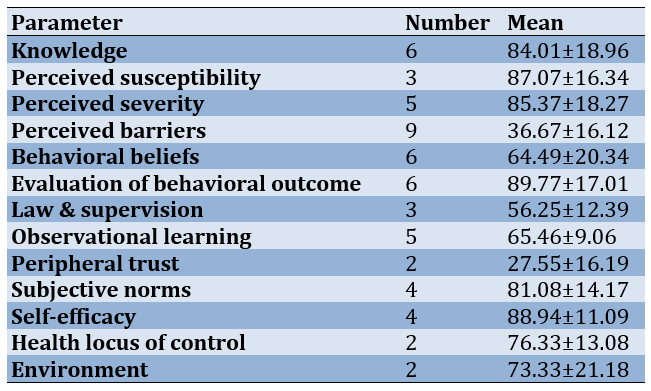
Among behavioral predictors, evaluation of behavioral outcomes had the highest mean score (89.77±17.01), whereas peripheral trust had the lowest (27.55±16.19; Table 1).
Table 1. Mean scores (0-100) of bus seat belt use predictors
Model 1 included only behavioral predictors; Model 2 added age and gender; and Model 3 further incorporated background variables with p-values less than 0.2 in univariate analyses, including marital status, bus type, travel distance, adherence to traffic laws, and education.
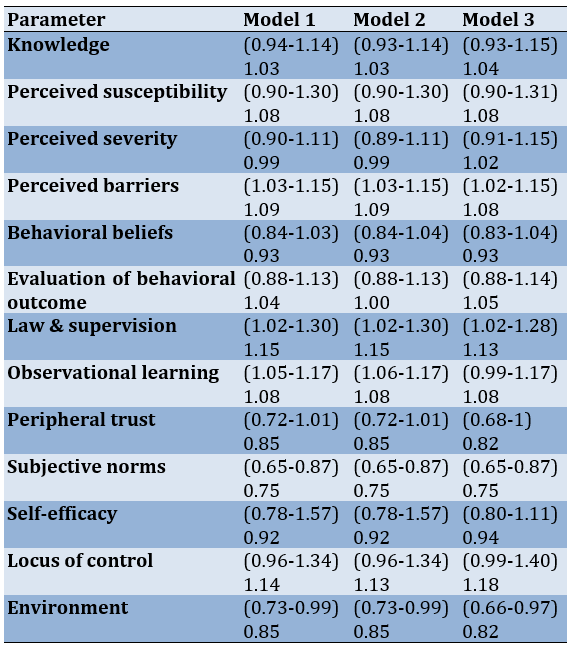
In the final logistic regression model (Model 3), perceived barriers positively predicted seat belt non-use (p=0.003), with each unit increase in score associated with a 9% higher likelihood of non-use. Law and supervision showed a consistent positive association with non-use (p=0.04). Conversely, subjective norms were inversely associated with non-use (p<0.001), increasing the likelihood of seat belt use by about 25%, and environmental factors were similarly protective (p=0.02). Health locus of control also showed a borderline association (p=0.05). Observational learning initially showed a negative association, which lost significance after adjustment in Model 3.
Among non-behavioral factors, bus type strongly influenced seat belt use: passengers on ordinary buses were 2.2 times as likely not to use seat belts as those on VIP buses (p=0.001). Poor adherence to traffic laws also significantly increased non-use (p<0.001). Other demographic factors such as age, gender, marital status, and education were not significantly associated with seat belt use.
Model 3 demonstrated the best fit, with an AUC of 0.78 (95%CI: 0.74–0.87), indicating that the included predictors correctly classified seat belt use in 78% of cases. The Hosmer-Lemeshow test confirmed good fit for Model 3 (p=0.8), supporting its adequacy over Models 1 and 2 Table 2; Figure 1).
Table 2. Analyzing the effect of predictive factors for bus seat belt use (95%Cl) on different models (Model 1: Unadjusted; Model 2: Model 1-adjusted for age and sex; Model 3: Model 2-adjusted for marriage, education, bus type, frequency of use of the bus, and non-compliance with the law) by logistic regression model
Model 1, which included only behavioral predictors, had an AUC of 0.733 (SE=0.24; p<0.001) and a 95%CI ranging from 0.686 to 0.779. Model 2, which added age and gender to the behavioral predictors, also had an AUC of 0.733 with a standard error of 0.24 (p<0.001), and a 95%CI of 0.687 to 0.780. Model 3, the full model that included behavioral predictors, demographic variables, and background parameters, demonstrated improved performance with an AUC of 0.784, a standard error of 0.22 (p<0.001), and a 95%CI of 0.741 to 0.872.
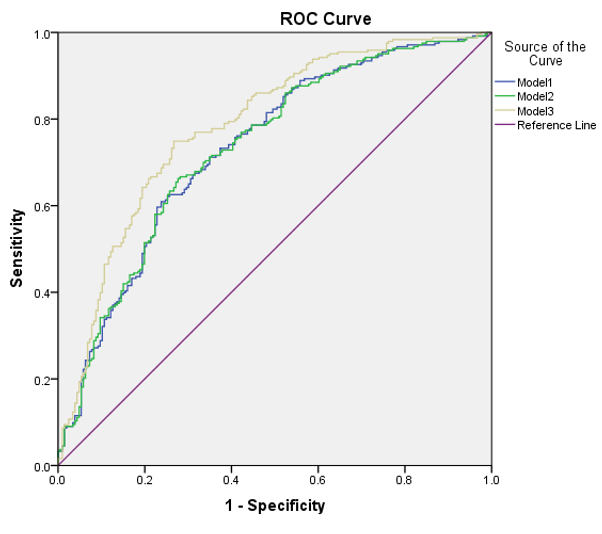
Figure 1. Fit of logistic regression models assessed using the area under the ROC curve
Discussion
To our knowledge, this is the first study to systematically evaluate seatbelt use among intercity bus passengers in Iran. While compliance in private vehicles has been reported as relatively high, only 24% of bus passengers consistently used seat belts, with the majority reporting compliance only at police checkpoints [20, 21]. This significant disparity highlights a mode-specific behavioral gap, suggesting that safety behaviors in private cars do not automatically transfer to public or collective transport. This pattern suggests that seatbelt use is perceived more as a legal requirement than as a preventive health behavior. Such a perception poses a critical challenge for intervention design, as seatbelt use appears to be externally motivated rather than internally valued as a protective measure. Accordingly, both behavioral and structural approaches are required to shift the perception of seatbelt use from an imposed obligation toward a self-protective norm [19, 22].
Among behavioral determinants, subjective norms emerged as the most powerful predictor. A one-unit increase in subjective norms was associated with a 25% higher likelihood of seatbelt use. This finding aligns with previous studies of taxi passengers, in which approval from significant others—such as drivers, traffic police, parents, and peers—is strongly linked to compliance [23, 24]. Passengers who perceived higher social expectations demonstrated greater adherence, whereas those lacking normative support were less likely to comply, which emphasizes the importance of integrating normative belief strategies into interventions, for example, through public messaging and driver-led reinforcement, to enhance the salience of social approval in bus settings.
Environmental determinants also played a substantial role. Each unit increase in the environmental score corresponded to an 18% higher probability of seatbelt use. Availability, accessibility, and functional integrity of seatbelts were among the most frequently cited factors, consistent with previous research highlighting the importance of equipment quality and accessibility in health-protective behaviors [25–27]. Inadequate or defective seatbelts undermine compliance and weaken passenger trust in the utility of safety measures. These findings underline the need for regulatory policies that ensure the proper installation and maintenance of functional seatbelts across the intercity bus fleet.
This also aligns with the finding that bus type is a strong non-behavioral determinant: passengers on ordinary buses were 2.2 times as likely not to use seat belts as VIP bus passengers. This suggests that seatbelt availability, accessibility, and functional integrity are superior in VIP buses, whereas ordinary buses may suffer from defective or inaccessible equipment. This discrepancy highlights the need for regulatory policies that ensure equitable safety infrastructure standards across all bus types, rather than allowing comfort levels to dictate safety features.
Perceived barriers represented another critical determinant. Each unit increase in perceived barriers increased the odds of non-use by 9%. Discomfort, stiffness, restricted movement, sweating in hot weather, and embarrassment were the most commonly reported barriers, consistent with prior studies in both private vehicle and bus settings [9, 28]. As with other preventive behaviors, such as helmet use among cyclists, perceived barriers consistently emerge as the strongest inhibitors of compliance [29]. Addressing these barriers requires both ergonomic modifications to seatbelt design and passenger education to mitigate misconceptions about discomfort and inconvenience.
Contrary to expectations, observational learning demonstrated a negative association with seatbelt use in the initial models, although this effect attenuated after adjustment. While prior research suggests that modeling is a critical mechanism for adopting preventive behaviors [30], the attenuation of observational learning may reflect the transient nature of intercity travel, in which passengers have limited engagement with others, thereby reducing the impact of modeling. Among adult bus passengers, observational cues were less influential than cognitive and attitudinal determinants. This may be explained by the reduced role of imitation in adults compared with children, as well as the stronger influence of personal perceptions such as barriers and subjective norms. Therefore, interventions should prioritize psychological and structural determinants rather than rely solely on modeling strategies.
Finally, enforcement and supervision showed a limited and even inverse association with consistent seatbelt use. Unlike private vehicles, collective transport environments diffuse individual responsibility, diminishing the effectiveness of legal oversight [31]. These observations underscore the necessity of integrated approaches that combine continuous enforcement with educational and environmental modifications. Tailored strategies that address behavioral determinants, reduce barriers, and strengthen normative support are essential for promoting sustained seatbelt use among intercity bus passengers.
A notable strength of this study is that it is the first to systematically investigate the behavioral determinants of seatbelt use among Iranian intercity bus passengers, addressing a significant gap in the road safety literature. However, certain limitations must be acknowledged. First, reliance on self-reported data may introduce social desirability bias, where passengers might overestimate their compliance. Future studies could consider incorporating direct observational methods or camera-based monitoring. Additionally, while the data were collected from major terminals in Tehran—the primary hub for intercity transportation in Iran—future research should encompass broader geographical diversity to account for potential regional cultural differences in safety behaviors.
Conclusion
Seatbelt use among intercity bus passengers in Iran is low and primarily driven by external enforcement rather than intrinsic safety awareness.
Acknowledgments: This research was extracted from the PhD thesis of Health Education and Health Promotion at Shahid Beheshti University of Medical Sciences. We appreciate all authorities and participants who helped in conducting this study.
Ethical Permissions: The study was performed in accordance with the Declaration of Helsinki and received ethical approval from the Ethics Committee of Shahid Beheshti University of Medical Sciences (IR.SBMU.PHNS.REC.1395.106).
Conflicts of Interest: The authors reported no conflicts of interest.
Authors' Contribution: Harouni J (First Author), Main Researcher/Statistical Analyst (35%); Rakhshanderou S (Second Author), Methodologist/Statistical Analyst (20%); Bahrambeygi F (Third Author), Introduction Writer/Discussion Writer (5%); Ghaffari M (Fourth Author), Methodologist/Discussion Writer/Statistical Analyst (40%)
Funding/Support: This study was not financially supported by any organization.
Road traffic crashes (RTCs) are sudden events that cause predictable and preventable injuries [1]. They remain a critical global public health challenge, claiming approximately 1.25 million lives annually and causing 20–50 million non-fatal injuries, many of which result in long-term disability [2]. RTCs are the leading cause of death among individuals aged 15-29 years, accounting for the loss of life during the most productive years [3]. Globally, RTCs rank as the ninth leading cause of death across all age groups and are projected to become the seventh by 2030 [4]. Iran faces a disproportionately high burden of RTCs, with an average of 20,000-28,000 fatalities annually between 2005 and 2015 [5]. Despite international and national efforts, including WHO recommendations and legislative interventions [6], Iran continues to experience one of the highest traffic-related mortality rates worldwide. Although recent years have witnessed a modest decline in deaths, the overall burden remains substantial, highlighting the need for ongoing public health strategies [5]. In the Iranian context, the long distances between provinces and the heavy reliance on the intercity bus fleet for public transportation make bus safety a national priority [7].
Seat belts are a primary protective measure against injuries in vehicle crashes, significantly reducing mortality and severe injuries [8, 9]. While compliance rates for private cars have improved due to enforcement and awareness campaigns, seat belt use in other modes of transport, particularly intercity buses, remains critically under-researched and underutilized. Although buses are generally safer than cars per vehicle-kilometer traveled, passengers in intercity bus crashes remain at significant risk of traumatic injuries, especially in rollover or high-speed impact scenarios, where unrestrained ejection or internal impact can occur [10]. A limited number of studies indicate that, paradoxically, bus passengers often perceive their environment as safe due to professional driving and vehicle size, which leads to lower adherence to safety protocols than car drivers [11]. Globally, adherence to seat belt use varies widely and depends on enforcement, awareness, and behavioral factors [12, 13]. In Iran, only 85% of front-seat and 10% of rear-seat passengers comply with seat belt regulations [5, 13]. Behavioral, human, and environmental factors—including non-compliance with traffic rules, alcohol or substance use, lack of awareness, and vehicle conditions—interact to influence crash outcomes [14–16]. Comprehensive interventions targeting five key factors—seat belts, child restraints, helmets, speed control, and impaired driving—have demonstrated significant reductions in RTC mortality [12, 17]. Despite this, there is a critical gap in understanding the determinants of seat belt use specifically among intercity bus passengers, with few studies focusing on this population [11, 18]. Addressing this knowledge gap is essential for designing effective health promotion interventions and policy strategies. To effectively increase compliance, it is crucial to understand the underlying behavioral determinants, such as subjective norms, perceived barriers, and environmental constraints, which often dictate health-protective actions in collective settings [19].
This study aimed to assess the prevalence of seat belt use among intercity bus passengers in Tehran, Iran, and identify the behavioral, demographic, and environmental determinants associated with seat belt compliance.
Instrument and Methods
This cross-sectional analytical study was conducted from February to April 2017 among 458 passengers selected through multistage sampling at intercity bus terminals in Tehran, of whom 10 were excluded for incomplete questionnaires, leaving 448 participants for the final analysis. Each terminal in Tehran (West, South, North, and East) was treated as a stratum, and the passenger cooperatives within each terminal as clusters. From each terminal, one cooperative was randomly selected. Coordination was subsequently established with the managers of these selected cooperatives to facilitate the recruitment of participants and the administration of the questionnaires, and eligible passengers were recruited from that cooperative. Inclusion criteria were age ≥14 years, no physical restrictions on fastening a seat belt, basic reading and writing literacy, and willingness to participate.
Data were collected using a researcher-developed questionnaire whose psychometric properties were rigorously evaluated. It underwent comprehensive validation, including face validity assessed qualitatively with bus passengers; content validity reviewed by an expert panel and quantified via CVI (0.95) and CVR; and construct validity confirmed through exploratory factor analysis. Reliability was demonstrated by internal consistency (Cronbach’s α=0.8) and by stability over time using a test-retest procedure (ICC=0.78). The questionnaire consisted of two sections. The first section captured demographic information, including age, gender, marital status, education level, bus type, travel distance, and adherence to traffic laws. The second section comprised 57 items across 13 dimensions—awareness, perceived susceptibility, perceived severity, perceived barriers, behavioral beliefs, evaluation of behavioral outcomes, law and supervision, observational learning, peripheral trust, subjective norms, self-efficacy, health locus of control, and environment—to assess determinants of seat belt use among bus passengers. Items were scored on a three-point Likert scale (0=disagree, 1=uncertain, 2=agree), with awareness items scored 2 for correct, 1 for “I do not know,” and 0 for incorrect responses. Awareness was measured using 8 dedicated items. It should be noted that informed consent was obtained from all participants. All questionnaires were kept anonymous, and the confidentiality of the data was strictly maintained.
Data were analyzed using SPSS 16. Logistic regression was conducted to identify behavioral and non-behavioral predictors of seat belt use. The outcome was dichotomized (0=seat belt use, 1=non-use), and three models were implemented. Model 1 included only behavioral predictors; Model 2 added age and gender to the parameters in Model 1; and Model 3 further incorporated other background parameters with p-values<0.2 in univariate analyses (including marital status, adherence to traffic laws, travel distance, bus type, and education level). Model fit was evaluated using the Hosmer-Lemeshow test and the area under the receiver operating characteristic curve (AUC).
Findings
The mean age of participants was 28.35±6.10 years, with 47% male and 53% female. Most were single (62%), resided in urban areas (89.1%), and held an associate or bachelor’s degree (46.2%). Seat belt use was higher in private vehicles (61%) compared to buses (24%). The majority preferred front seats (38.6%) and VIP buses (63.8%). Common reasons for using a seat belt included police presence, high bus speeds, nighttime travel, and adverse weather conditions, while 60.2% of participants reported no prior training on seat belt use.
Among behavioral predictors, evaluation of behavioral outcomes had the highest mean score (89.77±17.01), whereas peripheral trust had the lowest (27.55±16.19; Table 1).
Table 1. Mean scores (0-100) of bus seat belt use predictors
Model 1 included only behavioral predictors; Model 2 added age and gender; and Model 3 further incorporated background variables with p-values less than 0.2 in univariate analyses, including marital status, bus type, travel distance, adherence to traffic laws, and education.
In the final logistic regression model (Model 3), perceived barriers positively predicted seat belt non-use (p=0.003), with each unit increase in score associated with a 9% higher likelihood of non-use. Law and supervision showed a consistent positive association with non-use (p=0.04). Conversely, subjective norms were inversely associated with non-use (p<0.001), increasing the likelihood of seat belt use by about 25%, and environmental factors were similarly protective (p=0.02). Health locus of control also showed a borderline association (p=0.05). Observational learning initially showed a negative association, which lost significance after adjustment in Model 3.
Among non-behavioral factors, bus type strongly influenced seat belt use: passengers on ordinary buses were 2.2 times as likely not to use seat belts as those on VIP buses (p=0.001). Poor adherence to traffic laws also significantly increased non-use (p<0.001). Other demographic factors such as age, gender, marital status, and education were not significantly associated with seat belt use.
Model 3 demonstrated the best fit, with an AUC of 0.78 (95%CI: 0.74–0.87), indicating that the included predictors correctly classified seat belt use in 78% of cases. The Hosmer-Lemeshow test confirmed good fit for Model 3 (p=0.8), supporting its adequacy over Models 1 and 2 Table 2; Figure 1).
Table 2. Analyzing the effect of predictive factors for bus seat belt use (95%Cl) on different models (Model 1: Unadjusted; Model 2: Model 1-adjusted for age and sex; Model 3: Model 2-adjusted for marriage, education, bus type, frequency of use of the bus, and non-compliance with the law) by logistic regression model
Model 1, which included only behavioral predictors, had an AUC of 0.733 (SE=0.24; p<0.001) and a 95%CI ranging from 0.686 to 0.779. Model 2, which added age and gender to the behavioral predictors, also had an AUC of 0.733 with a standard error of 0.24 (p<0.001), and a 95%CI of 0.687 to 0.780. Model 3, the full model that included behavioral predictors, demographic variables, and background parameters, demonstrated improved performance with an AUC of 0.784, a standard error of 0.22 (p<0.001), and a 95%CI of 0.741 to 0.872.
Figure 1. Fit of logistic regression models assessed using the area under the ROC curve
Discussion
To our knowledge, this is the first study to systematically evaluate seatbelt use among intercity bus passengers in Iran. While compliance in private vehicles has been reported as relatively high, only 24% of bus passengers consistently used seat belts, with the majority reporting compliance only at police checkpoints [20, 21]. This significant disparity highlights a mode-specific behavioral gap, suggesting that safety behaviors in private cars do not automatically transfer to public or collective transport. This pattern suggests that seatbelt use is perceived more as a legal requirement than as a preventive health behavior. Such a perception poses a critical challenge for intervention design, as seatbelt use appears to be externally motivated rather than internally valued as a protective measure. Accordingly, both behavioral and structural approaches are required to shift the perception of seatbelt use from an imposed obligation toward a self-protective norm [19, 22].
Among behavioral determinants, subjective norms emerged as the most powerful predictor. A one-unit increase in subjective norms was associated with a 25% higher likelihood of seatbelt use. This finding aligns with previous studies of taxi passengers, in which approval from significant others—such as drivers, traffic police, parents, and peers—is strongly linked to compliance [23, 24]. Passengers who perceived higher social expectations demonstrated greater adherence, whereas those lacking normative support were less likely to comply, which emphasizes the importance of integrating normative belief strategies into interventions, for example, through public messaging and driver-led reinforcement, to enhance the salience of social approval in bus settings.
Environmental determinants also played a substantial role. Each unit increase in the environmental score corresponded to an 18% higher probability of seatbelt use. Availability, accessibility, and functional integrity of seatbelts were among the most frequently cited factors, consistent with previous research highlighting the importance of equipment quality and accessibility in health-protective behaviors [25–27]. Inadequate or defective seatbelts undermine compliance and weaken passenger trust in the utility of safety measures. These findings underline the need for regulatory policies that ensure the proper installation and maintenance of functional seatbelts across the intercity bus fleet.
This also aligns with the finding that bus type is a strong non-behavioral determinant: passengers on ordinary buses were 2.2 times as likely not to use seat belts as VIP bus passengers. This suggests that seatbelt availability, accessibility, and functional integrity are superior in VIP buses, whereas ordinary buses may suffer from defective or inaccessible equipment. This discrepancy highlights the need for regulatory policies that ensure equitable safety infrastructure standards across all bus types, rather than allowing comfort levels to dictate safety features.
Perceived barriers represented another critical determinant. Each unit increase in perceived barriers increased the odds of non-use by 9%. Discomfort, stiffness, restricted movement, sweating in hot weather, and embarrassment were the most commonly reported barriers, consistent with prior studies in both private vehicle and bus settings [9, 28]. As with other preventive behaviors, such as helmet use among cyclists, perceived barriers consistently emerge as the strongest inhibitors of compliance [29]. Addressing these barriers requires both ergonomic modifications to seatbelt design and passenger education to mitigate misconceptions about discomfort and inconvenience.
Contrary to expectations, observational learning demonstrated a negative association with seatbelt use in the initial models, although this effect attenuated after adjustment. While prior research suggests that modeling is a critical mechanism for adopting preventive behaviors [30], the attenuation of observational learning may reflect the transient nature of intercity travel, in which passengers have limited engagement with others, thereby reducing the impact of modeling. Among adult bus passengers, observational cues were less influential than cognitive and attitudinal determinants. This may be explained by the reduced role of imitation in adults compared with children, as well as the stronger influence of personal perceptions such as barriers and subjective norms. Therefore, interventions should prioritize psychological and structural determinants rather than rely solely on modeling strategies.
Finally, enforcement and supervision showed a limited and even inverse association with consistent seatbelt use. Unlike private vehicles, collective transport environments diffuse individual responsibility, diminishing the effectiveness of legal oversight [31]. These observations underscore the necessity of integrated approaches that combine continuous enforcement with educational and environmental modifications. Tailored strategies that address behavioral determinants, reduce barriers, and strengthen normative support are essential for promoting sustained seatbelt use among intercity bus passengers.
A notable strength of this study is that it is the first to systematically investigate the behavioral determinants of seatbelt use among Iranian intercity bus passengers, addressing a significant gap in the road safety literature. However, certain limitations must be acknowledged. First, reliance on self-reported data may introduce social desirability bias, where passengers might overestimate their compliance. Future studies could consider incorporating direct observational methods or camera-based monitoring. Additionally, while the data were collected from major terminals in Tehran—the primary hub for intercity transportation in Iran—future research should encompass broader geographical diversity to account for potential regional cultural differences in safety behaviors.
Conclusion
Seatbelt use among intercity bus passengers in Iran is low and primarily driven by external enforcement rather than intrinsic safety awareness.
Acknowledgments: This research was extracted from the PhD thesis of Health Education and Health Promotion at Shahid Beheshti University of Medical Sciences. We appreciate all authorities and participants who helped in conducting this study.
Ethical Permissions: The study was performed in accordance with the Declaration of Helsinki and received ethical approval from the Ethics Committee of Shahid Beheshti University of Medical Sciences (IR.SBMU.PHNS.REC.1395.106).
Conflicts of Interest: The authors reported no conflicts of interest.
Authors' Contribution: Harouni J (First Author), Main Researcher/Statistical Analyst (35%); Rakhshanderou S (Second Author), Methodologist/Statistical Analyst (20%); Bahrambeygi F (Third Author), Introduction Writer/Discussion Writer (5%); Ghaffari M (Fourth Author), Methodologist/Discussion Writer/Statistical Analyst (40%)
Funding/Support: This study was not financially supported by any organization.
References
1. WHO. World report on road traffic injury prevention. Geneva: World Health Organization; 2004. [Link]
2. Chen S, Kuhn M, Prettner K, Bloom DE. The global macroeconomic burden of road injuries: Estimates and projections for 166 countries. Lancet Planet Health. 2019;3(9):e390-8. [Link] [DOI:10.1016/S2542-5196(19)30170-6]
3. WHO. Global status report on road safety 2018. Geneva: World Health Organization; 2018. [Link]
4. Martin A, Lagarde E, Salmi LR. Burden of road traffic injuries related to delays in implementing safety belt laws in low-and lower-middle-income countries. Traffic Inj Prev. 2018;19(Suppl 1):S1-6. [Link] [DOI:10.1080/15389588.2017.1344354]
5. Jafari M, Hokmabadi R, Soori H. The status of road safety in Iran during 2001-2006. J Health Saf Work. 2013;3(2):1-12. [Persian] [Link]
6. WHO. Strengthening road safety legislation: A practice and resource manual for countries. Geneva: World Health Organization; 2013. [Link]
7. Mehrara M, Mohsenzadeh P. The road travel demand in Iran. Int J Phys Soc Sci. 2012;2(6):159-68. [Link]
8. WHO. Seat-belts and child restraints: A road safety manual for decision-makers and practitioners. London: FIA Foundation for the Automobile and Society; 2009. [Link]
9. Sadeghnejad F, Niknami S, Hydarnia A, Montazeri A. Using extended parallel process model (EPPM) to improve seat belt wearing among drivers in Tehran, Iran. PAYESH Health Monit. 2016;15(1):103-11. [Persian] [Link]
10. Nævestad TO, Høye AK, Elvik R. Safety in bus transport in Europe: Status of safety and discussion of. Int J Crashworthiness. 2019;12(1):217-25. [Link]
11. Nambulee W, Jomnonkwao S, Siridhara S, Ratanavaraha V. Modelling of seat belt use intention for intercity buses based on health belief model. Transportmetrica A Transp Sci. 2019;15(2):944-62. [Link] [DOI:10.1080/23249935.2018.1551946]
12. Dinh-Zarr TB, Sleet DA, Shults RA, Zaza S, Elder RW, Nichols JL, et al. Reviews of evidence regarding interventions to increase the use of safety belts. Am J Prev Med. 2001;21(Suppl 4):48-65. [Link] [DOI:10.1016/S0749-3797(01)00378-6]
13. Mehri A, Sedighi SKZ. Application and comparison of the theories of health belief model and planned behavior in determining the predictive factors associated with seat belt use among drivers in Sabzevar. Iran J Med Educ. 2012;11(7):806-18. [Persian] [Link]
14. Chang LY, Chien JT. Analysis of driver injury severity in truck-involved accidents using a non-parametric classification tree model. Saf Sci. 2013;51(1):17-22. [Link] [DOI:10.1016/j.ssci.2012.06.017]
15. Assari S, Moghani Lankarani M, Dejman M, Farnia M, Alasvand R, Sehat M, et al. Drug use among Iranian drivers involved in fatal car accidents. Front Psychiatry. 2014;5(1):69. [Link] [DOI:10.3389/fpsyt.2014.00069]
16. Vardaki S, Yannis G. Investigating the self-reported behavior of drivers and their attitudes to traffic violations. J Safety Res. 2013;46(1):1-11. [Link] [DOI:10.1016/j.jsr.2013.03.001]
17. Fisa R, Musukuma M, Sampa M, Musonda P, Young T. Effects of interventions for preventing road traffic crashes: An overview of systematic reviews. BMC Public Health. 2022;22(1):513. [Link] [DOI:10.1186/s12889-021-12253-y]
18. Shaaban K. Self-report and observational assessment and investigation of seat belt use among young drivers and passengers: The case of Qatar. Arab J Sci Eng. 2019;44(5):4441-51. [Link] [DOI:10.1007/s13369-018-3436-3]
19. Malekpour F, Moeini B, Tapak L, Sadeghi-Bazargani H, Rezapur-Shahkolai F. Prediction of seat belt use behavior among adolescents based on the theory of planned behavior. J Res Health Sci. 2021;21(4):e00536. [Link] [DOI:10.34172/jrhs.2021.71]
20. Høye A. How would increasing seat belt use affect the number of killed or seriously injured light vehicle occupants?. Accid Anal Prev. 2016;88(1):175-86. [Link] [DOI:10.1016/j.aap.2015.12.022]
21. Fowler M, Choudhury A. Motor vehicle crashes and seat belt compliance among law enforcement officers: A systematic literature review. J Saf Sustain. 2025;2(1):11-21. [Link] [DOI:10.1016/j.jsasus.2025.02.004]
22. Foxwell S, Lewis I, Watson B. Identifying factors that predict seatbelt use among drivers in Queensland, Australia using an extended theory of planned behaviour. Transp Res Part F Traffic Psychol Behav. 2023;92(1):56-72. [Link] [DOI:10.1016/j.trf.2022.11.005]
23. Tosi JD, Poó FM, Ledesma RD, Arrarás D. The reluctance of taxi drivers to use seat belts. Observed and self-reported behavior in Argentina. AVANCES EN PSICOLOGÍA LATINOAMERICANA. 2022;40(3):1-16. [Link] [DOI:10.12804/revistas.urosario.edu.co/apl/a.11151]
24. Simsekoglu Ö. Factors related to seat belt use: A Turkish case. Helsinki: University of Helsinki; 2009. [Link]
25. Şimşekoĝlu Ö, Lajunen T. Environmental and psychosocial factors affecting seat belt use among Turkish front-seat occupants in Ankara: Two observation studies. Traffic Inj Prev. 2008;9(3):264-7. [Link] [DOI:10.1080/15389580801966508]
26. Rezapour M, Ksaiabti K. Factors impacting the choice of seatbelt use, accounting for complexity of travelers' behaviors. Future Transp. 2022;2(1):237-48. [Link] [DOI:10.3390/futuretransp2010012]
27. Sadeghnejad F, Niknami S, Montazeri A, Hydarnia A. Safety belt use among drivers and front passengers in Tehran: Findings from observations and an interview survey. PAYESH Health Monit. 2014;13(2):177-87. [Persian] [Link]
28. Ogundele OJ, Ifesanya AO, Adeyanju SA, Ogunlade SO. The impact of seat‑belts in limiting the severity of injuries in patients presenting to a university hospital in the developing world. Niger Med J. 2013;54(1):17-21. [Link] [DOI:10.4103/0300-1652.108888]
29. Lajunen T, Räsänen M. Can social psychological models be used to promote bicycle helmet use among teenagers? A comparison of the Health Belief Model, Theory of Planned Behavior and the Locus of Control. J Saf Res. 2004;35(1):115-23. [Link] [DOI:10.1016/j.jsr.2003.09.020]
30. Glanz K, Rimer BK, Viswanath K. Health behavior: Theory, research, and practice. Hoboken: John Wiley & Sons; 2015. [Link]
31. Akbari MR, Nabipour AR, Hesampour M, Khanjani N. The rate of safety belt use and its associated factors in 15 to 44-years old of Kerman in 2012. J Saf Promot Inj Prev. 2013;1(3):116-22. [Persian] [Link]