

TMU
Owner
Tarbiat Modares University (TMU) is the owner of HEHP.

0.8
Cite Score 2025
Volume 14, Issue 1 (2026)
Health Educ Health Promot 2026, 14(1): 181-188 |
Back to browse issues page
Article Type:




History
Received: 2025/08/16 | Accepted: 2026/02/5 | Published: 2026/02/10
Received: 2025/08/16 | Accepted: 2026/02/5 | Published: 2026/02/10
How to cite this article
Ansarimoghaddam A, Khazaeian S, Arab Borzu Z, Shahraki‐Sanavi F, Hosseini Koukamari P, Rastegar M, et al . Determinants and Predictors of Age at Menopause among Women in Southeastern Iran. Health Educ Health Promot 2026; 14 (1) :181-188
URL: http://hehp.daneshafarand.org/article-4-85689-en.html
URL: http://hehp.daneshafarand.org/article-4-85689-en.html
Download citation:
BibTeX | RIS | EndNote | Medlars | ProCite | Reference Manager | RefWorks
Send citation to:


Rights and permissions
BibTeX | RIS | EndNote | Medlars | ProCite | Reference Manager | RefWorks
Send citation to:

Authors
A. Ansarimoghaddam1 
 , S. Khazaeian2 , Z. Arab Borzu *1 , F. Shahraki‐Sanavi3 , P. Hosseini Koukamari4 , M. Rastegar5 , M.H. Amiri Moghadam6 , M. Bakhtiyari6
, S. Khazaeian2 , Z. Arab Borzu *1 , F. Shahraki‐Sanavi3 , P. Hosseini Koukamari4 , M. Rastegar5 , M.H. Amiri Moghadam6 , M. Bakhtiyari6
1- “Department of Biostatistics and Epidemiology, Faculty of Health” and “Health Promotion Research Center”, Zahedan University of Medical Sciences, Zahedan, Iran
2- “Pregnancy Health Research Center” and “Department of Midwifery, Faculty of Nursing and Midwifery”, Zahedan University of Medical Sciences, Zahedan, Iran
3- Health Promotion Research Center, Zahedan University of Medical Sciences, Zahedan, Iran
4- “Department of Public Health, Faculty of Medical Sciences” and “Social Determinants of Health Research Center”, Saveh University of Medical Sciences, Saveh, Iran
5- Infectious Diseases and Tropical Medicine Research Center, Research Institute of Cellular and Molecular Sciences in Infectious Diseases, Zahedan University of Medical Sciences, Zahedan, Iran
6- Student Research Committee, Zahedan University of Medical Sciences, Zahedan, Iran
2- “Pregnancy Health Research Center” and “Department of Midwifery, Faculty of Nursing and Midwifery”, Zahedan University of Medical Sciences, Zahedan, Iran
3- Health Promotion Research Center, Zahedan University of Medical Sciences, Zahedan, Iran
4- “Department of Public Health, Faculty of Medical Sciences” and “Social Determinants of Health Research Center”, Saveh University of Medical Sciences, Saveh, Iran
5- Infectious Diseases and Tropical Medicine Research Center, Research Institute of Cellular and Molecular Sciences in Infectious Diseases, Zahedan University of Medical Sciences, Zahedan, Iran
6- Student Research Committee, Zahedan University of Medical Sciences, Zahedan, Iran
| Abstract (HTML) (68 Views)
Full-Text: (22 Views)
Introduction
Menopause marks the end of the monthly menstrual cycle in females and is characterized by amenorrhea for 12 consecutive months due to decreased ovarian follicular function [1]. This transition is accompanied by a reduction in estrogen levels, resulting in the cessation of menstruation and reproductive capability [2]. The natural age of menopause is typically defined as after age 45 [3, 4]. Menopause may occur before the age of 40, which is known as premature ovarian failure [3]. Approximately 4% of females experience this transition before age 40 [5], or it may occur between ages 40 and 44, a condition called early menopause [3]. The average age of menopause varies globally: Europe, 54 years; North America, 51.4 years; Latin America, 48.6 years; Asia, 51.1 years [6]; and Iran, 50.4 years [7]. The age of menopause serves as a predictor of mortality and disease risk in women’s later life stages. Early menopause is associated with increased risks of cardiovascular diseases, osteoporosis, and type 2 diabetes [7-9]. Epidemiological studies suggest a 2% reduction in mortality rates with adjustments in menopausal age [10], whereas late menopause is correlated with increased risks of endometrial and ovarian cancer [11-15].
Several factors may influence the age at menopause onset, including the use of contraceptive medications, body mass index (BMI), smoking and alcohol consumption, physical activity, socioeconomic status, genetic factors, education level, and environmental, socioeconomic, and lifestyle factors [16-18]. Identifying the factors that determine menopausal age is highly important. Understanding the genetic aspects of this phenomenon can enhance our knowledge of the causes of premature menopause, which in turn affects women’s fertility [19]. Therefore, careful study and identification of factors that affect the age at menopause can help predict and better manage the health risks associated with this period. This can improve the quality of life for postmenopausal women and enable them to approach this important stage of life with greater awareness and preparation.
While some studies have been conducted on menopause in Iran, there is a lack of research specifically focused on the age of menopause and its influencing factors in a large population of women in Zahedan. Understanding these parameters can provide valuable insights into women’s health in this region and inform public health strategies. To address these gaps, we conducted a cross-sectional study to determine the age at menopause and identify factors associated with it among women living in Zahedan, Iran.
Instrument and Methods
Design and participants
This cross-sectional study used data from the Zahedan Cohort Study (ZCS), part of the Prospective Epidemiological Research Studies in Iran (PERSIAN), conducted in Zahedan, a city in southeastern Iran. ZCS is a prospective, population-based study, with data collection conducted between October 2015 and January 2019 in Zahedan, and a 15-year follow-up was planned.
The ZCS used a multistage stratified approach, where Zahedan city was divided into three areas (periphery, center, and upper city) based on municipal regions and socioeconomic class. A comprehensive health service center was randomly selected in each region, and all women who met the study eligibility criteria were enrolled at each center.
Inclusion criteria were women with a history of cancer, hysterectomy, or oophorectomy (unilateral or bilateral) before menopause, as well as those who had not yet experienced menopause. Of the 6,099 women who participated, 3,450 were excluded, and 2,649 were postmenopausal (defined as the absence of menstruation for at least 12 months). The menopausal status of women was categorized as premature menopause, early menopause, or normal menopause. Premature menopause was defined as occurring before age 40, early menopause as occurring between ages 40 and 44, and normal menopause as occurring after age 45 [3].
Instrument
Data were collected using a questionnaire whose validity and reliability have been confirmed in Persian cohort studies [20, 21].
Socioeconomic status was measured using the wealth score index (WSI), which considers various factors, including access to facilities, travel status, homeownership, number of bedrooms, monthly household income, annual domestic and international trips, and number of books read. WSI was calculated via multiple correspondence analysis (MCA). MCA is a widely used technique for analyzing categorical data; it aims to reduce large sets of parameters into smaller sets of components that summarize the information contained in the data. MCA can be regarded as an adaptation of principal component analysis (PCA) for categorical data [22]. Using the MCA method, the WSI was divided into three groups (poor, moderate, and rich) based on the scoring of the mentioned parameters.
The level of physical activity was calculated based on metabolic equivalent task hours (MET-hours/day). The participants' BMI was calculated (BMI<18.5 as underweight, 18.5-24.9 as normal, 25-29.9 as overweight, and 30 or more as obese) [23]. Triglyceride (TG)≥150mg/dl and cholesterol (CHOL)≥200mg/dl were considered elevated [24]. Current cigarette smokers were defined as individuals who had smoked at least 100 cigarettes in their lifetime and currently smoked either every day or on some days [25].
Stillbirth was defined as the death of the pregnancy product after the 20th gestational week [26]. Menarche age is the age at which a person experiences their first menstruation. Menopause was defined as the passage of at least 12 months since the last menstruation [27]. To assess menopausal status, women were asked whether they had undergone menopause (yes/no). Furthermore, among women who had experienced menopause, the age at menopause completion was recorded.
Procedure
The questionnaire was administered and completed by trained personnel who collected information from the participants. The aims, foundation, and design of this study have been previously published [22]. Trained interviewers used a laptop-based questionnaire to gather data on participants’ socio-demographics, anthropometrics, medical history, lifestyle, nutrition, and reproductive characteristics. Data were collected after participants provided written informed consent. The research team received the data from the ZCS supervisor in a coded, anonymous form, and the authors did not have access to participants’ identification information. Trained personnel used validated questionnaires to collect data on sociodemographic characteristics, substance use, medical history, family history, socioeconomic status, and physical activity. Marital status was dichotomized as married and single, with the latter including never married, divorced, or widowed individuals. The level of physical activity was calculated based on metabolic equivalent task hours (MET-hours/day).
Data analysis
Individual characteristics were compared across menopausal age groups (premature, early, and normal) using the chi-square test and Fisher’s exact test for categorical variables, and one-way analysis of variance (ANOVA) and the independent-samples t-test for quantitative variables. Multiple logistic regression analyses were used to assess the associations between independent variables and premature, early, and normal menopause. The normal menopause category was set as the reference category in this model. Potential confounding parameters were entered into the model in order of their hypothesized strength of association with menopausal age. Parameters with a p-value less than 0.2 were selected as confounders. All analyses were performed using SPSS 22.
Findings
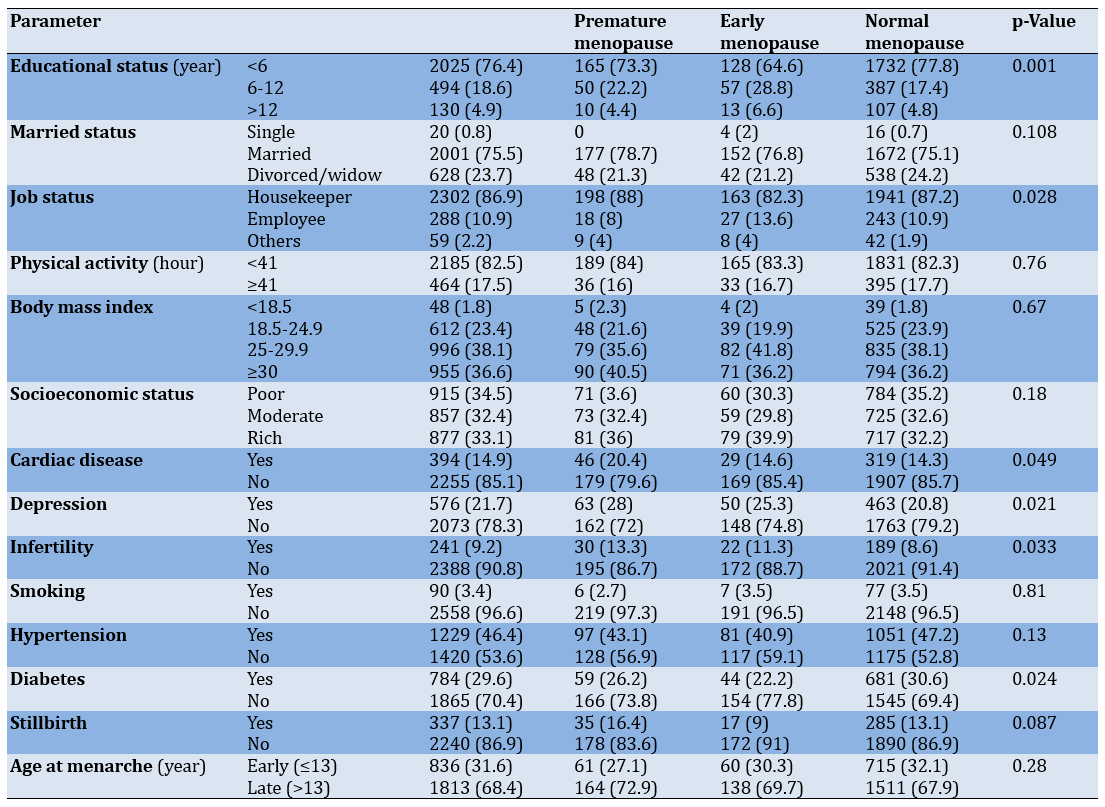
A total of 2,649 women with a mean age of 57.21±5.80 years (range: 35–70) were included. There were significant differences among the three menopausal age groups in terms of age, educational status, job status, cardiac disease, depression, infertility, and diabetes (Table 1).
Table 1. Frequency of baseline characteristics of menopausal women
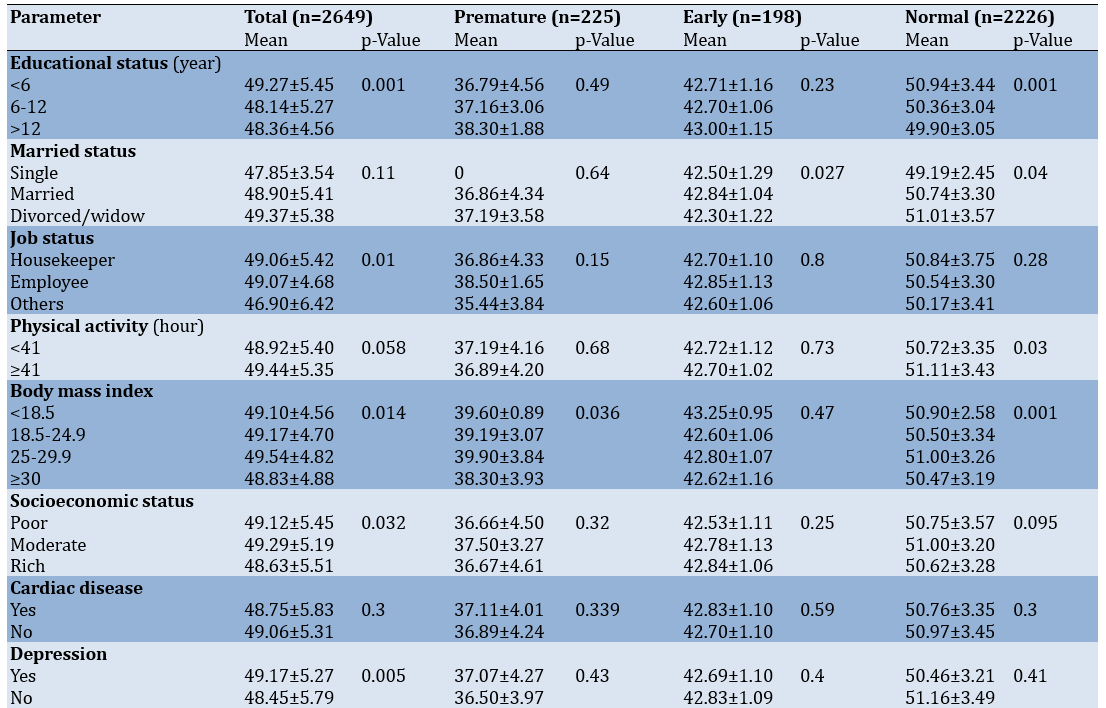
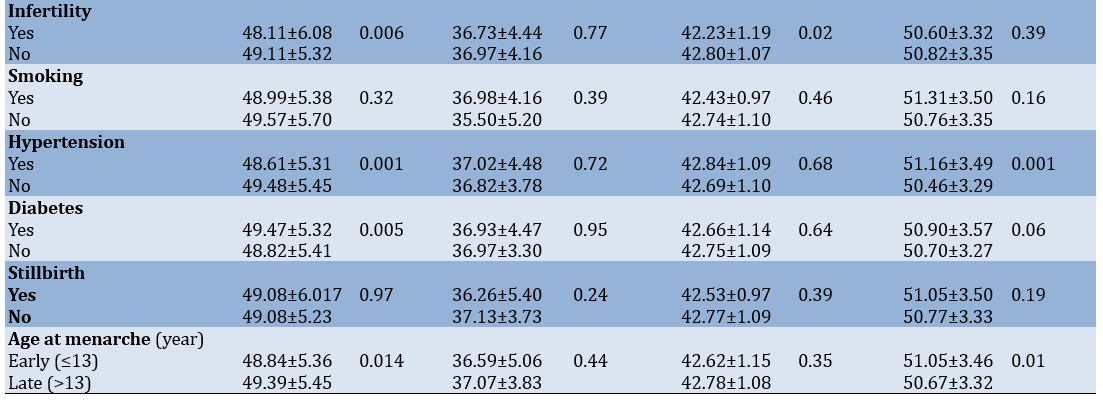
Menopausal age was significantly associated with educational status (p=0.001), job status (p=0.01), BMI (p=0.014), socioeconomic status (p=0.032), depression (p=0.005), infertility (p=0.006), hypertension (p=0.001), diabetes (p=0.005), and age at menarche (p=0.014) in the total sample (Table 2).
Table 2. Comparison of the mean menopausal age based on categorical parameters
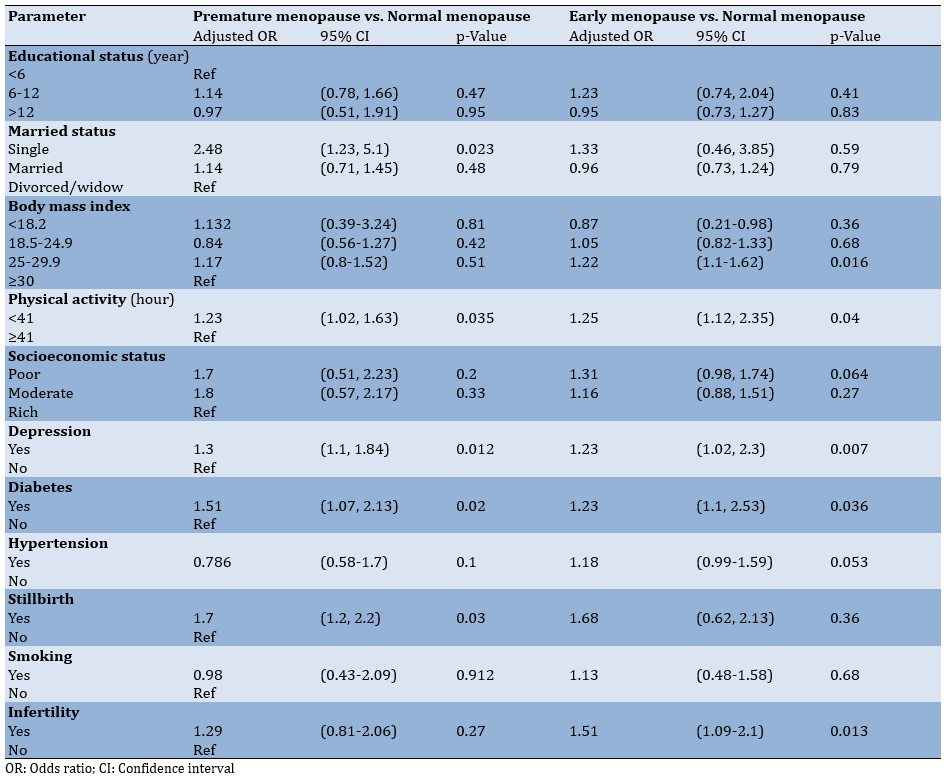
Single women had higher odds of premature menopause (p=0.023). Women with physical activity <41 MET-hours/day had higher odds of premature and early menopause (p=0.035 and p=0.04, respectively). Additionally, having diabetes increased the odds of premature and early menopause (p=0.02 and p=0.036, respectively). Women with a history of stillbirth had higher odds of premature menopause (p=0.03). Women with a history of depression had higher odds of premature and early menopause (p=0.012 and p=0.007, respectively). Women with a high BMI and a history of infertility had higher odds of early menopause (p=0.016 and p=0.013, respectively; Table 3).
Discussion
This study aimed to explore the determinants and predictors of age at menopause among Iranian women in the Zahedan Adult Cohort Study (PERSIAN) in Southeastern Iran. We investigated the risk factors for age at menopause, both in general and by classifying menopause as early, premature, or normal. The mean age of menopause in our sample (49.01±5.39 years) aligns with previous research conducted in Iran, where the average age at menopause has been reported to range from 48.3 to 49.6 years [28–33]. Notably, Iranian women tend to experience menopause earlier than their counterparts in Europe (50.1–52.8 years) and North America (50.5–51.4 years). However, the menopausal age of our population was higher than that reported in the Middle East (46.9-47.8 years) and Latin America (41.6–45.9 years) [6]. The observed differences in menopausal age across geographical regions may be attributed to a combination of genetic, social, economic, and lifestyle factors [34]. For example, premature menopause is often linked to genetic disorders, autoimmune conditions, and certain medical interventions [35]. Additionally, early menopause may be influenced by an accelerated aging process due to both genetic predispositions and environmental factors [3]. Our analysis revealed no significant correlation between education level and age at menopause, consistent with other findings [17, 29, 36] but contrasting with studies reporting a significant relationship [17, 37].
Table 3. Multiple logistic regression results for risk factors associated with menopausal age
Interestingly, single women were more likely to experience premature and early menopause than their married counterparts, particularly in cases of premature menopause, which aligns with the findings of Farjam et al. [37]. This observation underscores the potential role of social support structures in influencing menopausal timing. Physical activity was a significant predictor of menopausal age. Lower levels of physical activity were associated with increased odds of both premature and early menopause, which is consistent with some studies [6, 34] and contradicts others [38]. This aligns with the literature suggesting that active lifestyles may contribute positively to reproductive health outcomes in women. A higher BMI was linked to increased odds of early menopause, corroborating findings from previous research indicating that obesity can adversely affect hormonal balance and reproductive function [39, 40].
Socioeconomic status plays a critical role in determining the timing of menopause. Women from lower socioeconomic backgrounds had higher odds of experiencing premature and early menopause, although this relationship was not statistically significant in our analysis. However, several studies have reported a significant association between earlier age at normal menopause and lower social class [41–43]. Golshiri et al. report that women with lower socioeconomic status experience menopause at an earlier mean age, nearly three years earlier than those with moderate socioeconomic status. Additionally, women with moderate socioeconomic status have an earlier mean age at menopause, approximately four years earlier than women with high socioeconomic status [44]. There is a link between early menopause and a heightened risk of cardiovascular disease and hypertension, highlighting the importance of monitoring health outcomes in this group [45, 46].
We observed associations between a history of hypertension and early onset of menopause; however, these relationships were not statistically significant. Fertility history appeared to affect the timing of menopause. Some studies indicate that women with a history of infertility or stillbirth experience menopause earlier than those without such a history [35, 44]. A history of stillbirth increased the odds of premature menopause, and a history of infertility increased the odds of early menopause, suggesting that reproductive events may have lasting effects on women’s health trajectories.
Unexpected findings regarding smoking were obtained, while the literature often associates smoking with the earlier onset of menopause [47, 48]. Some studies have shown a statistically significant relationship between smoking and the age of menopause [49–51]. However, other studies, including the current one, did not find similar results [52]. This could be attributed to the small number of smokers in the cohort or the low prevalence of smoking among Iranian women.
Evidence suggests that diabetes may contribute to the early onset of menopause [53]. Specifically, women diagnosed with type 1 diabetes often experience menopause approximately five years earlier than their counterparts without diabetes [54]. However, some studies have failed to corroborate these findings. For example, Brand et al. report that women who develop diabetes before the age of 20 years experience earlier menopausal onset, whereas those diagnosed after the age of 50 years experience a delay in menopause [55]. Moreover, no significant correlation was found between diabetes onset between the ages of 20 and 50 years and the age at menopause. Women with a history of diabetes presented higher odds of experiencing premature and early menopause.
Additionally, women who began menstruating before the age of 13 years had elevated odds of both premature and early menopause. This observation aligns with certain studies but contradicts others in the literature [56–59]. The increased risk of depression during menopause has been attributed to biological vulnerability, with studies finding an association between greater variation in estradiol and follicle-stimulating hormone (FSH) levels and higher depressive symptoms [60]. A history of depression was also associated with increased odds of premature and early menopause, corroborating findings from Shea et al., indicating a similar association between depression and menopausal timing [61].
The strengths of our study include its large sample size and comprehensive evaluation of various factors influencing menopausal age among women. A significant advantage of our research is the adjustment for numerous potential confounders, such as demographic information and medical history. However, we acknowledge several limitations in our study. First, data regarding outcomes and exposures were primarily self-reported, which may introduce misclassification and recall bias among participants. Moreover, recalling the exact time of menopause might also be subject to recall bias. Second, we excluded women over the age of 70 years, who might face more severe health challenges that could affect menopausal timing. Finally, the cross-sectional nature of our study limits our ability to establish causal relationships between various factors and age at menopause; thus, further longitudinal studies are warranted to elucidate these associations.
While genetic factors significantly influence the age at menopause, social factors, such as marital status and pregnancy also play important roles. Improving the health of premenopausal women requires a multidimensional approach that simultaneously includes regular physical activity, screening for mental disorders, healthy nutrition, diabetes prevention, and social support. Implementing community-based interventions and integrating screenings into primary care can lead to effective prevention of the physical and psychological consequences of this period and sustainably improve women’s quality of life. It should be noted that menopause information relied on self-reports, potentially introducing reporting bias and misclassification of menopausal status.
Conclusion
Genetic factors, along with social and health-related factors, such as marital status, body mass index, physical activity, and reproductive history, influence menopausal age, with different factors predominating in premature versus early menopause.
Acknowledgments: The authors express their gratitude to the Research and Technology Vice-Chancellor of Zahedan University of Medical Sciences for approving the project and to all the participants who helped us conduct this research.
Ethical Permissions: The Ethics Committee of Zahedan University of Medical Sciences approved the study with code IR.ZAUMS.REC.1403.142.
Conflicts of Interest: The authors declared no conflicts of interest.
Authors' Contribution: Ansarimoghaddam A (First Author), Methodologist (10%); Khazaeian S (Second Author), Discussion Writer (20%); Arab Borzu Z (Third Author), Introduction Writer/Main Researcher (35%); Shahraki‐Sanavi F (Fourth Author), Assistant Researcher (10%); Hosseini Koukamari P (Fifth Author), Introduction Writer (10%); Rastegar M (Sixth Author), Statistical Analyst (5%); Amiri Moghadam MH (Seventh Author), Assistant Researcher (5%); Bakhtiyari M (Eighth Author), Assistant Researcher (5%)
Funding/Support: No external funding.
Menopause marks the end of the monthly menstrual cycle in females and is characterized by amenorrhea for 12 consecutive months due to decreased ovarian follicular function [1]. This transition is accompanied by a reduction in estrogen levels, resulting in the cessation of menstruation and reproductive capability [2]. The natural age of menopause is typically defined as after age 45 [3, 4]. Menopause may occur before the age of 40, which is known as premature ovarian failure [3]. Approximately 4% of females experience this transition before age 40 [5], or it may occur between ages 40 and 44, a condition called early menopause [3]. The average age of menopause varies globally: Europe, 54 years; North America, 51.4 years; Latin America, 48.6 years; Asia, 51.1 years [6]; and Iran, 50.4 years [7]. The age of menopause serves as a predictor of mortality and disease risk in women’s later life stages. Early menopause is associated with increased risks of cardiovascular diseases, osteoporosis, and type 2 diabetes [7-9]. Epidemiological studies suggest a 2% reduction in mortality rates with adjustments in menopausal age [10], whereas late menopause is correlated with increased risks of endometrial and ovarian cancer [11-15].
Several factors may influence the age at menopause onset, including the use of contraceptive medications, body mass index (BMI), smoking and alcohol consumption, physical activity, socioeconomic status, genetic factors, education level, and environmental, socioeconomic, and lifestyle factors [16-18]. Identifying the factors that determine menopausal age is highly important. Understanding the genetic aspects of this phenomenon can enhance our knowledge of the causes of premature menopause, which in turn affects women’s fertility [19]. Therefore, careful study and identification of factors that affect the age at menopause can help predict and better manage the health risks associated with this period. This can improve the quality of life for postmenopausal women and enable them to approach this important stage of life with greater awareness and preparation.
While some studies have been conducted on menopause in Iran, there is a lack of research specifically focused on the age of menopause and its influencing factors in a large population of women in Zahedan. Understanding these parameters can provide valuable insights into women’s health in this region and inform public health strategies. To address these gaps, we conducted a cross-sectional study to determine the age at menopause and identify factors associated with it among women living in Zahedan, Iran.
Instrument and Methods
Design and participants
This cross-sectional study used data from the Zahedan Cohort Study (ZCS), part of the Prospective Epidemiological Research Studies in Iran (PERSIAN), conducted in Zahedan, a city in southeastern Iran. ZCS is a prospective, population-based study, with data collection conducted between October 2015 and January 2019 in Zahedan, and a 15-year follow-up was planned.
The ZCS used a multistage stratified approach, where Zahedan city was divided into three areas (periphery, center, and upper city) based on municipal regions and socioeconomic class. A comprehensive health service center was randomly selected in each region, and all women who met the study eligibility criteria were enrolled at each center.
Inclusion criteria were women with a history of cancer, hysterectomy, or oophorectomy (unilateral or bilateral) before menopause, as well as those who had not yet experienced menopause. Of the 6,099 women who participated, 3,450 were excluded, and 2,649 were postmenopausal (defined as the absence of menstruation for at least 12 months). The menopausal status of women was categorized as premature menopause, early menopause, or normal menopause. Premature menopause was defined as occurring before age 40, early menopause as occurring between ages 40 and 44, and normal menopause as occurring after age 45 [3].
Instrument
Data were collected using a questionnaire whose validity and reliability have been confirmed in Persian cohort studies [20, 21].
Socioeconomic status was measured using the wealth score index (WSI), which considers various factors, including access to facilities, travel status, homeownership, number of bedrooms, monthly household income, annual domestic and international trips, and number of books read. WSI was calculated via multiple correspondence analysis (MCA). MCA is a widely used technique for analyzing categorical data; it aims to reduce large sets of parameters into smaller sets of components that summarize the information contained in the data. MCA can be regarded as an adaptation of principal component analysis (PCA) for categorical data [22]. Using the MCA method, the WSI was divided into three groups (poor, moderate, and rich) based on the scoring of the mentioned parameters.
The level of physical activity was calculated based on metabolic equivalent task hours (MET-hours/day). The participants' BMI was calculated (BMI<18.5 as underweight, 18.5-24.9 as normal, 25-29.9 as overweight, and 30 or more as obese) [23]. Triglyceride (TG)≥150mg/dl and cholesterol (CHOL)≥200mg/dl were considered elevated [24]. Current cigarette smokers were defined as individuals who had smoked at least 100 cigarettes in their lifetime and currently smoked either every day or on some days [25].
Stillbirth was defined as the death of the pregnancy product after the 20th gestational week [26]. Menarche age is the age at which a person experiences their first menstruation. Menopause was defined as the passage of at least 12 months since the last menstruation [27]. To assess menopausal status, women were asked whether they had undergone menopause (yes/no). Furthermore, among women who had experienced menopause, the age at menopause completion was recorded.
Procedure
The questionnaire was administered and completed by trained personnel who collected information from the participants. The aims, foundation, and design of this study have been previously published [22]. Trained interviewers used a laptop-based questionnaire to gather data on participants’ socio-demographics, anthropometrics, medical history, lifestyle, nutrition, and reproductive characteristics. Data were collected after participants provided written informed consent. The research team received the data from the ZCS supervisor in a coded, anonymous form, and the authors did not have access to participants’ identification information. Trained personnel used validated questionnaires to collect data on sociodemographic characteristics, substance use, medical history, family history, socioeconomic status, and physical activity. Marital status was dichotomized as married and single, with the latter including never married, divorced, or widowed individuals. The level of physical activity was calculated based on metabolic equivalent task hours (MET-hours/day).
Data analysis
Individual characteristics were compared across menopausal age groups (premature, early, and normal) using the chi-square test and Fisher’s exact test for categorical variables, and one-way analysis of variance (ANOVA) and the independent-samples t-test for quantitative variables. Multiple logistic regression analyses were used to assess the associations between independent variables and premature, early, and normal menopause. The normal menopause category was set as the reference category in this model. Potential confounding parameters were entered into the model in order of their hypothesized strength of association with menopausal age. Parameters with a p-value less than 0.2 were selected as confounders. All analyses were performed using SPSS 22.
Findings
A total of 2,649 women with a mean age of 57.21±5.80 years (range: 35–70) were included. There were significant differences among the three menopausal age groups in terms of age, educational status, job status, cardiac disease, depression, infertility, and diabetes (Table 1).
Table 1. Frequency of baseline characteristics of menopausal women
Menopausal age was significantly associated with educational status (p=0.001), job status (p=0.01), BMI (p=0.014), socioeconomic status (p=0.032), depression (p=0.005), infertility (p=0.006), hypertension (p=0.001), diabetes (p=0.005), and age at menarche (p=0.014) in the total sample (Table 2).
Table 2. Comparison of the mean menopausal age based on categorical parameters
Single women had higher odds of premature menopause (p=0.023). Women with physical activity <41 MET-hours/day had higher odds of premature and early menopause (p=0.035 and p=0.04, respectively). Additionally, having diabetes increased the odds of premature and early menopause (p=0.02 and p=0.036, respectively). Women with a history of stillbirth had higher odds of premature menopause (p=0.03). Women with a history of depression had higher odds of premature and early menopause (p=0.012 and p=0.007, respectively). Women with a high BMI and a history of infertility had higher odds of early menopause (p=0.016 and p=0.013, respectively; Table 3).
Discussion
This study aimed to explore the determinants and predictors of age at menopause among Iranian women in the Zahedan Adult Cohort Study (PERSIAN) in Southeastern Iran. We investigated the risk factors for age at menopause, both in general and by classifying menopause as early, premature, or normal. The mean age of menopause in our sample (49.01±5.39 years) aligns with previous research conducted in Iran, where the average age at menopause has been reported to range from 48.3 to 49.6 years [28–33]. Notably, Iranian women tend to experience menopause earlier than their counterparts in Europe (50.1–52.8 years) and North America (50.5–51.4 years). However, the menopausal age of our population was higher than that reported in the Middle East (46.9-47.8 years) and Latin America (41.6–45.9 years) [6]. The observed differences in menopausal age across geographical regions may be attributed to a combination of genetic, social, economic, and lifestyle factors [34]. For example, premature menopause is often linked to genetic disorders, autoimmune conditions, and certain medical interventions [35]. Additionally, early menopause may be influenced by an accelerated aging process due to both genetic predispositions and environmental factors [3]. Our analysis revealed no significant correlation between education level and age at menopause, consistent with other findings [17, 29, 36] but contrasting with studies reporting a significant relationship [17, 37].
Table 3. Multiple logistic regression results for risk factors associated with menopausal age
Interestingly, single women were more likely to experience premature and early menopause than their married counterparts, particularly in cases of premature menopause, which aligns with the findings of Farjam et al. [37]. This observation underscores the potential role of social support structures in influencing menopausal timing. Physical activity was a significant predictor of menopausal age. Lower levels of physical activity were associated with increased odds of both premature and early menopause, which is consistent with some studies [6, 34] and contradicts others [38]. This aligns with the literature suggesting that active lifestyles may contribute positively to reproductive health outcomes in women. A higher BMI was linked to increased odds of early menopause, corroborating findings from previous research indicating that obesity can adversely affect hormonal balance and reproductive function [39, 40].
Socioeconomic status plays a critical role in determining the timing of menopause. Women from lower socioeconomic backgrounds had higher odds of experiencing premature and early menopause, although this relationship was not statistically significant in our analysis. However, several studies have reported a significant association between earlier age at normal menopause and lower social class [41–43]. Golshiri et al. report that women with lower socioeconomic status experience menopause at an earlier mean age, nearly three years earlier than those with moderate socioeconomic status. Additionally, women with moderate socioeconomic status have an earlier mean age at menopause, approximately four years earlier than women with high socioeconomic status [44]. There is a link between early menopause and a heightened risk of cardiovascular disease and hypertension, highlighting the importance of monitoring health outcomes in this group [45, 46].
We observed associations between a history of hypertension and early onset of menopause; however, these relationships were not statistically significant. Fertility history appeared to affect the timing of menopause. Some studies indicate that women with a history of infertility or stillbirth experience menopause earlier than those without such a history [35, 44]. A history of stillbirth increased the odds of premature menopause, and a history of infertility increased the odds of early menopause, suggesting that reproductive events may have lasting effects on women’s health trajectories.
Unexpected findings regarding smoking were obtained, while the literature often associates smoking with the earlier onset of menopause [47, 48]. Some studies have shown a statistically significant relationship between smoking and the age of menopause [49–51]. However, other studies, including the current one, did not find similar results [52]. This could be attributed to the small number of smokers in the cohort or the low prevalence of smoking among Iranian women.
Evidence suggests that diabetes may contribute to the early onset of menopause [53]. Specifically, women diagnosed with type 1 diabetes often experience menopause approximately five years earlier than their counterparts without diabetes [54]. However, some studies have failed to corroborate these findings. For example, Brand et al. report that women who develop diabetes before the age of 20 years experience earlier menopausal onset, whereas those diagnosed after the age of 50 years experience a delay in menopause [55]. Moreover, no significant correlation was found between diabetes onset between the ages of 20 and 50 years and the age at menopause. Women with a history of diabetes presented higher odds of experiencing premature and early menopause.
Additionally, women who began menstruating before the age of 13 years had elevated odds of both premature and early menopause. This observation aligns with certain studies but contradicts others in the literature [56–59]. The increased risk of depression during menopause has been attributed to biological vulnerability, with studies finding an association between greater variation in estradiol and follicle-stimulating hormone (FSH) levels and higher depressive symptoms [60]. A history of depression was also associated with increased odds of premature and early menopause, corroborating findings from Shea et al., indicating a similar association between depression and menopausal timing [61].
The strengths of our study include its large sample size and comprehensive evaluation of various factors influencing menopausal age among women. A significant advantage of our research is the adjustment for numerous potential confounders, such as demographic information and medical history. However, we acknowledge several limitations in our study. First, data regarding outcomes and exposures were primarily self-reported, which may introduce misclassification and recall bias among participants. Moreover, recalling the exact time of menopause might also be subject to recall bias. Second, we excluded women over the age of 70 years, who might face more severe health challenges that could affect menopausal timing. Finally, the cross-sectional nature of our study limits our ability to establish causal relationships between various factors and age at menopause; thus, further longitudinal studies are warranted to elucidate these associations.
While genetic factors significantly influence the age at menopause, social factors, such as marital status and pregnancy also play important roles. Improving the health of premenopausal women requires a multidimensional approach that simultaneously includes regular physical activity, screening for mental disorders, healthy nutrition, diabetes prevention, and social support. Implementing community-based interventions and integrating screenings into primary care can lead to effective prevention of the physical and psychological consequences of this period and sustainably improve women’s quality of life. It should be noted that menopause information relied on self-reports, potentially introducing reporting bias and misclassification of menopausal status.
Conclusion
Genetic factors, along with social and health-related factors, such as marital status, body mass index, physical activity, and reproductive history, influence menopausal age, with different factors predominating in premature versus early menopause.
Acknowledgments: The authors express their gratitude to the Research and Technology Vice-Chancellor of Zahedan University of Medical Sciences for approving the project and to all the participants who helped us conduct this research.
Ethical Permissions: The Ethics Committee of Zahedan University of Medical Sciences approved the study with code IR.ZAUMS.REC.1403.142.
Conflicts of Interest: The authors declared no conflicts of interest.
Authors' Contribution: Ansarimoghaddam A (First Author), Methodologist (10%); Khazaeian S (Second Author), Discussion Writer (20%); Arab Borzu Z (Third Author), Introduction Writer/Main Researcher (35%); Shahraki‐Sanavi F (Fourth Author), Assistant Researcher (10%); Hosseini Koukamari P (Fifth Author), Introduction Writer (10%); Rastegar M (Sixth Author), Statistical Analyst (5%); Amiri Moghadam MH (Seventh Author), Assistant Researcher (5%); Bakhtiyari M (Eighth Author), Assistant Researcher (5%)
Funding/Support: No external funding.
References
1. WHO. Research on the menopause in the 1990s: Report of a WHO scientific group. Geneva: World Health Organization; 1996. [Link]
2. Santoro N, Roeca C, Peters BA, Neal-Perry G. The menopause transition: Signs, symptoms, and management options. J Clin Endocrinol Metab. 2021;106(1):1-15. [Link] [DOI:10.1210/clinem/dgaa764]
3. Shuster LT, Rhodes DJ, Gostout BS, Grossardt BR, Rocca WA. Premature menopause or early menopause: Long-term health consequences. Maturitas. 2010;65(2):161-6. [Link] [DOI:10.1016/j.maturitas.2009.08.003]
4. Monteleone P, Mascagni G, Giannini A, Genazzani AR, Simoncini T. Symptoms of menopause-global prevalence, physiology and implications. Nat Rev Endocrinol. 2018;14(4):199-215. [Link] [DOI:10.1038/nrendo.2017.180]
5. Gjelsvik B, Rosvold EO, Straand J, Dalen I, Hunskaar S. Symptom prevalence during menopause and factors associated with symptoms and menopausal age. The results from the Norwegian Hordaland Women's Cohort study. Maturitas. 2011;70(4):383-90. [Link] [DOI:10.1016/j.maturitas.2011.09.011]
6. Palacios S, Henderson V, Siseles N, Tan D, Villaseca P. Age of menopause and impact of climacteric symptoms by geographical region. Climacteric. 2010;13(5):419-28. [Link] [DOI:10.3109/13697137.2010.507886]
7. Ziaei S, Ziagham S, Sayahi M. Relationship between menopausal age and metabolic syndrome in non-obese postmenopausal women. J Arak Univ Med Sci. 2013;16(5):41-8. [Persian] [Link]
8. Elias SG, Van Noord PA, Peeters PH, Den Tonkelaar I, Grobbee DE. Caloric restriction reduces age at menopause: The effect of the 1944-1945 Dutch famine. Menopause. 2018;25(11):1232-7. [Link] [DOI:10.1097/GME.0000000000001224]
9. Morris DH, Jones ME, Schoemaker MJ, McFadden E, Ashworth A, Swerdlow AJ. Body mass index, exercise, and other lifestyle factors in relation to age at natural menopause: Analyses from the breakthrough generations study. Am J Epidemiol. 2012;175(10):998-1005. [Link] [DOI:10.1093/aje/kwr447]
10. Ahuja M. Age of menopause and determinants of menopause age: A PAN India survey by IMS. J Midlife Health. 2016;7(3):126-31. [Link] [DOI:10.4103/0976-7800.191012]
11. Brand JS, Van Der Schouw YT, Onland-Moret NC, Sharp SJ, Ong KK, Khaw KT, et al. Age at menopause, reproductive life span, and type 2 diabetes risk: Results from the EPIC-InterAct study. Diabetes care. 2013;36(4):1012-9. [Link] [DOI:10.2337/dc12-1020]
12. Collaborative Group on Hormonal Factors in Breast Cancer. Menarche, menopause, and breast cancer risk: Individual participant meta-analysis, including 118 964 women with breast cancer from 117 epidemiological studies. Lancet Oncol. 2012;13(11):1141-51. [Link] [DOI:10.1016/S1470-2045(12)70425-4]
13. Cauley JA, Danielson ME, Greendale GA, Finkelstein JS, Chang YF, Lo JC, et al. Bone resorption and fracture across the menopausal transition: The study of women's health across the nation. Menopause. 2012;19(11):1200-7. [Link] [DOI:10.1097/gme.0b013e31825ae17e]
14. Peters SA, Woodward M. Women's reproductive factors and incident cardiovascular disease in the UK Biobank. Heart. 2018;104(13):1069-75. [Link] [DOI:10.1136/heartjnl-2017-312289]
15. Shafrir AL, Babic A, Tamimi RM, Rosner BA, Tworoger SS, Terry KL. Reproductive and hormonal factors in relation to survival and platinum resistance among ovarian cancer cases. Br J Cancer. 2016;115(11):1391-9. [Link] [DOI:10.1038/bjc.2016.316]
16. Gold EB, Crawford SL, Avis NE, Crandall CJ, Matthews KA, Waetjen LE, et al. Factors related to age at natural menopause: Longitudinal analyses from SWAN. Am J Epidemiol. 2013;178(1):70-83. [Link] [DOI:10.1093/aje/kws421]
17. Schoenaker DA, Jackson CA, Rowlands JV, Mishra GD. Socioeconomic position, lifestyle factors and age at natural menopause: A systematic review and meta-analyses of studies across six continents. Int J Epidemiol. 2014;43(5):1542-62. [Link] [DOI:10.1093/ije/dyu094]
18. Borzu ZA, Karimy M, Leitão M, Pimenta F, Albergaria R, Khoshnazar Z, et al. Validation of the menopause representation questionnaire (MenoSentations-Q) among Iranian women and cross-cultural comparison with Portuguese women. BMC Womens Health. 2025;25(1):87. [Link] [DOI:10.1186/s12905-025-03606-5]
19. Ayatollahi SM, Ghaem H, Ayatollahi SA. Menstrual-reproductive factors and age at natural menopause in Iran. Int J Gynaecol Obstet. 2003;80(3):311-3. [Link] [DOI:10.1016/S0020-7292(02)00375-2]
20. Poustchi H, Eghtesad S, Kamangar F, Etemadi A, Keshtkar AA, Hekmatdoost A, et al. Prospective epidemiological research studies in Iran (the PERSIAN Cohort Study): Rationale, objectives, and design. Am J Epidemiol. 2018;187(4):647-55. [Link] [DOI:10.1093/aje/kwx314]
21. Shahraki-Sanavi F, Woodward M, Ansari-Moghaddam A, Okati-Aliabad H, Mohammadi M, Khorram A, et al. Cohort profile: The Zahedan Adult Cohort Study (ZACS)-a prospective study of non-communicable diseases in Sistani and Baluch populations. Int J Epidemiol. 2022;51(6):e350-7. [Link] [DOI:10.1093/ije/dyac011]
22. Mori Y, Kuroda M, Makino N. Multiple correspondence analysis. In: Nonlinear principal component analysis and its applications. Singapore: Springer; 2016. p. 21-8. [Link] [DOI:10.1007/978-981-10-0159-8_3]
23. Farmanfarma KK, Kaykhaei MA, Mohammadi M, Adineh HA, Ansari-Moghaddam A. The prevalence and trend of metabolic syndrome in the South-East of Iran. J Med Life. 2020;13(4):587-99. [Link] [DOI:10.25122/jml-2020-0052]
24. Zare MG, Okati-Aliabad H, Ansari-Moghaddam A, Mohammadi M, Shahraki-Sanavi F. Prevalence and risk factors of pre-hypertension and hypertension among adults in Southeastern Iran: Findings from the baseline survey of the Zahedan adult cohort study. PLoS One. 2023;18(12):e0295270. [Link] [DOI:10.1371/journal.pone.0295270]
25. Jamal A, Agaku IT, O'Connor E, King BA, Kenemer JB, Neff L. Current cigarette smoking among adults-United States, 2005-2013. MMWR Morb Mortal Wkly Rep. 2014;63(47):1108-12. [Link]
26. Reinebrant HE, Leisher SH, Coory M, Henry S, Wojcieszek AM, Gardener G, et al. Making stillbirths visible: A systematic review of globally reported causes of stillbirth. BJOG. 2018;125(2):212-24. [Link] [DOI:10.1111/1471-0528.14971]
27. Sherman S. Defining the menopausal transition. Am J Med. 2005;118(12):3-7. [Link] [DOI:10.1016/j.amjmed.2005.11.002]
28. Fallahzadeh H. Age at natural menopause in Yazd, Islamic Republic of Iran. Menopause. 2007;14(5):900-4. [Link] [DOI:10.1097/gme.0b013e318032b2e6]
29. Kutenaee MA, Dashti S, Rafati S, Moannaei M, Masoudi M, Nejatizadeh A, et al. Factors predicting age at menopause among Iranian women in the Bandare-Kong cohort study (a cross-sectional survey of PERSIAN cohort study). Womens Midlife Health. 2023;9(1):5. [Link] [DOI:10.1186/s40695-023-00088-z]
30. Mirinezhad MR, Khosroabadi N, Rahpeyma M, Khayami R, Hashemi SR, Ghazizadeh H, et al. Genetic determinants of premature menopause in a Mashhad population cohort. Int J Fertil Steril. 2021;15(1):26-33. [Link]
31. Mohsenian S, Shabbidar S, Siassi F, Qorbani M, Khosravi S, Abshirini M, et al. Carbohydrate quality index: Its relationship to menopausal symptoms in postmenopausal women. Maturitas. 2021;150:42-8. [Link] [DOI:10.1016/j.maturitas.2021.05.006]
32. Nahidi F, Karman N, Vallaei N, Fazli Z. Studying incidence of menopause and its effective factors in Tehran. Res Med. 2010;33(4):258-65. [Persian] [Link]
33. Zamaniyan M, Moosazadeh M, Peyvandi S, Jaefari K, Goudarzi R, Moradinazar M, et al. Age of natural menopause and related factors among the Tabari cohort. J Menopausal Med. 2020;26(1):18-23. [Link] [DOI:10.6118/jmm.19004]
34. Wang M, Gong WW, Hu RY, Wang H, Guo Y, Bian Z, et al. Age at natural menopause and associated factors in adult women: Findings from the China Kadoorie Biobank study in Zhejiang rural area. PLoS One. 2018;13(4):e0195658. [Link] [DOI:10.1371/journal.pone.0195658]
35. Cox L, Liu JH. Primary ovarian insufficiency: An update. Int J Womens Health. 2014;6:235-43. [Link] [DOI:10.2147/IJWH.S37636]
36. Delavar M, Hajiahmadi M. Factors affecting the age in normal menopause and frequency of menopausal symptoms in Northern Iran. Iran Red Crescent Med J. 2011;13(3):192-8. [Link]
37. Farjam M, Amiri Z, Sharafi M, Bahramali E. Factors associated with delayed menopause in Iran: Findings from Fasa cohort study, a branch of Persian cohort study. Galen Med J. 2018;7:e922. [Link] [DOI:10.31661/gmj.v7i0.922]
38. Vatankhah H, Khalili P, Vatanparast M, Ayoobi F, Esmaeili-Nadimi A, Jamali Z. Prevalence of early and late menopause and its determinants in Rafsanjan cohort study. Sci Rep. 2023;13(1):1847. [Link] [DOI:10.1038/s41598-023-28526-y]
39. Li L, Wu J, Pu D, Zhao Y, Wan C, Sun L, et al. Factors associated with the age of natural menopause and menopausal symptoms in Chinese women. Maturitas. 2012;73(4):354-60. [Link] [DOI:10.1016/j.maturitas.2012.09.008]
40. Moraes SD, Da Fonseca AM, Soares JM Jr, Bagnoli VR, Souza MA, Ariê WM, et al. Construction and validation of an instrument that breaks the silence: The impact of domestic and/or sexual violence on women's health, as shown during climacterium. Menopause. 2012;19(1):16-22. [Link] [DOI:10.1097/gme.0b013e3182214e12]
41. Castelo-Branco C, Blümel JE, Chedraui P, Calle A, Bocanera R, Depiano E, et al. Age at menopause in Latin America. Menopause. 2006;13(4):706-12. [Link] [DOI:10.1097/01.gme.0000227338.73738.2d]
42. Rödström K, Bengtsson C, Milsom I, Lissner L, Sundh V, Bjoürkelund C. Evidence for a secular trend in menopausal age: A population study of women in Gothenburg. Menopause. 2003;10(6):538-43. [Link] [DOI:10.1097/01.GME.0000094395.59028.0F]
43. Santoro N, Brockwell S, Johnston J, Crawford SL, Gold EB, Harlow SD, et al. Helping midlife women predict the onset of the final menses: SWAN, the study of women's health across the nation. Menopause. 2007;14:415-24. [Link] [DOI:10.1097/gme.0b013e31802cc289]
44. Golshiri P, Akbari M, Abdollahzadeh MR. Age at natural menopause and related factors in Isfahan, Iran. J Menopausal Med. 2016;22(2):87-93. [Link] [DOI:10.6118/jmm.2016.22.2.87]
45. Rosano G, Vitale C, Marazzi G, Volterrani M. Menopause and cardiovascular disease: The evidence. Climacteric. 2007;10(Suppl 1):19-24. [Link] [DOI:10.1080/13697130601114917]
46. Wild RA, Hovey KM, Andrews C, Robinson JG, Kaunitz AM, Manson JE, et al. Cardiovascular disease (CVD) risk scores, age, or years since menopause to predict cardiovascular disease in the Women's Health Initiative. Menopause. 2021;28(6):610-8. [Link] [DOI:10.1097/GME.0000000000001753]
47. Hardy R, Kuh D, Wadsworth M. Smoking, body mass index, socioeconomic status and the menopausal transition in a British national cohort. Int J Epidemiol. 2000;29(5):845-51. [Link] [DOI:10.1093/ije/29.5.845]
48. Zhu D, Chung HF, Pandeya N, Dobson AJ, Hardy R, Kuh D, et al. Premenopausal cardiovascular disease and age at natural menopause: A pooled analysis of over 170,000 women. Eur J Epidemiol. 2019;34(3):235-46. [Link] [DOI:10.1007/s10654-019-00490-w]
49. Zaldívar GA, Damm RR, Ruiz MR, Lozano FF, Malacara JM, Forsbach G. Factors possibly associated with the age at the onset of menopause. Multicenter study. GINECOLOGIA Y OBSTETRICIA DE MEXICO. 1995;63:432-8. [Link]
50. Noll PR, Campos CA, Leone C, Zangirolami-Raimundo J, Noll M, Baracat EC, et al. Dietary intake and menopausal symptoms in postmenopausal women: A systematic review. Climacteric. 2021;24(2):128-38. [Link] [DOI:10.1080/13697137.2020.1828854]
51. Glass RH, Kase NG. Clinical gynecologic endocrinology and infertility. Endocrinologist. 1991;1(1):65. [Link] [DOI:10.1097/00019616-199102000-00012]
52. Gold EB, Bromberger J, Crawford S, Samuels S, Greendale GA, Harlow SD, et al. Factors associated with age at natural menopause in a multiethnic sample of midlife women. Am J Epidemiol. 2001;153(9):865-74. [Link] [DOI:10.1093/aje/153.9.865]
53. Soto N, Iniguez G, Lopez P, Larenas G, Mujica V, Rey RA, et al. Anti-mullerian hormone and inhibin B levels as markers of premature ovarian aging and transition to menopause in type 1 diabetes mellitus. Hum Reprod. 2009;24(11):2838-44. [Link] [DOI:10.1093/humrep/dep276]
54. Dorman JS, Steenkiste AR, Foley TP, Strotmeyer ES, Burke JP, Kuller LH, et al. Menopause in type 1 diabetic women: Is it premature?. Diabetes. 2001;50(8):1857-62. [Link] [DOI:10.2337/diabetes.50.8.1857]
55. Brand J, Onland-Moret N, Eijkemans M, Tjonneland A, Roswall N, Overvad K, et al. Diabetes and onset of natural menopause: Results from the European prospective investigation into cancer and nutrition. Obstet Gynecol Surv. 2015;70(8):507-8. [Link] [DOI:10.1097/OGX.0000000000000235]
56. Bjelland E, Wilkosz P, Tanbo T, Eskild A. Is unilateral oophorectomy associated with age at menopause? A population study (the HUNT2 Survey). Hum Reprod. 2014;29(4):835-41. [Link] [DOI:10.1093/humrep/deu026]
57. Mishra GD, Pandeya N, Dobson AJ, Chung HF, Anderson D, Kuh D, et al. Early menarche, nulliparity and the risk for premature and early natural menopause. Hum Reprod. 2017;32(3):679-86. [Link] [DOI:10.1093/humrep/dew350]
58. Ruth KS, Perry JR, Henley WE, Melzer D, Weedon MN, Murray A. Events in early life are associated with female reproductive aging: A UK biobank study. Sci Rep. 2016;6(1):24710. [Link] [DOI:10.1038/srep24710]
59. Zsakai A, Mascie-Taylor N, Bodzsar EB. Relationship between some indicators of reproductive history, body fatness and the menopausal transition in Hungarian women. J Physiol Anthropol. 2015;34:35. [Link] [DOI:10.1186/s40101-015-0076-0]
60. Alblooshi S, Taylor M, Gill N. Does menopause elevate the risk for developing depression and anxiety? Results from a systematic review. Australas Psychiatry. 2023;31(2):165-73. [Link] [DOI:10.1177/10398562231165439]
61. Shea AK, Sohel N, Gilsing A, Mayhew AJ, Griffith LE, Raina P. Depression, hormone therapy, and the menopausal transition among women aged 45 to 64 years using Canadian longitudinal study on aging baseline data. Menopause. 2020;27(7):763-70. [Link] [DOI:10.1097/GME.0000000000001540]