

TMU
Owner
Tarbiat Modares University (TMU) is the owner of HEHP.

0.8
Cite Score 2025
Volume 14, Issue 1 (2026)
Health Educ Health Promot 2026, 14(1): 165-171 |
Back to browse issues page
Article Type:



History
Received: 2025/08/15 | Accepted: 2026/01/12 | Published: 2026/02/2
Received: 2025/08/15 | Accepted: 2026/01/12 | Published: 2026/02/2
How to cite this article
Asli Beigi M, Mohammadi Zeidi I, Ziaeiha M, Hosseini F, Mokri A. Role of Electronic Health Literacy in Predicting Health-Promoting Lifestyle Behaviors in College Students. Health Educ Health Promot 2026; 14 (1) :165-171
URL: http://hehp.daneshafarand.org/article-4-85682-en.html
URL: http://hehp.daneshafarand.org/article-4-85682-en.html
Download citation:
BibTeX | RIS | EndNote | Medlars | ProCite | Reference Manager | RefWorks
Send citation to:


Rights and permissions
BibTeX | RIS | EndNote | Medlars | ProCite | Reference Manager | RefWorks
Send citation to:


1- “Student Research Committee” and “Social Determinants of Health Research Center, Research Institute for Prevention of Non-Communicable Diseases”, Qazvin University of Medical Sciences, Qazvin, Iran
2- Social Determinants of Health Research Center, Research Institute for Prevention of Non-Communicable Diseases, Qazvin University of Medical Sciences, Qazvin, Iran
3- Department of Public Health, Faculty of Health, Qazvin University of Medical Sciences, Qazvin, Iran
4- “Student Research Committee” and “Department of Public Health, Faculty of Health”, Qazvin University of Medical Sciences, Qazvin, Iran
2- Social Determinants of Health Research Center, Research Institute for Prevention of Non-Communicable Diseases, Qazvin University of Medical Sciences, Qazvin, Iran
3- Department of Public Health, Faculty of Health, Qazvin University of Medical Sciences, Qazvin, Iran
4- “Student Research Committee” and “Department of Public Health, Faculty of Health”, Qazvin University of Medical Sciences, Qazvin, Iran
Keywords:
Student [MeSH], Health Promoting Behaviors [MeSH], Health Literacy [MeSH], eHealth [MeSH], Lifestyle [MeSH]
| Abstract (HTML) (889 Views)
Full-Text: (124 Views)
Introduction
With the rapid development of information and communication technologies in the Fourth Industrial Revolution (the digital revolution), individuals have become increasingly interested in managing their health by acquiring and utilizing health information from various sources [1].
Among these, the Internet has emerged as a primary source of health-related information [2], enabling users to acquire the knowledge needed to improve personal health and prevent disease [3]. Various groups—including university and school students, as well as patients—commonly use the Internet to search for information and make health-related decisions [4]. The academic community also has broad access to scientific and medical websites, as well as national and international databases, and remains highly dependent on the Internet for these activities. In this context, an individual’s ability to find, evaluate, and utilize web-based health information is influenced by their electronic health literacy [5].
Despite the many advantages of using the Internet to deliver health services, it has not yet had a significant impact on Iranian society, as many physicians and patients continue to prefer traditional methods for diagnosing diseases and prescribing drugs. This preference can be attributed to a lack of proficiency in using information technology for health maintenance, which requires skills, such as reading, computer use, information seeking, understanding health information, and applying it [6].
Health literacy is an important issue in public health and has received increasing attention [7]. Adequate health literacy among individuals leads to outcomes such as increased patient empowerment, informed decision-making, reduced health risks, improved disease prevention, increased safety, better quality of life, and higher-quality care [8]. Electronic health literacy (eHealth literacy) is defined as the ability to find, understand, and evaluate health-related information from electronic sources and to use this information to identify or solve a health problem [9]. Acquiring eHealth literacy requires a combination of computer literacy, information literacy, media literacy, health literacy, and Internet-use skills [10]. Individuals with higher levels of eHealth literacy are not only more likely to use the Internet to find answers to health-related questions but also more capable of understanding the information they find, verifying its accuracy, and using it to promote health-related behaviors [11]. In the context of eHealth literacy, studies among university students have shown that eHealth literacy is positively associated with health-promoting lifestyle behaviors (HPLBs), including healthy eating, exercise, not smoking, and adequate sleep [12, 13].
An HPLB is considered an important strategy for achieving overall public health [14]. Pender’s Health Promotion Model defines a health-promoting lifestyle as any set of activities performed to increase or maintain an individual’s or group’s level of health and self-actualization [15]. This lifestyle encompasses dimensions such as health responsibility, spiritual growth, physical activity, nutrition, interpersonal relations, and stress management [16]. Adopting health-promoting behaviors can significantly improve individuals’ health and productivity [17].
According to a World Health Organization statement at the first Global Conference on Healthy Lifestyles in Moscow, 60% of global mortality and 80% of mortality in developing countries are attributable to unhealthy lifestyles, and these figures are projected to rise to 75% by 2030 [8]. Studies have shown that students are more likely to engage in behaviors that jeopardize their health, such as physical inactivity, unhealthy diet, alcohol consumption, and smoking [18, 19]. Because lifestyle habits become difficult to change after adulthood and university is considered the last opportunity for significant behavioral development and learning, adopting a healthy lifestyle during this period can lay the foundation for better health in later life by reducing the risk of adverse health outcomes and delaying the onset of chronic diseases [20].
In this context, Rathnayake and Senevirathna [21] and Park and Lee [3] assessed the eHealth literacy levels of nursing students in Sri Lanka and South Korea, respectively. They found that these nursing students lack sufficient eHealth literacy and concluded that improving it is necessary, requiring measures such as curricular changes and enhanced information technology resources in educational settings.
Similarly, Cho et al. [22] examined the relationship between eHealth literacy and HPLB among hospital nurses in South Korea and found that nurses with higher eHealth literacy exhibit significantly more HPLB. A study in Iran also showed that eHealth literacy significantly predicts engagement in health-promoting behaviors among university students [8].
Thus, students with higher levels of eHealth literacy are more likely to engage in healthy behaviors [23]. Health knowledge depends on health literacy, which has been recognized as a public health goal for the twenty-first century. The advent of the Internet has increasingly transformed the health information landscape. Therefore, examining how eHealth literacy influences HPLB is essential [11].
This study aimed to investigate the role of eHealth literacy in the adoption of HPLB among students at Qazvin University of Medical Sciences.
Instrument and Methods
Design and participants
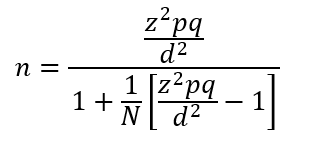
This cross-sectional descriptive-analytical study was conducted from October 2023 to June 2024 among 376 students enrolled at Qazvin University of Medical Sciences in northwestern Iran. Participants were selected from all faculties (Health, Paramedical Sciences, Nursing and Midwifery, Medicine, and Dentistry) using proportionate stratified sampling, accounting for the number of students in each faculty. The required sample size was calculated using Cochran’s formula, with a 5% margin of error, yielding a minimum of 342 participants. Considering a 10% attrition rate, the final sample size was determined to be 376 students.
The inclusion criteria were being enrolled as a student at the time of data collection, willingness to participate in the study, and having completed at least one academic semester in the relevant faculty. Those with incomplete questionnaire responses were excluded.
Instrument
The data collection instrument was a questionnaire consisting of three main sections. Section 1 concerned the demographic characteristics of participants, including gender, age, accommodation, student job, father’s education, mother’s education, father’s job, mother’s job, medical university field, self-reported health, and economic status.
Section 2 was the Electronic Health Literacy Scale (eHEALS), originally developed by Norman and Skinner [9], consisting of eight items rated on a five-point Likert scale (very poor, poor, fair, good, and very good), corresponding to scores ranging from 1 to 5. A higher mean score indicates a higher level of eHealth literacy, with total possible scores ranging from 8 to 40. The validity and reliability of the Persian version of this questionnaire were established by Bazm et al. [24], who translated it and conducted a psychometric evaluation. The instrument demonstrated satisfactory internal consistency (Cronbach’s α=0.88; p<0.001) and test-retest reliability (r=0.96; p<0.001).
Section 3 was the Health-Promoting Lifestyle Profile II (HPLP-II), developed by Walker et al. [14], which measures the extent to which individuals engage in health-promoting behaviors. The Persian translation and psychometric validation were conducted by Mohammadi Zeidi et al. [25]. The questionnaire contains 52 items across six dimensions, including health responsibility (9 items), physical activity (8 items), nutrition (9 items), spiritual growth (9 items), interpersonal relations (9 items), and stress management (8 items). Items are rated on a four-point Likert scale (1: never; 2: sometimes; 3: often; 4: routinely), with a total score range from 52 to 208. Higher mean scores represent more frequent engagement in health-promoting behaviors. Walker et al. reported a Cronbach’s alpha of 0.94 for the total scale, with subscales ranging from 0.79 to 0.94. The Persian version demonstrated a Cronbach’s alpha of 0.82 for the total scale and values ranging from 0.64 to 0.91 for the subscales [25]. Additionally, the reliability of the questionnaire was evaluated using internal consistency (Cronbach’s alpha) in a sample of 30 participants, yielding reliability coefficients of 0.86 for the eHEALS and 0.91 for the HPLP-II subscales.
Data collection
For data collection, the researchers approached the selected students in person. After introducing themselves and explaining the study objectives, participants were assured that their information would remain strictly confidential and that the results would be used solely in aggregate form within the research project. Participation was entirely voluntary and based on informed consent.
Data analysis
Data were analyzed using SPSS 22. The Kolmogorov-Smirnov test was used to assess the normality of the data distribution. Independent t-tests were applied to compare mean values between groups, Pearson’s correlation coefficient was used to examine associations between parameters, and multiple regression analysis was performed to predict HPLB.
Findings
Among the 376 students, 61.44% were female, and 79.78% were under 22 years old. Additionally, 46.01% of participants reported their health status as good.
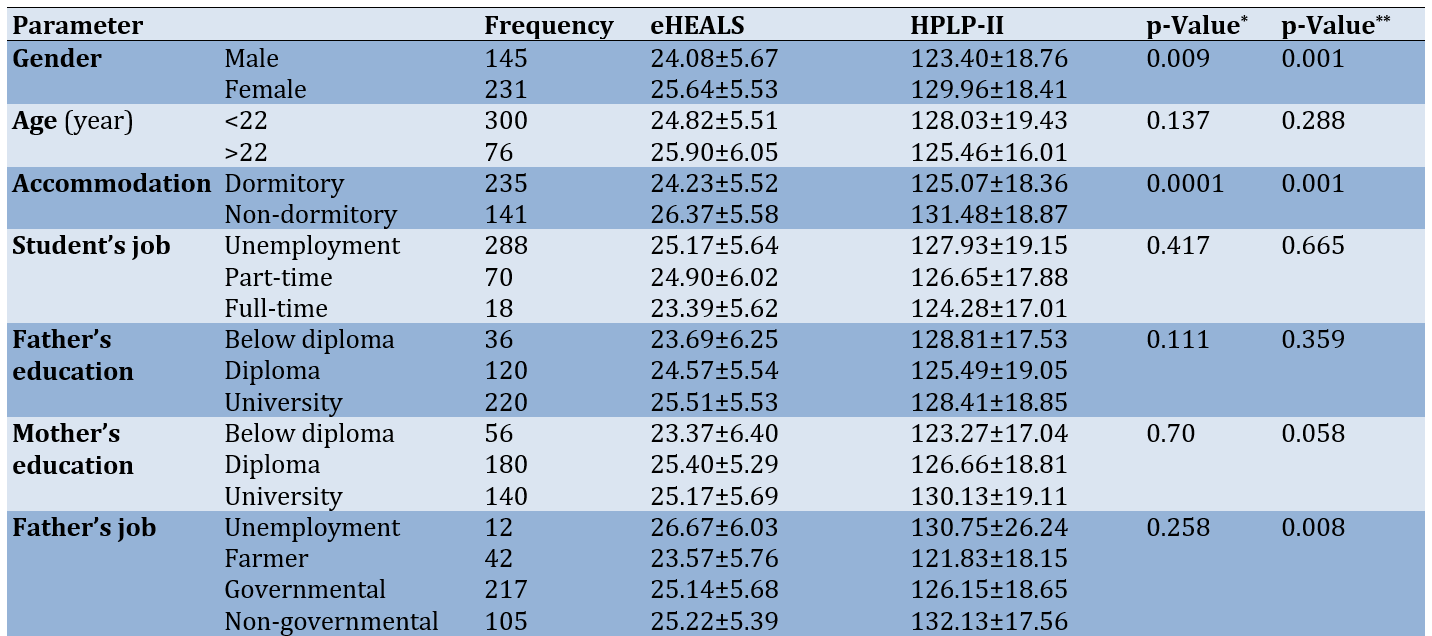
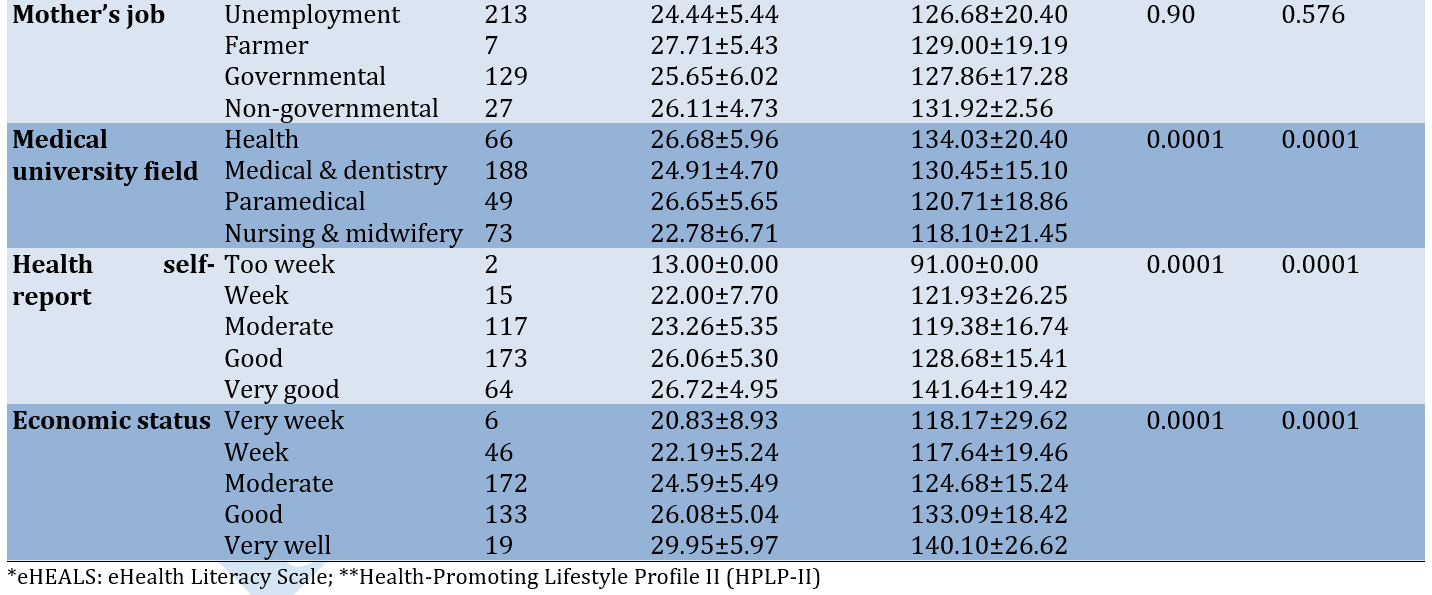
There was a statistically significant relationship between eHEALS scores and gender, place of residence, faculty, self-reported health status, and economic status (p<0.05). Moreover, gender, place of residence, faculty, father’s occupation, self-reported health status, and economic status were significantly associated with HPLB scores (p<0.05; Table 1).
Table 1. Comparison of eHealth Literacy Scale and Health-Promoting Lifestyle Profile II Scores across students’ demographic characteristics (n=376)
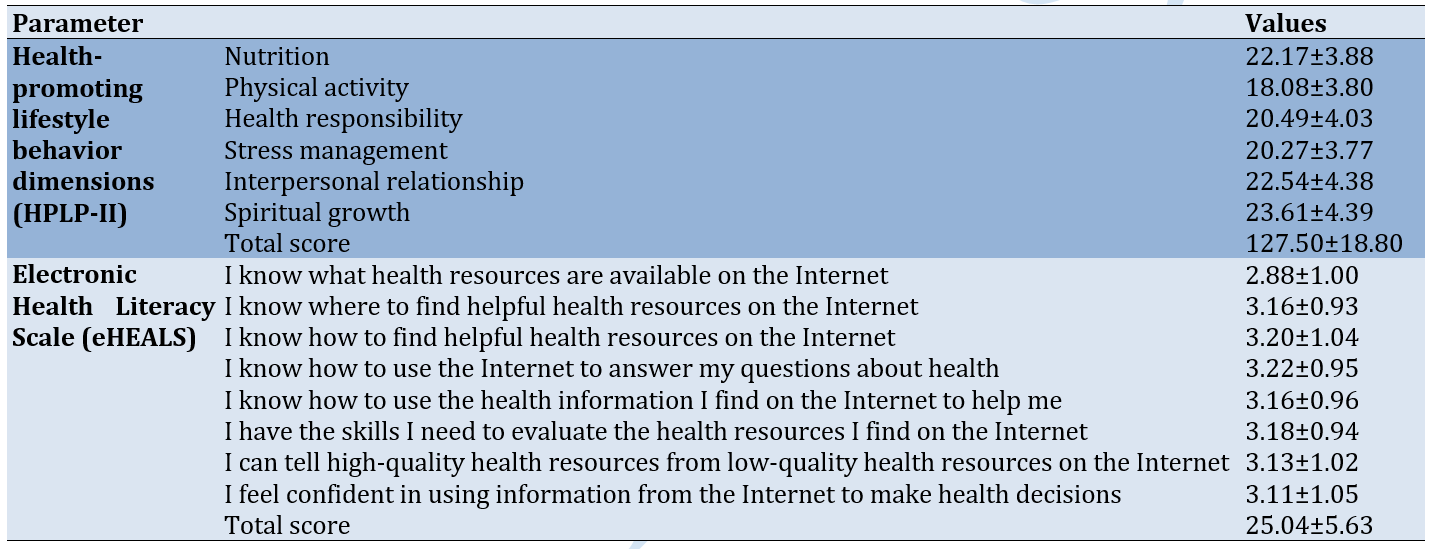
The mean HPLB score was 127.5±3.88, indicating a moderate level. The highest mean score among HPLB dimensions was for spiritual growth (23.61±4.39), while the lowest was for physical activity (18.08±3.80). The mean eHEALS score among students was 25.04±5.63. The mean value for individual items ranged from 2.88 to 3.22, with the lowest score recorded for the item: “I know what health resources are available on the Internet” (Table 2).
Table 2. Mean scores of the Health-Promoting Lifestyle Profile II (HPLP-II) and Electronic Health Literacy Scale (eHEALS)
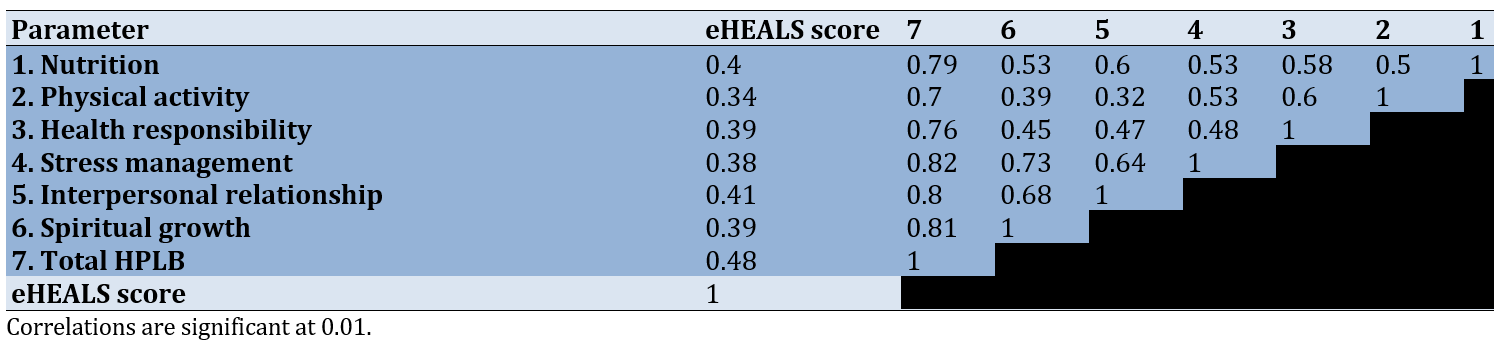
There were statistically significant and positive correlations among the HPLB dimensions (p<0.01). Additionally, there was a significant positive correlation between eHEALS and each HPLB dimension: health responsibility (r=0.39), spiritual growth (r=0.39), physical activity (r=0.34), nutrition (r=0.4), interpersonal relationships (r=0.41), and stress management (r=0.38; p<0.01 for all; Table 3).
Table 3. Correlations between Electronic Health Literacy Scale (eHEALS) scores and dimensions of health-promoting lifestyle behaviors
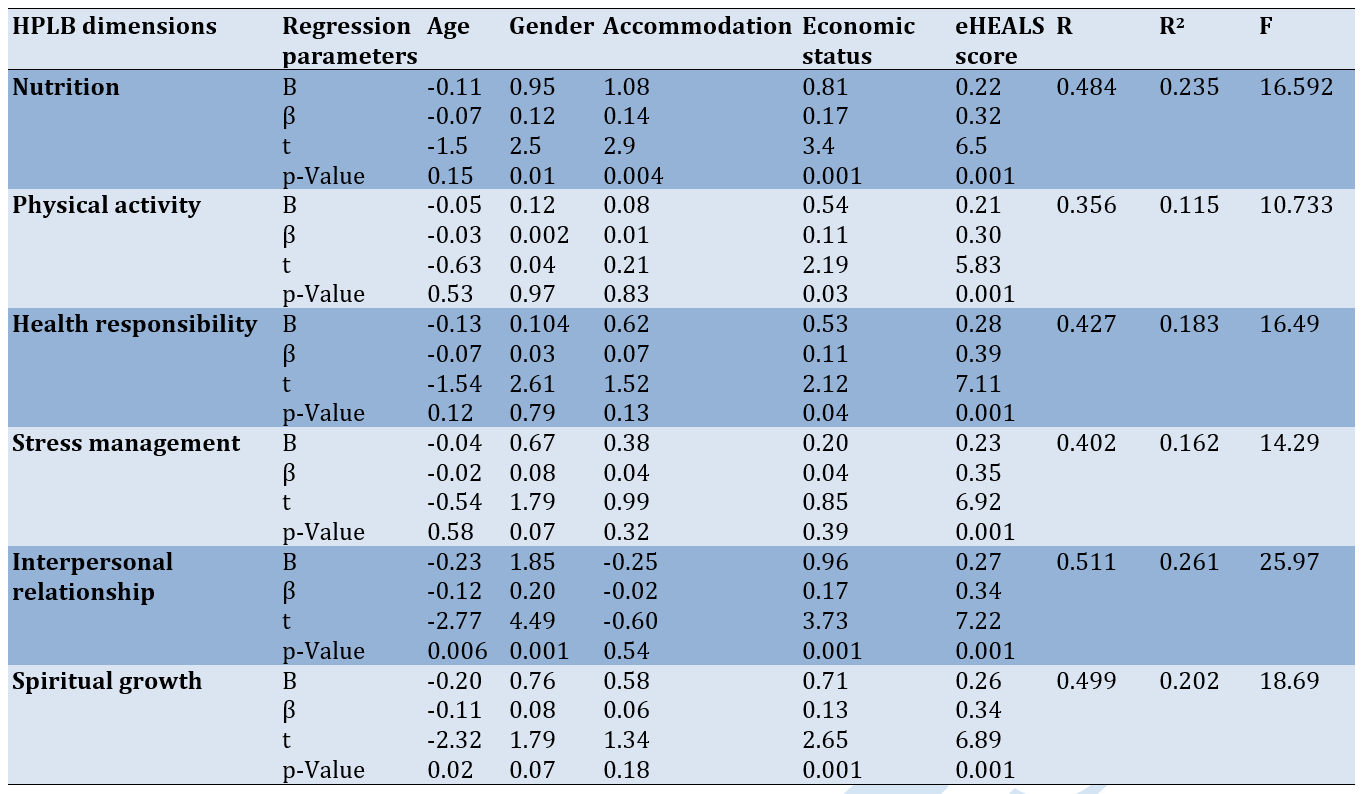
Multiple regression analysis demonstrated that age, gender, economic status, place of residence, and eHEALS together explained 32% of the variance in nutrition (R²=0.235; p=0.001), 26% in interpersonal relationships (R²=0.261; p=0.001), 20% in spiritual growth (R²= 0.202; p=0.001), 18% in health responsibility (R²=0.183; p=0.001), 16% in stress management (R²=0.162; p=0.001), and 11% in physical activity (R²=0.115; p=0.001). Furthermore, eHEALS predicted all six HPLB dimensions, such that a one standard deviation increase in eHEALS corresponded to increases of 0.32, 0.34, 0.34, 0.39, 0.35, and 0.30 standard deviations in nutrition, interpersonal relationships, spiritual growth, health responsibility, stress management, and physical activity scores, respectively (Table 4).
Table 4. Multiple regression analysis predicting health-promoting lifestyle behavior dimensions from demographic characteristics and Electronic Health Literacy Scale (eHEALS) Scores
Discussion
This study assessed the role of eHealth literacy in the adoption of HPLB among students at Qazvin University of Medical Sciences. Students had a moderate ability to use electronic technologies to search for and access essential health-related information. This level was relatively similar to findings from other studies in Iran, such as Dashti et al. [26] and Isazadeh et al. [6], and in Japan by Tsukahara et al. [27]. According to Kim & Oh [1], information-seeking is the most common purpose for Internet use, accounting for 89.1% of total usage. Consequently, students tend to utilize the Internet to acquire both basic and advanced health information.
The HPLB score was in the moderate range among students at Qazvin University of Medical Sciences, consistent with findings by Zehni & Rokhzadi [28], Saadatmajd et al. [29], and Peker & Bermek [30], who reported moderate lifestyle scores among the majority of medical students. This may be attributed to the relatively similar circumstances of students, including age group, enrollment in health-related disciplines, a high proportion residing in dormitories, and adherence to shared regulations governing their living conditions.
The prevalence of moderate lifestyle scores underscores the need for targeted interventions to promote healthy, health-oriented lifestyles among students. In terms of HPLB dimensions, students had the highest scores in spiritual growth, a finding consistent with several national and international studies, including those by Al-Momani [31] and Peker & Bermek [30]. This may be due to the influence of Islamic values, the emphasis on spiritual care by university authorities, and the promotion of spiritual and cultural environments, which collectively contribute to higher spiritual health among students.
Spirituality fosters a sense of meaning and purpose in life and a belief in a higher power, with potential positive effects on both mental and physical health. Fartookzadeh et al. emphasize the deep link between the Iranian-Islamic lifestyle and the spiritual dimension of society [32]. The lowest mean score was observed for physical activity, consistent with findings from other studies [33, 34].
Cho et al. [22] and Agapito et al. [23] report no relationship between eHEALS scores and physical activity. Physical activity, being a practical component of HPLB, is often influenced by cultural and social factors, situational constraints, and individual characteristics. Universities are therefore recommended to enhance students’ physical activity by establishing on-campus and dormitory sports and recreational centers and addressing barriers to exercise through short-term strategic planning. Notably, female students and those living with their parents reported higher HPLB scores compared to males and dormitory residents. This may be explained by the fact that students living away from their families are less likely to be reminded of healthy habits than those living with their parents. Can et al. report that students’ place of residence influences all six HPLB dimensions [35].
Dormitory living may increase stress levels and require independent decision-making during critical situations; therefore, health promotion strategies should increasingly focus on these student groups. There was a significant positive relationship between eHEALS scores and HPLB, with eHEALS predicting all six HPLB dimensions. Students with higher eHealth literacy were more likely to adopt health-promoting behaviors in health responsibility, spiritual growth, physical activity, nutrition, interpersonal relationships, and stress management.
This finding aligns with national and international evidence suggesting that individuals with higher eHealth literacy levels are more proactive in seeking health information and hold more positive attitudes toward Internet-based health information [23, 36]. Developing strategies to enhance students’ eHealth literacy could, therefore, protect them from lifestyle-related diseases and help sustain their health-promoting behaviors.
A key strength of this study was the absence of selection bias in recruiting participants. However, the study was conducted among students from only one medical sciences university in Iran, with no comparison to other universities; thus, the generalizability of the findings to all medical sciences universities in the country is limited. Future research should examine and compare the lifestyles of students in medical and non-medical disciplines.
Conclusion
Students have moderate mean lifestyle scores on both the Electronic Health Literacy Scale and health-promoting lifestyle behaviors, with a positive correlation between the Electronic Health Literacy Scale and all dimensions of health-promoting lifestyle behaviors.
Acknowledgments: The authors are grateful to the students who participated in the research.
Ethical Permissions: This study was approved by the Ethics Committee of Qazvin University of Medical Sciences (Ethics code: IR.QUMS.REC.1402.157).
Conflicts of Interest: The authors declared no conflicts of interest.
Authors' Contribution: Asli Beigi M (First Author) Introduction Writer/Methodologist/Assistant Researcher (20%); Mohammadi Zeidi I (Second Author), Methodologist/Statistical Analyst (20%); Ziaeiha M (Third Author), Introduction Writer/Methodologist (20%); Hosseini F (Fourth Author), Methodologist/Discussion Writer/Main Researcher (30%); Mokri A (Fifth Author), Methodologist/Assistant Researcher (10%)
Funding/Support: This study was conducted with financial support from the Deputy of Research and Technology at Qazvin University of Medical Sciences.
With the rapid development of information and communication technologies in the Fourth Industrial Revolution (the digital revolution), individuals have become increasingly interested in managing their health by acquiring and utilizing health information from various sources [1].
Among these, the Internet has emerged as a primary source of health-related information [2], enabling users to acquire the knowledge needed to improve personal health and prevent disease [3]. Various groups—including university and school students, as well as patients—commonly use the Internet to search for information and make health-related decisions [4]. The academic community also has broad access to scientific and medical websites, as well as national and international databases, and remains highly dependent on the Internet for these activities. In this context, an individual’s ability to find, evaluate, and utilize web-based health information is influenced by their electronic health literacy [5].
Despite the many advantages of using the Internet to deliver health services, it has not yet had a significant impact on Iranian society, as many physicians and patients continue to prefer traditional methods for diagnosing diseases and prescribing drugs. This preference can be attributed to a lack of proficiency in using information technology for health maintenance, which requires skills, such as reading, computer use, information seeking, understanding health information, and applying it [6].
Health literacy is an important issue in public health and has received increasing attention [7]. Adequate health literacy among individuals leads to outcomes such as increased patient empowerment, informed decision-making, reduced health risks, improved disease prevention, increased safety, better quality of life, and higher-quality care [8]. Electronic health literacy (eHealth literacy) is defined as the ability to find, understand, and evaluate health-related information from electronic sources and to use this information to identify or solve a health problem [9]. Acquiring eHealth literacy requires a combination of computer literacy, information literacy, media literacy, health literacy, and Internet-use skills [10]. Individuals with higher levels of eHealth literacy are not only more likely to use the Internet to find answers to health-related questions but also more capable of understanding the information they find, verifying its accuracy, and using it to promote health-related behaviors [11]. In the context of eHealth literacy, studies among university students have shown that eHealth literacy is positively associated with health-promoting lifestyle behaviors (HPLBs), including healthy eating, exercise, not smoking, and adequate sleep [12, 13].
An HPLB is considered an important strategy for achieving overall public health [14]. Pender’s Health Promotion Model defines a health-promoting lifestyle as any set of activities performed to increase or maintain an individual’s or group’s level of health and self-actualization [15]. This lifestyle encompasses dimensions such as health responsibility, spiritual growth, physical activity, nutrition, interpersonal relations, and stress management [16]. Adopting health-promoting behaviors can significantly improve individuals’ health and productivity [17].
According to a World Health Organization statement at the first Global Conference on Healthy Lifestyles in Moscow, 60% of global mortality and 80% of mortality in developing countries are attributable to unhealthy lifestyles, and these figures are projected to rise to 75% by 2030 [8]. Studies have shown that students are more likely to engage in behaviors that jeopardize their health, such as physical inactivity, unhealthy diet, alcohol consumption, and smoking [18, 19]. Because lifestyle habits become difficult to change after adulthood and university is considered the last opportunity for significant behavioral development and learning, adopting a healthy lifestyle during this period can lay the foundation for better health in later life by reducing the risk of adverse health outcomes and delaying the onset of chronic diseases [20].
In this context, Rathnayake and Senevirathna [21] and Park and Lee [3] assessed the eHealth literacy levels of nursing students in Sri Lanka and South Korea, respectively. They found that these nursing students lack sufficient eHealth literacy and concluded that improving it is necessary, requiring measures such as curricular changes and enhanced information technology resources in educational settings.
Similarly, Cho et al. [22] examined the relationship between eHealth literacy and HPLB among hospital nurses in South Korea and found that nurses with higher eHealth literacy exhibit significantly more HPLB. A study in Iran also showed that eHealth literacy significantly predicts engagement in health-promoting behaviors among university students [8].
Thus, students with higher levels of eHealth literacy are more likely to engage in healthy behaviors [23]. Health knowledge depends on health literacy, which has been recognized as a public health goal for the twenty-first century. The advent of the Internet has increasingly transformed the health information landscape. Therefore, examining how eHealth literacy influences HPLB is essential [11].
This study aimed to investigate the role of eHealth literacy in the adoption of HPLB among students at Qazvin University of Medical Sciences.
Instrument and Methods
Design and participants
This cross-sectional descriptive-analytical study was conducted from October 2023 to June 2024 among 376 students enrolled at Qazvin University of Medical Sciences in northwestern Iran. Participants were selected from all faculties (Health, Paramedical Sciences, Nursing and Midwifery, Medicine, and Dentistry) using proportionate stratified sampling, accounting for the number of students in each faculty. The required sample size was calculated using Cochran’s formula, with a 5% margin of error, yielding a minimum of 342 participants. Considering a 10% attrition rate, the final sample size was determined to be 376 students.
The inclusion criteria were being enrolled as a student at the time of data collection, willingness to participate in the study, and having completed at least one academic semester in the relevant faculty. Those with incomplete questionnaire responses were excluded.
Instrument
The data collection instrument was a questionnaire consisting of three main sections. Section 1 concerned the demographic characteristics of participants, including gender, age, accommodation, student job, father’s education, mother’s education, father’s job, mother’s job, medical university field, self-reported health, and economic status.
Section 2 was the Electronic Health Literacy Scale (eHEALS), originally developed by Norman and Skinner [9], consisting of eight items rated on a five-point Likert scale (very poor, poor, fair, good, and very good), corresponding to scores ranging from 1 to 5. A higher mean score indicates a higher level of eHealth literacy, with total possible scores ranging from 8 to 40. The validity and reliability of the Persian version of this questionnaire were established by Bazm et al. [24], who translated it and conducted a psychometric evaluation. The instrument demonstrated satisfactory internal consistency (Cronbach’s α=0.88; p<0.001) and test-retest reliability (r=0.96; p<0.001).
Section 3 was the Health-Promoting Lifestyle Profile II (HPLP-II), developed by Walker et al. [14], which measures the extent to which individuals engage in health-promoting behaviors. The Persian translation and psychometric validation were conducted by Mohammadi Zeidi et al. [25]. The questionnaire contains 52 items across six dimensions, including health responsibility (9 items), physical activity (8 items), nutrition (9 items), spiritual growth (9 items), interpersonal relations (9 items), and stress management (8 items). Items are rated on a four-point Likert scale (1: never; 2: sometimes; 3: often; 4: routinely), with a total score range from 52 to 208. Higher mean scores represent more frequent engagement in health-promoting behaviors. Walker et al. reported a Cronbach’s alpha of 0.94 for the total scale, with subscales ranging from 0.79 to 0.94. The Persian version demonstrated a Cronbach’s alpha of 0.82 for the total scale and values ranging from 0.64 to 0.91 for the subscales [25]. Additionally, the reliability of the questionnaire was evaluated using internal consistency (Cronbach’s alpha) in a sample of 30 participants, yielding reliability coefficients of 0.86 for the eHEALS and 0.91 for the HPLP-II subscales.
Data collection
For data collection, the researchers approached the selected students in person. After introducing themselves and explaining the study objectives, participants were assured that their information would remain strictly confidential and that the results would be used solely in aggregate form within the research project. Participation was entirely voluntary and based on informed consent.
Data analysis
Data were analyzed using SPSS 22. The Kolmogorov-Smirnov test was used to assess the normality of the data distribution. Independent t-tests were applied to compare mean values between groups, Pearson’s correlation coefficient was used to examine associations between parameters, and multiple regression analysis was performed to predict HPLB.
Findings
Among the 376 students, 61.44% were female, and 79.78% were under 22 years old. Additionally, 46.01% of participants reported their health status as good.
There was a statistically significant relationship between eHEALS scores and gender, place of residence, faculty, self-reported health status, and economic status (p<0.05). Moreover, gender, place of residence, faculty, father’s occupation, self-reported health status, and economic status were significantly associated with HPLB scores (p<0.05; Table 1).
Table 1. Comparison of eHealth Literacy Scale and Health-Promoting Lifestyle Profile II Scores across students’ demographic characteristics (n=376)
The mean HPLB score was 127.5±3.88, indicating a moderate level. The highest mean score among HPLB dimensions was for spiritual growth (23.61±4.39), while the lowest was for physical activity (18.08±3.80). The mean eHEALS score among students was 25.04±5.63. The mean value for individual items ranged from 2.88 to 3.22, with the lowest score recorded for the item: “I know what health resources are available on the Internet” (Table 2).
Table 2. Mean scores of the Health-Promoting Lifestyle Profile II (HPLP-II) and Electronic Health Literacy Scale (eHEALS)
There were statistically significant and positive correlations among the HPLB dimensions (p<0.01). Additionally, there was a significant positive correlation between eHEALS and each HPLB dimension: health responsibility (r=0.39), spiritual growth (r=0.39), physical activity (r=0.34), nutrition (r=0.4), interpersonal relationships (r=0.41), and stress management (r=0.38; p<0.01 for all; Table 3).
Table 3. Correlations between Electronic Health Literacy Scale (eHEALS) scores and dimensions of health-promoting lifestyle behaviors
Multiple regression analysis demonstrated that age, gender, economic status, place of residence, and eHEALS together explained 32% of the variance in nutrition (R²=0.235; p=0.001), 26% in interpersonal relationships (R²=0.261; p=0.001), 20% in spiritual growth (R²= 0.202; p=0.001), 18% in health responsibility (R²=0.183; p=0.001), 16% in stress management (R²=0.162; p=0.001), and 11% in physical activity (R²=0.115; p=0.001). Furthermore, eHEALS predicted all six HPLB dimensions, such that a one standard deviation increase in eHEALS corresponded to increases of 0.32, 0.34, 0.34, 0.39, 0.35, and 0.30 standard deviations in nutrition, interpersonal relationships, spiritual growth, health responsibility, stress management, and physical activity scores, respectively (Table 4).
Table 4. Multiple regression analysis predicting health-promoting lifestyle behavior dimensions from demographic characteristics and Electronic Health Literacy Scale (eHEALS) Scores
Discussion
This study assessed the role of eHealth literacy in the adoption of HPLB among students at Qazvin University of Medical Sciences. Students had a moderate ability to use electronic technologies to search for and access essential health-related information. This level was relatively similar to findings from other studies in Iran, such as Dashti et al. [26] and Isazadeh et al. [6], and in Japan by Tsukahara et al. [27]. According to Kim & Oh [1], information-seeking is the most common purpose for Internet use, accounting for 89.1% of total usage. Consequently, students tend to utilize the Internet to acquire both basic and advanced health information.
The HPLB score was in the moderate range among students at Qazvin University of Medical Sciences, consistent with findings by Zehni & Rokhzadi [28], Saadatmajd et al. [29], and Peker & Bermek [30], who reported moderate lifestyle scores among the majority of medical students. This may be attributed to the relatively similar circumstances of students, including age group, enrollment in health-related disciplines, a high proportion residing in dormitories, and adherence to shared regulations governing their living conditions.
The prevalence of moderate lifestyle scores underscores the need for targeted interventions to promote healthy, health-oriented lifestyles among students. In terms of HPLB dimensions, students had the highest scores in spiritual growth, a finding consistent with several national and international studies, including those by Al-Momani [31] and Peker & Bermek [30]. This may be due to the influence of Islamic values, the emphasis on spiritual care by university authorities, and the promotion of spiritual and cultural environments, which collectively contribute to higher spiritual health among students.
Spirituality fosters a sense of meaning and purpose in life and a belief in a higher power, with potential positive effects on both mental and physical health. Fartookzadeh et al. emphasize the deep link between the Iranian-Islamic lifestyle and the spiritual dimension of society [32]. The lowest mean score was observed for physical activity, consistent with findings from other studies [33, 34].
Cho et al. [22] and Agapito et al. [23] report no relationship between eHEALS scores and physical activity. Physical activity, being a practical component of HPLB, is often influenced by cultural and social factors, situational constraints, and individual characteristics. Universities are therefore recommended to enhance students’ physical activity by establishing on-campus and dormitory sports and recreational centers and addressing barriers to exercise through short-term strategic planning. Notably, female students and those living with their parents reported higher HPLB scores compared to males and dormitory residents. This may be explained by the fact that students living away from their families are less likely to be reminded of healthy habits than those living with their parents. Can et al. report that students’ place of residence influences all six HPLB dimensions [35].
Dormitory living may increase stress levels and require independent decision-making during critical situations; therefore, health promotion strategies should increasingly focus on these student groups. There was a significant positive relationship between eHEALS scores and HPLB, with eHEALS predicting all six HPLB dimensions. Students with higher eHealth literacy were more likely to adopt health-promoting behaviors in health responsibility, spiritual growth, physical activity, nutrition, interpersonal relationships, and stress management.
This finding aligns with national and international evidence suggesting that individuals with higher eHealth literacy levels are more proactive in seeking health information and hold more positive attitudes toward Internet-based health information [23, 36]. Developing strategies to enhance students’ eHealth literacy could, therefore, protect them from lifestyle-related diseases and help sustain their health-promoting behaviors.
A key strength of this study was the absence of selection bias in recruiting participants. However, the study was conducted among students from only one medical sciences university in Iran, with no comparison to other universities; thus, the generalizability of the findings to all medical sciences universities in the country is limited. Future research should examine and compare the lifestyles of students in medical and non-medical disciplines.
Conclusion
Students have moderate mean lifestyle scores on both the Electronic Health Literacy Scale and health-promoting lifestyle behaviors, with a positive correlation between the Electronic Health Literacy Scale and all dimensions of health-promoting lifestyle behaviors.
Acknowledgments: The authors are grateful to the students who participated in the research.
Ethical Permissions: This study was approved by the Ethics Committee of Qazvin University of Medical Sciences (Ethics code: IR.QUMS.REC.1402.157).
Conflicts of Interest: The authors declared no conflicts of interest.
Authors' Contribution: Asli Beigi M (First Author) Introduction Writer/Methodologist/Assistant Researcher (20%); Mohammadi Zeidi I (Second Author), Methodologist/Statistical Analyst (20%); Ziaeiha M (Third Author), Introduction Writer/Methodologist (20%); Hosseini F (Fourth Author), Methodologist/Discussion Writer/Main Researcher (30%); Mokri A (Fifth Author), Methodologist/Assistant Researcher (10%)
Funding/Support: This study was conducted with financial support from the Deputy of Research and Technology at Qazvin University of Medical Sciences.
References
1. Kim S, Oh J. The relationship between e-health literacy and health-promoting behaviors in nursing students: A multiple mediation model. Int J Environ Res Public Health. 2021;18(11):5804. [Link] [DOI:10.3390/ijerph18115804]
2. Tubaishat A, Habiballah L. eHealth literacy among undergraduate nursing students. Nurse Educ Today. 2016;42:47-52. [Link] [DOI:10.1016/j.nedt.2016.04.003]
3. Park H, Lee E. Self-reported eHealth literacy among undergraduate nursing students in South Korea: A pilot study. Nurse Educ Today. 2015;35(2):408-13. [Link] [DOI:10.1016/j.nedt.2014.10.022]
4. Quinn S, Bond R, Nugent C. Quantifying health literacy and eHealth literacy using existing instruments and browser-based software for tracking online health information seeking behavior. Comput Hum Behav. 2017;69:256-67. [Link] [DOI:10.1016/j.chb.2016.12.032]
5. Dastani M, Mokhtarzadeh M, Eydi M, Delshad A. Evaluating the Internet-based electronic health literacy among students of Gonabad University of Medical Sciences. J Med Educ Dev. 2019;14(1). [Link] [DOI:10.18502/jmed.v14i1.683]
6. Isazadeh M, Asadi ZS, Jamshidian A, Khademi Geshlagh R. The relationship between students' e-health literacy and general health in a military university of medical sciences. Mil Caring Sci. 2019;6(3):234-43. [Persian] [Link]
7. Eden K, Mann M, Miller G, Abraham S. Health literacy and use of preventative care of female undergraduate nursing vs. non-nursing students. Int J Stud Nurs. 2017;3(1):22-33. [Link] [DOI:10.20849/ijsn.v3i1.230]
8. Mousazadeh Y, Sarbakhsh P, Arbabisarjou A, Tolouei M, Mousavi H, Molaei S. Association between health-promoting lifestyle and electronic health literacy among Iranian university students. BMC Med Educ. 2025;25(1):246. [Link] [DOI:10.1186/s12909-025-06823-6]
9. Norman CD, Skinner HA. eHEALS: The eHealth literacy scale. J Med Internet Res. 2006;8(4):e27. [Link] [DOI:10.2196/jmir.8.4.e27]
10. Chan CV, Kaufman DR. A framework for characterizing eHealth literacy demands and barriers. J Med Internet Res. 2011;13(4):e94. [Link] [DOI:10.2196/jmir.1750]
11. Yang SC, Luo YF, Chiang CH. The associations among individual factors, eHealth literacy, and health-promoting lifestyles among college students. J Med Internet Res. 2017;19(1):e15. [Link] [DOI:10.2196/jmir.5964]
12. Wang X, Yue T, Mo PKH. The associations among cognitive social factors, eHealth literacy and health-promoting behaviors in Chinese adolescents. Health Promot Int. 2022;37(6):daac143. [Link] [DOI:10.1093/heapro/daac143]
13. Chiang C, Yang S, Hsu W. Development and validation of the e-health literacy scale and investigation of the relationships between e-health literacy and healthy behavior among undergraduate students in Taiwan. Formosa J Ment Health. 2015;28(3):389-420. [Chinese] [Link]
14. Walker SN, Sechrist KR, Pender NJ. The health-promoting lifestyle profile: Development and psychometric characteristics. Nurs Res. 1987;36(2):76-81. [Link] [DOI:10.1097/00006199-198703000-00002]
15. Chehri M, Farsi Z, Zareiyan A. The effect of a healthcare plan based on the Pender health promotion model on quality of life in patients with heart failure in a military setting. Mil Caring Sci. 2018;5(1):13-25. [Persian] [Link] [DOI:10.29252/mcs.5.1.13]
16. Kim MS, Yun SY. Effects of eating habits and self-efficacy on nursing students' health promotion behaviors: In convergence era. J Converg Inf Technol. 2017;7(2):111-7. [Korean] [Link] [DOI:10.22156/CS4SMB.2017.7.2.111]
17. Mohammadyari Z, Poortaghi S, Pashaeipour S, Haghani S. The relationship between health promotion behaviors of nurses and quality nursing of care. Iran J Nurs Res. 2022;17(3):16-26. [Persian] [Link]
18. Almutairi KM, Alonazi WB, Vinluan JM, Almigbal TH, Batais MA, Alodhayani AA, et al. Health promoting lifestyle of university students in Saudi Arabia: A cross-sectional assessment. BMC Public Health. 2018;18(1):1093. [Link] [DOI:10.1186/s12889-018-5999-z]
19. Chao DP. Health-promoting lifestyle and influencing factors among students from different types of universities in Taiwan. Taiwan J Public Health. 2022;41(3):312-30. [Chinese] [Link]
20. Chen J, Xiang H, Jiang P, Yu L, Jing Y, Li F, et al. The role of healthy lifestyle in the implementation of regressing suboptimal health status among college students in China: A nested case-control study. Int J Environ Res Public Health. 2017;14(3):240. [Link] [DOI:10.3390/ijerph14030240]
21. Rathnayake S, Senevirathna A. Self-reported eHealth literacy skills among nursing students in Sri Lanka: A cross-sectional study. Nurse Educ Today. 2019;78:50-6. [Link] [DOI:10.1016/j.nedt.2019.04.006]
22. Cho H, Han K, Park BK. Associations of eHealth literacy with health‐promoting behaviours among hospital nurses: A descriptive cross‐sectional study. J Adv Nurs. 2018;74(7):1618-27. [Link] [DOI:10.1111/jan.13575]
23. Agapito LF, Cortez AM, Fong A, Sanchez CJ, Calong KC, Balaria CJ, et al. Relationship between ehealth literacy and health promoting behaviors among nursing students. JURNAL KEPERAWATAN PADJADJARAN. 2024;12(2):193-200. [Indonesian] [Link] [DOI:10.24198/jkp.v12i2.2353]
24. Bazm S, Mirzaei M, Fallahzadeh H, Bazm R. Validity and reliability of the Iranian version of eHealth literacy scale. J Community Health Res. 2016;5(2):121-30. [Link]
25. Mohammadi Zeidi I, Pakpour Hajiagha A, Mohammadi Zeidi B. Reliability and validity of Persian version of the health-promoting lifestyle profile. J Mazandaran Univ Med Sci. 2011;20(1):102-13. [Persian] [Link]
26. Dashti S, Peyman N, Tajfard M, Esmaeeli H. E-Health literacy of medical and health sciences university students in Mashhad, Iran in 2016: A pilot study. Electron Phys. 2017;9(3):3966. [Link] [DOI:10.19082/3966]
27. Tsukahara S, Yamaguchi S, Igarashi F, Uruma R, Ikuina N, Iwakura K, et al. Association of eHealth literacy with lifestyle behaviors in university students: Questionnaire-based cross-sectional study. J Med Internet Res. 2020;22(6):e18155. [Link] [DOI:10.2196/18155]
28. Zehni K, Rokhzadi MZ. The relationship between healthy lifestyle and demographic characteristics of students at Kurdistan University of Medical Sciences in 2018. Sci J Nurs Midwifery Paramed Fac. 2021;7(1):80-95. [Persian] [Link]
29. Saadatmajd Z, Fallahi-Khosknab M, Vahedi M, Pourebrahimi M, Hosseinabadi-Farahani M. Relationship between health beliefs and health-promoting behaviours among nursing students: A multi-universities cross-sectional study. Iran J Rehabil Res Nurs. 2025;11(3):1-8. [Persian] [Link]
30. Peker K, Bermek G. Predictors of health‐promoting behaviors among freshman dental students at Istanbul University. J Dent Educ. 2011;75(3):413-20. [Link] [DOI:10.1002/j.0022-0337.2011.75.3.tb05054.x]
31. Al-Momani MM. Health-promoting lifestyle and its association with the academic achievements of medical students in Saudi Arabia. Pak J Med Sci. 2021;37(2):561. [Link] [DOI:10.12669/pjms.37.2.3417]
32. Fartookzadeh MR, Hadjiakhoondi A, Nouri F, Abedi F, Mohagheghi MA, Tabrizchi N. The Islamic-Iranian model of a healthy lifestyle: An examination of concepts and principles. Iran J Cult Health Promot. 2024;8(3):276-83. [Persian] [Link]
33. Reisi M, Tavassoli E, Javadzade H. Health literacy and the status of health-promoting behaviors in Shahrekord adults. Sci J Nurs Midwifery Paramed Fac. 2020;6(2):93-103. [Persian] [Link]
34. Motlagh Z, Mazloomy-Mahmoodabad S, Momayyezi M. Study of health-promotion behaviors among university of medical science students. Zahedan J Res Med Sci. 2011;13(4):29-34. [Persian] [Link]
35. Can G, Ozdilli K, Erol O, Unsar S, Tulek Z, Savaser S, et al. Comparison of the health‐promoting lifestyles of nursing and non‐nursing students in Istanbul, Turkey. Nurs Health Sci. 2008;10(4):273-80. [Link] [DOI:10.1111/j.1442-2018.2008.00405.x]
36. Britt RK, Collins WB, Wilson K, Linnemeier G, Englebert AM. eHealth literacy and health behaviors affecting modern college students: A pilot study of issues identified by the American College Health Association. J Med Internet Res. 2017;19(12):e3100. [Link] [DOI:10.2196/jmir.3100]