

TMU
Owner
Tarbiat Modares University (TMU) is the owner of HEHP.

0.8
Cite Score 2025
Volume 14, Issue 1 (2026)
Health Educ Health Promot 2026, 14(1): 115-123 |
Back to browse issues page
Article Type:




History
Received: 2026/05/13 | Accepted: 2026/01/29 | Published: 2026/01/29
Received: 2026/05/13 | Accepted: 2026/01/29 | Published: 2026/01/29
How to cite this article
Ghozali M, Dewi C. Regulatory Pressure and Perceived Threats in Indonesian Electronic Medical Records Adoption. Health Educ Health Promot 2026; 14 (1) :115-123
URL: http://hehp.daneshafarand.org/article-4-85680-en.html
URL: http://hehp.daneshafarand.org/article-4-85680-en.html
Download citation:
BibTeX | RIS | EndNote | Medlars | ProCite | Reference Manager | RefWorks
Send citation to:


Rights and permissions
BibTeX | RIS | EndNote | Medlars | ProCite | Reference Manager | RefWorks
Send citation to:


1- Department of Quranic Studies and Interpretation, Faculty of Islamic Theology and Thought, Sunan Kalijaga State Islamic University, Yogyakarta, Indonesia, Department of Quranic Studies and Interpretation, Faculty of Islamic Theology and Thought, Sunan Kalijaga State Islamic University, Yogyakarta, Indonesia
2- Department of Biomedical Sciences, Faculty of Science and Technology, Sunan Kalijaga State Islamic University, Yogyakarta, Indonesia
2- Department of Biomedical Sciences, Faculty of Science and Technology, Sunan Kalijaga State Islamic University, Yogyakarta, Indonesia
Keywords:
| Abstract (HTML) (971 Views)
Full-Text: (152 Views)
Introduction
Digital transformation has become a strategic priority in health system reform across many developing countries, including Indonesia. In this context, Indonesia’s Ministry of Health (Kementerian Kesehatan Republik Indonesia—Kemenkes) is actively promoting the adoption of Electronic Medical Records (EMRs) as part of the national agenda to strengthen the health system. This initiative is outlined in the 2020-2024 National Medium-Term Development Plan (RPJMN) and will continue through the 2025-2029 RPJMN. The agenda is supported by various regulatory frameworks, including Law (Undang-Undang—UU) Number 17 of 2023 concerning Health, the Health Digital Transformation Strategy policy, and Minister of Health Regulation (Peraturan Menteri Kesehatan—Permenkes) No. 24 of 2022, Article 45, which mandates that all health facilities implement EMRs within a specified timeframe. Collectively, these policies aim to establish an integrated digital health ecosystem through the SATUSEHAT platform.
At the macro level, Indonesia has made significant progress in digitizing the health sector. The WHO Global Health Monitor ranks Indonesia at digital maturity level 4 [1], indicating that digital technology use is mature and functional. However, achievements in national-level policy are not fully reflected in implementation at the health facility level. Data from the Center for Indonesia’s Strategic Development Initiatives (CISDI) reveal that 48.9% (4,807) of community health centers (Pusat Kesehatan Masyarakat—Puskesmas) have yet to adopt electronic medical records (EMRs), with low technological literacy among healthcare workers identified as the primary obstacle [2].
These findings align with numerous studies confirming that barriers to health technology adoption in developing countries arise not only from limited exposure to technology but also from psychological and structural factors, such as low self-efficacy [3], intrinsic motivation [4, 5], and low trust in technology [6]. Furthermore, digitizing health systems—particularly those requiring interoperability—demands maturity in resources, infrastructure, and governance, which developing countries often lack [7–9]. Under these conditions, governments tend to rely on mandatory policies to accelerate the adoption of health technologies.
This coercive regulatory approach generates institutional pressure that may shape healthcare workers’ technology use. Several studies demonstrate that public policy can affect behavioral intentions both directly and indirectly through attitudes, perceived control, and risk perceptions [10–12]. However, policy factors are generally not yet systematically incorporated into mainstream health technology adoption frameworks. In the context of developing countries, regulation functions not merely as a supportive tool but as a coercive mechanism that demands compliance and may induce psychological stress due to the threat of sanctions.
In institutional literature, coercive pressure from regulators is recognized as a major driver of organizational change, particularly during the formal technology adoption phase [13]. In the health sector, responses to this pressure manifest through coercive, normative, and mimetic mechanisms [14]. Recent studies indicate that coercive pressure not only promotes compliance but also heightens sanction-based strain, which is likely to influence how individuals interpret and utilize technology [15].
In line with this, research on health technology adoption heavily relies on the Unified Theory of Acceptance and Use of Technology (UTAUT) as its primary analytical framework [16]. Various adaptations of UTAUT have incorporated contextual factors, including policy and risk perception [17–19]. However, most studies treat policy as a form of facility support that enhances trust and reduces risk [20–22], rather than as coercive pressure that mandates technology adoption.
In addition to regulatory factors, perceived threat is increasingly recognized as a crucial determinant in technology adoption, especially in environments characterized by low digital literacy and limited infrastructure [23, 24]. Perceived threats—whether technological risks or psychological pressures such as technostress—can shape perceptions of ease of use, behavioral intention, and actual use of digital systems [25, 26]. In the context of mandatory EMR implementation, there is significant interest in exploring how regulatory pressure and perceived threat interact to shape healthcare workers' behavior.
Studies on EMR adoption in Indonesia have highlighted the benefits of EMR for data security and service monitoring [27] and identified various obstacles, including regional disparities [28], infrastructure limitations [29, 30], and low literacy levels [31]. However, empirical evidence remains limited regarding the simultaneous influence of coercive regulatory pressure and perceived threat on the cognitive determinants of EMR adoption.
By positioning EMR as a tool for health policy and service system development, this study aimed to provide empirical contributions to strengthening the governance of digital health transformation in developing countries, while offering policy implications to enhance the effectiveness of EMR implementation at the primary care level. This study analyzed EMR adoption in Indonesia using the UTAUT framework, which integrates regulatory pressure and perceived threat as key factors.
Instrument and Methods
This analytical multisite cross-sectional study integrated the UTAUT with two regulatory pressures and perceived threat to examine EMR adoption within the context of health policy in developing countries [16, 32].
UTAUT identifies the core cognitive determinants of EMR adoption, including performance expectancy, effort expectancy, social influence, and facilitating conditions, all of which are explored in relation to behavioral intention and actual use [16]. To capture the context of mandatory EMR implementation, the model is expanded to include regulatory pressure, which represents the coercive influence of government policies and regulations on institutional compliance [33-35].
Additionally, perceived threat is considered a psychological response to the risks, uncertainties, and adaptation burdens associated with mandatory implementation, especially in environments with low digital literacy [36, 37]. This framework guided the analysis of the structural relationships among these factors, which were evaluated using partial least squares structural equation modeling (PLS-SEM; Figure 1).
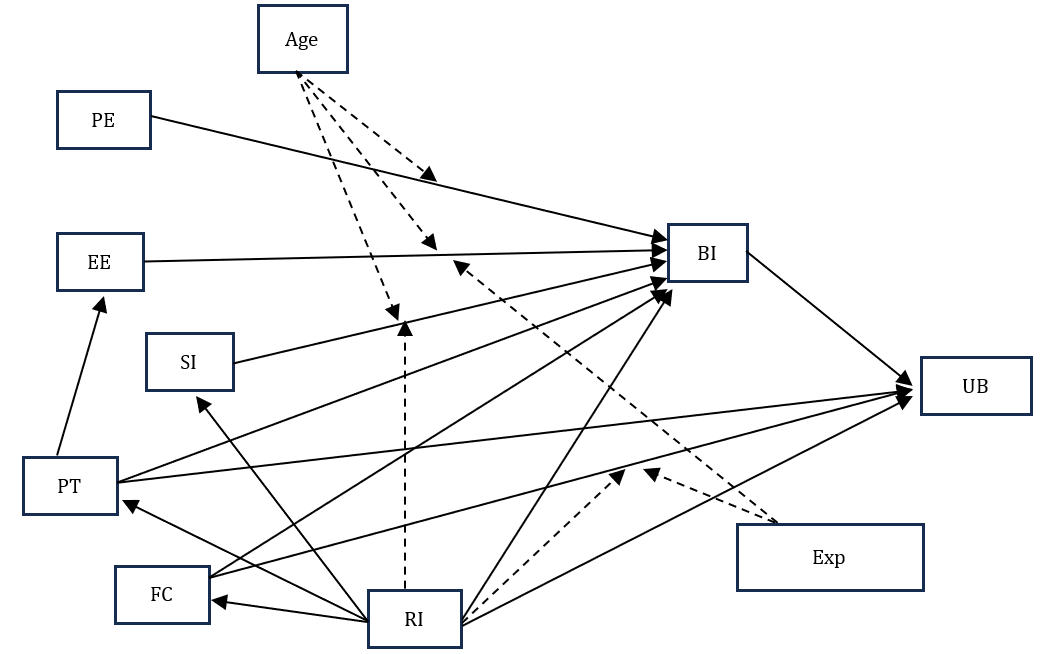
Figure 1. Theoretical framework model
An instrument was developed to measure EMR adoption by adapting and expanding the UTAUT model to incorporate perceived threat and regulatory influence, with the questionnaire grounded in relevant literature on technology adoption and health information systems and tailored specifically to the context of EMR use by healthcare workers. The initial draft was refined through consultations with experts in digital transformation and healthcare management to ensure both conceptual accuracy and contextual relevance.
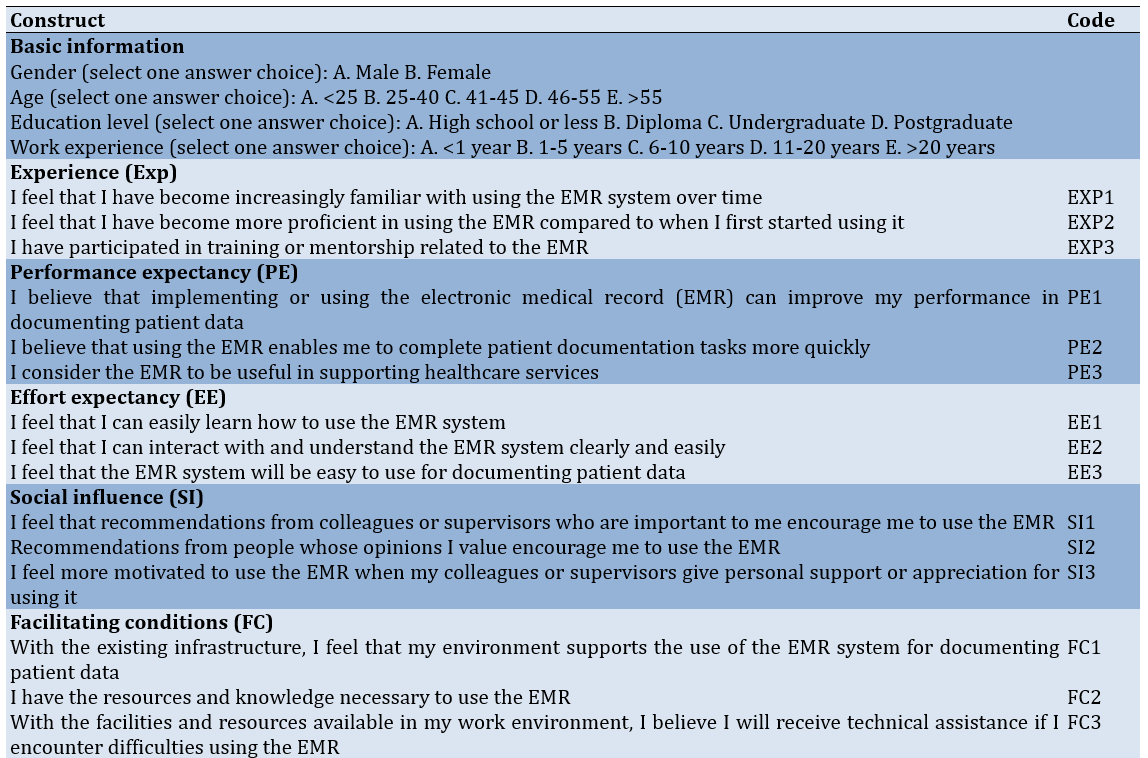
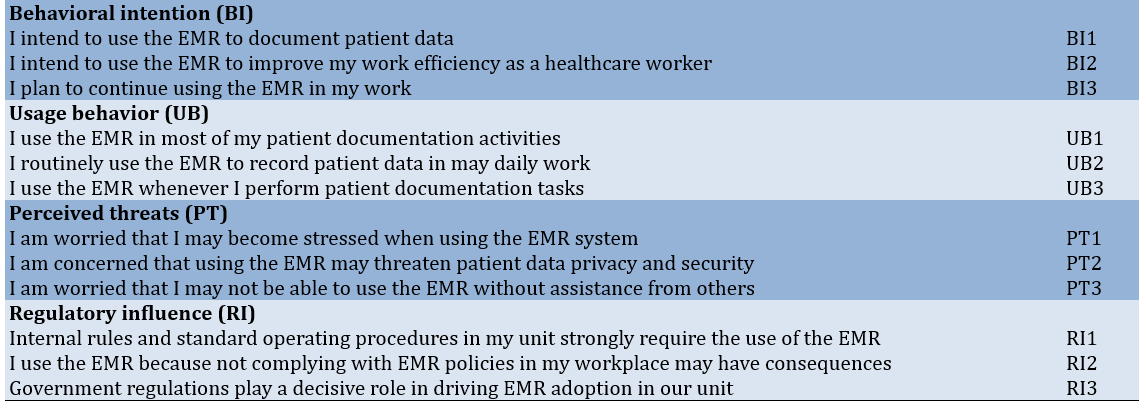
The questionnaire was organized into sections covering basic information, experience (Exp), core UTAUT constructs (performance expectancy (PE), effort expectancy (EE), Social influence (SI), Facilitating conditions (FC), Behavioral intention (BI), Usage behavior (UB), Perceived threats (PT), and Regulatory influence (RI). All items were measured using a five-point Likert scale. It was translated into Indonesian through a back-translation procedure and piloted to ensure clarity of wording. Reliability testing produced Cronbach’s alpha values exceeding the acceptable threshold for all constructs (Table 1).
Table 1. The developed instrument
The questionnaire was distributed to healthcare workers in Bantul Regency, Indonesia, through both an online survey (Google Forms) and offline printed questionnaires. Of the 748 targeted healthcare workers, 688 completed valid questionnaires, resulting in a response rate of 91.98%. All returned questionnaires met the inclusion criteria, and no data were excluded during screening.
We assessed indicator reliability, internal consistency reliability, convergent validity, and discriminant validity. Structural model evaluation involved a bootstrapping procedure to examine the strength and direction of associations among constructs, as well as the model's explanatory power (R²), predictive relevance (Q²), and effect size (f²). The roles of mediation and moderation were also assessed in accordance with the proposed model. To enhance methodological validity, common method bias (CMB) was assessed using the full collinearity variance inflation factor (VIF) and Harman’s single-factor test.
Data analysis was conducted using partial least squares structural equation modeling with SmartPLS 4 software. The PLS-SEM approach was chosen because it is well-suited for analyzing complex relationships involving multiple constructs simultaneously [38, 39]. Q² values above 0.4 indicate medium-to-high predictive relevance, along with relatively low root mean squared error and mean absolute error [40, 41].
Findings
A total of 603 respondents (88%) were female, and 85 (12%) were male. Also, 11 cases (2%) were under 25 years, 371 cases (54%) were aged 25-40 years, 129 cases (19%) were aged 41-45 years, 135 cases (20%) were aged 46-55 years, and 42 cases (6%) were over 55 years. Regarding work experience, most respondents had 11-20 years (31%), followed by more than 20 years (24%), 6-10 years (23%), 1-5 years (19%), and less than 1 year (4%).
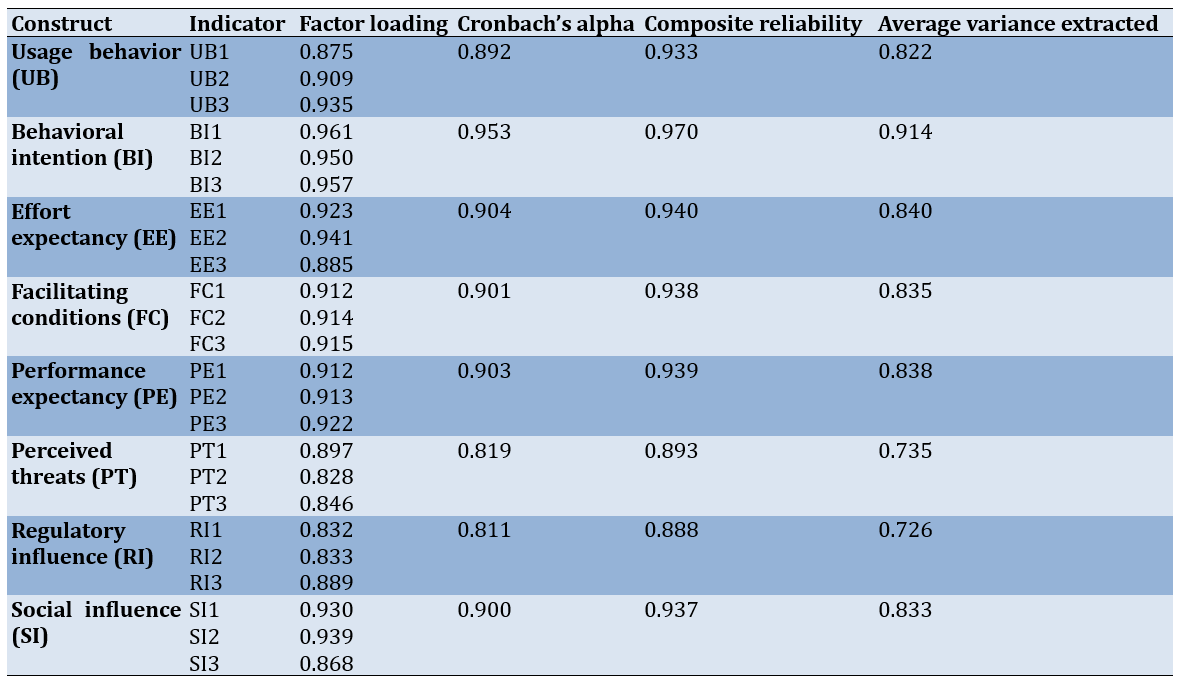
The model showed the reliability of the indicators through outer loadings, with all indicators exceeding the 0.70 threshold (ranging from 0.828 to 0.961). Internal consistency and convergent validity were confirmed, with average variance extracted (AVE) values ranging from 0.726 to 0.914, indicating that each construct adequately explained the variance in its respective indicators (Table 2). Furthermore, discriminant validity was assessed to assess the conceptual distinctiveness of the parameters; all Heterotrait-Monotrait (HTMT) values were below the required threshold (<0.90), confirming that each construct was empirically distinct and did not overlap with others. Consequently, the correlation matrix and the ratio of shared variance demonstrate that the measures for each parameter specifically capture their intended concepts, establishing the validity and independence of the framework’s components (Table 2).
Table 2. Summary of the measurement model results
Structural analysis explored the relationships between the constructs using a bootstrapping procedure. Behavioral intention played a positive role in shaping usage behavior. Among the primary factors, effort expectancy, facilitating conditions, and performance expectancy emerged as contributors to behavioral intention, while social influence showed a minimal role.
Regulatory influence emerged as a central determinant within the framework and showed a strong association with facilitating conditions, perceived threat, and social influence, and it also directly related to behavioral intention. Perceived threat demonstrated a positive connection with effort expectancy and usage behavior (Table 3).
Table 3. Summary of structural relationships
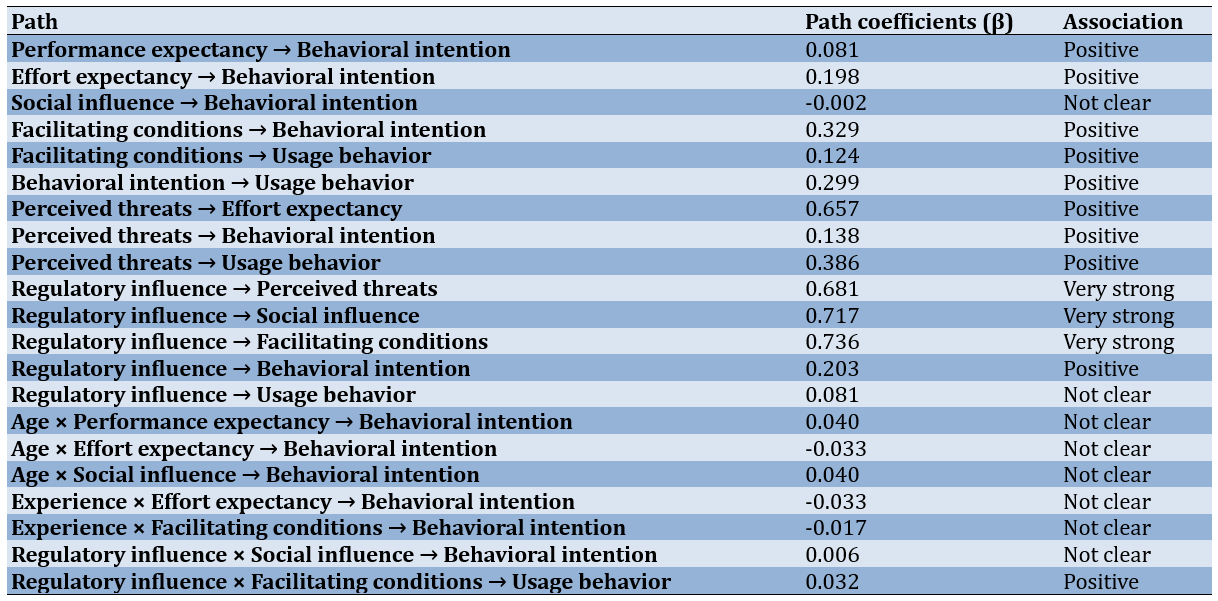
Demographic parameters, such as age and work experience, did not substantially alter the primary relationships within the model. However, a notable interaction was observed between regulatory influence and facilitating conditions regarding usage behavior (β=0.032).
The model demonstrated substantial explanatory power, with R² values of 0.698 for behavioral intention and 0.66 for use behavior. Regulatory pressure significantly shaped the mediating of the digital constructs, confirming its dominant role in the transformation process within this context. Predictive relevance analysis (Q²) further supported the model’s robustness, showing that regulatory influence had a large effect size on facilitating conditions and perceived threat. Effect size (f²) analysis revealed that regulatory influence had large-to-very-large effects on facilitating conditions, social influence, and perceived threat. In contrast, traditional UTAUT constructs and moderator parameters contributed only modestly to the primary endogenous parameters (Table 4).
Table 4. Predictive power and effect size results

To ensure data integrity, potential biases were monitored using multiple diagnostic approaches, including collinearity assessment and factor analysis, and the data were free of substantial bias, supporting the reliability and consistency of the findings.
Discussion
This study analyzed EMR adoption in Indonesia using the UTAUT framework, which integrates regulatory pressure and perceived threat as key factors. EMR adoption in primary healthcare services in Indonesia cannot be explained solely by individual cognitive determinants but must be understood in the context of coercive health policies and systemic inequalities in developing countries. Thus, digital health transformation in such settings is driven more by structural and institutional factors than by the individual preferences of healthcare workers [33, 34].
The primary elements of the UTAUT framework—performance expectancy, effort expectancy, and facilitating conditions—showed a positive role in shaping behavioral intention. These findings align with existing literature, which demonstrates that perceptions of benefits and ease of use remain crucial in shaping technology adoption intentions, even under mandatory conditions [16, 42, 43]. However, the pronounced role of facilitating conditions highlights that infrastructure readiness and organizational support are essential prerequisites in resource-constrained primary healthcare settings burdened by high administrative demands [44, 45].
The limited role of social influence on behavioral intention suggests that interpersonal pressure becomes less relevant when system use is mandated by policy. In top-down managed healthcare systems, compliance with regulations and institutional standards often replaces informal social norms [46, 47]. This indicates that social influence is highly contextual and diminishes in professional, mandated environments [48, 49].
The positive role of perceived threat was observed, which contributed to effort expectancy, behavioral intention, and usage behavior. This contrasts with the dominant technostress literature, which views technological threats as inhibitors of adoption [50, 51]. In Indonesian health services, threat perceptions—arising from regulatory compliance demands, administrative risks, and professional pressures—trigger adaptive responses. Healthcare workers respond by increasing learning efforts and making adjustments to their work to meet institutional demands, thereby accelerating system use [52-54].
The predominance of regulatory pressure over other factors confirms that EMR adoption in Indonesia is primarily driven by institutional forces. Regulations not only mandate usage but also shape compliance norms and perceptions of facility readiness. The direct link between regulatory pressure and behavioral intention suggests that technology acceptance in the public health sector is more policy-driven than based on individual evaluations of usefulness [33].
However, regulatory pressure did not automatically lead to actual use. The gap between policy mandates and actual usage behavior highlights a common challenge in implementing health technologies in developing countries [55-57]. This confirms that mandatory policies, without accompanying infrastructure support, system stability, and capacity building, may result in administrative compliance rather than sustainable use. Policy effectiveness is maximized when regulatory pressure works in tandem with facility readiness, as demonstrated by its moderating role in promoting actual EMR use [58, 59].
Theoretically, this study extends the analytical framework by demonstrating that, in developing countries subject to coercive health policies, external factors—particularly regulatory pressure and technostress—can overshadow individual cognitive constructs. Integrating technology acceptance models with institutional theory provides a more comprehensive understanding of how health policies influence technology acceptance and use [60, 61]. Furthermore, the positive role of perceived threat supports the concept of techno-eustress, where stress triggers adaptive responses and improves performance [51, 62].
From a public health policy perspective, successful EMR implementation cannot rely solely on regulation. Digital transformation in primary health care requires sustained investments in infrastructure, technical support, and organizational readiness. Policies must also address the psychological impacts of regulations on health workers through training, technical assistance, and supervision to manage technostress constructively [3, 63]. In this way, EMR adoption moves beyond administrative compliance to strengthen the health system and improve the quality of public health services.
Our findings have significant implications for strengthening the public health system and advancing health development, particularly in primary healthcare within developing countries. Based on the observed relationships between institutional pressure and practitioner behavior, three recommendations are proposed. First, in the context of primary and community health care, EMR implementation should be viewed as a tool for enhancing services rather than simply an administrative requirement. Governments and primary healthcare managers must ensure that EMRs support service continuity, patient monitoring, and the integration of community health data. Essential prerequisites include basic infrastructure, system stability, and technical support to enable the effective functioning of EMRs in community health services. Second, in health policy and management, institutional and regulatory factors are the primary drivers of EMR adoption. Therefore, health digitalization policies should be supported by managerial mechanisms to ensure facility readiness and system sustainability. EMR regulations should be integrated with resource planning, budget allocation, and health facility performance evaluation systems to maximize their impact on the quality of public services. Third, from the perspective of environmental and occupational health, EMR implementation policies should consider digital workload, the psychosocial impact of rapid adoption, and the psychosocial well-being of health workers. Promoting a supportive work environment that encourages healthy technology use is essential for the sustainability of digital transformation in the public health sector.
Conclusion
The interplay among institutional pressure, organizational readiness, and the psychological adaptation of healthcare workers forms the foundation of EMR adoption and use.
Acknowledgments: The authors extend their appreciation to the research assistants—Rafi Muhammad Akhdhar, Berlinda Putri Nurrochayati, Hanum Latifah Niswandhini, and Naila Farchatun Nisa—for their valuable support in distributing the questionnaires and facilitating data collection. Their contributions were essential to the successful completion of this study.
Ethical Permissions: This study received ethical approval from the Research and Community Service Institute of Sunan Kalijaga State Islamic University, Yogyakarta (4013/Un.02/L3/08/2025).
Conflicts of Interest: No potential conflicts of interest were reported by the authors.
Authors' Contribution: Ghozali M (First Author), Introduction Writer/Main Researcher/Discussion Writer (60%); Dewi CK (Second Author), Assistant Researcher/Methodologist/Statistical Analyst (40%)
Funding/Support: The Research and Community Service Institute, Sunan Kalijaga State Islamic University, Yogyakarta, funded this research (3055/Un.02/L3/TL/07/2025).
Digital transformation has become a strategic priority in health system reform across many developing countries, including Indonesia. In this context, Indonesia’s Ministry of Health (Kementerian Kesehatan Republik Indonesia—Kemenkes) is actively promoting the adoption of Electronic Medical Records (EMRs) as part of the national agenda to strengthen the health system. This initiative is outlined in the 2020-2024 National Medium-Term Development Plan (RPJMN) and will continue through the 2025-2029 RPJMN. The agenda is supported by various regulatory frameworks, including Law (Undang-Undang—UU) Number 17 of 2023 concerning Health, the Health Digital Transformation Strategy policy, and Minister of Health Regulation (Peraturan Menteri Kesehatan—Permenkes) No. 24 of 2022, Article 45, which mandates that all health facilities implement EMRs within a specified timeframe. Collectively, these policies aim to establish an integrated digital health ecosystem through the SATUSEHAT platform.
At the macro level, Indonesia has made significant progress in digitizing the health sector. The WHO Global Health Monitor ranks Indonesia at digital maturity level 4 [1], indicating that digital technology use is mature and functional. However, achievements in national-level policy are not fully reflected in implementation at the health facility level. Data from the Center for Indonesia’s Strategic Development Initiatives (CISDI) reveal that 48.9% (4,807) of community health centers (Pusat Kesehatan Masyarakat—Puskesmas) have yet to adopt electronic medical records (EMRs), with low technological literacy among healthcare workers identified as the primary obstacle [2].
These findings align with numerous studies confirming that barriers to health technology adoption in developing countries arise not only from limited exposure to technology but also from psychological and structural factors, such as low self-efficacy [3], intrinsic motivation [4, 5], and low trust in technology [6]. Furthermore, digitizing health systems—particularly those requiring interoperability—demands maturity in resources, infrastructure, and governance, which developing countries often lack [7–9]. Under these conditions, governments tend to rely on mandatory policies to accelerate the adoption of health technologies.
This coercive regulatory approach generates institutional pressure that may shape healthcare workers’ technology use. Several studies demonstrate that public policy can affect behavioral intentions both directly and indirectly through attitudes, perceived control, and risk perceptions [10–12]. However, policy factors are generally not yet systematically incorporated into mainstream health technology adoption frameworks. In the context of developing countries, regulation functions not merely as a supportive tool but as a coercive mechanism that demands compliance and may induce psychological stress due to the threat of sanctions.
In institutional literature, coercive pressure from regulators is recognized as a major driver of organizational change, particularly during the formal technology adoption phase [13]. In the health sector, responses to this pressure manifest through coercive, normative, and mimetic mechanisms [14]. Recent studies indicate that coercive pressure not only promotes compliance but also heightens sanction-based strain, which is likely to influence how individuals interpret and utilize technology [15].
In line with this, research on health technology adoption heavily relies on the Unified Theory of Acceptance and Use of Technology (UTAUT) as its primary analytical framework [16]. Various adaptations of UTAUT have incorporated contextual factors, including policy and risk perception [17–19]. However, most studies treat policy as a form of facility support that enhances trust and reduces risk [20–22], rather than as coercive pressure that mandates technology adoption.
In addition to regulatory factors, perceived threat is increasingly recognized as a crucial determinant in technology adoption, especially in environments characterized by low digital literacy and limited infrastructure [23, 24]. Perceived threats—whether technological risks or psychological pressures such as technostress—can shape perceptions of ease of use, behavioral intention, and actual use of digital systems [25, 26]. In the context of mandatory EMR implementation, there is significant interest in exploring how regulatory pressure and perceived threat interact to shape healthcare workers' behavior.
Studies on EMR adoption in Indonesia have highlighted the benefits of EMR for data security and service monitoring [27] and identified various obstacles, including regional disparities [28], infrastructure limitations [29, 30], and low literacy levels [31]. However, empirical evidence remains limited regarding the simultaneous influence of coercive regulatory pressure and perceived threat on the cognitive determinants of EMR adoption.
By positioning EMR as a tool for health policy and service system development, this study aimed to provide empirical contributions to strengthening the governance of digital health transformation in developing countries, while offering policy implications to enhance the effectiveness of EMR implementation at the primary care level. This study analyzed EMR adoption in Indonesia using the UTAUT framework, which integrates regulatory pressure and perceived threat as key factors.
Instrument and Methods
This analytical multisite cross-sectional study integrated the UTAUT with two regulatory pressures and perceived threat to examine EMR adoption within the context of health policy in developing countries [16, 32].
UTAUT identifies the core cognitive determinants of EMR adoption, including performance expectancy, effort expectancy, social influence, and facilitating conditions, all of which are explored in relation to behavioral intention and actual use [16]. To capture the context of mandatory EMR implementation, the model is expanded to include regulatory pressure, which represents the coercive influence of government policies and regulations on institutional compliance [33-35].
Additionally, perceived threat is considered a psychological response to the risks, uncertainties, and adaptation burdens associated with mandatory implementation, especially in environments with low digital literacy [36, 37]. This framework guided the analysis of the structural relationships among these factors, which were evaluated using partial least squares structural equation modeling (PLS-SEM; Figure 1).
Figure 1. Theoretical framework model
An instrument was developed to measure EMR adoption by adapting and expanding the UTAUT model to incorporate perceived threat and regulatory influence, with the questionnaire grounded in relevant literature on technology adoption and health information systems and tailored specifically to the context of EMR use by healthcare workers. The initial draft was refined through consultations with experts in digital transformation and healthcare management to ensure both conceptual accuracy and contextual relevance.
The questionnaire was organized into sections covering basic information, experience (Exp), core UTAUT constructs (performance expectancy (PE), effort expectancy (EE), Social influence (SI), Facilitating conditions (FC), Behavioral intention (BI), Usage behavior (UB), Perceived threats (PT), and Regulatory influence (RI). All items were measured using a five-point Likert scale. It was translated into Indonesian through a back-translation procedure and piloted to ensure clarity of wording. Reliability testing produced Cronbach’s alpha values exceeding the acceptable threshold for all constructs (Table 1).
Table 1. The developed instrument
The questionnaire was distributed to healthcare workers in Bantul Regency, Indonesia, through both an online survey (Google Forms) and offline printed questionnaires. Of the 748 targeted healthcare workers, 688 completed valid questionnaires, resulting in a response rate of 91.98%. All returned questionnaires met the inclusion criteria, and no data were excluded during screening.
We assessed indicator reliability, internal consistency reliability, convergent validity, and discriminant validity. Structural model evaluation involved a bootstrapping procedure to examine the strength and direction of associations among constructs, as well as the model's explanatory power (R²), predictive relevance (Q²), and effect size (f²). The roles of mediation and moderation were also assessed in accordance with the proposed model. To enhance methodological validity, common method bias (CMB) was assessed using the full collinearity variance inflation factor (VIF) and Harman’s single-factor test.
Data analysis was conducted using partial least squares structural equation modeling with SmartPLS 4 software. The PLS-SEM approach was chosen because it is well-suited for analyzing complex relationships involving multiple constructs simultaneously [38, 39]. Q² values above 0.4 indicate medium-to-high predictive relevance, along with relatively low root mean squared error and mean absolute error [40, 41].
Findings
A total of 603 respondents (88%) were female, and 85 (12%) were male. Also, 11 cases (2%) were under 25 years, 371 cases (54%) were aged 25-40 years, 129 cases (19%) were aged 41-45 years, 135 cases (20%) were aged 46-55 years, and 42 cases (6%) were over 55 years. Regarding work experience, most respondents had 11-20 years (31%), followed by more than 20 years (24%), 6-10 years (23%), 1-5 years (19%), and less than 1 year (4%).
The model showed the reliability of the indicators through outer loadings, with all indicators exceeding the 0.70 threshold (ranging from 0.828 to 0.961). Internal consistency and convergent validity were confirmed, with average variance extracted (AVE) values ranging from 0.726 to 0.914, indicating that each construct adequately explained the variance in its respective indicators (Table 2). Furthermore, discriminant validity was assessed to assess the conceptual distinctiveness of the parameters; all Heterotrait-Monotrait (HTMT) values were below the required threshold (<0.90), confirming that each construct was empirically distinct and did not overlap with others. Consequently, the correlation matrix and the ratio of shared variance demonstrate that the measures for each parameter specifically capture their intended concepts, establishing the validity and independence of the framework’s components (Table 2).
Table 2. Summary of the measurement model results
Structural analysis explored the relationships between the constructs using a bootstrapping procedure. Behavioral intention played a positive role in shaping usage behavior. Among the primary factors, effort expectancy, facilitating conditions, and performance expectancy emerged as contributors to behavioral intention, while social influence showed a minimal role.
Regulatory influence emerged as a central determinant within the framework and showed a strong association with facilitating conditions, perceived threat, and social influence, and it also directly related to behavioral intention. Perceived threat demonstrated a positive connection with effort expectancy and usage behavior (Table 3).
Table 3. Summary of structural relationships
Demographic parameters, such as age and work experience, did not substantially alter the primary relationships within the model. However, a notable interaction was observed between regulatory influence and facilitating conditions regarding usage behavior (β=0.032).
The model demonstrated substantial explanatory power, with R² values of 0.698 for behavioral intention and 0.66 for use behavior. Regulatory pressure significantly shaped the mediating of the digital constructs, confirming its dominant role in the transformation process within this context. Predictive relevance analysis (Q²) further supported the model’s robustness, showing that regulatory influence had a large effect size on facilitating conditions and perceived threat. Effect size (f²) analysis revealed that regulatory influence had large-to-very-large effects on facilitating conditions, social influence, and perceived threat. In contrast, traditional UTAUT constructs and moderator parameters contributed only modestly to the primary endogenous parameters (Table 4).
Table 4. Predictive power and effect size results
To ensure data integrity, potential biases were monitored using multiple diagnostic approaches, including collinearity assessment and factor analysis, and the data were free of substantial bias, supporting the reliability and consistency of the findings.
Discussion
This study analyzed EMR adoption in Indonesia using the UTAUT framework, which integrates regulatory pressure and perceived threat as key factors. EMR adoption in primary healthcare services in Indonesia cannot be explained solely by individual cognitive determinants but must be understood in the context of coercive health policies and systemic inequalities in developing countries. Thus, digital health transformation in such settings is driven more by structural and institutional factors than by the individual preferences of healthcare workers [33, 34].
The primary elements of the UTAUT framework—performance expectancy, effort expectancy, and facilitating conditions—showed a positive role in shaping behavioral intention. These findings align with existing literature, which demonstrates that perceptions of benefits and ease of use remain crucial in shaping technology adoption intentions, even under mandatory conditions [16, 42, 43]. However, the pronounced role of facilitating conditions highlights that infrastructure readiness and organizational support are essential prerequisites in resource-constrained primary healthcare settings burdened by high administrative demands [44, 45].
The limited role of social influence on behavioral intention suggests that interpersonal pressure becomes less relevant when system use is mandated by policy. In top-down managed healthcare systems, compliance with regulations and institutional standards often replaces informal social norms [46, 47]. This indicates that social influence is highly contextual and diminishes in professional, mandated environments [48, 49].
The positive role of perceived threat was observed, which contributed to effort expectancy, behavioral intention, and usage behavior. This contrasts with the dominant technostress literature, which views technological threats as inhibitors of adoption [50, 51]. In Indonesian health services, threat perceptions—arising from regulatory compliance demands, administrative risks, and professional pressures—trigger adaptive responses. Healthcare workers respond by increasing learning efforts and making adjustments to their work to meet institutional demands, thereby accelerating system use [52-54].
The predominance of regulatory pressure over other factors confirms that EMR adoption in Indonesia is primarily driven by institutional forces. Regulations not only mandate usage but also shape compliance norms and perceptions of facility readiness. The direct link between regulatory pressure and behavioral intention suggests that technology acceptance in the public health sector is more policy-driven than based on individual evaluations of usefulness [33].
However, regulatory pressure did not automatically lead to actual use. The gap between policy mandates and actual usage behavior highlights a common challenge in implementing health technologies in developing countries [55-57]. This confirms that mandatory policies, without accompanying infrastructure support, system stability, and capacity building, may result in administrative compliance rather than sustainable use. Policy effectiveness is maximized when regulatory pressure works in tandem with facility readiness, as demonstrated by its moderating role in promoting actual EMR use [58, 59].
Theoretically, this study extends the analytical framework by demonstrating that, in developing countries subject to coercive health policies, external factors—particularly regulatory pressure and technostress—can overshadow individual cognitive constructs. Integrating technology acceptance models with institutional theory provides a more comprehensive understanding of how health policies influence technology acceptance and use [60, 61]. Furthermore, the positive role of perceived threat supports the concept of techno-eustress, where stress triggers adaptive responses and improves performance [51, 62].
From a public health policy perspective, successful EMR implementation cannot rely solely on regulation. Digital transformation in primary health care requires sustained investments in infrastructure, technical support, and organizational readiness. Policies must also address the psychological impacts of regulations on health workers through training, technical assistance, and supervision to manage technostress constructively [3, 63]. In this way, EMR adoption moves beyond administrative compliance to strengthen the health system and improve the quality of public health services.
Our findings have significant implications for strengthening the public health system and advancing health development, particularly in primary healthcare within developing countries. Based on the observed relationships between institutional pressure and practitioner behavior, three recommendations are proposed. First, in the context of primary and community health care, EMR implementation should be viewed as a tool for enhancing services rather than simply an administrative requirement. Governments and primary healthcare managers must ensure that EMRs support service continuity, patient monitoring, and the integration of community health data. Essential prerequisites include basic infrastructure, system stability, and technical support to enable the effective functioning of EMRs in community health services. Second, in health policy and management, institutional and regulatory factors are the primary drivers of EMR adoption. Therefore, health digitalization policies should be supported by managerial mechanisms to ensure facility readiness and system sustainability. EMR regulations should be integrated with resource planning, budget allocation, and health facility performance evaluation systems to maximize their impact on the quality of public services. Third, from the perspective of environmental and occupational health, EMR implementation policies should consider digital workload, the psychosocial impact of rapid adoption, and the psychosocial well-being of health workers. Promoting a supportive work environment that encourages healthy technology use is essential for the sustainability of digital transformation in the public health sector.
Conclusion
The interplay among institutional pressure, organizational readiness, and the psychological adaptation of healthcare workers forms the foundation of EMR adoption and use.
Acknowledgments: The authors extend their appreciation to the research assistants—Rafi Muhammad Akhdhar, Berlinda Putri Nurrochayati, Hanum Latifah Niswandhini, and Naila Farchatun Nisa—for their valuable support in distributing the questionnaires and facilitating data collection. Their contributions were essential to the successful completion of this study.
Ethical Permissions: This study received ethical approval from the Research and Community Service Institute of Sunan Kalijaga State Islamic University, Yogyakarta (4013/Un.02/L3/08/2025).
Conflicts of Interest: No potential conflicts of interest were reported by the authors.
Authors' Contribution: Ghozali M (First Author), Introduction Writer/Main Researcher/Discussion Writer (60%); Dewi CK (Second Author), Assistant Researcher/Methodologist/Statistical Analyst (40%)
Funding/Support: The Research and Community Service Institute, Sunan Kalijaga State Islamic University, Yogyakarta, funded this research (3055/Un.02/L3/TL/07/2025).
References
1. WHO. Global digital health monitor. Geneva: World Health Organization; 2023. [Link]
2. CISDI. Navigating digital-in-health pathways in Indonesia: Steps towards health equity and improving health outcomes. Jakarta: CISDI; 2024. [Link]
3. Arruum D, Setyowati, Handiyani H, Artono Koestoer R. Nurses' job satisfaction regarding the use of health technology: A survey study. JURNAL KEPERAWATAN INDONESIA. 2024;27(1):47-58. [Link] [DOI:10.7454/jki.v27i1.1076]
4. Taryudi T, Mutiar A, Supriatin E, Lindayani L. Digital media literacy level among nurses in urban area of Indonesia. Int Public Health J. 2021;13(2):213-8. [Link]
5. Taryudi T, Lindayani L, Mutiar A, Purnama H. Perceptions of Indonesian nurses toward the application of the internet of things in the future. KnE Life Sci. 2022;7(2):974-81. [Link] [DOI:10.18502/kls.v7i2.10398]
6. Betriana F, Tanioka T, Locsin R, Malini H, Lenggogeni DP. Are Indonesian nurses ready for healthcare robots during the Covid-19 pandemic?. Belitung Nurs J. 2020;6(3):63-6. [Link] [DOI:10.33546/bnj.1114]
7. Chukwu E, Garg L, Foday E, Konomanyi A, Wright R, Smart F. Digital health solutions and state of interoperability: Landscape analysis of Sierra Leone. JMIR Form Res. 2022;6(6):e29930. [Link] [DOI:10.2196/29930]
8. Oemig F, Blobel B. Modeling digital health systems to foster interoperability. Front Med. 2022;9:896670. [Link] [DOI:10.3389/fmed.2022.896670]
9. Borges do Nascimento IJ, Abdulazeem H, Vasanthan LT, Martinez EZ, Zucoloto ML, Østengaard L, et al. Barriers and facilitators to utilizing digital health technologies by healthcare professionals. NPJ Digit Med. 2023;6(1):161. [Link] [DOI:10.1038/s41746-023-00899-4]
10. Yang M, Chen H, Long R, Yang J. How does government regulation shape residents' green consumption behavior? A multi-agent simulation considering environmental values and social interaction. J Environ Manag. 2023;331:117231. [Link] [DOI:10.1016/j.jenvman.2023.117231]
11. Yang M, Chen H, Long R, Yang J. The impact of different regulation policies on promoting green consumption behavior based on social network modeling. Sustain Prod Consum. 2022;32:468-78. [Link] [DOI:10.1016/j.spc.2022.05.007]
12. Guo Y, Li S, Zhou L, Sun Y. Exploring the influence of technology regulatory policy instruments on public acceptance of algorithm recommender systems. Gov Inf Q. 2024;41(3):101940. [Link] [DOI:10.1016/j.giq.2024.101940]
13. Dang D, Pekkola S. Institutional perspectives on the process of enterprise architecture adoption. Inf Syst Front. 2020;22(6):1433-45. [Link] [DOI:10.1007/s10796-019-09944-8]
14. Campion TR, Gadd CS. Peers, regulators, and professions: The influence of organizations in health information technology adoption. AMIA Annu Symp Proc. 2010;2010:86-90. [Link]
15. Yuning M, Taozhen H, Saleem N, Hassan AH. Institutional pressure and low carbon innovation policy: The role of EMS, environmental interpretations and governance heterogeneity. Front Environ Sci. 2024;12. [Link] [DOI:10.3389/fenvs.2024.1385062]
16. Venkatesh V, Morris MG, Davis GB, Davis FD. User acceptance of information technology: Toward a unified view. MIS Q. 2003;27(3):425-78. [Link] [DOI:10.2307/30036540]
17. Al-Saedi K, Al-Emran M, Ramayah T, Abusham E. Developing a general extended UTAUT model for M-payment adoption. Technol Soc. 2020;62:101293. [Link] [DOI:10.1016/j.techsoc.2020.101293]
18. Bhatiasevi V. An extended UTAUT model to explain the adoption of mobile banking. Inf Dev. 2016;32(4):799-814. [Link] [DOI:10.1177/0266666915570764]
19. Teng Z, Cai Y, Gao Y, Zhang X, Li X. Factors affecting learners' adoption of an educational metaverse platform: An empirical study based on an extended UTAUT model. Mob Inf Syst. 2022;2022:1-15. [Link] [DOI:10.1155/2022/5479215]
20. Ananda AD, Mumtaza AR, Harsyarie SD, Jingga F. Cryptocurrency exchange application acceptance with TAM model in Indonesia. Proceedings of the International Conference on Industrial Engineering and Operations Management. Istanbul: IEOM; 2022. [Link]
21. Yadav M, Shanmugam S. Factors influencing behavioral intentions to use digital lending: An extension of TAM model. Jindal J Bus Res. 2024;13(2):213-26. [Link] [DOI:10.1177/22786821231211411]
22. Chen J, Abdul-Hamid AQ, Zailani S. Blockchain adoption for a circular economy in the Chinese automotive industry: Identification of influencing factors using an integrated TOE-TAM model. Sustainability. 2024;16(24):10817. [Link] [DOI:10.3390/su162410817]
23. Abdennebi HB. M-banking adoption from the developing countries perspective: A mediated model. Digit Bus. 2023;3(2):100065. [Link] [DOI:10.1016/j.digbus.2023.100065]
24. Riasat I, Shah M, Gonul MS. Strengthening cybersecurity resilience: An investigation of customers' adoption of emerging security tools in mobile banking apps. Computers. 2025;14(4):129. [Link] [DOI:10.3390/computers14040129]
25. Su CY, Chao CM. Investigating factors influencing nurses' behavioral intention to use mobile learning: Using a modified unified theory of acceptance and use of technology model. Front Psychol. 2022;13:673350. [Link] [DOI:10.3389/fpsyg.2022.673350]
26. Awang Kader MAR, Abd Aziz NN, Mohd Zaki S, Ishak M, Hazudin SF. The effect of technostress on online learning behaviour among undergraduates. Malays J Learn Instr. 2022;19(1):183-211. [Link] [DOI:10.32890/mjli2022.19.1.7]
27. Juliansyah R, Aqid BM, Salsabila AP, Nurfiyanti K. Implementation of EMR system in Indonesian health facilities: Benefits and constraints. J Indones Health Policy Adm. 2025;10(1):31-8. [Link] [DOI:10.7454/ihpa.v10i1.1140]
28. Hossain MK, Sutanto J, Handayani PW, Haryanto AA, Bhowmik J, Frings-Hessami V. An exploratory study of electronic medical record implementation and recordkeeping culture: The case of hospitals in Indonesia. BMC Health Serv Res. 2025;25(1):249. [Link] [DOI:10.1186/s12913-025-12399-0]
29. Tilaar TS, Sewu PLS. Review of electronic medical records in Indonesia and its developments based on legal regulations in Indonesia and its harmonization with electronic health records (manual for developing countries). Daengku J Humanit Soc Sci Innov. 2023;3(3):422-30. [Link] [DOI:10.35877/454RI.daengku1662]
30. Larasati T, Fardiansyah AI, Saketi D, Nusa Dewiarti A. The ethical and legal aspects of health policy on electronic medical records in Indonesia. Cepalo. 2024;8(2):103-12. [Link] [DOI:10.25041/cepalo.v8no2.3634]
31. Nasution NS, Alfiansyah G, Deharja A, Suyoso GEJ. Factors contributing to incomplete of manual and electronic medical record (EMR) entries in hospital. J Public Health Trop Coast Reg. 2025;8(1):26-39. [Link] [DOI:10.14710/jphtcr.v8i1.25860]
32. Tamilmani K, Rana NP, Dwivedi YK. Consumer acceptance and use of information technology: A meta-analytic evaluation of UTAUT2. Inf Syst Front. 2021;23(4):987-1005. [Link] [DOI:10.1007/s10796-020-10007-6]
33. Jin S, Wang J, Zhu P. The impact of regulatory pressure on eco-innovation: The role of eco-motivation and network embeddedness. J Clean Prod. 2024;466:142749. [Link] [DOI:10.1016/j.jclepro.2024.142749]
34. Lu HP, Wang JC. Exploring the effects of sudden institutional coercive pressure on digital transformation in colleges from teachers' perspective. Educ Inf Technol. 2023;28(12):5991-6015. [Link] [DOI:10.1007/s10639-023-11781-x]
35. Lin J, Luo Z, Luo X. Understanding the roles of institutional pressures and organizational innovativeness in contextualized transformation toward e-business: Evidence from agricultural firms. Int J Inf Manag. 2020;51:102025. [Link] [DOI:10.1016/j.ijinfomgt.2019.10.010]
36. Nam T. Understanding the gap between perceived threats to and preparedness for cybersecurity. Technol Soc. 2019;58:101122. [Link] [DOI:10.1016/j.techsoc.2019.03.005]
37. Abousweilem F, Alzghoul A, Khaddam AA, Khaddam LA. Revealing the effects of business intelligence tools on technostress and withdrawal behavior: The context of a developing country. Inf Dev. 2026;42(1):125-37. [Link] [DOI:10.1177/02666669231207592]
38. Hair Jr. JF, Hult GT, Ringle C, Sarstedt M. A primer on partial least squares structural equation modeling (PLS-SEM). Thousand Oaks: SAGE Publications; 2017. [Link]
39. Henseler J, Ringle CM, Sinkovics RR. The use of partial least squares path modeling in international marketing. In: Sinkovics RR, Ghauri PN, editors. New challenges to international marketing: Advances in international marketing. Leeds: Emerald Group Publishing Limited; 2009. p. 277-319. [Link] [DOI:10.1108/S1474-7979(2009)0000020014]
40. Shmueli G, Sarstedt M, Hair JF, Cheah JH, Ting H, Vaithilingam S, et al. Predictive model assessment in PLS-SEM: Guidelines for using PLSpredict. Eur J Mark. 2019;53(11):2322-47. [Link] [DOI:10.1108/EJM-02-2019-0189]
41. Hair Jr. JF, Hult GTM, Ringle C, Sarstedt M, Danks NP, Ray S. Partial least squares structural equation modeling (PLS-SEM) using R: A workbook. Cham: Springer Nature Switzerland; 2021. [Link] [DOI:10.1007/978-3-030-80519-7]
42. Faida EW, Supriyanto S, Haksama S, Suryaningtyas W, Astuti W, Nudji B, et al. The effect of performance expectancy and behavioral intention on the use of electronic medical record (EMR) in tertier hospital in Indonesia. Int J Health Sci. 2022;6(S9):1195-205. [Link] [DOI:10.53730/ijhs.v6nS9.12729]
43. Ahmed MH, Bogale AD, Tilahun B, Kalayou MH, Klein J, Mengiste SA, et al. Intention to use electronic medical record and its predictors among health care providers at referral hospitals, north-West Ethiopia, 2019: Using unified theory of acceptance and use technology 2 (UTAUT2) model. BMC Med Inform Decis Mak. 2020;20(1):207. [Link] [DOI:10.1186/s12911-020-01222-x]
44. Mukhopadhyay S, Basak R, Carpenter D, Reithel BJ. Patient use of online medical records: An application of technology acceptance framework. Inf Comput Secur. 2019;28(1):97-115. [Link] [DOI:10.1108/ICS-07-2019-0076]
45. Zhou LL, Owusu-Marfo J, Asante Antwi H, Antwi MO, Kachie ADT, Ampon-Wireko S. "Assessment of the social influence and facilitating conditions that support nurses' adoption of hospital electronic information management systems (HEIMS) in Ghana using the unified theory of acceptance and use of technology (UTAUT) model". BMC Med Inform Decis Mak. 2019;19(1):230. [Link] [DOI:10.1186/s12911-019-0956-z]
46. Wang J, Li X, Wang P, Liu Q, Deng Z, Wang J. Research trend of the unified theory of acceptance and use of technology theory: A bibliometric analysis. Sustainability. 2021;14(1):10. [Link] [DOI:10.3390/su14010010]
47. Reyes-Mercado P, Barajas-Portas K, Kasuma J, Almonacid-Duran M, Zamacona-Aboumrad GA. Adoption of digital learning environments during the COVID-19 pandemic: Merging technology readiness index and UTAUT model. J Int Educ Bus. 2023;16(1):91-114. [Link] [DOI:10.1108/JIEB-10-2021-0097]
48. Nuari ES, Nurkhin A, Kardoyo K. Determinan analysis of using edmodo using unified theory of acceptance and use of technology (UTAUT). J Pendidik Akunt Indones. 2019;17(1):57-73. [Link] [DOI:10.21831/jpai.v17i1.26337]
49. Cobelli N, Cassia F, Donvito R. Pharmacists' attitudes and intention to adopt telemedicine: Integrating the market-orientation paradigm and the UTAUT. Technol Forecast Soc Chang. 2023;196:122871. [Link] [DOI:10.1016/j.techfore.2023.122871]
50. Ayyagari R, Grover V, Purvis R. Technostress: Technological antecedents and implications. MIS Q. 2011;35(4):831-58. [Link] [DOI:10.2307/41409963]
51. Tarafdar M, Cooper CL, Stich J. The technostress trifecta‐techno eustress, techno distress and design: Theoretical directions and an agenda for research. Inf Syst J. 2019;29(1):6-42. [Link] [DOI:10.1111/isj.12169]
52. Ngafeeson MN, Manga JA. User-resistance behaviours toward electronic health records: Uncovering the determinants of perceived threats. Behav Inf Technol. 2025;44(11):2742-59. [Link] [DOI:10.1080/0144929X.2024.2410312]
53. Cao G, Duan Y, Edwards JS, Dwivedi YK. Understanding managers' attitudes and behavioral intentions towards using artificial intelligence for organizational decision-making. Technovation. 2021;106:102312. [Link] [DOI:10.1016/j.technovation.2021.102312]
54. Kumar PS. Technostress: A comprehensive literature review on dimensions, impacts, and management strategies. Comput Hum Behav Reports. 2024;16:100475. [Link] [DOI:10.1016/j.chbr.2024.100475]
55. Golz C, Peter KA, Müller TJ, Mutschler J, Zwakhalen SMG, Hahn S. Technostress and digital competence among health professionals in Swiss psychiatric hospitals: Cross-sectional study. JMIR Ment Health. 2021;8(11):e31408. [Link] [DOI:10.2196/31408]
56. Salzmann-Erikson M, Olsson A, Rezagholi M, Fjellström D, Osarenkhoe A. Bridging technostress and continuous learning in knowledge-intensive organizations: A socio-technical systems approach for the future of healthy working life. J Infrastruct Policy Dev. 2024;8(13):8938. [Link] [DOI:10.24294/jipd8938]
57. Sheeran P. Intention-behavior relations: A conceptual and empirical review. Eur Rev Soc Psychol. 2002;12(1):1-36. [Link] [DOI:10.1080/14792772143000003]
58. Jianxun C, Arkorful VE, Shuliang Z. Electronic health records adoption: Do institutional pressures and organizational culture matter?. Technol Soc. 2021;65:101531. [Link] [DOI:10.1016/j.techsoc.2021.101531]
59. Liu N, Hu H, Wang Z. The relationship between institutional pressure, green entrepreneurial orientation, and entrepreneurial performance-the moderating effect of network centrality. Sustainability. 2022;14(19):12055. [Link] [DOI:10.3390/su141912055]
60. DiMaggio PJ, Powell WW. The iron cage revisited: Institutional isomorphism and collective rationality in organizational fields. Am Sociol Rev. 1983;48(2):147. [Link] [DOI:10.2307/2095101]
61. Scott WR. Approaching adulthood: The maturing of institutional theory. Theory Soc. 2008;37(5):427-42. [Link] [DOI:10.1007/s11186-008-9067-z]
62. Califf CB, Sarker S, Sarker S. The bright and dark sides of technostress: A mixed-methods study involving healthcare IT. MIS Q. 2020;44(2):809-56. [Link] [DOI:10.25300/MISQ/2020/14818]
63. Guna SD, Nita Y, Premono SJ. Barriers and opportunities of using electronic nursing record in Indonesia: Nurses' perspective. ICIC Express Lett. 2020;11(12):1159-64. [Link]