

TMU
Owner
Tarbiat Modares University (TMU) is the owner of HEHP.

0.8
Cite Score 2025
Volume 14, Issue 1 (2026)
Health Educ Health Promot 2026, 14(1): 53-59 |
Back to browse issues page
Article Type:




History
Received: 2026/01/5 | Accepted: 2026/02/16 | Published: 2026/01/29
Received: 2026/01/5 | Accepted: 2026/02/16 | Published: 2026/01/29
How to cite this article
Karazhian E, Davoudi Hasanabad N, Ebrahimi S, Nazemi S, Mazlom S. Effects of Nature-Based Educational Therapy on Treatment Adherence and Exercise Capacity in Ischemic Heart Disease Patients. Health Educ Health Promot 2026; 14 (1) :53-59
URL: http://hehp.daneshafarand.org/article-4-83091-en.html
URL: http://hehp.daneshafarand.org/article-4-83091-en.html
Download citation:
BibTeX | RIS | EndNote | Medlars | ProCite | Reference Manager | RefWorks
Send citation to:


Rights and permissions
BibTeX | RIS | EndNote | Medlars | ProCite | Reference Manager | RefWorks
Send citation to:


1- Department of Medical-Surgical Nursing, School of Nursing and Midwifery, Mashhad University of MedicalSciences, Mashhad, Iran
Keywords:
| Abstract (HTML) (600 Views)
Full-Text: (35 Views)
Introduction
Cardiovascular diseases (CVDs) remain a leading cause of morbidity and mortality worldwide and represent a major public health challenge [1]. In Iran, these diseases are among the primary causes of death and disability, highlighting the need for effective preventive, therapeutic, and rehabilitative strategies [2]. Ischemic heart disease (IHD), the most common type of CVD, results from reduced myocardial blood supply and is associated with angina pectoris, myocardial infarction, decreased quality of life, and increased healthcare costs [3-5].
Adherence to treatment is a fundamental component of successful management in patients with IHD. Appropriate medication use, lifestyle modification, and patient engagement have been shown to reduce complications, hospital readmissions, and mortality [6]. Nevertheless, adherence to long-term treatment remains suboptimal. Previous studies indicate that a substantial proportion of patients discontinue essential cardiovascular medications over time, including antiplatelet agents, statins, and antihypertensive drugs [7, 8]. Poor adherence is strongly associated with adverse clinical outcomes and increased risk of recurrent cardiac events [9].
Exercise capacity is another critical indicator of functional status and prognosis in patients with IHD. Reduced exercise tolerance is common in these patients and is linked to physical limitations, fatigue, and diminished quality of life [10]. Cardiac rehabilitation programs have demonstrated significant benefits in improving exercise capacity and cardiovascular function; however, maintaining patient participation and long-term adherence to these programs remains a challenge [11, 12].
In recent years, interest has grown in complementary approaches that may enhance the effectiveness of cardiac rehabilitation. Nature-based therapy (ecotherapy) involves structured physical and educational activities conducted in natural environments with the aim of improving physical and psychological health [13]. Evidence suggests that exposure to natural settings can reduce stress, improve mood, and increase motivation for physical activity, potentially leading to better engagement in rehabilitation programs [14]. Additionally, exercising in green environments may confer greater cardiovascular benefits than indoor exercise, including improvements in blood pressure and heart rate [15].
Despite growing evidence supporting the general health benefits of nature-based interventions, research focusing on their impact on treatment adherence and exercise capacity in patients with IHD remains limited. Existing studies have primarily addressed psychological outcomes, while functional and behavioral outcomes have received less attention [13, 16]. Moreover, the role of education delivered through nature-based therapy as a structured nursing intervention has not been adequately explored.
Therefore, the present study aimed to investigate the effect of education through nature-based therapy on treatment adherence and exercise capacity in patients with IHD, with the intention of providing evidence to support the integration of nature-based approaches into cardiac rehabilitation and nursing practice.
Materials and Methods
Design and sample
This randomized controlled clinical trial with a pretest–posttest design was carried out in 2024 in Mashhad, Iran. Participants were recruited from patients referred to a cardiologist’s private clinic. The intervention sessions for the experimental group were held in Koohsangi Park, while the control group received conventional face-to-face education at the School of Nursing and Midwifery of Mashhad University of Medical Sciences.
The sample consisted of patients diagnosed with IHD who met the inclusion criteria. A total of 58 patients were enrolled and randomly assigned to either the intervention group (n=29) or the control group (n=29). Sample size calculation was based on previous studies using VO₂max as the primary outcome related to exercise capacity, with a confidence level of 95% and a statistical power of 80% [17]. Considering a potential dropout rate of 20%, 29 participants were allocated to each group. Sample size estimation based on treatment adherence outcomes yielded a smaller required sample; therefore, the larger calculated sample size was adopted [2].
Participants were recruited using convenience sampling from eligible patients who met the inclusion criteria. Randomization was applied only at the allocation stage. After recruitment, participants were randomly assigned to the intervention or control group using block randomization with a block size of four. Allocation concealment was ensured using sealed opaque envelopes. This approach ensured unbiased assignment to study groups while acknowledging that the sample was not randomly selected from the population.
Inclusion criteria were diagnosis of IHD class I or II, age between 18 and 70 years, literacy, cognitive orientation to time and place, at least two weeks since the acute cardiac event, ability to walk for more than six minutes, and medical clearance from a cardiologist to engage in mild physical activity. Exclusion criteria included the need for urgent invasive procedures, physical or mental disabilities limiting participation, unwillingness to continue the study, and occurrence of acute symptoms such as chest pain during the intervention.
Procedure
Written informed consent was obtained from all participants prior to enrollment. Confidentiality of participant data was strictly maintained, and all participants were informed of their right to withdraw from the study at any time without any consequences.
The intervention group participated in a structured nature-based therapy (ecotherapy) educational program consisting of four weekly sessions held from 8:00 a.m. to 12:00 p.m. in Koohsangi Park. Sessions were conducted in small groups (10–15 participants) and facilitated by a nurse researcher and a physiotherapist. The program included educational and practical components focusing on medication adherence, dietary recommendations, stress management, and physical exercise. Activities consisted of guided walking and discussion, relaxation exercises accompanied by natural sounds, and group stretching and aerobic exercises performed in a natural environment. Participants were encouraged to perform additional home-based exercises between sessions, which were followed up via telephone calls.
The control group received the same educational content through four weekly face-to-face classroom sessions at the School of Nursing and Midwifery, without exposure to a natural environment.
Instrument
Data were collected using a demographic questionnaire, the eight-item Morisky Medication Adherence Scale (MMAS-8), and the Six-Minute Walk Test (6MWT) [18, 19].
The demographic information questionnaire was used to collect patients’ personal and clinical characteristics and was completed through face-to-face interviews conducted by the researcher. The questionnaire included items on age, gender, weight, height, marital status, level of education, smoking status, substance use, and history of hospitalization.
Medication adherence was assessed using the standardized 8-item Morisky Medication Adherence Scale (MMAS-8) [18]. The first seven items are answered in a dichotomous (yes/no) format, with a score of 0 assigned to “yes” and 1 to “no.” The eighth item is rated on a 5-point Likert scale, with scores ranging from 0 (always) to 4 (never/rarely). The total score ranges from 0 to 8. The validity and reliability of the MMAS-8 have been well established in previous studies, with acceptable construct and criterion validity and satisfactory reliability indices, including internal consistency (Cronbach’s alpha=0.83) and test–retest reliability, as reported by Morisky et al. [18]. In the present study, to ensure the appropriateness of the instrument within the research context, the questionnaire was reviewed by 10 relevant faculty members, and its content validity was confirmed in terms of clarity, relevance, and applicability. Internal consistency reliability was evaluated using Cronbach’s alpha, based on data obtained from 10 participants, yielding a coefficient of 0.78, which indicates acceptable reliability.
The Six-Minute Walk Test (6MWT) is a standardized functional exercise test used to assess patients’ functional capacity. It provides valuable information regarding the ability to perform daily activities and evaluates the physiological responses of the cardiovascular and respiratory systems to physical activity. Participants were instructed to walk at their usual pace along a flat, measured corridor for six minutes, and the total distance walked during this period was recorded. Vital signs, including heart rate, respiratory rate, blood pressure, and peripheral oxygen saturation, were measured by the researcher immediately before and after the test. The distance covered in six minutes typically ranges from 400 to 700 meters in adults, with greater distances indicating higher functional capacity [19, 20]. Previous studies, including those conducted by Hamilton & Haennel, have demonstrated that the 6MWT is a valid and reliable method for assessing functional capacity in cardiac patients during the rehabilitation phase [21]. In the current study, content validity of the 6MWT was confirmed by 10 faculty members with relevant expertise who evaluated its applicability to the study objectives. Reliability was assessed using the inter-rater reliability method, whereby the test was independently administered by two observers with a minimum interval of two hours for 10 patients. The intraclass correlation coefficient (ICC) was calculated and found to be 0.92, indicating excellent reliability.
Statistical analysis
Data were analyzed using SPSS 26. The normality of continuous parameters was assessed using the Shapiro–Wilk test. Baseline characteristics between the intervention and control groups were compared using the independent samples t-test for continuous parameters and the chi-square test for categorical parameters. To evaluate the effect of the intervention on primary and secondary outcomes, analysis of covariance (ANCOVA) was performed to compare post-intervention values between the two groups while adjusting for baseline values of the outcome, body mass index (BMI), smoking status, and medication regimen. Adjusted means and standard errors (SE) were reported. The adjusted mean difference between groups and corresponding p-values were calculated. A two-tailed p-value <0.05 was considered significant.
Findings
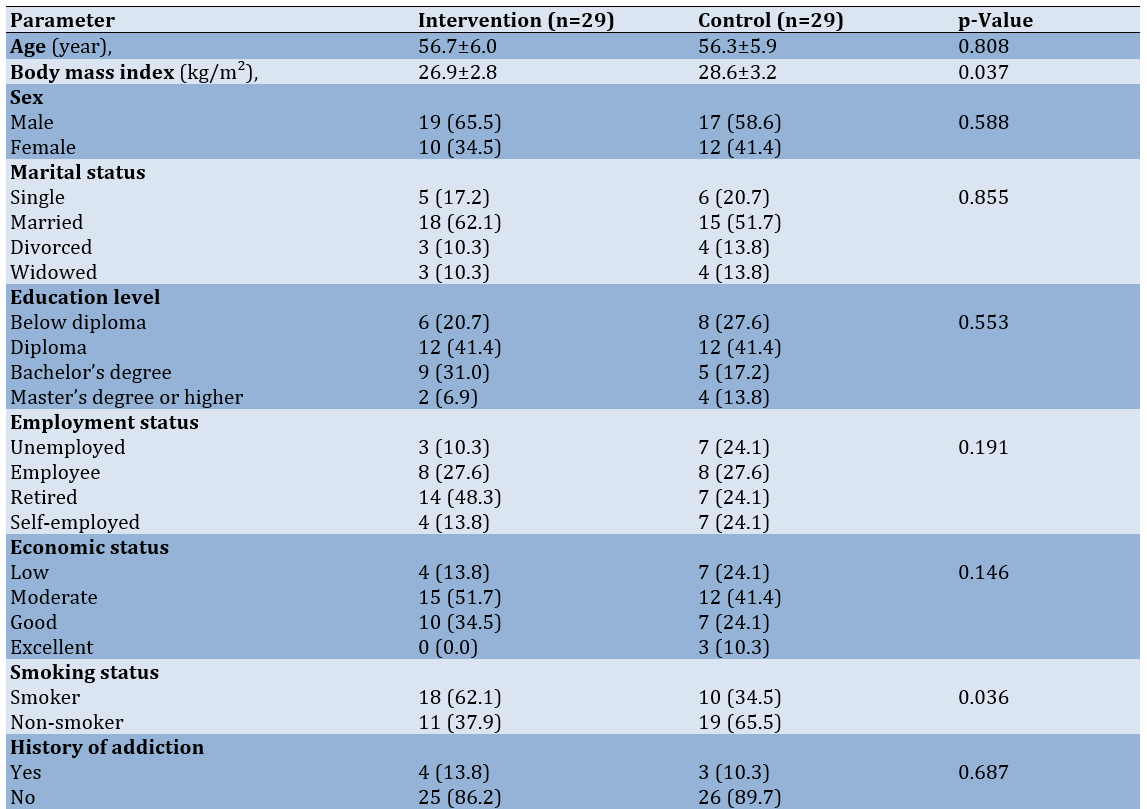
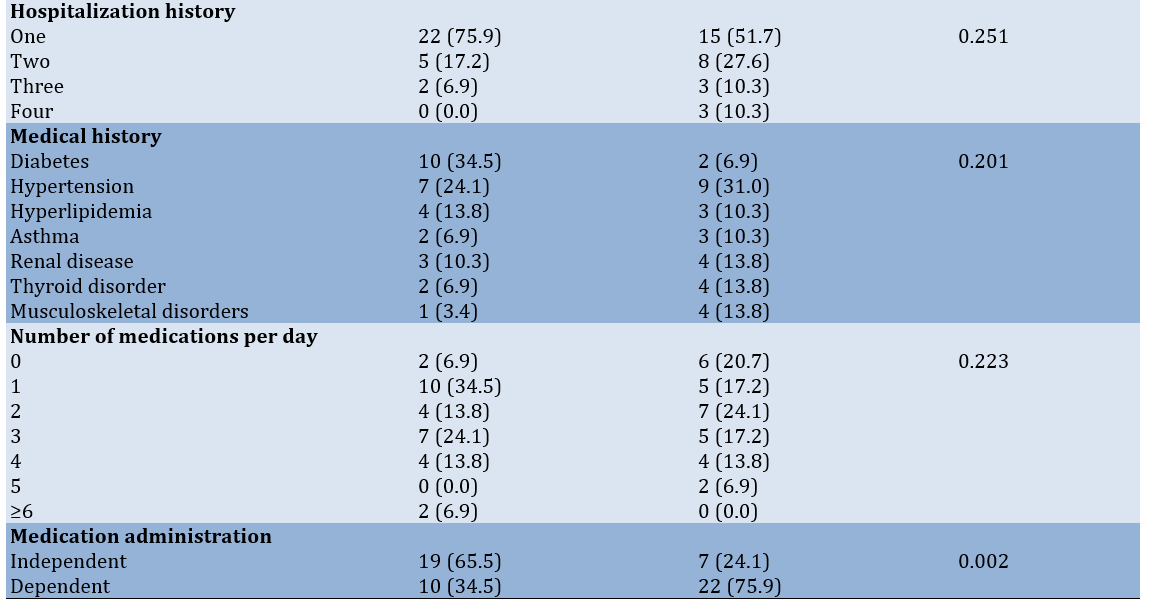
A total of 58 patients with IHD were included in the analysis. The two groups were comparable across most baseline parameters, including age, sex, marital status, educational level, employment status, economic status, comorbidities, hospitalization history, and patterns of medication use (p>0.05). Significant between-group differences were observed in BMI, smoking status, and method of medication administration at baseline (p<0.05; Table 1).
Table 1. Comparison of the frequency of participants’ baseline characteristics
After adjusting for baseline values and the three heterogeneous covariates (BMI, smoking status, and medication administration), the intervention group showed significantly greater improvement in treatment adherence compared with the control group (adjusted post-mean: 3.27±0.31 vs. 4.83±0.31; p=0.002). Similarly, exercise capacity increased significantly in the intervention group (adjusted post-mean: 392.34±6.73) compared with the control group (345.24±6.73m; p<0.001; Table 2).
Table 2. Comparison of mean treatment adherence and exercise capacity scores between the intervention and control groups

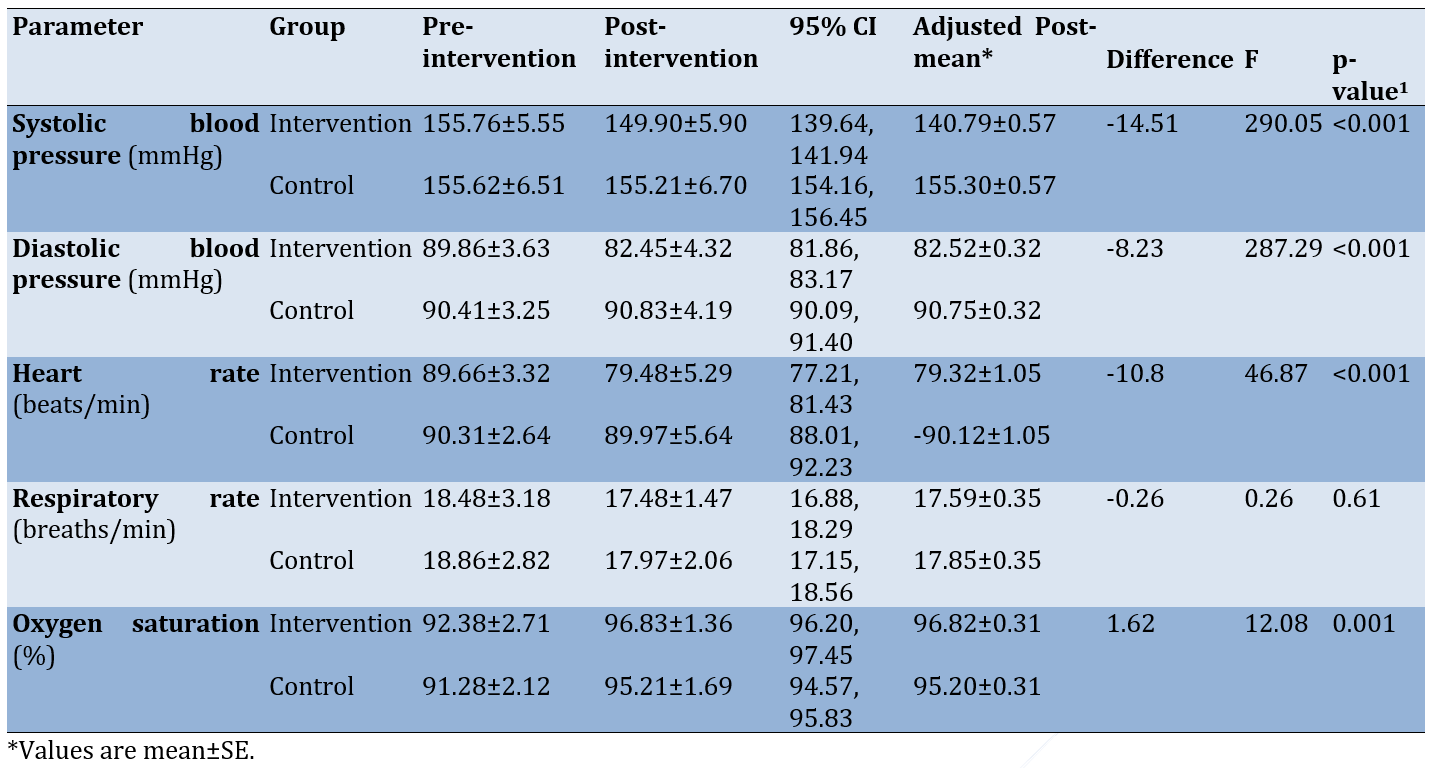
After adjusting for baseline values and heterogeneous covariates (BMI, smoking status, and medication administration), the intervention group showed significant reductions in systolic blood pressure (-14.51mmHg, p<0.001), diastolic blood pressure (-8.23mmHg, p<0.001), and heart rate (-10.8bpm, p<0.001) compared with the control group. There were no significant between-group differences in respiratory rate (p=0.61). Oxygen saturation significantly improved in the intervention group compared with the control group (p=0.001; Table 3).
Table 3. Comparison of mean scores of secondary physiological outcomes between the intervention and control groups
Discussion
The present study examined the effect of education delivered through nature-based therapy on treatment adherence and exercise capacity in patients with IHD. Nature-based therapy resulted in meaningful improvements in both primary outcomes when compared with routine care, supporting the potential role of this approach as a complementary strategy in cardiac rehabilitation.
With regard to treatment adherence, there was a significant improvement in the intervention group after controlling for baseline values, BMI, smoking status, and medication administration. The adjusted post-intervention mean in the intervention group was significantly higher than that in the control group, indicating that the nature-based educational program effectively enhanced treatment adherence independent of baseline differences and relevant covariates.
To the best of our knowledge, no previous studies have directly investigated the effect of nature-based therapy on treatment adherence in patients with IHD. In the absence of direct evidence, the present findings should therefore be interpreted in relation to studies that have examined nature-based interventions targeting related behavioral and psychological factors known to influence adherence. Prior research has shown that exposure to natural environments can reduce stress, enhance motivation, and increase engagement in health-promoting behaviors, all of which are recognized determinants of adherence to long-term treatment regimens [13, 22-25]. Nature-based interventions have been reported to improve participation in physical activity, self-care behaviors, and lifestyle modification, even when medication adherence was not assessed as a primary outcome [13].
In contrast, a substantial body of evidence exists regarding the impact of structured educational and cardiac rehabilitation programs on adherence. Studies have consistently demonstrated that educational, motivational, and supervised rehabilitation interventions improve adherence to medication, dietary recommendations, and physical activity [17, 26–28]. Our intervention shares several core elements with these programs, including structured education, guided activity, and patient engagement. However, it differs in that education and exercise were delivered in a natural environment rather than a clinical setting. This contextual difference may be critical, as the natural environment likely facilitated experiential learning, reduced perceived burden, and increased enjoyment, thereby enhancing patients’ intrinsic motivation and self-efficacy [22, 24]. Nevertheless, given the short follow-up period, the findings primarily support the short-term effectiveness of nature-based therapy on adherence, and future studies are needed to evaluate the durability of these effects over longer periods [29, 30].
In terms of exercise capacity, ANCOVA results revealed a significant improvement in the intervention group after adjusting for baseline exercise capacity and heterogeneous parameters. The adjusted post-intervention six-minute walk distance was significantly higher in the intervention group compared with the control group, indicating that participation in the nature-based therapy program led to a clinically meaningful enhancement of functional capacity independent of baseline differences and other covariates. Previous studies have examined the effects of nature-based and outdoor rehabilitation on physical performance and functional outcomes, although not all have focused specifically on IHD. Several investigations have reported improvements in walking distance, aerobic capacity, and physical functioning following nature-based or green exercise interventions [13, 31–33]. These benefits appear to be comparable to those reported for conventional cardiac rehabilitation, particularly when the interventions are structured and supervised [31, 34]. The intervention in the present study closely resembles traditional cardiac rehabilitation in content, incorporating aerobic exercise, education, and stress management, while differing primarily in the environment in which it was delivered. This similarity suggests that nature-based therapy may function as a form of rehabilitation analogous to conventional programs, at least in the short term.
At the same time, inconsistencies in the literature indicate that the effectiveness of nature-based interventions on exercise capacity may depend on intervention duration, intensity, and structure. Studies reporting neutral findings have often employed brief or unsupervised exposure to natural environments or focused solely on environmental comparison rather than intervention content [35–37]. In contrast, the present study implemented a structured, group-based program with guided activity and education. This comparison suggests that nature-based therapy supports exercise capacity primarily when delivered as a structured and supervised intervention, reinforcing the importance of program design rather than environment alone [13, 31]. As with adherence, further research is required to determine whether improvements in exercise capacity persist beyond the immediate post-intervention period.
In addition to the primary outcomes, favorable changes were observed in several physiological parameters, including blood pressure, heart rate, and oxygen saturation. These findings suggest that improvements in adherence and exercise capacity were accompanied by measurable physiological adaptations. Such changes are consistent with previous research demonstrating that exposure to natural environments modulates autonomic nervous system activity, reduces sympathetic activation, and enhances parasympathetic tone, leading to improved cardiovascular and respiratory function [38-40].
One limitation of this study is the relatively small sample size, which may limit the generalizability of the findings. Future studies with larger sample sizes are recommended to confirm these results.
This intervention may serve as a useful complementary approach in cardiac rehabilitation. However, further studies with larger sample sizes and longer follow-up periods are needed to confirm these findings.
Conclusion
Nature-based therapy-based education improves treatment adherence and exercise capacity in patients with IHD.
Acknowledgments: The authors would like to express their sincere gratitude to all participants who took part in this study, as well as to the staff and authorities of the study setting for their cooperation and support.
Ethical Permissions: The study was approved by the Ethics Committee of Mashhad University of Medical Sciences (IR.MUMS.NURSE.REC.1403.048) and was conducted in accordance with the ethical principles of clinical research. The trial was also registered in the Iranian Registry of Clinical Trials (IRCT20240226061114N1).
Conflicts of Interests: The authors declared no conflicts of interests.
Authors' Contribution: Karazhian E (First Author), Introduction Writer/Main Researcher/Discussion Writer (35%); Davoudi Hasanabad N (Second Author), Methodologist/Assistant Researcher (15%); Ebrahimi SA (Third Author), Assistant Researcher (5%); Nazemi S (Fourth Author), Assistant Researcher (10%); Mazlom SR (Fifth Author), Methodologist/Assistant Researcher/Statistical Analyst (35%)
Funding/Support: Nothing to be reported.
Cardiovascular diseases (CVDs) remain a leading cause of morbidity and mortality worldwide and represent a major public health challenge [1]. In Iran, these diseases are among the primary causes of death and disability, highlighting the need for effective preventive, therapeutic, and rehabilitative strategies [2]. Ischemic heart disease (IHD), the most common type of CVD, results from reduced myocardial blood supply and is associated with angina pectoris, myocardial infarction, decreased quality of life, and increased healthcare costs [3-5].
Adherence to treatment is a fundamental component of successful management in patients with IHD. Appropriate medication use, lifestyle modification, and patient engagement have been shown to reduce complications, hospital readmissions, and mortality [6]. Nevertheless, adherence to long-term treatment remains suboptimal. Previous studies indicate that a substantial proportion of patients discontinue essential cardiovascular medications over time, including antiplatelet agents, statins, and antihypertensive drugs [7, 8]. Poor adherence is strongly associated with adverse clinical outcomes and increased risk of recurrent cardiac events [9].
Exercise capacity is another critical indicator of functional status and prognosis in patients with IHD. Reduced exercise tolerance is common in these patients and is linked to physical limitations, fatigue, and diminished quality of life [10]. Cardiac rehabilitation programs have demonstrated significant benefits in improving exercise capacity and cardiovascular function; however, maintaining patient participation and long-term adherence to these programs remains a challenge [11, 12].
In recent years, interest has grown in complementary approaches that may enhance the effectiveness of cardiac rehabilitation. Nature-based therapy (ecotherapy) involves structured physical and educational activities conducted in natural environments with the aim of improving physical and psychological health [13]. Evidence suggests that exposure to natural settings can reduce stress, improve mood, and increase motivation for physical activity, potentially leading to better engagement in rehabilitation programs [14]. Additionally, exercising in green environments may confer greater cardiovascular benefits than indoor exercise, including improvements in blood pressure and heart rate [15].
Despite growing evidence supporting the general health benefits of nature-based interventions, research focusing on their impact on treatment adherence and exercise capacity in patients with IHD remains limited. Existing studies have primarily addressed psychological outcomes, while functional and behavioral outcomes have received less attention [13, 16]. Moreover, the role of education delivered through nature-based therapy as a structured nursing intervention has not been adequately explored.
Therefore, the present study aimed to investigate the effect of education through nature-based therapy on treatment adherence and exercise capacity in patients with IHD, with the intention of providing evidence to support the integration of nature-based approaches into cardiac rehabilitation and nursing practice.
Materials and Methods
Design and sample
This randomized controlled clinical trial with a pretest–posttest design was carried out in 2024 in Mashhad, Iran. Participants were recruited from patients referred to a cardiologist’s private clinic. The intervention sessions for the experimental group were held in Koohsangi Park, while the control group received conventional face-to-face education at the School of Nursing and Midwifery of Mashhad University of Medical Sciences.
The sample consisted of patients diagnosed with IHD who met the inclusion criteria. A total of 58 patients were enrolled and randomly assigned to either the intervention group (n=29) or the control group (n=29). Sample size calculation was based on previous studies using VO₂max as the primary outcome related to exercise capacity, with a confidence level of 95% and a statistical power of 80% [17]. Considering a potential dropout rate of 20%, 29 participants were allocated to each group. Sample size estimation based on treatment adherence outcomes yielded a smaller required sample; therefore, the larger calculated sample size was adopted [2].
Participants were recruited using convenience sampling from eligible patients who met the inclusion criteria. Randomization was applied only at the allocation stage. After recruitment, participants were randomly assigned to the intervention or control group using block randomization with a block size of four. Allocation concealment was ensured using sealed opaque envelopes. This approach ensured unbiased assignment to study groups while acknowledging that the sample was not randomly selected from the population.
Inclusion criteria were diagnosis of IHD class I or II, age between 18 and 70 years, literacy, cognitive orientation to time and place, at least two weeks since the acute cardiac event, ability to walk for more than six minutes, and medical clearance from a cardiologist to engage in mild physical activity. Exclusion criteria included the need for urgent invasive procedures, physical or mental disabilities limiting participation, unwillingness to continue the study, and occurrence of acute symptoms such as chest pain during the intervention.
Procedure
Written informed consent was obtained from all participants prior to enrollment. Confidentiality of participant data was strictly maintained, and all participants were informed of their right to withdraw from the study at any time without any consequences.
The intervention group participated in a structured nature-based therapy (ecotherapy) educational program consisting of four weekly sessions held from 8:00 a.m. to 12:00 p.m. in Koohsangi Park. Sessions were conducted in small groups (10–15 participants) and facilitated by a nurse researcher and a physiotherapist. The program included educational and practical components focusing on medication adherence, dietary recommendations, stress management, and physical exercise. Activities consisted of guided walking and discussion, relaxation exercises accompanied by natural sounds, and group stretching and aerobic exercises performed in a natural environment. Participants were encouraged to perform additional home-based exercises between sessions, which were followed up via telephone calls.
The control group received the same educational content through four weekly face-to-face classroom sessions at the School of Nursing and Midwifery, without exposure to a natural environment.
Instrument
Data were collected using a demographic questionnaire, the eight-item Morisky Medication Adherence Scale (MMAS-8), and the Six-Minute Walk Test (6MWT) [18, 19].
The demographic information questionnaire was used to collect patients’ personal and clinical characteristics and was completed through face-to-face interviews conducted by the researcher. The questionnaire included items on age, gender, weight, height, marital status, level of education, smoking status, substance use, and history of hospitalization.
Medication adherence was assessed using the standardized 8-item Morisky Medication Adherence Scale (MMAS-8) [18]. The first seven items are answered in a dichotomous (yes/no) format, with a score of 0 assigned to “yes” and 1 to “no.” The eighth item is rated on a 5-point Likert scale, with scores ranging from 0 (always) to 4 (never/rarely). The total score ranges from 0 to 8. The validity and reliability of the MMAS-8 have been well established in previous studies, with acceptable construct and criterion validity and satisfactory reliability indices, including internal consistency (Cronbach’s alpha=0.83) and test–retest reliability, as reported by Morisky et al. [18]. In the present study, to ensure the appropriateness of the instrument within the research context, the questionnaire was reviewed by 10 relevant faculty members, and its content validity was confirmed in terms of clarity, relevance, and applicability. Internal consistency reliability was evaluated using Cronbach’s alpha, based on data obtained from 10 participants, yielding a coefficient of 0.78, which indicates acceptable reliability.
The Six-Minute Walk Test (6MWT) is a standardized functional exercise test used to assess patients’ functional capacity. It provides valuable information regarding the ability to perform daily activities and evaluates the physiological responses of the cardiovascular and respiratory systems to physical activity. Participants were instructed to walk at their usual pace along a flat, measured corridor for six minutes, and the total distance walked during this period was recorded. Vital signs, including heart rate, respiratory rate, blood pressure, and peripheral oxygen saturation, were measured by the researcher immediately before and after the test. The distance covered in six minutes typically ranges from 400 to 700 meters in adults, with greater distances indicating higher functional capacity [19, 20]. Previous studies, including those conducted by Hamilton & Haennel, have demonstrated that the 6MWT is a valid and reliable method for assessing functional capacity in cardiac patients during the rehabilitation phase [21]. In the current study, content validity of the 6MWT was confirmed by 10 faculty members with relevant expertise who evaluated its applicability to the study objectives. Reliability was assessed using the inter-rater reliability method, whereby the test was independently administered by two observers with a minimum interval of two hours for 10 patients. The intraclass correlation coefficient (ICC) was calculated and found to be 0.92, indicating excellent reliability.
Statistical analysis
Data were analyzed using SPSS 26. The normality of continuous parameters was assessed using the Shapiro–Wilk test. Baseline characteristics between the intervention and control groups were compared using the independent samples t-test for continuous parameters and the chi-square test for categorical parameters. To evaluate the effect of the intervention on primary and secondary outcomes, analysis of covariance (ANCOVA) was performed to compare post-intervention values between the two groups while adjusting for baseline values of the outcome, body mass index (BMI), smoking status, and medication regimen. Adjusted means and standard errors (SE) were reported. The adjusted mean difference between groups and corresponding p-values were calculated. A two-tailed p-value <0.05 was considered significant.
Findings
A total of 58 patients with IHD were included in the analysis. The two groups were comparable across most baseline parameters, including age, sex, marital status, educational level, employment status, economic status, comorbidities, hospitalization history, and patterns of medication use (p>0.05). Significant between-group differences were observed in BMI, smoking status, and method of medication administration at baseline (p<0.05; Table 1).
Table 1. Comparison of the frequency of participants’ baseline characteristics
After adjusting for baseline values and the three heterogeneous covariates (BMI, smoking status, and medication administration), the intervention group showed significantly greater improvement in treatment adherence compared with the control group (adjusted post-mean: 3.27±0.31 vs. 4.83±0.31; p=0.002). Similarly, exercise capacity increased significantly in the intervention group (adjusted post-mean: 392.34±6.73) compared with the control group (345.24±6.73m; p<0.001; Table 2).
Table 2. Comparison of mean treatment adherence and exercise capacity scores between the intervention and control groups
After adjusting for baseline values and heterogeneous covariates (BMI, smoking status, and medication administration), the intervention group showed significant reductions in systolic blood pressure (-14.51mmHg, p<0.001), diastolic blood pressure (-8.23mmHg, p<0.001), and heart rate (-10.8bpm, p<0.001) compared with the control group. There were no significant between-group differences in respiratory rate (p=0.61). Oxygen saturation significantly improved in the intervention group compared with the control group (p=0.001; Table 3).
Table 3. Comparison of mean scores of secondary physiological outcomes between the intervention and control groups
Discussion
The present study examined the effect of education delivered through nature-based therapy on treatment adherence and exercise capacity in patients with IHD. Nature-based therapy resulted in meaningful improvements in both primary outcomes when compared with routine care, supporting the potential role of this approach as a complementary strategy in cardiac rehabilitation.
With regard to treatment adherence, there was a significant improvement in the intervention group after controlling for baseline values, BMI, smoking status, and medication administration. The adjusted post-intervention mean in the intervention group was significantly higher than that in the control group, indicating that the nature-based educational program effectively enhanced treatment adherence independent of baseline differences and relevant covariates.
To the best of our knowledge, no previous studies have directly investigated the effect of nature-based therapy on treatment adherence in patients with IHD. In the absence of direct evidence, the present findings should therefore be interpreted in relation to studies that have examined nature-based interventions targeting related behavioral and psychological factors known to influence adherence. Prior research has shown that exposure to natural environments can reduce stress, enhance motivation, and increase engagement in health-promoting behaviors, all of which are recognized determinants of adherence to long-term treatment regimens [13, 22-25]. Nature-based interventions have been reported to improve participation in physical activity, self-care behaviors, and lifestyle modification, even when medication adherence was not assessed as a primary outcome [13].
In contrast, a substantial body of evidence exists regarding the impact of structured educational and cardiac rehabilitation programs on adherence. Studies have consistently demonstrated that educational, motivational, and supervised rehabilitation interventions improve adherence to medication, dietary recommendations, and physical activity [17, 26–28]. Our intervention shares several core elements with these programs, including structured education, guided activity, and patient engagement. However, it differs in that education and exercise were delivered in a natural environment rather than a clinical setting. This contextual difference may be critical, as the natural environment likely facilitated experiential learning, reduced perceived burden, and increased enjoyment, thereby enhancing patients’ intrinsic motivation and self-efficacy [22, 24]. Nevertheless, given the short follow-up period, the findings primarily support the short-term effectiveness of nature-based therapy on adherence, and future studies are needed to evaluate the durability of these effects over longer periods [29, 30].
In terms of exercise capacity, ANCOVA results revealed a significant improvement in the intervention group after adjusting for baseline exercise capacity and heterogeneous parameters. The adjusted post-intervention six-minute walk distance was significantly higher in the intervention group compared with the control group, indicating that participation in the nature-based therapy program led to a clinically meaningful enhancement of functional capacity independent of baseline differences and other covariates. Previous studies have examined the effects of nature-based and outdoor rehabilitation on physical performance and functional outcomes, although not all have focused specifically on IHD. Several investigations have reported improvements in walking distance, aerobic capacity, and physical functioning following nature-based or green exercise interventions [13, 31–33]. These benefits appear to be comparable to those reported for conventional cardiac rehabilitation, particularly when the interventions are structured and supervised [31, 34]. The intervention in the present study closely resembles traditional cardiac rehabilitation in content, incorporating aerobic exercise, education, and stress management, while differing primarily in the environment in which it was delivered. This similarity suggests that nature-based therapy may function as a form of rehabilitation analogous to conventional programs, at least in the short term.
At the same time, inconsistencies in the literature indicate that the effectiveness of nature-based interventions on exercise capacity may depend on intervention duration, intensity, and structure. Studies reporting neutral findings have often employed brief or unsupervised exposure to natural environments or focused solely on environmental comparison rather than intervention content [35–37]. In contrast, the present study implemented a structured, group-based program with guided activity and education. This comparison suggests that nature-based therapy supports exercise capacity primarily when delivered as a structured and supervised intervention, reinforcing the importance of program design rather than environment alone [13, 31]. As with adherence, further research is required to determine whether improvements in exercise capacity persist beyond the immediate post-intervention period.
In addition to the primary outcomes, favorable changes were observed in several physiological parameters, including blood pressure, heart rate, and oxygen saturation. These findings suggest that improvements in adherence and exercise capacity were accompanied by measurable physiological adaptations. Such changes are consistent with previous research demonstrating that exposure to natural environments modulates autonomic nervous system activity, reduces sympathetic activation, and enhances parasympathetic tone, leading to improved cardiovascular and respiratory function [38-40].
One limitation of this study is the relatively small sample size, which may limit the generalizability of the findings. Future studies with larger sample sizes are recommended to confirm these results.
This intervention may serve as a useful complementary approach in cardiac rehabilitation. However, further studies with larger sample sizes and longer follow-up periods are needed to confirm these findings.
Conclusion
Nature-based therapy-based education improves treatment adherence and exercise capacity in patients with IHD.
Acknowledgments: The authors would like to express their sincere gratitude to all participants who took part in this study, as well as to the staff and authorities of the study setting for their cooperation and support.
Ethical Permissions: The study was approved by the Ethics Committee of Mashhad University of Medical Sciences (IR.MUMS.NURSE.REC.1403.048) and was conducted in accordance with the ethical principles of clinical research. The trial was also registered in the Iranian Registry of Clinical Trials (IRCT20240226061114N1).
Conflicts of Interests: The authors declared no conflicts of interests.
Authors' Contribution: Karazhian E (First Author), Introduction Writer/Main Researcher/Discussion Writer (35%); Davoudi Hasanabad N (Second Author), Methodologist/Assistant Researcher (15%); Ebrahimi SA (Third Author), Assistant Researcher (5%); Nazemi S (Fourth Author), Assistant Researcher (10%); Mazlom SR (Fifth Author), Methodologist/Assistant Researcher/Statistical Analyst (35%)
Funding/Support: Nothing to be reported.
References
1. Nedkoff L, Briffa T, Zemedikun D, Herrington S, Wright FL. Global trends in atherosclerotic cardiovascular disease. Clin Ther. 2023;45(11):1087-91. [Link] [DOI:10.1016/j.clinthera.2023.09.020]
2. Sarrafzadegan N, Mohammmadifard N. Cardiovascular disease in Iran in the last 40 years: Prevalence, mortality, morbidity, challenges and strategies for cardiovascular prevention. Arch Iran Med. 2019;22(4):204-10. [Link]
3. Jensen RV, Hjortbak MV, Bøtker HE. Ischemic heart disease: An update. Semin Nucl Med. 2020;50(3):195-207. [Link] [DOI:10.1053/j.semnuclmed.2020.02.007]
4. Shi H, Xia Y, Cheng Y, Liang P, Cheng M, Zhang B, et al. Global burden of ischaemic heart disease from 2022 to 2050: projections of incidence, prevalence, deaths, and disability-adjusted life years. Eur Heart J Qual Care Clin Outcomes. 2025;11(4):355-66. [Link] [DOI:10.1093/ehjqcco/qcae049]
5. Ambrose-Oji B. Mindfulness practice in woods and forests: An evidence review. Warrington: The Mersey Forest; 2013. [Link]
6. Religioni U, Barrios-Rodríguez R, Requena P, Borowska M, Ostrowski J. Enhancing therapy adherence: Impact on clinical outcomes, healthcare costs, and patient quality of life. Medicina. 2025;61(1):153. [Link] [DOI:10.3390/medicina61010153]
7. Özlek B, Başaran Ö. Statin discontinuation: Global challenge in secondary prevention. Am J Cardiol. 2024;212:40. [Link] [DOI:10.1016/j.amjcard.2023.11.051]
8. Leslie KH, McCowan C, Pell JP. Adherence to cardiovascular medication: A review of systematic reviews. J Public Health. 2018;41(1):e84-94. [Link] [DOI:10.1093/pubmed/fdy088]
9. Malachias MVB, Kaiser SE, Albuquerque DCd, Brandão AA, Sposito AC, Moura LZ, et al. Risk of adverse health outcomes in patients with poor adherence to cardiovascular medication treatment: A systematic review. Arq Bras Cardiol. 2024;121(10):e20240469. [Link] [DOI:10.36660/abc.20240469]
10. Gomes-Neto M, Durães AR, Conceição LSR, Silva CM, Martinez BP, Carvalho VO. High-intensity interval training versus moderate-intensity continuous training on exercise capacity and health-related quality of life in patients with coronary artery disease: An updated systematic review and meta-analysis. Braz J Phys Ther. 2025;29(1):101137. [Link] [DOI:10.1016/j.bjpt.2024.101137]
11. Pagnoni G, Vicenzi A, Darroudi S, Maini A, Sbarra F, Marangi F, et al. Adherence to exercise and functional rehabilitation programs in patients with cardiovascular diseases: Barriers and strategies. J Cardiovasc Dev Dis. 2026;13(1):8. [Link] [DOI:10.3390/jcdd13010008]
12. Ruano-Ravina A, Pena-Gil C, Abu-Assi E, Raposeiras S, Van't Hof A, Meindersma E, et al. Participation and adherence to cardiac rehabilitation programs. A systematic review. Int J Cardiol. 2016;223:436-43. [Link] [DOI:10.1016/j.ijcard.2016.08.120]
13. Struthers NA, Guluzade NA, Zecevic AA, Walton DM, Gunz A. Nature-based interventions for physical health conditions: A systematic review and meta-analysis. Environ Res. 2024;258:119421. [Link] [DOI:10.1016/j.envres.2024.119421]
14. Coventry PA, Brown JE, Pervin J, Brabyn S, Pateman R, Breedvelt J, et al. Nature-based outdoor activities for mental and physical health: Systematic review and meta-analysis. SSM Popul Health. 2021;16:100934. [Link] [DOI:10.1016/j.ssmph.2021.100934]
15. Laezza L, Vacondio M, Fornasiero A, Pellegrini B, Pasini M, Brondino M, et al. Evaluating the benefits of green exercise: A randomized controlled trial in natural and built environments assessed for their restorative properties. Psychol Sport Exerc. 2025;80:102883. [Link] [DOI:10.1016/j.psychsport.2025.102883]
16. Harrison L, Coventry P, Armitt H, Chew-Graham C, Churchill R, Darcy P, et al. Nature-based interventions for health and wellbeing: What works. York: University of York; 2023. [Link]
17. Tilgner N, Nehls D, Lichtmess C, Kober A, Küsel C, Radloff L, et al. Adherence to exercise and fitness following exercise-based outpatient cardiac rehabilitation: A cross-sectional survey for Germany. BMC Sports Sci Med Rehabil. 2022;14(1):191. [Link] [DOI:10.1186/s13102-022-00585-0]
18. Morisky DE, Ang A, Krousel‐Wood M, Ward HJ. Retracted: Predictive validity of a medication adherence measure in an outpatient setting. J Clin Hypertens. 2008;10(5):348-54. [Link] [DOI:10.1111/j.1751-7176.2008.07572.x]
19. Bellet RN, Adams L, Morris NR. The 6-minute walk test in outpatient cardiac rehabilitation: Validity, reliability and responsiveness-a systematic review. Physiotherapy. 2012;98(4):277-86. [Link] [DOI:10.1016/j.physio.2011.11.003]
20. ATS Committee on Proficiency Standards for Clinical Pulmonary Function Laboratories. ATS statement: Guidelines for the six-minute walk test. Am J Respir Crit Care Med. 2002;166(1):111-7. [Link] [DOI:10.1164/ajrccm.166.1.at1102]
21. Hamilton DM, Haennel R. Validity and reliability of the 6-minute walk test in a cardiac rehabilitation population. J Cardiopulm Rehabil. 2000;20(3):156-64. [Link] [DOI:10.1097/00008483-200005000-00003]
22. Summers JK, Vivian DN. Ecotherapy-A forgotten ecosystem service: A review. Front Psychol. 2018;9:1389. [Link] [DOI:10.3389/fpsyg.2018.01389]
23. Chalquist C. Ecotherapy: Healing with nature in mind. Berkeley: Counterpoint; 2009. [Link]
24. Isham A, Jefferies L, Blackburn J, Fisher Z, Kemp A. Green healing: Ecotherapy as a transformative model of health and social care. Curr Opin Psychol. 2025;62:102005. [Link] [DOI:10.1016/j.copsyc.2025.102005]
25. Field T, Field T. Ecotherapy research: A narrative review. J Clin Psychol Neurol. 2024;2(4):1-12. [Link] [DOI:10.61440/JCPN.2024.v2.32]
26. Tüner H, Polat F, Alıç E, Kaya AN, Çakmak Ç B, Coşkun F, et al. Effectiveness of cardiac rehabilitation in enhancing adherence and improving clinical outcomes post-acute coronary syndrome: A randomized controlled trial. Clin Cardiol. 2025;48(6):e70160. [Link] [DOI:10.1002/clc.70160]
27. Aharon KB, Gershfeld-Litvin A, Amir O, Nabutovsky I, Klempfner R. Improving cardiac rehabilitation patient adherence via personalized interventions. PLoS One. 2022;17(8):e0273815. [Link] [DOI:10.1371/journal.pone.0273815]
28. Santiago De Araújo Pio C, Chaves GS, Davies P, Taylor RS, Grace SL. Interventions to promote patient utilisation of cardiac rehabilitation. Cochrane Database Syst Rev. 2019;2(2):Cd007131. [Link] [DOI:10.1002/14651858.CD007131.pub4]
29. Matata BM, Williamson SA. A review of interventions to improve enrolment and adherence to cardiac rehabilitation among patients aged 65 years or above. Curr Cardiol Rev. 2017;13(4):252-62. [Link] [DOI:10.2174/1574884712666170710094842]
30. Yang Z, Jia H, Wang A. Predictors of home-based cardiac rehabilitation exercise adherence among patients with chronic heart failure: A theory-driven cross-sectional study. BMC Nurs. 2023;22(1):415. [Link] [DOI:10.1186/s12912-023-01566-5]
31. Busk H, Ahler J, Bricca A, Mikal Holm P, Varning Poulsen D, Skou ST, et al. Exercise-based rehabilitation in and with nature: A scoping review mapping available interventions. Ann Med. 2023;55(2):2267083. [Link] [DOI:10.1080/07853890.2023.2267083]
32. Huber D, Mayr M, Hartl A, Sittenthaler S, Traut-Mattausch E, Weisböck-Erdheim R, et al. Sustainability of hiking in combination with coaching in cardiorespiratory fitness and quality of life. Int J Environ Res Public Health. 2022;19(7):3848. [Link] [DOI:10.3390/ijerph19073848]
33. Fortin É, Langelier MÈ, Léonard G, Da Silva RA. The impact of nature-based interventions on physical, psychosocial, and physiological functioning for physical chronic diseases: A systematic review. J Ageing Longev. 2025;5(3):35. [Link] [DOI:10.3390/jal5030035]
34. Sheng SP, Feinberg JL, Bostrom JA, Tang Y, Sweeney G, Pierre A, et al. Adherence and exercise capacity improvements of patients with adult congenital heart disease participating in cardiac rehabilitation. J Am Heart Assoc. 2022;11(16):e023896. [Link] [DOI:10.1161/JAHA.121.023896]
35. Lahart I, Darcy P, Gidlow C, Calogiuri G. The effects of green exercise on physical and mental wellbeing: A systematic review. Int J Environ Res Public Health. 2019;16(8):1352. [Link] [DOI:10.3390/ijerph16081352]
36. Simpattanawong D, Li Q, McEwan K. A controlled trial comparing the impact of guided forest bathing or a mindful urban walk on heart rate, blood pressure, and mood in young Thai adults. People Nat. 2024;6(6):2577-86. [Link] [DOI:10.1002/pan3.10744]
37. Brooks D, Solway S, Weinacht K, Wang D, Thomas S. Comparison between an indoor and an outdoor 6-minute walk test among individuals with chronic obstructive pulmonary disease. Arch Phys Med Rehabil. 2003;84(6):873-6. [Link] [DOI:10.1016/S0003-9993(03)00011-X]
38. Torng CS, Lin PC. Impacts of ecotherapy on physiological and psychological benefits. AIP Conf Proc. 2023;2685:060008. [Link] [DOI:10.1063/5.0116597]
39. Ideno Y, Hayashi K, Abe Y, Ueda K, Iso H, Noda M, et al. Blood pressure-lowering effect of Shinrin-yoku (forest bathing): A systematic review and meta-analysis. BMC Complement Altern Med. 2017;17(1):409. [Link] [DOI:10.1186/s12906-017-1912-z]
40. Twohig-Bennett C, Jones A. The health benefits of the great outdoors: A systematic review and meta-analysis of greenspace exposure and health outcomes. Environ Res. 2018;166:628-37. [Link] [DOI:10.1016/j.envres.2018.06.030]
Send email to the article author