

TMU
Owner
Tarbiat Modares University (TMU) is the owner of HEHP.

0.8
Cite Score 2025
Volume 14, Issue 1 (2026)
Health Educ Health Promot 2026, 14(1): 99-105 |
Back to browse issues page
Article Type:




History
Received: 2025/12/31 | Accepted: 2026/01/27 | Published: 2026/01/29
Received: 2025/12/31 | Accepted: 2026/01/27 | Published: 2026/01/29
How to cite this article
Trisnaningtyas W, Kurnia Wulandari N, Metasari S, Sawab S. Impact of the Teach-Back Method on Self-Care Behaviors in Hemodialysis Patients in Indonesia. Health Educ Health Promot 2026; 14 (1) :99-105
URL: http://hehp.daneshafarand.org/article-4-83081-en.html
URL: http://hehp.daneshafarand.org/article-4-83081-en.html
Download citation:
BibTeX | RIS | EndNote | Medlars | ProCite | Reference Manager | RefWorks
Send citation to:


Rights and permissions
BibTeX | RIS | EndNote | Medlars | ProCite | Reference Manager | RefWorks
Send citation to:


1- Nursing Department, Ministry of Health Polytechnic, Semarang, Indonesia
Keywords:
| Abstract (HTML) (652 Views)
Full-Text: (42 Views)
Introduction
Chronic kidney disease (CKD) has emerged as a major global health challenge, characterized by a steadily increasing prevalence and a substantial clinical and economic burden [1]. Maintenance hemodialysis remains the most widely used renal replacement therapy for patients with end-stage kidney disease, playing a pivotal role in preserving residual physiological function and improving survival [2]. Across the globe, hemodialysis serves as the principal life-sustaining treatment for more than 80% of patients with kidney failure [3]. Despite the 2023 Indonesian Health Survey indicating a CKD prevalence of only 0.18%, national registry data reveal a sharp rise in hemodialysis utilization following the introduction of Universal Health Coverage in 2014 [4]. These trends highlight the imperative for integrated care approaches to strengthen adaptive capacity and improve patients' levels of life satisfaction.
Comprehensive care for patients undergoing hemodialysis requires active engagement in multiple complex aspects of self-care, which must be aligned with individual goals and preferences. Nevertheless, many patients continue to face limitations in understanding therapeutic regimens, developing self-care skills, and adapting to the demands of a progressive chronic illness. The management of CKD through hemodialysis necessitates substantial lifestyle modifications, including sodium restriction, electrolyte control, fluid management, and vigilant monitoring of complication risks [5], which may diminish motivation and hinder patient engagement in daily self-care [6].
Multiple factors influence self-care ability among patients undergoing hemodialysis, including age, educational level, depression, low risk perception, medication side effects, clarity of medical instructions, communication with healthcare providers, therapeutic regimen complexity, and socioeconomic constraints. Deficits in self-care within this population are largely attributable to low self-efficacy in disease management [7]. In addition, available traditional educational interventions have not consistently enhanced self-care ability [8]. This condition reinforces the need for educational approaches that are more targeted, structured, and oriented toward strengthening patient understanding.
The Teach-Back approach represents a promising educational method in this context [9]. This strategy involves patients restating healthcare instructions in their own words, allowing providers to objectively assess comprehension levels and promptly correct any errors or gaps in understanding. Empirical studies have shown that this method promotes better information retention, greater adherence to therapeutic regimens, and improved health outcomes among patients with complex chronic conditions. Although its advantages have been well demonstrated across various global healthcare settings, the integration of Teach-Back practices into nephrology services in Indonesia remains uncommon. Most patients continue to exhibit passive involvement in medical decision-making and a high degree of dependence on healthcare providers and family members, which may hinder the success of long-term management. The Teach-Back method is an educational approach that emphasizes active patient understanding through a structured process of explanation, repetition, clarification, and continuous evaluation [10]. In this approach, the educator first delivers the health-related information, then asks patients to restate the content in their own words to assess comprehension. Any errors or misconceptions are corrected through re-explanation or by adjusting the instructional strategy as necessary. At the final stage, patient understanding is reassessed using open-ended questions to ensure that essential information has been accurately understood [11]. This approach promotes interactive and effective learning, thereby enhancing patients’ ability to manage their health care independently.
The scarcity of empirical data on the application of the Teach-Back method in Indonesian hemodialysis settings underscores the need for continued research. Our obtained outcomes are expected to serve as a reference for developing structured and culturally sensitive educational strategies in nephrology practice. This study aimed to determine the effect of teach-back–oriented educational interventions on patients’ self-care skills.
Materials and Methods
Design and sample
This quasi-experimental study was conducted among 158 hemodialysis patients at two tertiary hospitals between May and August 2025. Sample size calculation was performed using G*Power 3.1 [12]. According to Karami et al. [13], the calculated sample size was 158 individuals (79 in each group), with α set at 0.05, β at 0.2, and a 20% anticipated dropout rate. Participants were randomly assigned to the experimental and control groups through a simple randomization procedure employing the lottery method, achieving balanced allocation (1:1) with 79 individuals per group. A consecutive sampling method was employed to recruit eligible participants who attended the hemodialysis units during the study period and fulfilled the predefined inclusion criteria
The inclusion criteria were the age of 18 years or older, being fully conscious (compos mentis), the ability to communicate effectively in Indonesian, individuals who met the established diagnostic criteria for CKD, those who met the indications for renal replacement therapy, those who exhibited clinical stability, undergoing hemodialysis for more than 3 months with a regular schedule of 2–3 sessions per week, and providing informed consent to participate. Patients were excluded if they were transferred to another healthcare facility during the study period, underwent kidney transplantation, switched to peritoneal dialysis, passed away, did not complete the teach-back sessions, or could not be tracked during the follow-up period.
Instrument
A self-designed demographic and clinical information form collected data, including age, gender, education level, employment status, income level, comorbidities, and duration and frequency of dialysis.
The Self-Care Agency Scale (SCAS), originally developed by Ören & Enç [14] specifically for individuals undergoing hemodialysis and peritoneal dialysis, comprises 22 items rated on a 3-point Likert format. This instrument was designed to be straightforward and comprehensible for respondents. The scale enables participants to indicate the extent of their engagement in self-care practices in their daily routines by selecting the option that best reflects their behavior (0=“I always apply it”; 1=“I sometimes apply it”; and 2=“I never apply it”). Total scores range from 0 to 44, with lower scores signifying reduced self-care capacity. Domain scores are derived by aggregating the relevant item scores, yielding potential ranges of 0-12 for medication adherence, 0-10 for dietary management, 0-8 for self-monitoring, 0-4 for personal hygiene, and 0-6 for psychological well-being. The internal consistency of the scale in our study, as measured by Cronbach’s alpha, was 0.88.
Procedure
The study was conducted in line with strict ethical guidelines, specifically the Declaration of Helsinki. The educational program was delivered over an eight-week duration. Individuals in the control group received routine hospital-based health instruction, whereas those in the experimental group received structured health education incorporating the teach-back technique. Patients were asked to sign an informed consent form after being clearly informed that their participation was voluntary and that they had the right to withdraw at any time without affecting their treatment plan. Prior to signing, the data collection procedures and the steps taken to ensure data confidentiality were fully explained to the patients. All research data were stored securely on a password-protected external hard drive and managed by the involved researchers.
Participants assigned to the control group received conventional hospital-delivered health instruction comprising three stages. In the verbal explanation stage, a trained research assistant, independent of the study participants and responsible for data collection, provided general information to patients and their families about fluid restriction, a sodium-restricted diet, and the importance of adherence to regular hemodialysis. In the written materials stage, patients received printed educational materials. Participants were prompted to raise any queries after reviewing the materials and to provide responses to the questions presented. During the centralized education stage, a single health education session lasting 30 minutes to 1 hour was conducted, focusing on hemodialysis. In the additional education (post-study) stage, upon completion of data acquisition in the experimental arm, participants in the comparison arm were offered health education sessions covering the same content as that delivered in the experimental group. This included understanding kidney failure, its signs and symptoms, risk factors, the importance of physical activity and diet for CKD, as well as medication adherence and healthy lifestyle behaviors.
For the experimental group, the teach-back method was used. The team consisted of 14 members, including 2 head nurses, 1 hemodialysis unit nurse, and 11 nursing profession students. To ensure methodological consistency, all team members received structured training in both the theoretical foundations and practical application of the teach-back method. Competency testing was required for the intervention team, and only those who passed were permitted to participate in the study. Patients eligible for inclusion in the intervention group were enrolled in an eight-week teach-back educational program, initiated at their first clinical meeting. They were instructed to continue practicing and reinforcing the educational content independently at home, following the prescribed protocol until the program concluded. We assessed the maximum effectiveness of the teach-back method during the eight-week period following patients’ hemodialysis treatments.
Data collection occurred at two distinct intervals: At baseline (pre-intervention) on the first day of the initial week (T1), and post-intervention during the ninth week while patients were undergoing hemodialysis (T2). Throughout the data-gathering process, reflective discussions were held in parallel with patients’ hemodialysis sessions from week 2 to week 8 to clarify the educational content and address participants’ questions. The intervention was delivered by three nurses and eleven trained assistants who served as primary implementers. In week 1, the program began with Knowledge Delivery, during which the researcher provided individualized education combining verbal explanation and written materials in 30-40-minute sessions. The educational content was equivalent to that provided to the control group. Clarification of patient questions continued through week 4.
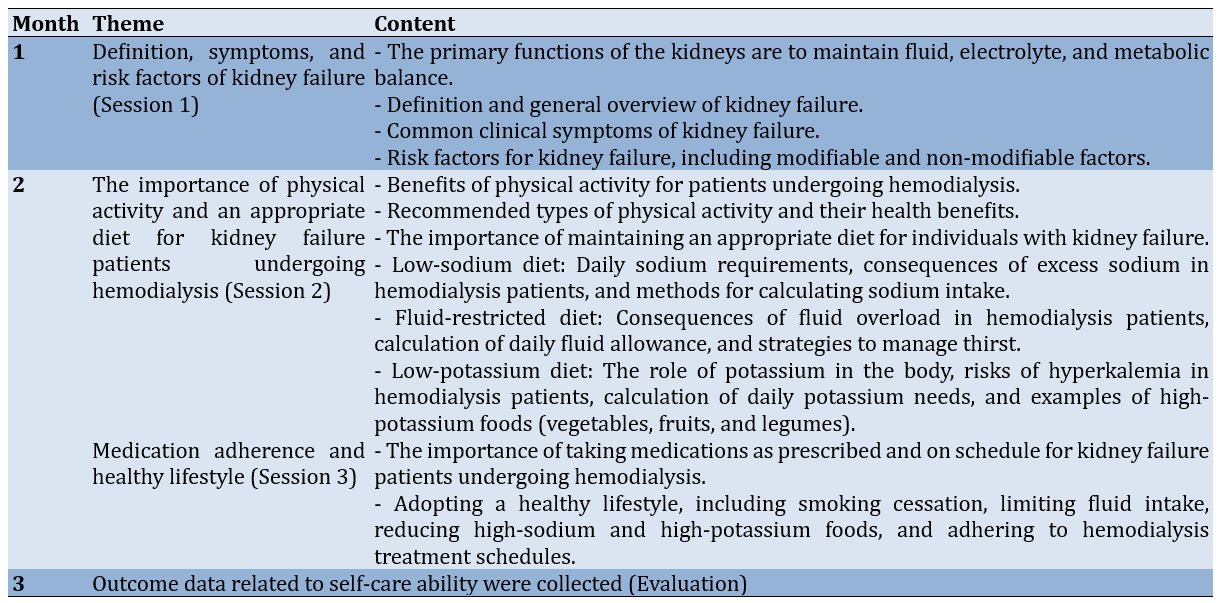
In the second month, the program incorporated Offline Network-Based Learning. During this phase, patients viewed 10-15-minute offline videos, which were digitally updated based on dialysis sessions. The video content included definitions of CKD, symptoms and risk factors, the importance of physical activity and dietary management, medication adherence, and healthy lifestyle practices. This phase was followed by individual guidance through week 4, during which the researcher and assistants responded to patients’ questions, either face-to-face or online, for 20-30 minutes each weekend. In the third month (week 1), outcome data related to self-care ability were collected (Table 1).
Table 1. The teach-back educational program
Data analysis
Data analysis was performed using SPSS 21. To verify the equivalence of baseline demographic and clinical characteristics between the experimental and control groups, and to examine differences in outcome measures at baseline, homogeneity and comparative analyses were conducted using the Chi-square test for categorical data and the independent-samples t-test for continuous data.
Findings
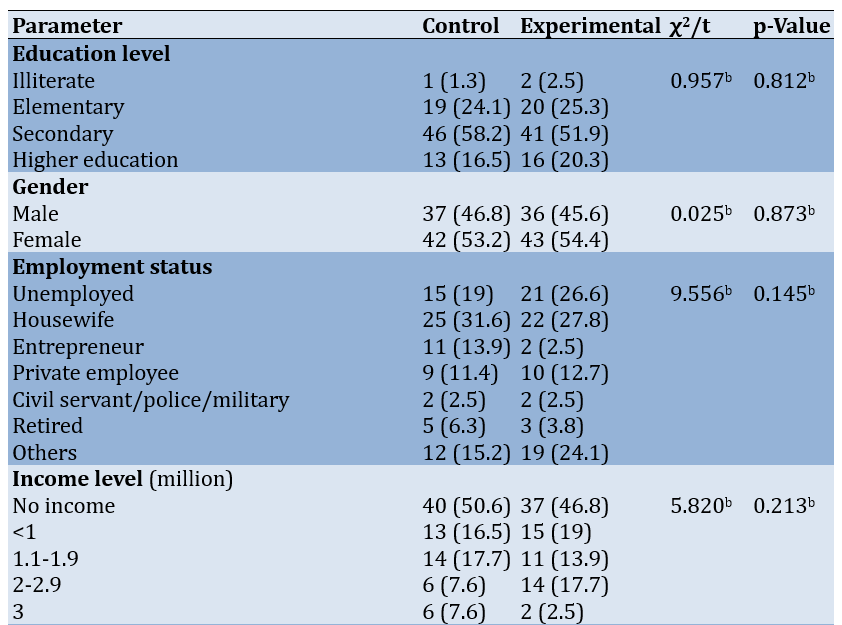
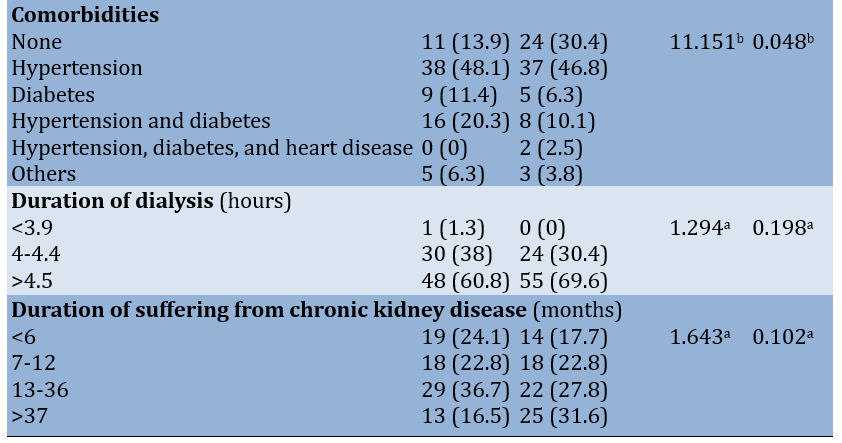
The mean age in the control and experimental groups was 50.66±13.22 and 49.43±14.27 years, respectively (p=0.575). Gender distribution was nearly equal, with females predominating in the experimental group and males slightly higher in the control group. Education levels were concentrated at the secondary stage. Housewives represented the largest occupational category, while a substantial proportion of participants reported no independent income. Clinically, hypertension emerged as the most prevalent comorbidity. A significant difference was observed in the distribution of comorbidities, with the control group showing more cases of combined hypertension and diabetes, whereas the experimental group included more individuals without comorbidities. Dialysis duration and duration of CKD in the control and experimental groups were 4.54±0.50 and 4.66±0.45 hours, and 24.22±28.19 and 32.30±32.61 months, respectively (Table 2).
Table 2. Comparing the participants’ demographic and clinical characteristics between the control (n=79) and experimental (n=79) groups by independent t-test(a) and Chi-square test(b)
Prior to the intervention, independent t-tests revealed no statistically significant differences in overall self-care scores or in any individual dimension scores between the experimental and control groups (p>0.05). Following three months of intervention, the experimental group demonstrated significantly higher scores in both the total self-care behavior and all specific dimensions compared to the control group (p<0.05; Table 3).
Table 3. Comparing mean self-care scores between the experimental (n=79) and control (n=79) groups by an independent t-test

Discussion
This research investigated the effect of teach-back–oriented educational interventions on patients’ self-care skills. Health education employing the teach-back technique substantially improved self-care practices in patients undergoing hemodialysis in Indonesia. At baseline, independent comparisons showed no statistically significant differences in self-care scores, including overall scores and all subdomains (medication adherence, self-monitoring, dietary compliance, personal hygiene, and psychological well-being), between the experimental and control groups.
In contrast, after a three-month application of the educational program, participants in the experimental group achieved markedly higher scores across all assessed domains than the control group, with the most pronounced improvements observed in mental state. Thus, targeted educational strategies can substantially enhance self-care behaviors among hemodialysis patients, consistent with prior evidence that interactive, teach-back methods yield superior and sustained improvements in self-management compared with routine care [2, 15].
Our results align with existing literature on the efficacy of teach-back in chronic conditions [15]. Prior studies in patients with heart failure have consistently shown that teach-back, whether delivered at the bedside, in single sessions, or combined with booklets and telephone follow-up, outperforms routine care in promoting self-care knowledge and behaviors [16-18]. The superiority of teach-back observed here, despite variations in session frequency and delivery mode across studies, underscores its robustness as an interactive, patient-centered educational strategy [19-21].
Nursing interventions are essential to the effectiveness of the teach-back approach in health education. Nurses serve as the primary facilitators, employing clear, non-jargon explanations, visual aids, and open-ended questions to confirm patient understanding. Through active listening, immediate clarification of misconceptions, and repeated teaching until mastery is achieved, nurses foster a therapeutic alliance that enhances patient engagement and information retention [22, 23]. This personalized, interactive approach directly addresses barriers, such as low health literacy, advanced age, and cognitive limitations commonly seen in hemodialysis populations [24, 25]. Furthermore, when teach-back is integrated with nurse-initiated follow-up phone calls involving patients and caregivers, it reinforces accountability, provides ongoing support, and sustains behavioral changes beyond the clinical setting. Evidence from systematic reviews indicates that consistent, high-fidelity implementation of these nursing actions correlates strongly with improved self-efficacy, treatment adherence, and reduced complications, highlighting teach-back as an essential competency in nephrology nursing practice [26, 27].
The superior efficacy of the teach-back approach was further supported by evidence that combining audiovisual materials with follow-up communication yields greater improvements in self-care behaviors than employing multimedia or telephone elements in isolation [28, 29]. Although some studies report non-significant differences between teach-back and standard approaches, these discrepancies may be attributable to baseline educational materials provided in routine care or differences in intervention intensity and setting [13, 30, 31].
Hemodialysis, while effective in toxin removal and prolonging survival in CKD, imposes substantial long-term burdens that reduce treatment adherence, exacerbate disease progression, and impair psychological well-being and quality of life [10, 32]. Self-care proficiency emerges as a critical prognostic factor, highlighting the urgency of targeted interventions [5, 33]. The teach-back method addresses limitations of traditional education, such as poor intuitiveness, rapid knowledge decay, and barriers related to age and health literacy by fostering active nurse-patient interaction, personalized support, and repetitive clarification until mastery is achieved. This process deepens understanding of disease, boosts self-efficacy, stimulates patient initiative, and promotes sustainable behavioral change.
Incorporating the teach-back protocol into health education offers a robust, empirically supported intervention to enhance self-management routines among individuals on hemodialysis, with the potential to improve therapeutic outcomes and life satisfaction in low-resource environments such as Indonesia. Equipping nurses with specialized training and the authority to consistently deploy teach-back strategies is essential, as their expert implementation drives these gains. Subsequent investigations ought to assess the long-term viability and adaptability of hybrid teach-back programs across diverse demographic contexts.
Health education using the teach-back method was highly effective in significantly improving hemodialysis patients' self-care abilities. Embedding audiovisual materials within the framework, personalized instruction, and the teach-back technique provide patients with a more engaging and superior learning experience. Crucially, this combined approach enables healthcare professionals to receive faster, more comprehensive feedback from patients, making it a valuable, recommended strategy for implementation in clinical hospital settings.
Several limitations of this investigation warrant acknowledgment. First, the study design did not allow for blinding of either participants or intervention providers due to the characteristics of the educational intervention. Additionally, the current investigation omitted the deployment of a digital learning platform, potentially limiting opportunities for expanded patient involvement and interaction. Third, the study participants were recruited only from hemodialysis patients at two tertiary care hospitals in Indonesia. Accordingly, the modest sample size, coupled with the recruitment of participants from a single geographic region, limits the external validity of the results, thereby constraining their applicability to broader, more heterogeneous populations.
As a follow-up, it is recommended that future research utilize a larger sample size and cover a wider geographical area. Furthermore, developing an interactive application that provides reminders and supports continuous patient learning could enhance the effectiveness of the intervention.
Conclusion
The teach-back technique is effective in bolstering self-care skills among individuals receiving hemodialysis.
Acknowledgments: We sincerely thank all the team members who supported and assisted with the implementation of this study at the Hemodialysis Centers. We sincerely appreciate the hemodialysis participants whose involvement and collaboration made this study possible.
Ethical Permissions: The research was officially approved by the Moewardi Hospital Medical Ethics Committee, under approval number (947/V/HREC/2025).
Conflicts of Interest: No potential conflicts of interest were reported by the contributing authors.
Authors' Contribution: Trisnaningtyas W (First Author), Introduction Writer/Methodologist/Main Researcher/Discussion Writer/Statistical Analyst (40%); Wulandari NK (Second Author), Introduction Writer/Assistant Researcher (15%); Metasari Sh (Third Author), Assistant Researcher/Discussion Writer (15%); Sawab S (Fourth Author), Introduction Writer/Methodologist/Assistant Researcher/Statistical Analyst (30%)
Funding/Support: The authors acknowledge that this study and/or the publication of this article was financially supported by Poltekkes Kemenkes Semarang under grant number HK.02.03/F.XV/1950/2025.
Chronic kidney disease (CKD) has emerged as a major global health challenge, characterized by a steadily increasing prevalence and a substantial clinical and economic burden [1]. Maintenance hemodialysis remains the most widely used renal replacement therapy for patients with end-stage kidney disease, playing a pivotal role in preserving residual physiological function and improving survival [2]. Across the globe, hemodialysis serves as the principal life-sustaining treatment for more than 80% of patients with kidney failure [3]. Despite the 2023 Indonesian Health Survey indicating a CKD prevalence of only 0.18%, national registry data reveal a sharp rise in hemodialysis utilization following the introduction of Universal Health Coverage in 2014 [4]. These trends highlight the imperative for integrated care approaches to strengthen adaptive capacity and improve patients' levels of life satisfaction.
Comprehensive care for patients undergoing hemodialysis requires active engagement in multiple complex aspects of self-care, which must be aligned with individual goals and preferences. Nevertheless, many patients continue to face limitations in understanding therapeutic regimens, developing self-care skills, and adapting to the demands of a progressive chronic illness. The management of CKD through hemodialysis necessitates substantial lifestyle modifications, including sodium restriction, electrolyte control, fluid management, and vigilant monitoring of complication risks [5], which may diminish motivation and hinder patient engagement in daily self-care [6].
Multiple factors influence self-care ability among patients undergoing hemodialysis, including age, educational level, depression, low risk perception, medication side effects, clarity of medical instructions, communication with healthcare providers, therapeutic regimen complexity, and socioeconomic constraints. Deficits in self-care within this population are largely attributable to low self-efficacy in disease management [7]. In addition, available traditional educational interventions have not consistently enhanced self-care ability [8]. This condition reinforces the need for educational approaches that are more targeted, structured, and oriented toward strengthening patient understanding.
The Teach-Back approach represents a promising educational method in this context [9]. This strategy involves patients restating healthcare instructions in their own words, allowing providers to objectively assess comprehension levels and promptly correct any errors or gaps in understanding. Empirical studies have shown that this method promotes better information retention, greater adherence to therapeutic regimens, and improved health outcomes among patients with complex chronic conditions. Although its advantages have been well demonstrated across various global healthcare settings, the integration of Teach-Back practices into nephrology services in Indonesia remains uncommon. Most patients continue to exhibit passive involvement in medical decision-making and a high degree of dependence on healthcare providers and family members, which may hinder the success of long-term management. The Teach-Back method is an educational approach that emphasizes active patient understanding through a structured process of explanation, repetition, clarification, and continuous evaluation [10]. In this approach, the educator first delivers the health-related information, then asks patients to restate the content in their own words to assess comprehension. Any errors or misconceptions are corrected through re-explanation or by adjusting the instructional strategy as necessary. At the final stage, patient understanding is reassessed using open-ended questions to ensure that essential information has been accurately understood [11]. This approach promotes interactive and effective learning, thereby enhancing patients’ ability to manage their health care independently.
The scarcity of empirical data on the application of the Teach-Back method in Indonesian hemodialysis settings underscores the need for continued research. Our obtained outcomes are expected to serve as a reference for developing structured and culturally sensitive educational strategies in nephrology practice. This study aimed to determine the effect of teach-back–oriented educational interventions on patients’ self-care skills.
Materials and Methods
Design and sample
This quasi-experimental study was conducted among 158 hemodialysis patients at two tertiary hospitals between May and August 2025. Sample size calculation was performed using G*Power 3.1 [12]. According to Karami et al. [13], the calculated sample size was 158 individuals (79 in each group), with α set at 0.05, β at 0.2, and a 20% anticipated dropout rate. Participants were randomly assigned to the experimental and control groups through a simple randomization procedure employing the lottery method, achieving balanced allocation (1:1) with 79 individuals per group. A consecutive sampling method was employed to recruit eligible participants who attended the hemodialysis units during the study period and fulfilled the predefined inclusion criteria
The inclusion criteria were the age of 18 years or older, being fully conscious (compos mentis), the ability to communicate effectively in Indonesian, individuals who met the established diagnostic criteria for CKD, those who met the indications for renal replacement therapy, those who exhibited clinical stability, undergoing hemodialysis for more than 3 months with a regular schedule of 2–3 sessions per week, and providing informed consent to participate. Patients were excluded if they were transferred to another healthcare facility during the study period, underwent kidney transplantation, switched to peritoneal dialysis, passed away, did not complete the teach-back sessions, or could not be tracked during the follow-up period.
Instrument
A self-designed demographic and clinical information form collected data, including age, gender, education level, employment status, income level, comorbidities, and duration and frequency of dialysis.
The Self-Care Agency Scale (SCAS), originally developed by Ören & Enç [14] specifically for individuals undergoing hemodialysis and peritoneal dialysis, comprises 22 items rated on a 3-point Likert format. This instrument was designed to be straightforward and comprehensible for respondents. The scale enables participants to indicate the extent of their engagement in self-care practices in their daily routines by selecting the option that best reflects their behavior (0=“I always apply it”; 1=“I sometimes apply it”; and 2=“I never apply it”). Total scores range from 0 to 44, with lower scores signifying reduced self-care capacity. Domain scores are derived by aggregating the relevant item scores, yielding potential ranges of 0-12 for medication adherence, 0-10 for dietary management, 0-8 for self-monitoring, 0-4 for personal hygiene, and 0-6 for psychological well-being. The internal consistency of the scale in our study, as measured by Cronbach’s alpha, was 0.88.
Procedure
The study was conducted in line with strict ethical guidelines, specifically the Declaration of Helsinki. The educational program was delivered over an eight-week duration. Individuals in the control group received routine hospital-based health instruction, whereas those in the experimental group received structured health education incorporating the teach-back technique. Patients were asked to sign an informed consent form after being clearly informed that their participation was voluntary and that they had the right to withdraw at any time without affecting their treatment plan. Prior to signing, the data collection procedures and the steps taken to ensure data confidentiality were fully explained to the patients. All research data were stored securely on a password-protected external hard drive and managed by the involved researchers.
Participants assigned to the control group received conventional hospital-delivered health instruction comprising three stages. In the verbal explanation stage, a trained research assistant, independent of the study participants and responsible for data collection, provided general information to patients and their families about fluid restriction, a sodium-restricted diet, and the importance of adherence to regular hemodialysis. In the written materials stage, patients received printed educational materials. Participants were prompted to raise any queries after reviewing the materials and to provide responses to the questions presented. During the centralized education stage, a single health education session lasting 30 minutes to 1 hour was conducted, focusing on hemodialysis. In the additional education (post-study) stage, upon completion of data acquisition in the experimental arm, participants in the comparison arm were offered health education sessions covering the same content as that delivered in the experimental group. This included understanding kidney failure, its signs and symptoms, risk factors, the importance of physical activity and diet for CKD, as well as medication adherence and healthy lifestyle behaviors.
For the experimental group, the teach-back method was used. The team consisted of 14 members, including 2 head nurses, 1 hemodialysis unit nurse, and 11 nursing profession students. To ensure methodological consistency, all team members received structured training in both the theoretical foundations and practical application of the teach-back method. Competency testing was required for the intervention team, and only those who passed were permitted to participate in the study. Patients eligible for inclusion in the intervention group were enrolled in an eight-week teach-back educational program, initiated at their first clinical meeting. They were instructed to continue practicing and reinforcing the educational content independently at home, following the prescribed protocol until the program concluded. We assessed the maximum effectiveness of the teach-back method during the eight-week period following patients’ hemodialysis treatments.
Data collection occurred at two distinct intervals: At baseline (pre-intervention) on the first day of the initial week (T1), and post-intervention during the ninth week while patients were undergoing hemodialysis (T2). Throughout the data-gathering process, reflective discussions were held in parallel with patients’ hemodialysis sessions from week 2 to week 8 to clarify the educational content and address participants’ questions. The intervention was delivered by three nurses and eleven trained assistants who served as primary implementers. In week 1, the program began with Knowledge Delivery, during which the researcher provided individualized education combining verbal explanation and written materials in 30-40-minute sessions. The educational content was equivalent to that provided to the control group. Clarification of patient questions continued through week 4.
In the second month, the program incorporated Offline Network-Based Learning. During this phase, patients viewed 10-15-minute offline videos, which were digitally updated based on dialysis sessions. The video content included definitions of CKD, symptoms and risk factors, the importance of physical activity and dietary management, medication adherence, and healthy lifestyle practices. This phase was followed by individual guidance through week 4, during which the researcher and assistants responded to patients’ questions, either face-to-face or online, for 20-30 minutes each weekend. In the third month (week 1), outcome data related to self-care ability were collected (Table 1).
Table 1. The teach-back educational program
Data analysis
Data analysis was performed using SPSS 21. To verify the equivalence of baseline demographic and clinical characteristics between the experimental and control groups, and to examine differences in outcome measures at baseline, homogeneity and comparative analyses were conducted using the Chi-square test for categorical data and the independent-samples t-test for continuous data.
Findings
The mean age in the control and experimental groups was 50.66±13.22 and 49.43±14.27 years, respectively (p=0.575). Gender distribution was nearly equal, with females predominating in the experimental group and males slightly higher in the control group. Education levels were concentrated at the secondary stage. Housewives represented the largest occupational category, while a substantial proportion of participants reported no independent income. Clinically, hypertension emerged as the most prevalent comorbidity. A significant difference was observed in the distribution of comorbidities, with the control group showing more cases of combined hypertension and diabetes, whereas the experimental group included more individuals without comorbidities. Dialysis duration and duration of CKD in the control and experimental groups were 4.54±0.50 and 4.66±0.45 hours, and 24.22±28.19 and 32.30±32.61 months, respectively (Table 2).
Table 2. Comparing the participants’ demographic and clinical characteristics between the control (n=79) and experimental (n=79) groups by independent t-test(a) and Chi-square test(b)
Prior to the intervention, independent t-tests revealed no statistically significant differences in overall self-care scores or in any individual dimension scores between the experimental and control groups (p>0.05). Following three months of intervention, the experimental group demonstrated significantly higher scores in both the total self-care behavior and all specific dimensions compared to the control group (p<0.05; Table 3).
Table 3. Comparing mean self-care scores between the experimental (n=79) and control (n=79) groups by an independent t-test
Discussion
This research investigated the effect of teach-back–oriented educational interventions on patients’ self-care skills. Health education employing the teach-back technique substantially improved self-care practices in patients undergoing hemodialysis in Indonesia. At baseline, independent comparisons showed no statistically significant differences in self-care scores, including overall scores and all subdomains (medication adherence, self-monitoring, dietary compliance, personal hygiene, and psychological well-being), between the experimental and control groups.
In contrast, after a three-month application of the educational program, participants in the experimental group achieved markedly higher scores across all assessed domains than the control group, with the most pronounced improvements observed in mental state. Thus, targeted educational strategies can substantially enhance self-care behaviors among hemodialysis patients, consistent with prior evidence that interactive, teach-back methods yield superior and sustained improvements in self-management compared with routine care [2, 15].
Our results align with existing literature on the efficacy of teach-back in chronic conditions [15]. Prior studies in patients with heart failure have consistently shown that teach-back, whether delivered at the bedside, in single sessions, or combined with booklets and telephone follow-up, outperforms routine care in promoting self-care knowledge and behaviors [16-18]. The superiority of teach-back observed here, despite variations in session frequency and delivery mode across studies, underscores its robustness as an interactive, patient-centered educational strategy [19-21].
Nursing interventions are essential to the effectiveness of the teach-back approach in health education. Nurses serve as the primary facilitators, employing clear, non-jargon explanations, visual aids, and open-ended questions to confirm patient understanding. Through active listening, immediate clarification of misconceptions, and repeated teaching until mastery is achieved, nurses foster a therapeutic alliance that enhances patient engagement and information retention [22, 23]. This personalized, interactive approach directly addresses barriers, such as low health literacy, advanced age, and cognitive limitations commonly seen in hemodialysis populations [24, 25]. Furthermore, when teach-back is integrated with nurse-initiated follow-up phone calls involving patients and caregivers, it reinforces accountability, provides ongoing support, and sustains behavioral changes beyond the clinical setting. Evidence from systematic reviews indicates that consistent, high-fidelity implementation of these nursing actions correlates strongly with improved self-efficacy, treatment adherence, and reduced complications, highlighting teach-back as an essential competency in nephrology nursing practice [26, 27].
The superior efficacy of the teach-back approach was further supported by evidence that combining audiovisual materials with follow-up communication yields greater improvements in self-care behaviors than employing multimedia or telephone elements in isolation [28, 29]. Although some studies report non-significant differences between teach-back and standard approaches, these discrepancies may be attributable to baseline educational materials provided in routine care or differences in intervention intensity and setting [13, 30, 31].
Hemodialysis, while effective in toxin removal and prolonging survival in CKD, imposes substantial long-term burdens that reduce treatment adherence, exacerbate disease progression, and impair psychological well-being and quality of life [10, 32]. Self-care proficiency emerges as a critical prognostic factor, highlighting the urgency of targeted interventions [5, 33]. The teach-back method addresses limitations of traditional education, such as poor intuitiveness, rapid knowledge decay, and barriers related to age and health literacy by fostering active nurse-patient interaction, personalized support, and repetitive clarification until mastery is achieved. This process deepens understanding of disease, boosts self-efficacy, stimulates patient initiative, and promotes sustainable behavioral change.
Incorporating the teach-back protocol into health education offers a robust, empirically supported intervention to enhance self-management routines among individuals on hemodialysis, with the potential to improve therapeutic outcomes and life satisfaction in low-resource environments such as Indonesia. Equipping nurses with specialized training and the authority to consistently deploy teach-back strategies is essential, as their expert implementation drives these gains. Subsequent investigations ought to assess the long-term viability and adaptability of hybrid teach-back programs across diverse demographic contexts.
Health education using the teach-back method was highly effective in significantly improving hemodialysis patients' self-care abilities. Embedding audiovisual materials within the framework, personalized instruction, and the teach-back technique provide patients with a more engaging and superior learning experience. Crucially, this combined approach enables healthcare professionals to receive faster, more comprehensive feedback from patients, making it a valuable, recommended strategy for implementation in clinical hospital settings.
Several limitations of this investigation warrant acknowledgment. First, the study design did not allow for blinding of either participants or intervention providers due to the characteristics of the educational intervention. Additionally, the current investigation omitted the deployment of a digital learning platform, potentially limiting opportunities for expanded patient involvement and interaction. Third, the study participants were recruited only from hemodialysis patients at two tertiary care hospitals in Indonesia. Accordingly, the modest sample size, coupled with the recruitment of participants from a single geographic region, limits the external validity of the results, thereby constraining their applicability to broader, more heterogeneous populations.
As a follow-up, it is recommended that future research utilize a larger sample size and cover a wider geographical area. Furthermore, developing an interactive application that provides reminders and supports continuous patient learning could enhance the effectiveness of the intervention.
Conclusion
The teach-back technique is effective in bolstering self-care skills among individuals receiving hemodialysis.
Acknowledgments: We sincerely thank all the team members who supported and assisted with the implementation of this study at the Hemodialysis Centers. We sincerely appreciate the hemodialysis participants whose involvement and collaboration made this study possible.
Ethical Permissions: The research was officially approved by the Moewardi Hospital Medical Ethics Committee, under approval number (947/V/HREC/2025).
Conflicts of Interest: No potential conflicts of interest were reported by the contributing authors.
Authors' Contribution: Trisnaningtyas W (First Author), Introduction Writer/Methodologist/Main Researcher/Discussion Writer/Statistical Analyst (40%); Wulandari NK (Second Author), Introduction Writer/Assistant Researcher (15%); Metasari Sh (Third Author), Assistant Researcher/Discussion Writer (15%); Sawab S (Fourth Author), Introduction Writer/Methodologist/Assistant Researcher/Statistical Analyst (30%)
Funding/Support: The authors acknowledge that this study and/or the publication of this article was financially supported by Poltekkes Kemenkes Semarang under grant number HK.02.03/F.XV/1950/2025.
References
1. Kidney Disease: Improving Global Outcomes (KDIGO) CKD Work Group. KDIGO 2024 clinical practice guideline for the evaluation and management of chronic kidney disease. Kidney Int. 2024;105(4s):S117-314. [Link]
2. Liu Y, Luo X, Ru X, Wen C, Ding N, Zhang J. Impact of a multimodal health education combined with teach-back method on self-management in hemodialysis patients: A randomized controlled trial. Medicine. 2024;103(52):e39971. [Link] [DOI:10.1097/MD.0000000000039971]
3. Hustrini NM, Susalit E, Harimurti K, Haryoso IS, Legrans AE, Damarjati K, et al. Prevalence, incidence and risk factors of chronic kidney disease in people with diabetes and hypertension, and the prognosis and kidney function decline in Indonesia: A multicentre cross-sectional study in primary care centres. BMJ Open. 2025;15(10):e103779. [Link] [DOI:10.1136/bmjopen-2025-103779]
4. Kemenkes RI. Thematic Report of the Indonesian Health Survey. Jakarta: Kemenkes RI; 2023. [Indonesian] [Link]
5. Mehraeen E, SeyedAlinaghi S, Mohammadi S, Matini P, Mirzapour P, Heydari M, et al. Self-care behaviors in patients receiving hemodialysis: A systematic review of recent evidence. Int J Prev Med. 2025;16:71. [Link] [DOI:10.4103/ijpvm.ijpvm_126_24]
6. Zhang P, Zhu Y, Wang Y, Zhang W, Qiao C, Lou H, et al. Effects of the teach-back method on the health status of patients with chronic obstructive pulmonary disease: A real-world community-based cluster-randomized controlled trial. J Thorac Dis. 2024;16(8):5209-21. [Link] [DOI:10.21037/jtd-23-1895]
7. Rini IS, Rahmayani T, Sari EK, Lestari R. Differences in the quality of life of chronic kidney disease patients undergoing hemodialysis and continuous ambulatory peritoneal dialysis. J Public Health Res. 2021;10(2):2209. [Link] [DOI:10.4081/jphr.2021.2209]
8. Abbasi Abianeh N, Abdollah Zargar S, Amirkhani A, Adelipouramlash A. The effect of self-care education through teach back method on the quality of life in hemodialysis patients. Nephrol Ther. 2020;16(4):197-200. [Link] [DOI:10.1016/j.nephro.2020.01.002]
9. Borzou SR, Rasoli M, Khalili Z, Tapak L. Comparison of group discussion and teach back selfcare education effects on knowledge, attitude, and performance of hemodialysis patients. Nephro Urol Mon. 2020;12(3):e105938. [Link] [DOI:10.5812/numonthly.105938]
10. Sharifian P, Khalili A, Shamsizadeh M. Effects of physical activity by the teach-back educational method on the physical ability and quality of life in hemodialysis patients: A clinical trial. Front Nurs. 2023;10(2):223-31. [Link] [DOI:10.2478/fon-2023-0027]
11. Tran S, Bennett G, Richmond J, Nguyen T, Ryan M, Hong T, et al. 'Teach-back' is a simple communication tool that improves disease knowledge in people with chronic hepatitis B-a pilot randomized controlled study. BMC Public Health. 2019;19(1):1355. [Link] [DOI:10.1186/s12889-019-7658-4]
12. Mayr S, Erdfelder E, Buchner A, Faul F. A short tutorial of GPower. Tutor Quantit Method Psychol. 2007;3(2). [Link] [DOI:10.20982/tqmp.03.2.p051]
13. Karami Salaheddin Kola M, Jafari H, Charati JY, Shafipour V. Comparing the effects of teach-back method, multimedia and blended training on self-care and social support in patients with heart failure: A randomized clinical trial. J Educ Health Promot. 2021;10:248. [Link] [DOI:10.4103/jehp.jehp_1481_20]
14. Ören B, Enç N. Development and psychometric testing of the self-care agency scale for patients undergoing long-term dialysis in Turkey. J Ren Care. 2014;40(4):266-73. [Link] [DOI:10.1111/jorc.12098]
15. Ha Dinh TT, Bonner A, Clark R, Ramsbotham J, Hines S. The effectiveness of the teach-back method on adherence and self-management in health education for people with chronic disease: A systematic review. JBI Database Syst Rev Implement Rep. 2016;14(1):210-47. [Link] [DOI:10.11124/jbisrir-2016-2296]
16. Rahmani A, Vahedian-Azimi A, Sirati-Nir M, Norouzadeh R, Rozdar H, Sahebkar A. The effect of the teach-back method on knowledge, performance, readmission, and quality of life in heart failure patients. Cardiol Res Pract. 2020;2020:8897881. [Link] [DOI:10.1155/2020/8897881]
17. Irajpour A, Hashemi MS, Abazari P, Shahidi S. The effects of peer education on treatment adherence among patients receiving hemodialysis: A randomized controlled trial. Iran J Nurs Midwifery Res. 2024;29(1):46-55. [Link] [DOI:10.4103/ijnmr.ijnmr_155_22]
18. Mohammadi F, Jahromi MS, Bijani M, Karimi S, Dehghan A. Investigating the effect of multimedia education in combination with teach-back method on quality of life and cardiac anxiety in patients with heart failure: A randomized clinical trial. BMC Cardiovasc Disord. 2021;21(1):535. [Link] [DOI:10.1186/s12872-021-02357-z]
19. Xia F, Wang G. Influence of teach-back strategy on hemodialysis related knowledge level, self-efficacy and self-management in patients receiving maintenance hemodialysis. Sci Rep. 2024;14(1):4010. [Link] [DOI:10.1038/s41598-024-54044-6]
20. Ouyang WW, Chen HF, Xu XY, Zhang XL, Fu LZ, Tang F, et al. Self-management program for patients with chronic kidney disease (SMP-CKD) in Southern China: Protocol for an ambispective cohort study. BMC Nephrol. 2022;23(1):93. [Link] [DOI:10.1186/s12882-022-02700-2]
21. Mahmoodi H. Empowering patients through effective communication: The teach-back method as a tool for health literacy. Health Promot Perspect. 2025;15(3):211-2. [Link] [DOI:10.34172/hpp.025.44214]
22. Yen PH, Leasure AR. Use and effectiveness of the teach-back method in patient education and health outcomes. Fed Pract. 2019;36(6):284-9. [Link]
23. Talevski J, Wong Shee A, Rasmussen B, Kemp G, Beauchamp A. Teach-back: A systematic review of implementation and impacts. PLoS One. 2020;15(4):e0231350. [Link] [DOI:10.1371/journal.pone.0231350]
24. Natashia D, Yen M, Chen HM, Fetzer SJ. Self-management behaviors in relation to psychological factors and interdialytic weight gain among patients undergoing hemodialysis in Indonesia. J Nurs Scholarsh. 2019;51(4):417-26. [Link] [DOI:10.1111/jnu.12464]
25. Wasilah H, Natashia D, Huang CH, Chen HM, Yen M. Multidimensional symptom burden among patients with hemodialysis in Indonesia. JURNAL KEPERAWATAN PADJADJARAN. 2021;9(2):159-66. [Link] [DOI:10.24198/jkp.v9i2.1660]
26. Jagodage HMH, McGuire A, Seib C, Bonner A. Effectiveness of teach-back for chronic kidney disease patient education: A systematic review. J Ren Care. 2024;50(2):92-103. [Link] [DOI:10.1111/jorc.12462]
27. Sleiman AA, Richard EM, Gonzales-Portillo D, Tallman S, Gravina NE. Evaluation of teach-back and plain language acceptability during patient interactions. PEC Innov. 2025;8:100445. [Link] [DOI:10.1016/j.pecinn.2025.100445]
28. Yasin F, Khraim F, Santos M, Forgrave D, Hamad A. Factors influencing self-care management in adult hemodialysis patients: An integrative review. Qatar Med J. 2024;2024(1):12. [Link] [DOI:10.5339/qmj.2024.12]
29. Lee J, Noh D. Factors associated with self-care among patients receiving hemodialysis: A cross-sectional observational study. Res Theory Nurs Pract. 2021. [Link] [DOI:10.1891/RTNP-D-20-00042]
30. Yangöz ŞT, Özer Z, Boz İ. Comparison of the effect of educational and self-management interventions on adherence to treatment in hemodialysis patients: A systematic review and meta-analysis of randomized controlled trials. Int J Clin Pract. 2021;75(5):e13842. [Link] [DOI:10.1111/ijcp.13842]
31. Li H, Li W, Kong X, Wang Z, Lu C, Shi D. Application of teach-back health education combined with continuity care in patients with knee joint training injuries: An analysis of clinical effects. Front Public Health. 2025;13:1577538. [Link] [DOI:10.3389/fpubh.2025.1577538]
32. Zhao C, Zhao Z, Song L. The effectiveness of teach-back health education combined with high-quality nursing in patients with atrial fibrillation receiving anticoagulant treatment. Pak J Med Sci. 2025;41(4):1066-71. [Link] [DOI:10.12669/pjms.41.4.11676]
33. Xie K, Cao H, Ling S, Zhong J, Chen H, Chen P, et al. Global, regional, and national burden of chronic kidney disease, 1990-2021: A systematic analysis for the global burden of disease study 2021. Front Endocrinol. 2025;16:1526482. [Link] [DOI:10.3389/fendo.2025.1526482]
Send email to the article author