

TMU
Owner
Tarbiat Modares University (TMU) is the owner of HEHP.

0.8
Cite Score 2025
Volume 14, Issue 1 (2026)
Health Educ Health Promot 2026, 14(1): 77-82 |
Back to browse issues page
Article Type:




History
Received: 2025/12/23 | Accepted: 2026/01/27 | Published: 2026/01/29
Received: 2025/12/23 | Accepted: 2026/01/27 | Published: 2026/01/29
How to cite this article
Jumakil J, Suhadi S, Kalza L, Yahya M, Wahida M, Ihsani M. Digital Literacy and Health Service Effectiveness in Kendari City. Health Educ Health Promot 2026; 14 (1) :77-82
URL: http://hehp.daneshafarand.org/article-4-83057-en.html
URL: http://hehp.daneshafarand.org/article-4-83057-en.html
Download citation:
BibTeX | RIS | EndNote | Medlars | ProCite | Reference Manager | RefWorks
Send citation to:


Rights and permissions
BibTeX | RIS | EndNote | Medlars | ProCite | Reference Manager | RefWorks
Send citation to:


| Abstract (HTML) (932 Views)
Full-Text: (124 Views)
Introduction
The advancement of digital technology has significantly changed a number of industries, including health [1-3]. In Indonesia, community health centers are the spearheads of primary health services [4], required to adapt to digital-based systems to facilitate health services [5], such as the community health center management information system (SIMPUS) [6], telemedicine applications [7], and electronic medical records [8]. However, the effectiveness of this technology’s implementation depends heavily on the digital literacy of healthcare workers and the public. Digital literacy encompasses not only the ability to handle devices technically, but also knowledge of digital ethics, data security, and the proper use of health information [9].
According to data from the Indonesian Ministry of Health, which indicate that the degree of digital technology use in primary health care institutions still varies, health center services in Indonesia have not fully implemented digital information system technology for the operational management needs of health services [10]. This state indicates a deficiency in health workers’ digital literacy, human resource competency, and technical infrastructure readiness. When it comes to the digital transformation of healthcare services, Kendari City, the capital of Southeast Sulawesi Province, faces comparable difficulties. A population of hundreds of millions of individuals with a variety of demographic and geographic features is served by 15 community health clinics, according to data from the Kendari City Health Office [11]. The community health center information system and other digital-based health applications have begun developing digital infrastructure, but given the disparities in digital literacy among medical professionals and administrative staff, the efficacy of these digital tools remains in doubt.
Although the government is actively encouraging the digitalization of community health centers through policies such as digital health transformation [12], the reality on the ground shows that a digital literacy gap persists. Preliminary surveys at several Community Health Centers revealed that some staff had difficulty using SIMPUS, inputting data accurately, or utilizing analytical features for decision-making. On the other hand, low digital literacy among the public also hinders the optimization of services such as online registration or virtual consultations. As a result, service processes become less efficient, data duplication occurs, and disparities in healthcare access between urban and rural areas arise.
Previous studies [13, 14] show that digital literacy of health workers is correlated with technology adoption, but there is no research that proves a causal relationship between digital literacy and specific service quality indicators at Community Health Centers (e.g., waiting time, accuracy of medical records). Digital literacy includes technical skills, ethics, and data security, but research at the community health center [15] only measures basic skills without exploring the impact of each dimension on service quality. Although digital literacy is important, research [16] has ignored infrastructure factors (internet connectivity, device availability) that may influence the digital literacy of community health center officers. This study aimed to analyze the extent to which digital literacy influences the effectiveness of health services at community health centers.
Instrument and Methods
Design and sample
This quantitative and explanatory study using analytic survey was conducted from August to November 2025. This type was used to explain existing phenomena and clarify the position of the parameters studied, indicating the nature of the relationships between them [17]. An analytic survey can not only detect whether a factor has been involved in an event, but also determine the degree of involvement through correlation studies (Figure 1) [18].
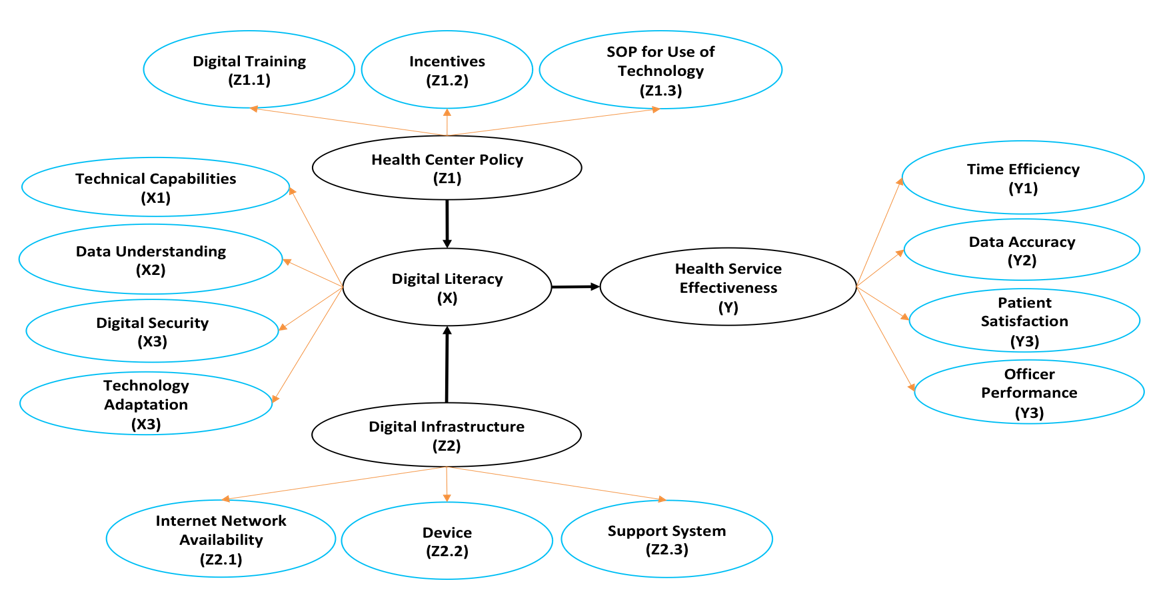
Figure 1. The research model.
The sampling method at the research locations used proportional random sampling to determine the number of respondents at each community health center, while purposive sampling techniques were used at the community health center. The number of samples was 224 people from the 504 existing population of health center employees in Kendari City.
Instrument
A questionnaire was used to collect data and was distributed to health center officers in Kendari City. Validity and reliability testing of the questionnaire was conducted using SmartPLS 3.0 software with the partial least squares structural equation modeling (PLS-SEM) approach. Instrument validity was tested through two aspects, namely convergent validity and discriminant validity. Convergent validity was measured using the outer loading value and average variance extracted (AVE). Each indicator must have an outer loading value ≥0.70 to be considered valid [19]. Furthermore, the AVE for each latent parameter must be ≥0.50, indicating that the parameter explains more than half of the variance in its indicators [20]. Instrument reliability was tested using Cronbach’s alpha and composite reliability (CR), which must be ≥0.70 to indicate good internal consistency [19, 21-23]. CR is considered superior because it takes into account the different weights of each indicator in measuring the latent parameter. If there are indicators that do not meet the validity or reliability criteria, these indicators will be eliminated from the model and retested until all criteria are met.
Data collection
Data collection employed various methods to obtain comprehensive information on healthcare workers’ digital literacy, policies, and supporting infrastructure. All respondents were provided with comprehensive information about the study’s goals, methods, potential risks, and benefits. Data were collected using questionnaires distributed to community health center staff in Kendari City. Secondary data were also obtained from administrative records at the community health centers. The data collection process was conducted with the consent of the participants, and confidentiality was guaranteed to maintain the validity of the data obtained.
Statistical analysis
The inferential analysis used to test the hypothesis in this research was PLS-SEM. Evidence of estimation of indicators and constructs was identified by applying tests for validity and reliability [20, 24]. The research involved two testing phases, including outer model testing and inner model testing. The outer model test assessed the validity and reliability of the study’s data. Convergent validity was evaluated using the AVE value, outer loading values, or a combination of both. Once all parameters and indicators satisfied the minimum test requirements, the inner model was tested. The inner model test examined the relationships among latent parameters. Hypothesis testing involved testing the p-value, t-statistic, and original sample. Next, a model-fit test (goodness of fit (GOF)) was carried out, which is a series of statistical tests used to evaluate how well the proposed statistical model fits the observation data. The model-fit test used the standardized root mean square residual (SRMR) value. SRMR is a tool to measure model fit (model suitability), the d-ULS and d-G values with GOF criteria, to validate the overall model. GOF is used for evaluating measurement models and structural models, simple measurements for model prediction, and the normed fit index (NFI) value. The SRMR value accepted as a fit model is with a value <0.1, the exact fit criteria d-ULS and d-G values <95%, and NFI values close to 1 indicate good model suitability [25].
Findings
The data analysis was conducted with 224 respondents. The gender distribution was 133 (59.38%) female respondents and 91 (40.62%) male respondents. Since every indicator’s outer loading value was greater than 0.7, all indicators were deemed valid (Figure 2).
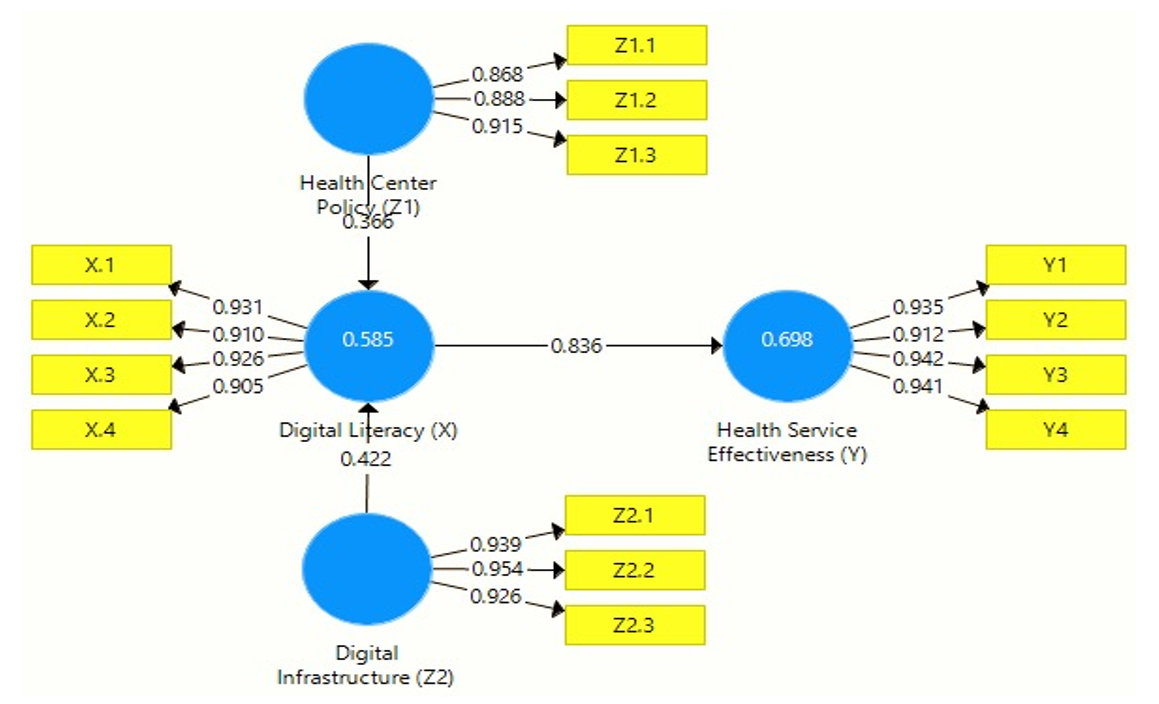
Figure 2. Outer loading value.
A reliability test was carried out using Cronbach’s alpha and CR and all dimensions and parameters studied showed Cronbach’s alpha and CR values greater than 0.7, and were considered reliable (Table 1).
Table 1. Reliability test results using Cronbach's alpha and composite reliability

There was a positive and statistically significant relationship between the parameters (p<0.05). Specifically, digital literacy demonstrated a positive and significant impact on the effectiveness of health services (p=0.0001). Health center policies had a positive and significant impact on digital literacy (p=0.011), while digital infrastructure had a positive and significant impact (p=0.016; (Table 2).
Table 2. Directional path effects among parameters

The SRMR value obtained was 0.062, indicating a good fit. The model met the exact fit criteria, with d-ULS and d-G values of 39.8% <95%. Additionally, an excellent model fit was indicated by the NFI value of 0.847.
Discussion
This study aimed to analyze the extent to which digital literacy influences the effectiveness of health services at community health centers. In the health context, digital literacy of health workers includes technical skills (such as operating health applications, e-medical records, telemedicine), critical understanding (assessing the credibility of digital health information), digital security and ethics (protection of patient data, privacy, cybersecurity), and digital collaboration (use of communication platforms for health teamwork).
Digital literacy of health workers played a role in the effectiveness of health services at Community Health Centers. These results are in line with research conducted by Bejaković & Mrnjavac, which states that increasing health literacy will contribute to the provision of superior health services and ultimately to the overall well-being of society [26]. The findings of this study are also consistent with research by Kruse et al., which demonstrates that when service providers have sufficient digital literacy, the use of digital technology in health services can boost service efficacy by up to 35%. On the other hand, insufficient digital literacy can seriously hinder the uptake of health technology and even lower the standard of care [27].
This digital literacy role model must be supported by community health center policies related to digital health implementation and the availability of adequate digital infrastructure. Improving the digital literacy of community health center staff requires support from these policies.
The policy included providing digital training for community health center officers, building an adaptive mindset through mentoring and incentives for officers who actively adopt technology, and issuing standard operating procedures related to the use of technology. This outcome is consistent with a study by Ekong et al., which claims that frontline healthcare personnel’s digital readiness can be significantly increased by systematic digital literacy training based on a competence framework and contextual design. These kinds of actions are essential for long-term digital transformation in healthcare systems [28]. In addition to policies, community health centers (Puskesmas) also need to provide digital infrastructure support. Local governments must ensure adequate equipment and internet connections, as well as the existence of supporting systems, particularly software that supports digital technology operations in health centers.
Most community health center staff had low to moderate levels of digital literacy. While they were proficient in operating digital applications, they did not fully understand how to secure patient data digitally. These results are in line with research by Tegegne et al., which found that 48.2% of healthcare workers lack computer literacy. Views about digital health technology, training in digital technology, and access to digital technology are all substantially correlated with digital literacy [29].
They did not regularly participate in digital skills training or development, which led to discomfort with using new technology and an inability to effectively analyze digital health data for program evaluation. This impacts the effectiveness of health services at community health centers, which remain suboptimal, though they have improved since the implementation of digital technology. Therefore, accessibility of digital-based services requires adequate technological assets, including staff skills, the applications used, and the infrastructure to ensure the sustainability of digital health services [30].
Improving digital competency not only accelerates services but also supports Indonesia’s digital health transformation. Technology acceptance depends on perceived ease of use and perceived benefits. High digital literacy enables staff to better adopt digital health tools, thereby speeding up the service process [31]. Digital integration in primary care can reduce staff workload and human error, but its success depends heavily on human resource capacity [32].
In the context of digital healthcare services, service quality includes accessibility, defined as the ease with which patients can access healthcare services through digital platforms (telemedicine, health apps, and electronic medical records) [33]. Information accuracy refers to the reliability of health information provided through digital platforms [34]. Response speed refers to time efficiency in services, such as online consultations and AI-based diagnoses [35]. Data security refers to patient privacy protection in accordance with regulations, such as GDPR and HIPAA [36].
To achieve more effective digital health services at community health centers, good digital literacy among staff is required. For staff to have good digital health literacy, support from community health center policies and adequate digital infrastructure are needed.
Conclusion
Digital literacy significantly improves service effectiveness, while digital infrastructure and community health center policies significantly boost digital literacy.
Acknowledgments: We extend our deepest gratitude to the Rector of Halo Oleo University for his contributions to this research, including academic support and facilities provided, which enabled the research to be carried out successfully and achieve the desired results. The authors also extend their gratitude to all respondents who participated and provided valuable information for this research.
Ethical Permissions: The Health Research Ethics Commission (KEPK) of the Regional Executive Board of the Indonesian Public Health Experts Association (IAKMI) of Southeast Sulawesi Province granted ethics approval for the study under the number 104/KEPK-IAKMI/VII/2025.
Conflicts of Interests: No conflicts of interests were reported by the authors.
Authors' Contribution: Jumakil J (First Author), Introduction Author/Main Researcher/Methodologist/Discussion Writer/Statistical Analyst (50%); Suhadi S (Second Author), Main Researcher/Discussion Writer (20%); Kalza LA (Third Author), Main Researcher/Discussion Writer (15%); Yahya MB (Fourth Author), Main Researcher/Data Analyst (5%); Wahida M (Fifth Author), Main Researcher/Data Analyst (5%); Ihsani MJ (Sixth Author), Main Researcher/Data Analyst (5%)
Funding/Support: The Indonesian Ministry of Health, via Halu Oleo University, provided funding for this study.
The advancement of digital technology has significantly changed a number of industries, including health [1-3]. In Indonesia, community health centers are the spearheads of primary health services [4], required to adapt to digital-based systems to facilitate health services [5], such as the community health center management information system (SIMPUS) [6], telemedicine applications [7], and electronic medical records [8]. However, the effectiveness of this technology’s implementation depends heavily on the digital literacy of healthcare workers and the public. Digital literacy encompasses not only the ability to handle devices technically, but also knowledge of digital ethics, data security, and the proper use of health information [9].
According to data from the Indonesian Ministry of Health, which indicate that the degree of digital technology use in primary health care institutions still varies, health center services in Indonesia have not fully implemented digital information system technology for the operational management needs of health services [10]. This state indicates a deficiency in health workers’ digital literacy, human resource competency, and technical infrastructure readiness. When it comes to the digital transformation of healthcare services, Kendari City, the capital of Southeast Sulawesi Province, faces comparable difficulties. A population of hundreds of millions of individuals with a variety of demographic and geographic features is served by 15 community health clinics, according to data from the Kendari City Health Office [11]. The community health center information system and other digital-based health applications have begun developing digital infrastructure, but given the disparities in digital literacy among medical professionals and administrative staff, the efficacy of these digital tools remains in doubt.
Although the government is actively encouraging the digitalization of community health centers through policies such as digital health transformation [12], the reality on the ground shows that a digital literacy gap persists. Preliminary surveys at several Community Health Centers revealed that some staff had difficulty using SIMPUS, inputting data accurately, or utilizing analytical features for decision-making. On the other hand, low digital literacy among the public also hinders the optimization of services such as online registration or virtual consultations. As a result, service processes become less efficient, data duplication occurs, and disparities in healthcare access between urban and rural areas arise.
Previous studies [13, 14] show that digital literacy of health workers is correlated with technology adoption, but there is no research that proves a causal relationship between digital literacy and specific service quality indicators at Community Health Centers (e.g., waiting time, accuracy of medical records). Digital literacy includes technical skills, ethics, and data security, but research at the community health center [15] only measures basic skills without exploring the impact of each dimension on service quality. Although digital literacy is important, research [16] has ignored infrastructure factors (internet connectivity, device availability) that may influence the digital literacy of community health center officers. This study aimed to analyze the extent to which digital literacy influences the effectiveness of health services at community health centers.
Instrument and Methods
Design and sample
This quantitative and explanatory study using analytic survey was conducted from August to November 2025. This type was used to explain existing phenomena and clarify the position of the parameters studied, indicating the nature of the relationships between them [17]. An analytic survey can not only detect whether a factor has been involved in an event, but also determine the degree of involvement through correlation studies (Figure 1) [18].
Figure 1. The research model.
The sampling method at the research locations used proportional random sampling to determine the number of respondents at each community health center, while purposive sampling techniques were used at the community health center. The number of samples was 224 people from the 504 existing population of health center employees in Kendari City.
Instrument
A questionnaire was used to collect data and was distributed to health center officers in Kendari City. Validity and reliability testing of the questionnaire was conducted using SmartPLS 3.0 software with the partial least squares structural equation modeling (PLS-SEM) approach. Instrument validity was tested through two aspects, namely convergent validity and discriminant validity. Convergent validity was measured using the outer loading value and average variance extracted (AVE). Each indicator must have an outer loading value ≥0.70 to be considered valid [19]. Furthermore, the AVE for each latent parameter must be ≥0.50, indicating that the parameter explains more than half of the variance in its indicators [20]. Instrument reliability was tested using Cronbach’s alpha and composite reliability (CR), which must be ≥0.70 to indicate good internal consistency [19, 21-23]. CR is considered superior because it takes into account the different weights of each indicator in measuring the latent parameter. If there are indicators that do not meet the validity or reliability criteria, these indicators will be eliminated from the model and retested until all criteria are met.
Data collection
Data collection employed various methods to obtain comprehensive information on healthcare workers’ digital literacy, policies, and supporting infrastructure. All respondents were provided with comprehensive information about the study’s goals, methods, potential risks, and benefits. Data were collected using questionnaires distributed to community health center staff in Kendari City. Secondary data were also obtained from administrative records at the community health centers. The data collection process was conducted with the consent of the participants, and confidentiality was guaranteed to maintain the validity of the data obtained.
Statistical analysis
The inferential analysis used to test the hypothesis in this research was PLS-SEM. Evidence of estimation of indicators and constructs was identified by applying tests for validity and reliability [20, 24]. The research involved two testing phases, including outer model testing and inner model testing. The outer model test assessed the validity and reliability of the study’s data. Convergent validity was evaluated using the AVE value, outer loading values, or a combination of both. Once all parameters and indicators satisfied the minimum test requirements, the inner model was tested. The inner model test examined the relationships among latent parameters. Hypothesis testing involved testing the p-value, t-statistic, and original sample. Next, a model-fit test (goodness of fit (GOF)) was carried out, which is a series of statistical tests used to evaluate how well the proposed statistical model fits the observation data. The model-fit test used the standardized root mean square residual (SRMR) value. SRMR is a tool to measure model fit (model suitability), the d-ULS and d-G values with GOF criteria, to validate the overall model. GOF is used for evaluating measurement models and structural models, simple measurements for model prediction, and the normed fit index (NFI) value. The SRMR value accepted as a fit model is with a value <0.1, the exact fit criteria d-ULS and d-G values <95%, and NFI values close to 1 indicate good model suitability [25].
Findings
The data analysis was conducted with 224 respondents. The gender distribution was 133 (59.38%) female respondents and 91 (40.62%) male respondents. Since every indicator’s outer loading value was greater than 0.7, all indicators were deemed valid (Figure 2).
Figure 2. Outer loading value.
A reliability test was carried out using Cronbach’s alpha and CR and all dimensions and parameters studied showed Cronbach’s alpha and CR values greater than 0.7, and were considered reliable (Table 1).
Table 1. Reliability test results using Cronbach's alpha and composite reliability
There was a positive and statistically significant relationship between the parameters (p<0.05). Specifically, digital literacy demonstrated a positive and significant impact on the effectiveness of health services (p=0.0001). Health center policies had a positive and significant impact on digital literacy (p=0.011), while digital infrastructure had a positive and significant impact (p=0.016; (Table 2).
Table 2. Directional path effects among parameters
The SRMR value obtained was 0.062, indicating a good fit. The model met the exact fit criteria, with d-ULS and d-G values of 39.8% <95%. Additionally, an excellent model fit was indicated by the NFI value of 0.847.
Discussion
This study aimed to analyze the extent to which digital literacy influences the effectiveness of health services at community health centers. In the health context, digital literacy of health workers includes technical skills (such as operating health applications, e-medical records, telemedicine), critical understanding (assessing the credibility of digital health information), digital security and ethics (protection of patient data, privacy, cybersecurity), and digital collaboration (use of communication platforms for health teamwork).
Digital literacy of health workers played a role in the effectiveness of health services at Community Health Centers. These results are in line with research conducted by Bejaković & Mrnjavac, which states that increasing health literacy will contribute to the provision of superior health services and ultimately to the overall well-being of society [26]. The findings of this study are also consistent with research by Kruse et al., which demonstrates that when service providers have sufficient digital literacy, the use of digital technology in health services can boost service efficacy by up to 35%. On the other hand, insufficient digital literacy can seriously hinder the uptake of health technology and even lower the standard of care [27].
This digital literacy role model must be supported by community health center policies related to digital health implementation and the availability of adequate digital infrastructure. Improving the digital literacy of community health center staff requires support from these policies.
The policy included providing digital training for community health center officers, building an adaptive mindset through mentoring and incentives for officers who actively adopt technology, and issuing standard operating procedures related to the use of technology. This outcome is consistent with a study by Ekong et al., which claims that frontline healthcare personnel’s digital readiness can be significantly increased by systematic digital literacy training based on a competence framework and contextual design. These kinds of actions are essential for long-term digital transformation in healthcare systems [28]. In addition to policies, community health centers (Puskesmas) also need to provide digital infrastructure support. Local governments must ensure adequate equipment and internet connections, as well as the existence of supporting systems, particularly software that supports digital technology operations in health centers.
Most community health center staff had low to moderate levels of digital literacy. While they were proficient in operating digital applications, they did not fully understand how to secure patient data digitally. These results are in line with research by Tegegne et al., which found that 48.2% of healthcare workers lack computer literacy. Views about digital health technology, training in digital technology, and access to digital technology are all substantially correlated with digital literacy [29].
They did not regularly participate in digital skills training or development, which led to discomfort with using new technology and an inability to effectively analyze digital health data for program evaluation. This impacts the effectiveness of health services at community health centers, which remain suboptimal, though they have improved since the implementation of digital technology. Therefore, accessibility of digital-based services requires adequate technological assets, including staff skills, the applications used, and the infrastructure to ensure the sustainability of digital health services [30].
Improving digital competency not only accelerates services but also supports Indonesia’s digital health transformation. Technology acceptance depends on perceived ease of use and perceived benefits. High digital literacy enables staff to better adopt digital health tools, thereby speeding up the service process [31]. Digital integration in primary care can reduce staff workload and human error, but its success depends heavily on human resource capacity [32].
In the context of digital healthcare services, service quality includes accessibility, defined as the ease with which patients can access healthcare services through digital platforms (telemedicine, health apps, and electronic medical records) [33]. Information accuracy refers to the reliability of health information provided through digital platforms [34]. Response speed refers to time efficiency in services, such as online consultations and AI-based diagnoses [35]. Data security refers to patient privacy protection in accordance with regulations, such as GDPR and HIPAA [36].
To achieve more effective digital health services at community health centers, good digital literacy among staff is required. For staff to have good digital health literacy, support from community health center policies and adequate digital infrastructure are needed.
Conclusion
Digital literacy significantly improves service effectiveness, while digital infrastructure and community health center policies significantly boost digital literacy.
Acknowledgments: We extend our deepest gratitude to the Rector of Halo Oleo University for his contributions to this research, including academic support and facilities provided, which enabled the research to be carried out successfully and achieve the desired results. The authors also extend their gratitude to all respondents who participated and provided valuable information for this research.
Ethical Permissions: The Health Research Ethics Commission (KEPK) of the Regional Executive Board of the Indonesian Public Health Experts Association (IAKMI) of Southeast Sulawesi Province granted ethics approval for the study under the number 104/KEPK-IAKMI/VII/2025.
Conflicts of Interests: No conflicts of interests were reported by the authors.
Authors' Contribution: Jumakil J (First Author), Introduction Author/Main Researcher/Methodologist/Discussion Writer/Statistical Analyst (50%); Suhadi S (Second Author), Main Researcher/Discussion Writer (20%); Kalza LA (Third Author), Main Researcher/Discussion Writer (15%); Yahya MB (Fourth Author), Main Researcher/Data Analyst (5%); Wahida M (Fifth Author), Main Researcher/Data Analyst (5%); Ihsani MJ (Sixth Author), Main Researcher/Data Analyst (5%)
Funding/Support: The Indonesian Ministry of Health, via Halu Oleo University, provided funding for this study.
References
1. Singh S, Bhatt P, Sharma SK, Rabiu S. Digital Transformation in healthcare: Innovation and technologies. In: Blockchain for healthcare systems. 1st ed. Boca Raton: CRC Press; 2021. [Link] [DOI:10.1201/9781003141471-5]
2. Gopal G, Suter-Crazzolara C, Toldo L, Eberhardt W. Digital transformation in healthcare-architectures of present and future information technologies. Clin Chem Lab Med. 2019;57(3):328-35. [Link] [DOI:10.1515/cclm-2018-0658]
3. Marques ICP, Ferreira JJM. Digital transformation in the area of health: Systematic review of 45 years of evolution. Health Technol. 2020;10(3):575-86. [Link] [DOI:10.1007/s12553-019-00402-8]
4. Sulaiman ES. Health management: Theory and practice in community health centers. Yogyakarta: Gadjah Mada University Press; 2021. [Indonesian] [Link]
5. Kemenkes R.I. Digitalization facilitates access to primary health care services [Internet]. Jakarta: Ministry of Health of the Republic of Indonesia; 2025 [cited 2025 February 10]. Available from: https://kemkes.go.id/id/digitalisasi-permudah-akses-layanan-kesehatan-primer. [Indonesian] [Link]
6. Kemenkes R.I. Minister of Health Regulation Number 31 of 2019 concerning the Community Health Center Information System. Jakarta: Ministry of Health of the Republic of Indonesia; 2019. [Indonesian] [Link]
7. Kemenkes R.I. Minister of Health Regulation Number 20 of 2019 concerning the provision of telemedicine services between health service facilities. Jakarta: Ministry of Health of the Republic of Indonesia; 2019. [Indonesian] [Link]
8. Kemenkes R.I. Minister of Health Regulation Number 24 of 2022 concerning Medical Records. Jakarta: Ministry of Health of the Republic of Indonesia; 2022. [Indonesian] [Link]
9. Arias López MDP, Ong BA, Borrat Frigola X, Fernández AL, Hicklent RS, Obeles AJT, et al. Digital literacy as a new determinant of health: A scoping review. PLOS Digit Health. 2023;2(10):e0000279. [Link] [DOI:10.1371/journal.pdig.0000279]
10. Kementerian Kesehatan RI. Indonesia's health profile in 2022. Jakarta: Ministry of Health of the Republic of Indonesia; 2022. [Indonesian] [Link]
11. Kendari City Health Office. Kendari City Health Profile in 2023. Kendari: Kendari City Health Office; 2023. [Indonesian] [Link]
12. Kemenkes R.I. Decree of the Minister of Health (Kepmenkes) number HK.01.07/MENKES/1559/2022 concerning the implementation of an electronic-based government system in the health sector and digital transformation strategies for health. Jakarta: Ministry of Health of the Republic of Indonesia; 2022. [Indonesian] [Link]
13. Sufriyana H, Husnayain A, Chen YL, Kuo CY, Singh O, Yeh TY, et al. Comparison of multivariable logistic regression and other machine learning algorithms for prognostic prediction studies in pregnancy care: Systematic review and meta-analysis. JMIR Med Inform. 2020;8(11):e16503. [Link] [DOI:10.2196/16503]
14. Kemenkes R.I. Evaluation of the implementation of the health center information system. Jakarta: Ministry of Health of the Republic of Indonesia; 2022. [Indonesian] [Link]
15. Mahmoud Z, Angelé-Halgand N, Churruca K, Ellis LA, Braithwaite J. The impact of lean management on frontline healthcare professionals: A scoping review of the literature. BMC Health Serv Res. 2021;21(1):383. [Link] [DOI:10.1186/s12913-021-06344-0]
16. Bonacossa De Almeida CE, Harbron RW, Valle Bahia PR, Murta Dovales AC. The impact of the COVID-19 pandemic on the use of diagnostic imaging examinations in the Brazilian unified healthcare system (SUS). Health Policy Technol. 2023;12(1):100725. [Link] [DOI:10.1016/j.hlpt.2023.100725]
17. Sugiyono. Quantitative, qualitative, and R&D research methods. Bandung: Alfabeta; 2017. [Indonesian] [Link]
18. Notoadmojo S. Health research methodology. Jakarta: Rineka Cipta; 2018. [Indonesian] [Link]
19. Hair JF, Hult GTM, Ringle CM, Sarstedt M, Danks NP, Ray S. Partial least squares structural equation modeling (PLS-SEM) using R. Cham: Springer; 2021. [Link] [DOI:10.1007/978-3-030-80519-7]
20. Fornell C, Larcker DF. Structural equation models with unobservable variables and measurement error: Algebra and statistics. J Mark Res. 1981;18(3):382-8. [Link] [DOI:10.1177/002224378101800313]
21. Nunnally J, Bernstein I. The assessment of reliability. In: Psychometric theory. Columbus: McGraw-Hill Companies, Incorporated; 1994. p. 248-92. [Link]
22. Chin WW. The partial least squares approach to structural equation modeling. In: Modern methods for business research. Mahwah: Lawrence Erlbaum Associates Publishers; 1998. p. 295-336. [Link]
23. Ghozali I, Latan H. Partial least square Concepts, methods and applications using the WarpPLS 5.0 program. Semarang: Diponegoro University Press; 2014. [Link]
24. Sarwono J, Narimawati U. Creating a thesis and dissertation with partial least squares SEM (PLS-SEM). Yogyakarta: ANDI; 2015. [Indonesian] [Link]
25. Worthington RL, Whittaker TA. Scale development research: A content analysis and recommendations for best practices. Couns Psychol. 2006;34(6):806-38. [Link] [DOI:10.1177/0011000006288127]
26. Bejaković P, Mrnjavac Ž. The characteristics and role of digital literacy in an effective health protection. Heliyon. 2024;10(8):e29737. [Link] [DOI:10.1016/j.heliyon.2024.e29737]
27. Kruse CS, Karem P, Shifflett K, Vegi L, Ravi K, Brooks M. Evaluating barriers to adopting telemedicine worldwide: A systematic review. J Telemed Telecare. 2018;24(1):4-12. [Link] [DOI:10.1177/1357633X16674087]
28. Ekong I, Sesay T, Samuels R, Foday E, Smart F, Kangbai D, et al. Foundational digital literacy training for frontline immunization officers: Lessons from implementing the electronic stock management tool across selected comprehensive health centers in Sierra Leone. Front Digit Health. 2025;7:1673085. [Link] [DOI:10.3389/fdgth.2025.1673085]
29. Tegegne MD, Tilahun B, Mamuye A, Kerie H, Nurhussien F, Zemen E, et al. Digital literacy level and associated factors among health professionals in a referral and teaching hospital: An implication for future digital health systems implementation. Front public Health. 2023;11:1130894. [Link] [DOI:10.3389/fpubh.2023.1130894]
30. Jumakil J, Takdir D, Golok M, Yuniar N. The effect of health information technology assets on the sustainability of health management information systems usage moderated by strategy in Kendari City. Public Health Indones. 2024;10(2):118-32. [Link] [DOI:10.36685/phi.v10i2.782]
31. Davis FD. Perceived usefulness, perceived ease of use, and user acceptance of information technology. MIS Q. 1989;13(3):319-39. [Link] [DOI:10.2307/249008]
32. WHO. Support tool to strengthen health information systems: Guidance for health information system assessment and strategy development, second edition. Geneva: World Health Organization; 2024. [Link]
33. Parasuraman A, Zeithaml VA, Berry LL. SERVQUAL: A multiple-item scale for measuring consumer perceptions of service quality. J Retail. 1988;64(1):12-40. [Link]
34. Albarrak MS, Elnahass M, Papagiannidis S, Salama A. The effect of twitter dissemination on cost of equity: A big data approach. Int J Inf Manage. 2020;50:1-16. [Link] [DOI:10.1016/j.ijinfomgt.2019.04.014]
35. Lupton D. The internet of things: Social dimensions. Sociol Compass. 2020;14(4). [Link] [DOI:10.1111/soc4.12770]
36. Kruse CS, Krowski N, Rodriguez B, Tran L, Vela J, Brooks M. Telehealth and patient satisfaction: A systematic review and narrative analysis. BMJ Open. 2017;7(8):e016242. [Link] [DOI:10.1136/bmjopen-2017-016242]
Send email to the article author