

TMU
Owner
Tarbiat Modares University (TMU) is the owner of HEHP.

0.8
Cite Score 2025
Volume 13, Issue 4 (2025)
Health Educ Health Promot 2025, 13(4): 751-757 |
Back to browse issues page
Article Type:


History
Received: 2025/12/14 | Accepted: 2025/12/24 | Published: 2025/11/19
Received: 2025/12/14 | Accepted: 2025/12/24 | Published: 2025/11/19
How to cite this article
Mohammadi M, Mohammadnabizadeh S. Health Education and Promotion Intervention to Improve Students’ Health-Promoting Lifestyle, Attitudes, and Diabetes-Prevention Knowledge. Health Educ Health Promot 2025; 13 (4) :751-757
URL: http://hehp.daneshafarand.org/article-4-83040-en.html
URL: http://hehp.daneshafarand.org/article-4-83040-en.html
Download citation:
BibTeX | RIS | EndNote | Medlars | ProCite | Reference Manager | RefWorks
Send citation to:


Rights and permissions
BibTeX | RIS | EndNote | Medlars | ProCite | Reference Manager | RefWorks
Send citation to:


| Abstract (HTML) (573 Views)
Full-Text: (39 Views)
Introduction
Type 2 diabetes mellitus (T2DM) is a costly disease that has a global impact on individuals, economies, healthcare systems, and entire societies [1]. T2DM represents 95% of all diabetes cases [2] and is progressively evolving into a widespread non-communicable health issue, contributing to considerable illness and death [3]. The World Health Organization has reported that the number of individuals with diabetes in Iran was 2,300,110 in 2000, and this figure is projected to rise to 6,421,000 by 2030 [4]. Furthermore, considering that 50% of individuals with diabetes are unaware of their condition, and that the onset of diabetes in Iran occurs 5 to 10 years earlier than the global average, it is anticipated that the actual prevalence of diabetes in Iran exceeds the aforementioned estimates [5].
Unhealthy lifestyle behaviours, such as poor diet, smoking and drug use, insufficient physical activity, disrupted sleep patterns, and stress, have been identified as independent risk factors for developing diabetes [6, 7]. Numerous studies conducted over the past two decades have demonstrated the effectiveness of lifestyle interventions in preventing diabetes. For instance, prospective randomized studies have shown that modifying diet and engaging in regular exercise can reduce the risk of developing diabetes [8, 9]. Furthermore, evidence suggests that lifestyle changes can help mitigate the impact of genetic factors on diabetes risk. These findings highlight the significant and long-lasting benefits of lifestyle interventions in preventing T2DM [10]. Moreover, improving individuals’ knowledge and attitudes towards T2DM and its complications has been shown to have substantial advantages. These include preventing diabetes, maintaining optimal blood sugar levels, enhancing treatment adherence, reducing treatment costs, and slowing disease progression [11].
Education plays a crucial role in healthcare today, particularly in promoting lifestyle changes and self-management [7, 12]. As individuals become more engaged in health-related activities, effective healthcare education and promotion are essential. This is achieved through efficient instructional techniques [13, 14]. The use of theories and models in healthcare education provides a systematic view of events and helps assess the success and shortcomings of interventions [15]. These theories and models serve as a roadmap for planning, implementing, and evaluating educational interventions, and they provide valuable information for the educational process [12, 16].
The development of the systematic, comprehensive health education and promotion (SHEP) model aimed to improve health literacy by utilizing educators who have received specialized training. This model is characterized by its comprehensiveness and systematic approach [17]. The ‘comprehensive’ aspect of the SHEP model involves including all relevant health concepts that contribute to enhancing health literacy. The trainer delivers content to the audience based on the target group’s specific characteristics and needs. The ‘systematic’ nature of the model means that the program follows a flowchart that encompasses all components, including evaluation, research, development of educational packages, workshops, and stages of monitoring and evaluation. The SHEP model consists of three main stages: Valuation, implementation, and assessment. The evaluation stage involves activities such as literature review, selection of research topics, and provision of educational content. The implementation stage includes designing visual training tools, training educators, and conducting audience training. The assessment stage of the program incorporates short-term, medium-term, and long-term evaluations to gauge the program’s effectiveness [18].
Despite reports of increased awareness among trainees using the SHEP educational materials in various provinces in Iran, there is a lack of studies utilizing this approach. Therefore, it is crucial to establish and implement regular training for students as both instructors and end users to enhance health awareness and literacy in this important segment of society. The findings of this research can have implications across different managerial and executive levels. The purpose of this study was to investigate the effects of an educational intervention utilizing the SHEP model on students’ health-promoting lifestyle, attitude, and knowledge regarding diabetes prevention.
Materials and Methods
Design and sample
This quasi-experimental intervention was conducted among university students in Mashhad, Iran, in 2024. It involved six student trainers and 120 audience members who were divided into experimental and control groups. For the educational intervention program, one trainer was assigned for every ten participants from the experimental audience group, resulting in a total of six trainers. The eligibility criteria for this study included Iranian nationality, not having participated in any relevant educational programs for at least six months prior to the study, actively participating in training sessions, not having diabetes, and expressing willingness to take part in the study. The exclusion criteria encompassed participants who were unwilling to continue their participation, provided incomplete questionnaire responses, failed to take part in any tests or assessments, or did not attend the training sessions.
The sample size for the audience was determined using an appropriate formula based on previous studies [19]. With a power of 0.80, a mean difference of 48.47, and standard deviations of 12.98 and 12.09, and at a confidence level of 0.95, the initial estimated sample size was 52 cases per group. To account for potential subject attrition, the final sample size for each group was determined to be 60 cases.
Data collection
The data collection tools used included measures of personal characteristics, knowledge about diabetes, attitudes toward diabetes prevention and management, and health-promoting lifestyle behaviors.
The personal information questionnaire collected data on age, marital status, and personal and family history of diabetes.
The knowledge questionnaire comprised 10 items that assessed participants’ understanding of diabetes symptoms, diagnostic methods, complications, and preventive behaviours. Participants were asked to indicate whether each statement was true, false, or whether they had no idea. For each correct response, one point was awarded; incorrect answers or “do not know” responses received zero points. The total knowledge score ranged from 0 to 20. The validity of this questionnaire was confirmed by Ghazanfari et al. [20].
The attitude questionnaire comprised 15 statements in which participants rated their agreement on a 5-point Likert scale. The responses ranged from “totally disagree” (score 1) to “absolutely agree” (score 5), yielding a possible score range of 15 to 75 for each participant. The validity of this scale was also confirmed by Ghazanfari et al. [20].
The Health-Promoting Lifestyle Questionnaire (HPLP) consisted of 52 items that evaluated participants’ engagement in health-promoting behaviours across six dimensions: physical activity, diet, health responsibility, interpersonal relations, stress management, and self-actualization. Participants rated the frequency of engaging in these behaviours on a scale from never (score 1) to always (score 4). The total HPLP score ranged from 52 to 208. The Persian version of the HPLP questionnaire was validated by Mohammadi Zeidi et al. [21]. The reliability computed from a pilot study of 30 cases using Cronbach’s alpha yielded values of 0.78 for knowledge, 0.75 for attitude, and 0.88 for HPLP, respectively.
Procedure
Written informed consent was obtained from all participants after explaining the aim of the study. In the first phase, an educational intervention based on the SHEP model was implemented through workshops comprising four 2-hour sessions for trainers. First, a pre-test was administered using the questionnaires mentioned earlier to assess participants’ knowledge, attitudes, and HPLP. Following the pre-test, the trainers reviewed education and communication skills and presented educational materials based on the prepared training packages. The educational package covered various aspects of diabetes, including its framework, risk factors, signs and symptoms, screening techniques, preventive measures, and health-enhancing behaviours. The training was delivered using different educational approaches such as lectures, group discussions, question and answer sessions, brainstorming and problem-solving skills, and the use of visual aids like PowerPoint presentations and pamphlets. Then, each trainer received a diabetes education package and was instructed to practice delivering the educational material according to the principles taught. This allowed trainers to familiarize themselves with the content and delivery methods. In the last workshop session, each trainer presented the contents of their assigned topic, and their peers provided feedback by identifying strengths and limitations in their presentations. This peer feedback helped improve the trainers’ delivery skills and ensured they were well-prepared to deliver effective diabetes education.
During the second phase of the study, the trainers conducted the training program (eight 1-hour sessions) for the experimental group of the target audience. This program utilized various educational approaches such as lectures, group discussions, question and answer sessions, and the distribution of educational materials based on the SHEP model. The control group did not receive any training during this period.
Questionnaires were completed by the participants 3 times before the intervention, immediately after the educational intervention, and 3 months’ follow-up.
Data analysis
Data analysis was performed using SPSS 22. The first step involved assessing the normality of the variables using the Kolmogorov–Smirnov test. To analyze group differences and changes in outcome parameters over time, a two-way repeated-measures ANOVA was performed. The significance level was set at α=0.05.
Findings
At baseline, participants in all groups had similar demographic characteristics, with no significant differences among them. The mean age was 44.0±7.2 years in the experimental group and 45.0±7.7 years in the control group (p=0.85). In terms of marital status, 10 participants (16.7%) in the experimental group and 7 participants (11.7%) in the control group were married, while 50 participants (83.3%) in the experimental group and 53 participants (88.3%) in the control group were single (p=0.73). For family history of diabetes, 11 participants (18.3%) in the experimental group and 18 participants (30%) in the control group had a history, and 49 (81.7%) in the experimental group and 42 (70%) in the control group had no family history of diabetes (p=0.30).
At baseline, the mean scores for knowledge, attitude, and HPLP scores were lower in the trainers’ group. However, after the intervention, scores increased immediately and remained higher at three months follow-up (Table 1).
Table 1. Comparison of the mean scores for the trainer group at pre-test, post-test, and follow-up

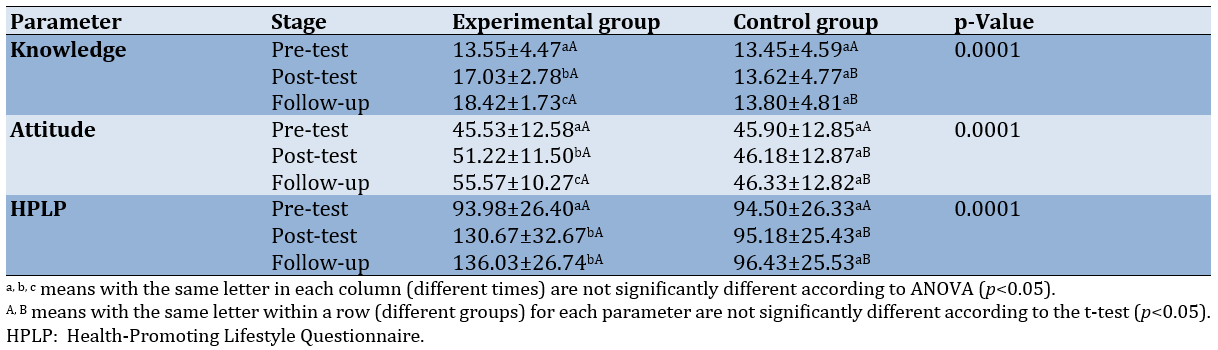
In addition, no significant differences were found between the control and experimental audience groups for knowledge, attitude, and HPLP scores at baseline. There were also significant interaction effects between time and group for all parameters. Furthermore, there were significant differences in changes from baseline to follow-up in the intervention group for knowledge, attitude, and HPLP scores (Table 2).
Table 2. Within-group changes in the audience group from baseline through follow-up
Discussion
The purpose of this study was to investigate the effects of an educational intervention utilizing the SHEP model on students’ health-promoting lifestyle, attitude, and knowledge regarding diabetes prevention. By implementing this intervention, the researchers aimed to assess whether the SHEP model could positively influence these outcomes among the student participants. Diabetes is a prevalent metabolic disorder that can have long-lasting effects on a person’s health. It is important to recognize the implications of diabetes, especially in advanced stages, as neglecting its management can lead to irreversible physical and spiritual harm. On the other hand, timely awareness and education can help prevent such losses and slow the progression of the disease [22]. Health education and behavioural enhancement methods have proven effective in preventing and managing diabetes. The SHEP model, based on the theory of knowledge management, is a novel tool used in the health education and promotion system [17].
It is important to note that no similar articles utilizing the SHEP model for diabetes prevention were found during our literature search. Therefore, in the discussion section, a comparative analysis was made with studies applying the SHEP model to other behaviours, as well as education-related studies using different models for diabetes prevention. The absence of similar articles for review and comparison was acknowledged as a limitation of this study. By addressing this gap in research, it contributes to the existing body of knowledge on health education interventions for diabetes prevention and management.
Participants in the intervention group showed significant improvements in their knowledge scores immediately after the intervention and three months later. This suggests that the educational intervention based on the SHEP model effectively enhanced participants’ knowledge about diabetes prevention. These findings are consistent with previous studies that have applied the SHEP model or similar educational interventions for diabetes prevention [17]. In the study by Safajou et al., the intervention group shows a statistically significant increase in mean knowledge scores at multiple time points, while the control group do not show such improvements [23]. Similarly, Peyman & Alipour Anbarani’s research demonstrates that diabetes prevention behaviour training leads to a significant increase in knowledge, attitude, and practice scores among students [24]. The study conducted by Mirzaii et al. demonstrates the effectiveness of training using the SHEP model with peer trainers in enhancing women’s knowledge about breast cancer screening [18]. Their findings, aligning with ours but with a different educational focus, suggested that the SHEP model facilitates superior and more impactful learning among students. Additionally, Akbarzadeh et al.'s study, by utilizing a combination of peer-led and professional-led education, aimed to assess the effectiveness of this approach in enhancing knowledge and promoting positive attitudes toward breast self-examination among the student participants [25]. Similarly, Malak & Dicle examined the efficacy of matching coaches with female students in Turkey to enhance their health-related knowledge [26]. Both studies found that training with matched trainers is associated with increased knowledge scores among participants. The SHEP model, with its emphasis on knowledge management, appears to be a valuable framework for designing and implementing such interventions. These findings reinforce the importance of tailored and engaging educational strategies in promoting knowledge acquisition and behaviour change among students.
Participants in the intervention group had significantly higher attitude scores immediately after the intervention and three months later. This suggests that the educational intervention based on the SHEP model effectively influenced participants’ attitudes related to diabetes prevention. The cultivation of attitudes is an important aspect of education and requires a relevant and effective approach to enhance attitudes [27]. In our research, the observed elevation in attitude scores may be attributed to the effectiveness of student educators in positively influencing the audience group’s attitudes. Peer education involves dynamic group problem-solving, which is crucial for creating a successful program. Effective education goes beyond knowledge acquisition and also involves examining values and attitudes. We utilized educational methods such as group discussions, brainstorming, and problem-solving skills to influence participants’ attitudes. It was emphasized that simply providing information alone is not enough to bring about a desired change in behaviour unless it also leads to a change in attitude. The use of peer educators and interactive educational methods played a crucial role in shaping these attitudes. These findings underscore the significance of addressing attitudes alongside knowledge acquisition in health education interventions. Safajou et al. also emphasize the need for a change in attitude alongside knowledge acquisition for effective behaviour change [23]. Akbarzadeh et al. examined the effectiveness of peer health educators in reshaping students’ attitudes through teaching. The researchers found that this form of instruction has the potential to enhance students’ attitudes. In their study, there is a significant difference in average attitude scores between the two groups immediately after the intervention, and this difference persists one month later [25]. Similarly, Mirzaii et al. highlight the effectiveness of training using the SHEP model with peer trainers in reforming women’s attitudes toward breast cancer screening [17]. These studies collectively demonstrate that educational interventions utilizing peer educators or trainers can effectively reshape attitudes. The findings suggest that peer education is a valuable approach for promoting positive attitudes towards health-related behaviours.
There was a significant change in mean HPLP scores between the pre-test and immediate post-test, as well as 3 months after the intervention, within the experimental group. These scores were notably higher than those of the control group. This suggests that the intervention had a positive effect on participants’ lifestyles. One strength of our study compared to other studies is the emphasis on skills of problem-solving, brainstorming, and discussion in groups to enhance participants’ self-actualization. By incorporating these interactive and participatory activities into the educational intervention, we provided a platform for students to actively engage in the learning process and apply their knowledge in real-life scenarios. Therefore, cognitive and behavioural interventions aimed at modifying and improving health-related lifestyles are crucial [28, 29]. Lifestyle changes can help individuals with diabetes maintain better health and reduce various related issues, including hypertension [30]. Educational interventions have been shown to significantly increase individuals’ awareness and understanding of their health status, leading to changes in their health-related behaviours [12]. Understanding the role of these factors in predicting diabetes risk can inform interventions aimed at promoting healthier lifestyles and preventing the onset of the disease. By addressing irrational health beliefs and encouraging a health-oriented lifestyle, healthcare professionals can help individuals reduce their risk of developing diabetes and improve their overall well-being [31]. Healthcare training plays a vital role in promoting beneficial behavioural patterns by providing necessary knowledge and cultivating positive attitudes towards specific health-related behaviours [24, 32]. Ebrahimi et al. supports the impact of educational interventions on women’s lifestyles. The intervention group shows improvements in various dimensions of lifestyle [30]. Similarly, Khani Jeihooni et al. found that the mean scores of different lifestyle dimensions significantly increase following an educational intervention [33]. These studies collectively demonstrate the effectiveness of educational interventions in promoting lifestyle modification.
Our research aligns with previous studies that have highlighted the efficacy of the SHEP model in promoting various health-related behaviours. For example, Sevil et al. explored the effects of a peer education project on breast screening in Turkey and reported positive results [34]. Mirzaii et al.'s study highlights the importance of using a comprehensive educational approach, such as the SHEP model, combined with peer trainers, to improve women’s knowledge, self-efficacy, and intention for breast cancer screening [18]. Despite variations in the specific focus of these studies, the findings consistently support the efficacy of the SHEP model in promoting positive health-related behaviours and lifestyle changes.
Our study has several limitations. Firstly, the sample was confined to a specific group of female university students, which may restrict the generalizability of the findings to the larger population. Additionally, the use of self-report data carries the risk of bias, as participants might not accurately portray their behaviours or attitudes. Moreover, the short time frame between the pre- and post-tests poses another limitation; conducting a longer-term follow-up evaluation would be beneficial for assessing the lasting effects of the educational intervention on behaviour change over time.
In conclusion, the SHEP model’s approach of matching coaches to specific audiences, promoting open discussions, and tailoring education to local culture has proven effective in enhancing attitudes, values, and knowledge. Its cost-efficiency and adaptability make it a valuable tool for healthcare education. The application of this model in diabetes prevention training among university students shows promise for future research and development using this learning approach.
Conclusion
The health education and promotion model, with its approach of matching coaches to specific audiences, promoting open discussions, and tailoring education to local culture, is effective in enhancing attitudes, values, and knowledge.
Acknowledgments: The authors wish to express their gratitude towards the Social Determinants of Health Research Center and the vice president of research at Mashhad University of Medical Sciences.
Ethical Permissions: The study was approved by the Mashhad University of Medical Sciences ethics board (Number: IR.MUMS.FHMPM.REC.1402.167).
Conflicts of Interests: The authors declared that they have no competing interests.
Authors' Contribution: Mohammadi M (First Author), Assistant Researcher (20%); Mohammadnabizadeh S (Second Author), Introduction Writer/Methodologist/Main Researcher/Discussion Writer/Statistical Analyst (80%)
Funding/Support: No funding was received.
Type 2 diabetes mellitus (T2DM) is a costly disease that has a global impact on individuals, economies, healthcare systems, and entire societies [1]. T2DM represents 95% of all diabetes cases [2] and is progressively evolving into a widespread non-communicable health issue, contributing to considerable illness and death [3]. The World Health Organization has reported that the number of individuals with diabetes in Iran was 2,300,110 in 2000, and this figure is projected to rise to 6,421,000 by 2030 [4]. Furthermore, considering that 50% of individuals with diabetes are unaware of their condition, and that the onset of diabetes in Iran occurs 5 to 10 years earlier than the global average, it is anticipated that the actual prevalence of diabetes in Iran exceeds the aforementioned estimates [5].
Unhealthy lifestyle behaviours, such as poor diet, smoking and drug use, insufficient physical activity, disrupted sleep patterns, and stress, have been identified as independent risk factors for developing diabetes [6, 7]. Numerous studies conducted over the past two decades have demonstrated the effectiveness of lifestyle interventions in preventing diabetes. For instance, prospective randomized studies have shown that modifying diet and engaging in regular exercise can reduce the risk of developing diabetes [8, 9]. Furthermore, evidence suggests that lifestyle changes can help mitigate the impact of genetic factors on diabetes risk. These findings highlight the significant and long-lasting benefits of lifestyle interventions in preventing T2DM [10]. Moreover, improving individuals’ knowledge and attitudes towards T2DM and its complications has been shown to have substantial advantages. These include preventing diabetes, maintaining optimal blood sugar levels, enhancing treatment adherence, reducing treatment costs, and slowing disease progression [11].
Education plays a crucial role in healthcare today, particularly in promoting lifestyle changes and self-management [7, 12]. As individuals become more engaged in health-related activities, effective healthcare education and promotion are essential. This is achieved through efficient instructional techniques [13, 14]. The use of theories and models in healthcare education provides a systematic view of events and helps assess the success and shortcomings of interventions [15]. These theories and models serve as a roadmap for planning, implementing, and evaluating educational interventions, and they provide valuable information for the educational process [12, 16].
The development of the systematic, comprehensive health education and promotion (SHEP) model aimed to improve health literacy by utilizing educators who have received specialized training. This model is characterized by its comprehensiveness and systematic approach [17]. The ‘comprehensive’ aspect of the SHEP model involves including all relevant health concepts that contribute to enhancing health literacy. The trainer delivers content to the audience based on the target group’s specific characteristics and needs. The ‘systematic’ nature of the model means that the program follows a flowchart that encompasses all components, including evaluation, research, development of educational packages, workshops, and stages of monitoring and evaluation. The SHEP model consists of three main stages: Valuation, implementation, and assessment. The evaluation stage involves activities such as literature review, selection of research topics, and provision of educational content. The implementation stage includes designing visual training tools, training educators, and conducting audience training. The assessment stage of the program incorporates short-term, medium-term, and long-term evaluations to gauge the program’s effectiveness [18].
Despite reports of increased awareness among trainees using the SHEP educational materials in various provinces in Iran, there is a lack of studies utilizing this approach. Therefore, it is crucial to establish and implement regular training for students as both instructors and end users to enhance health awareness and literacy in this important segment of society. The findings of this research can have implications across different managerial and executive levels. The purpose of this study was to investigate the effects of an educational intervention utilizing the SHEP model on students’ health-promoting lifestyle, attitude, and knowledge regarding diabetes prevention.
Materials and Methods
Design and sample
This quasi-experimental intervention was conducted among university students in Mashhad, Iran, in 2024. It involved six student trainers and 120 audience members who were divided into experimental and control groups. For the educational intervention program, one trainer was assigned for every ten participants from the experimental audience group, resulting in a total of six trainers. The eligibility criteria for this study included Iranian nationality, not having participated in any relevant educational programs for at least six months prior to the study, actively participating in training sessions, not having diabetes, and expressing willingness to take part in the study. The exclusion criteria encompassed participants who were unwilling to continue their participation, provided incomplete questionnaire responses, failed to take part in any tests or assessments, or did not attend the training sessions.
The sample size for the audience was determined using an appropriate formula based on previous studies [19]. With a power of 0.80, a mean difference of 48.47, and standard deviations of 12.98 and 12.09, and at a confidence level of 0.95, the initial estimated sample size was 52 cases per group. To account for potential subject attrition, the final sample size for each group was determined to be 60 cases.
Data collection
The data collection tools used included measures of personal characteristics, knowledge about diabetes, attitudes toward diabetes prevention and management, and health-promoting lifestyle behaviors.
The personal information questionnaire collected data on age, marital status, and personal and family history of diabetes.
The knowledge questionnaire comprised 10 items that assessed participants’ understanding of diabetes symptoms, diagnostic methods, complications, and preventive behaviours. Participants were asked to indicate whether each statement was true, false, or whether they had no idea. For each correct response, one point was awarded; incorrect answers or “do not know” responses received zero points. The total knowledge score ranged from 0 to 20. The validity of this questionnaire was confirmed by Ghazanfari et al. [20].
The attitude questionnaire comprised 15 statements in which participants rated their agreement on a 5-point Likert scale. The responses ranged from “totally disagree” (score 1) to “absolutely agree” (score 5), yielding a possible score range of 15 to 75 for each participant. The validity of this scale was also confirmed by Ghazanfari et al. [20].
The Health-Promoting Lifestyle Questionnaire (HPLP) consisted of 52 items that evaluated participants’ engagement in health-promoting behaviours across six dimensions: physical activity, diet, health responsibility, interpersonal relations, stress management, and self-actualization. Participants rated the frequency of engaging in these behaviours on a scale from never (score 1) to always (score 4). The total HPLP score ranged from 52 to 208. The Persian version of the HPLP questionnaire was validated by Mohammadi Zeidi et al. [21]. The reliability computed from a pilot study of 30 cases using Cronbach’s alpha yielded values of 0.78 for knowledge, 0.75 for attitude, and 0.88 for HPLP, respectively.
Procedure
Written informed consent was obtained from all participants after explaining the aim of the study. In the first phase, an educational intervention based on the SHEP model was implemented through workshops comprising four 2-hour sessions for trainers. First, a pre-test was administered using the questionnaires mentioned earlier to assess participants’ knowledge, attitudes, and HPLP. Following the pre-test, the trainers reviewed education and communication skills and presented educational materials based on the prepared training packages. The educational package covered various aspects of diabetes, including its framework, risk factors, signs and symptoms, screening techniques, preventive measures, and health-enhancing behaviours. The training was delivered using different educational approaches such as lectures, group discussions, question and answer sessions, brainstorming and problem-solving skills, and the use of visual aids like PowerPoint presentations and pamphlets. Then, each trainer received a diabetes education package and was instructed to practice delivering the educational material according to the principles taught. This allowed trainers to familiarize themselves with the content and delivery methods. In the last workshop session, each trainer presented the contents of their assigned topic, and their peers provided feedback by identifying strengths and limitations in their presentations. This peer feedback helped improve the trainers’ delivery skills and ensured they were well-prepared to deliver effective diabetes education.
During the second phase of the study, the trainers conducted the training program (eight 1-hour sessions) for the experimental group of the target audience. This program utilized various educational approaches such as lectures, group discussions, question and answer sessions, and the distribution of educational materials based on the SHEP model. The control group did not receive any training during this period.
Questionnaires were completed by the participants 3 times before the intervention, immediately after the educational intervention, and 3 months’ follow-up.
Data analysis
Data analysis was performed using SPSS 22. The first step involved assessing the normality of the variables using the Kolmogorov–Smirnov test. To analyze group differences and changes in outcome parameters over time, a two-way repeated-measures ANOVA was performed. The significance level was set at α=0.05.
Findings
At baseline, participants in all groups had similar demographic characteristics, with no significant differences among them. The mean age was 44.0±7.2 years in the experimental group and 45.0±7.7 years in the control group (p=0.85). In terms of marital status, 10 participants (16.7%) in the experimental group and 7 participants (11.7%) in the control group were married, while 50 participants (83.3%) in the experimental group and 53 participants (88.3%) in the control group were single (p=0.73). For family history of diabetes, 11 participants (18.3%) in the experimental group and 18 participants (30%) in the control group had a history, and 49 (81.7%) in the experimental group and 42 (70%) in the control group had no family history of diabetes (p=0.30).
At baseline, the mean scores for knowledge, attitude, and HPLP scores were lower in the trainers’ group. However, after the intervention, scores increased immediately and remained higher at three months follow-up (Table 1).
Table 1. Comparison of the mean scores for the trainer group at pre-test, post-test, and follow-up
In addition, no significant differences were found between the control and experimental audience groups for knowledge, attitude, and HPLP scores at baseline. There were also significant interaction effects between time and group for all parameters. Furthermore, there were significant differences in changes from baseline to follow-up in the intervention group for knowledge, attitude, and HPLP scores (Table 2).
Table 2. Within-group changes in the audience group from baseline through follow-up
Discussion
The purpose of this study was to investigate the effects of an educational intervention utilizing the SHEP model on students’ health-promoting lifestyle, attitude, and knowledge regarding diabetes prevention. By implementing this intervention, the researchers aimed to assess whether the SHEP model could positively influence these outcomes among the student participants. Diabetes is a prevalent metabolic disorder that can have long-lasting effects on a person’s health. It is important to recognize the implications of diabetes, especially in advanced stages, as neglecting its management can lead to irreversible physical and spiritual harm. On the other hand, timely awareness and education can help prevent such losses and slow the progression of the disease [22]. Health education and behavioural enhancement methods have proven effective in preventing and managing diabetes. The SHEP model, based on the theory of knowledge management, is a novel tool used in the health education and promotion system [17].
It is important to note that no similar articles utilizing the SHEP model for diabetes prevention were found during our literature search. Therefore, in the discussion section, a comparative analysis was made with studies applying the SHEP model to other behaviours, as well as education-related studies using different models for diabetes prevention. The absence of similar articles for review and comparison was acknowledged as a limitation of this study. By addressing this gap in research, it contributes to the existing body of knowledge on health education interventions for diabetes prevention and management.
Participants in the intervention group showed significant improvements in their knowledge scores immediately after the intervention and three months later. This suggests that the educational intervention based on the SHEP model effectively enhanced participants’ knowledge about diabetes prevention. These findings are consistent with previous studies that have applied the SHEP model or similar educational interventions for diabetes prevention [17]. In the study by Safajou et al., the intervention group shows a statistically significant increase in mean knowledge scores at multiple time points, while the control group do not show such improvements [23]. Similarly, Peyman & Alipour Anbarani’s research demonstrates that diabetes prevention behaviour training leads to a significant increase in knowledge, attitude, and practice scores among students [24]. The study conducted by Mirzaii et al. demonstrates the effectiveness of training using the SHEP model with peer trainers in enhancing women’s knowledge about breast cancer screening [18]. Their findings, aligning with ours but with a different educational focus, suggested that the SHEP model facilitates superior and more impactful learning among students. Additionally, Akbarzadeh et al.'s study, by utilizing a combination of peer-led and professional-led education, aimed to assess the effectiveness of this approach in enhancing knowledge and promoting positive attitudes toward breast self-examination among the student participants [25]. Similarly, Malak & Dicle examined the efficacy of matching coaches with female students in Turkey to enhance their health-related knowledge [26]. Both studies found that training with matched trainers is associated with increased knowledge scores among participants. The SHEP model, with its emphasis on knowledge management, appears to be a valuable framework for designing and implementing such interventions. These findings reinforce the importance of tailored and engaging educational strategies in promoting knowledge acquisition and behaviour change among students.
Participants in the intervention group had significantly higher attitude scores immediately after the intervention and three months later. This suggests that the educational intervention based on the SHEP model effectively influenced participants’ attitudes related to diabetes prevention. The cultivation of attitudes is an important aspect of education and requires a relevant and effective approach to enhance attitudes [27]. In our research, the observed elevation in attitude scores may be attributed to the effectiveness of student educators in positively influencing the audience group’s attitudes. Peer education involves dynamic group problem-solving, which is crucial for creating a successful program. Effective education goes beyond knowledge acquisition and also involves examining values and attitudes. We utilized educational methods such as group discussions, brainstorming, and problem-solving skills to influence participants’ attitudes. It was emphasized that simply providing information alone is not enough to bring about a desired change in behaviour unless it also leads to a change in attitude. The use of peer educators and interactive educational methods played a crucial role in shaping these attitudes. These findings underscore the significance of addressing attitudes alongside knowledge acquisition in health education interventions. Safajou et al. also emphasize the need for a change in attitude alongside knowledge acquisition for effective behaviour change [23]. Akbarzadeh et al. examined the effectiveness of peer health educators in reshaping students’ attitudes through teaching. The researchers found that this form of instruction has the potential to enhance students’ attitudes. In their study, there is a significant difference in average attitude scores between the two groups immediately after the intervention, and this difference persists one month later [25]. Similarly, Mirzaii et al. highlight the effectiveness of training using the SHEP model with peer trainers in reforming women’s attitudes toward breast cancer screening [17]. These studies collectively demonstrate that educational interventions utilizing peer educators or trainers can effectively reshape attitudes. The findings suggest that peer education is a valuable approach for promoting positive attitudes towards health-related behaviours.
There was a significant change in mean HPLP scores between the pre-test and immediate post-test, as well as 3 months after the intervention, within the experimental group. These scores were notably higher than those of the control group. This suggests that the intervention had a positive effect on participants’ lifestyles. One strength of our study compared to other studies is the emphasis on skills of problem-solving, brainstorming, and discussion in groups to enhance participants’ self-actualization. By incorporating these interactive and participatory activities into the educational intervention, we provided a platform for students to actively engage in the learning process and apply their knowledge in real-life scenarios. Therefore, cognitive and behavioural interventions aimed at modifying and improving health-related lifestyles are crucial [28, 29]. Lifestyle changes can help individuals with diabetes maintain better health and reduce various related issues, including hypertension [30]. Educational interventions have been shown to significantly increase individuals’ awareness and understanding of their health status, leading to changes in their health-related behaviours [12]. Understanding the role of these factors in predicting diabetes risk can inform interventions aimed at promoting healthier lifestyles and preventing the onset of the disease. By addressing irrational health beliefs and encouraging a health-oriented lifestyle, healthcare professionals can help individuals reduce their risk of developing diabetes and improve their overall well-being [31]. Healthcare training plays a vital role in promoting beneficial behavioural patterns by providing necessary knowledge and cultivating positive attitudes towards specific health-related behaviours [24, 32]. Ebrahimi et al. supports the impact of educational interventions on women’s lifestyles. The intervention group shows improvements in various dimensions of lifestyle [30]. Similarly, Khani Jeihooni et al. found that the mean scores of different lifestyle dimensions significantly increase following an educational intervention [33]. These studies collectively demonstrate the effectiveness of educational interventions in promoting lifestyle modification.
Our research aligns with previous studies that have highlighted the efficacy of the SHEP model in promoting various health-related behaviours. For example, Sevil et al. explored the effects of a peer education project on breast screening in Turkey and reported positive results [34]. Mirzaii et al.'s study highlights the importance of using a comprehensive educational approach, such as the SHEP model, combined with peer trainers, to improve women’s knowledge, self-efficacy, and intention for breast cancer screening [18]. Despite variations in the specific focus of these studies, the findings consistently support the efficacy of the SHEP model in promoting positive health-related behaviours and lifestyle changes.
Our study has several limitations. Firstly, the sample was confined to a specific group of female university students, which may restrict the generalizability of the findings to the larger population. Additionally, the use of self-report data carries the risk of bias, as participants might not accurately portray their behaviours or attitudes. Moreover, the short time frame between the pre- and post-tests poses another limitation; conducting a longer-term follow-up evaluation would be beneficial for assessing the lasting effects of the educational intervention on behaviour change over time.
In conclusion, the SHEP model’s approach of matching coaches to specific audiences, promoting open discussions, and tailoring education to local culture has proven effective in enhancing attitudes, values, and knowledge. Its cost-efficiency and adaptability make it a valuable tool for healthcare education. The application of this model in diabetes prevention training among university students shows promise for future research and development using this learning approach.
Conclusion
The health education and promotion model, with its approach of matching coaches to specific audiences, promoting open discussions, and tailoring education to local culture, is effective in enhancing attitudes, values, and knowledge.
Acknowledgments: The authors wish to express their gratitude towards the Social Determinants of Health Research Center and the vice president of research at Mashhad University of Medical Sciences.
Ethical Permissions: The study was approved by the Mashhad University of Medical Sciences ethics board (Number: IR.MUMS.FHMPM.REC.1402.167).
Conflicts of Interests: The authors declared that they have no competing interests.
Authors' Contribution: Mohammadi M (First Author), Assistant Researcher (20%); Mohammadnabizadeh S (Second Author), Introduction Writer/Methodologist/Main Researcher/Discussion Writer/Statistical Analyst (80%)
Funding/Support: No funding was received.
References
1. McGill RL, Bragg-Gresham JL, He K, Lacson EK Jr, Miskulin DC, Saran R. Chronic disease burdens of incident U.S. dialysis patients, 1996-2015. Clin Nephrol. 2020;93(1):1-8. [Link] [DOI:10.5414/CN109745]
2. Guariguata L, Whiting DR, Hambleton I, Beagley J, Linnenkamp U, Shaw JE. Global estimates of diabetes prevalence for 2013 and projections for 2035. Diabetes Res Clin Pract. 2014;103(2):137-49. [Link] [DOI:10.1016/j.diabres.2013.11.002]
3. Fan W. Epidemiology in diabetes mellitus and cardiovascular disease. Cardiovasc Endocrinol. 2017;6(1):8-16. [Link] [DOI:10.1097/XCE.0000000000000116]
4. Salehi M, Mesgarani A, Karimipour S, Pasha SZ, Kashi Z, Abedian S, et al. Comparison of salivary cortisol level in type 2 diabetic patients and pre-diabetics with healthy people. Open Access Maced J Med Sci. 2019;7(14):2321-7. [Link] [DOI:10.3889/oamjms.2019.340]
5. Larijani B, Abolhasani F, Mohajeri-Tehrani MR, Tabtabaie O. Prevalence of diabetes mellitus in Iran in 2000. Iran J Diabetes Metab. 2005;4(3):75-83. [Persian] [Link]
6. Rockette-Wagner B, Edelstein S, Venditti EM, Reddy D, Bray GA, Carrion-Petersen ML, et al. The impact of lifestyle intervention on sedentary time in individuals at high risk of diabetes. Diabetologia. 2015;58(6):1198-202. [Link] [DOI:10.1007/s00125-015-3565-0]
7. Mohammad Nabizadeh S. Examining the impact of an educational intervention on enhancing different aspects of health-promoting behaviors: Using the BAZNEF model. Health Educ. 2025;125(5):553-61. [Link] [DOI:10.1108/HE-09-2024-0110]
8. Li G, Zhang P, Wang J, Gregg EW, Yang W, Gong Q, et al. The long-term effect of lifestyle interventions to prevent diabetes in the China Da Qing diabetes prevention study: A 20-year follow-up study. Lancet. 2008;371(9626):1783-9. [Link] [DOI:10.1016/S0140-6736(08)60766-7]
9. Ramachandran A, Snehalatha C, Mary S, Mukesh B, Bhaskar AD, Vijay V, et al. The Indian diabetes prevention programme shows that lifestyle modification and metformin prevent type 2 diabetes in Asian Indian subjects with impaired glucose tolerance (IDPP-1). Diabetologia. 2006;49(2):289-97. [Link] [DOI:10.1007/s00125-005-0097-z]
10. Yoon U, Kwok LL, Magkidis A. Efficacy of lifestyle interventions in reducing diabetes incidence in patients with impaired glucose tolerance: A systematic review of randomized controlled trials. BMC Proc. 2012;6(3):P28. [Link] [DOI:10.1186/1753-6561-6-S3-P28]
11. Schapira M, Swartz S, Ganschow P, Jacobs E, Neuner J, Walker C, et al. Tailoring educational and behavioral interventions to level of health literacy: A systematic review. MDM Policy Pract. 2017;2(1):238146831771447. [Link] [DOI:10.1177/2381468317714474]
12. Mohammadnabizadeh S, Najafpoor AA, Ghavami V. Effect of health education on COVID-19 preventive behaviors in oil industry workers: An application of health belief model. J Res Health. 2023;13(5):343-50. [Link] [DOI:10.32598/JRH.13.5.2135.1]
13. Iquize R, Theodoro F, Andrea K, Oliveira M, Barros J, Silva A. Educational practices in diabetic patient and perspective of health professional: A systematic review. J Braz Soc Nephrol. 2017;39(2):196-204. [Link] [DOI:10.5935/0101-2800.20170034]
14. Mohammad Nabizadeh S, Taymoori P, Hazhir MS, Roshani D. Educational intervention based on protection motivation theory to improve vitamin E and C consumption among Iranian factory workers. J Clin Diagn Res. 2018;12(10):JC01-6. [Link] [DOI:10.7860/JCDR/2018/37056.12079]
15. Mohammadnabizadeh S, Mohammadi M. Predicting mammography behaviour based on the integrated model of the theory of planned behaviour and the health belief model among Iranian women in the pre-menopausal stage. Int J Health Promot Educ. 2025. [Link] [DOI:10.1080/14635240.2025.2489377]
16. Nabizadeh SM, Taymoori P, Shahmoradi B, Roshani D. Effects of face-to-face education on vitamins consumption using protection motivation theory. J Biochem Tech. 2018;9(2):145-52. [Link]
17. Mirzaii K, Nesari Ashkezari S, Khadivzadeh T, Shakeri Mt. The effect of education based on systematic comprehensive health education and promotion model to health volunteers on their female clients' knowledge regarding breast cancer screening. J Midwifery Reprod Health. 2017;5(3):998-1007. [Link]
18. Mirzaii K, Nessari Ashkezari S, Khadivzadeh T, Shakeri MT. Evaluation of the effects of breast cancer screening training based on the systematic comprehensive health education and promotion model on the attitudes and breast self-examination skills of women. Evid Based Care J. 2016;6(3):7-18. [Link]
19. Bahramian Z, Moghimian M, Azarbarzin M. The effect of education based on health belief model on health-promoting the lifestyle of patients with type 2 diabetes. DANESHVAR Med. 2022;30(3):42-51. [Persian] [Link]
20. Ghazanfari Z, Ghofranipour F, Tavafian S, Ahmadi F, Rajab A. Lifestyle education and diabetes mellitus type 2: A non-randomized control trial. Iran J Public Health. 2007;36(2). [Link]
21. Mohammadi Zeidi I, Pakpour Hajiagha A, Mohammadi Zeidi B. Reliability and validity of Persian version of the health-promoting lifestyle profile. J Mazandaran Univ Med Sci. 2011;20(1):102-13. [Persian] [Link]
22. Mohammadi M, Mohammadnabizadeh S. Investigating the effect of educational intervention based on the BAZNEF model on the improvement of various dimensions of quality of life in university students. Adv Health Behav. 2025;8(1):312-20. [Link] [DOI:10.25082/AHB.2025.01.001]
23. Safajou S, Rezaeian M, Salim Abadi Y, Mazar L, Nasirzadeh M. The effect of educational intervention on the preventive behaviors of diabetes based on the health belief model among at-risk male students in the second grade of Khash High School in 2019: A quasi-experimental study. J Rafsanjan Univ Med Sci. 2022;21(5):515-32. [Persian] [Link] [DOI:10.52547/jrums.21.5.515]
24. Peyman N, Alipour Anbarani M. The effect of training diabetes prevention behaviors on promotion of knowledge, attitude and practice of students for prevention of diabetes in Mashhad City. J Pediatr Perspect. 2015;3(2.2):501-7. [Link]
25. Akbarzadeh M, Zangiabadi M, Moattari M, Tabatabaei H. Comparing the effect of teaching breast self-examination by peers and health care personnel on students knowledge and attitude. Iran J Med Educ. 2009;8(2):195-203. [Persian] [Link]
26. Malak AT, Dicle A. Assessing the efficacy of a peer education model in teaching breast self-examination to university students. Asian Pac J Cancer Prev. 2007;8(4):481-4. [Link]
27. Peyman N, Amani M, Esmaili H. The relationship between health literacy and constructs of theory of planned behavior and breast cancer screening tests performance among women referred to health care centers in Roshtkhar, 2015. Iran J Breast Dis. 2016;9(3):60-9. [Persian] [Link]
28. Mohammadnabizadeh S, Mohammadi M. Investigating the role of lifestyle, knowledge and health beliefs in performing preventive behaviours against human papilloma virus in married women. Appl Nurs Res. 2025;81:151901. [Link] [DOI:10.1016/j.apnr.2025.151901]
29. Mohammadnabizadeh S. Predicting mammography screening behavior among women employed at university: A theory of planned behavior approach. J Educ Community Health. 2024;11(3):150-5. [Link] [DOI:10.34172/jech.2943]
30. Ebrahimi F, Aghamolaei T, Abedini S, Rafati S. Effect of educational intervention using mobile on life style of women who referred to health centers in Bandar Abbas. Iran J Health Educ Health Promot. 2017;5(2):81-9. [Persian] [Link] [DOI:10.30699/acadpub.ijhehp.5.2.81]
31. Pitel L, Mikušková EB. The irrational health beliefs scale and health behaviors in a non-clinical population. Eur J Health Psychol. 2021;28(3):111-9. [Link] [DOI:10.1027/2512-8442/a000075]
32. Mohammadnabizadeh S, Najafpoor AA, Vahedian-Shahroodi M, Ghavami V. Effects of educational intervention on promoting preventive behaviors of cardiovascular disease using the health belief model in oil regions workers. J Educ Community Health. 2022;9(4):221-7. [Link] [DOI:10.34172/jech.2022.1852]
33. Khani Jeihooni A, Sobhani A, Afzali Harsini P, Amirkhani M. Effect of educational intervention based on PRECEDE model on lifestyle modification, self-management behaviors, and hypertension in diabetic patients. BMC Endocr Disord. 2023;23(1):6. [Link] [DOI:10.1186/s12902-023-01264-y]
34. Sevil U, Atan SU, Kiris H, Tok F, Colak G, Sagit B, et al. Peer education project on breast self-examination in Izmir, Turkey. Asian Pac J Cancer Prev. 2005;6(1):29-32. [Link]
Send email to the article author