

TMU
Owner
Tarbiat Modares University (TMU) is the owner of HEHP.

0.8
Cite Score 2025
Volume 13, Issue 4 (2025)
Health Educ Health Promot 2025, 13(4): 777-782 |
Back to browse issues page
Article Type:




History
Received: 2025/12/3 | Accepted: 2025/12/28 | Published: 2025/11/19
Received: 2025/12/3 | Accepted: 2025/12/28 | Published: 2025/11/19
How to cite this article
Panahi R, Shokhmgar Z, Sarvari M H, Hosseini S H, Ghorbani S. Adoption of Hypertension Preventive Behaviors among Rural Residents of Qayenat. Health Educ Health Promot 2025; 13 (4) :777-782
URL: http://hehp.daneshafarand.org/article-4-83023-en.html
URL: http://hehp.daneshafarand.org/article-4-83023-en.html
Download citation:
BibTeX | RIS | EndNote | Medlars | ProCite | Reference Manager | RefWorks
Send citation to:


Rights and permissions
BibTeX | RIS | EndNote | Medlars | ProCite | Reference Manager | RefWorks
Send citation to:

Authors
Rahman Panahi 
 , Zahra Shokhmgar , Mohammad Hadi Sarvari , Seyed hamid Hosseini , Sakineh Ghorbani *1
, Zahra Shokhmgar , Mohammad Hadi Sarvari , Seyed hamid Hosseini , Sakineh Ghorbani *1
| Abstract (HTML) (762 Views)
Full-Text: (119 Views)
Introduction
Hypertension is considered one of the major health and treatment problems worldwide. With significant progress made in controlling communicable diseases, the focus today has shifted more toward the control and treatment of non-communicable diseases [1]. It is a chronic condition in which the pressure of blood within the arteries is elevated. As a result of this increased pressure, the heart must work harder than normal to maintain blood circulation throughout the blood vessels. Blood pressure consists of two readings, systolic and diastolic, which correspond to the contraction and relaxation of the heart muscles between beats, respectively [2]. High blood pressure is defined as systolic blood pressure of 140mmHg or higher, diastolic blood pressure of 90mmHg or higher, or both [3].
Hypertension is one of the most significant risk factors for cardiovascular diseases. Its most important characteristic is its asymptomatic nature, which has led to it being called “the silent killer”. Additionally, diagnosing hypertension does not require advanced medical equipment, and it can be effectively managed through lifestyle changes and pharmacological treatments [4]. People with hypertension may experience a variety of symptoms, including headache, blurred vision, nausea, vomiting, seizures, heart failure, and oliguria (reduced urine output) [5].
More than 90% of hypertension cases are classified as primary (essential) hypertension, for which the exact cause is not fully understood. Nonetheless, both genetic and environmental factors are believed to play a role in its development. In contrast, secondary hypertension arises from identifiable conditions such as kidney and adrenal disorders, hormonal imbalances, and coarctation of the aorta, and can often be managed by treating the underlying cause [6]. If left untreated, approximately 50% of people with hypertension will die from coronary artery disease and congestive heart failure, 33% from stroke, and 10–15% from kidney complications. Other organs, including the eyes and major blood vessels, may also be affected [2]. Additionally, hypertension contributes to disability, increased mortality, and imposes significant economic burdens on society [7].
Azizi et al. found that the prevalence of hypertension in Iran is 22%, highlighting the high burden of this condition in the country [8]. While the significance of hypertension as a chronic disease and a major contributor to mortality is well established in developed countries, its importance is less widely recognized in developing nations [9]. In Iran, various studies have reported the prevalence of hypertension as 20.88% in Gonabad, 14% in Kermanshah, 20.82% in Tabriz, and 22% in Tehran [7]. According to research by Vazifeh et al., nearly 60% of people up to the age of 60 years have hypertension, and by the age of 70, approximately 65% of men and 75% of women are affected [10].
According to the National Survey of Risk Factors for Non-Communicable Diseases conducted in 2016, approximately 30% of Iran’s population over the age of 30 suffers from hypertension, which equates to more than 15 million individuals. Notably, only 60% of affected individuals are aware of their condition, just half of those diagnosed receive treatment with medication, and blood pressure is adequately controlled in only 19% of patients [11].
Some studies have reported a lower prevalence of hypertension and awareness in rural communities compared with urban populations, whereas others have noted a higher prevalence of hypertension in rural areas than in urban settings. For instance, in a study conducted in a major Iranian city (Isfahan), the prevalence of hypertension is higher among the urban population than among their rural counterparts [12].
The rising prevalence of hypertension worldwide serves as a serious warning of the need for increased attention to this disease. Evidence suggests that, in recent years, hypertension has become the leading cause of mortality among non-communicable diseases globally. Furthermore, it is projected that by 2025, approximately 1.5 billion people worldwide will be affected by hypertension [2].
Regarding the adoption of preventive behaviors for hypertension, limited studies have been conducted in Iran. For example, the results of a study by Ramezankhani et al. showed that mothers aged 20 to 49 years have a moderate level of engagement in preventive behaviors for hypertension [13].
Given the limited number of studies assessing preventive behaviors for hypertension among the adult population [13], the recognized importance of compliance with blood pressure-related behaviors in preventing the complications associated with hypertension [14], and the need to specifically evaluate these behaviors among rural residents, the present study was conducted to assess the extent to which preventive behaviors for hypertension are adopted and identify the factors influencing these behaviors among rural residents.
Instrument and Methods
The present descriptive-analytical, cross-sectional study was conducted on 300 rural residents of Qayenat County in 2024.
Sampling was conducted using a multi-stage random sampling approach. Initially, a comprehensive list of all villages, their associated health houses, and the respective covered populations was compiled. Subsequently, three villages were randomly selected from this list. Within each selected village, families were randomly selected, and from each family, one individual aged between 18 and 65 years was randomly recruited for participation.
The sample size was determined based on the prevalence of hypertension reported by Safari Moradabadi et al. (20%) [7], using the Cochran sample size formula with a precision level (d) of 0.05. Accordingly, the minimum required sample size was calculated to be 246 participants. Taking into account expert statistical opinion and accounting for a potential 20% attrition rate, the final sample size was increased to 300 individuals.
Eligibility criteria for participation included willingness to take part in the study, current residence in a rural area, having a registered health record in the SIB system, and possessing at least basic literacy (reading and writing skills). Exclusion criteria encompassed incomplete responses to the study questionnaires.
The data collection tools included a comprehensive questionnaire comprising two distinct sections.
The first section was designed to gather detailed information on the participants’ demographic and personal backgrounds. This section included items pertaining to age, gender, marital status, number of children, occupation, spouse’s occupation, level of education, spouse’s education level, economic status, body mass index (BMI), the average amount of weekly physical activity, cigarette and hookah (waterpipe) smoking habits, history of comorbid diseases, family history of hypertension, duration of hypertension (if present), history of antihypertensive medication use, and whether the participant had relatives or acquaintances suffering from hypertension.
The second section was dedicated to evaluating the adoption of preventive behaviors for hypertension, utilizing the questionnaire developed by Ramezankhani et al. [13]. This validated instrument comprised 8 items specifically focused on preventive behaviors. Response options for each item were scored on a 4-point Likert scale (ranging from 1 to 4), resulting in a total score range between 8 and 32, with higher scores indicating greater engagement in preventive behaviors.
The validity of this questionnaire was established through rigorous face and content validity procedures, referencing relevant scientific literature and reputable sources. The questionnaire underwent expert review by a panel consisting of five faculty members: two specialists in health education and promotion, one epidemiologist, one internal cardiologist, and two researchers with experience in the field of hypertension prevention. Modifications were made to address identified ambiguities and errors, and the final version was confirmed as valid. Reliability was ensured through both test-retest methodology and measurement of internal consistency (Cronbach’s alpha), with satisfactory results reported in the original development [13]. The instrument was pilot-tested on a sample of 30 individuals to further assess its reliability in the current context. The Cronbach’s alpha coefficient for the entire questionnaire was 0.93, indicating excellent internal consistency.
The study was conducted after approval from the Vice-Chancellor for Research and Technology at Birjand University of Medical Sciences. All necessary permissions and coordination were obtained with the selected rural health centers (health houses) prior to data collection. Before enrollment, the purpose and objectives of the study were fully explained to all prospective participants, and written informed consent was obtained from each individual. Participation in the study was entirely voluntary. Questionnaires were completed using a self-report method, with participants explicitly instructed to answer all items honestly and based on their own experiences. Participants were also assured that the information provided would be kept strictly confidential and analyzed anonymously, with no identifiers or names attached.
Upon completion, the collected data were entered into SPSS 23 software for analysis. Statistical analysis included multiple linear regression to identify predictors of preventive behaviors.
Findings
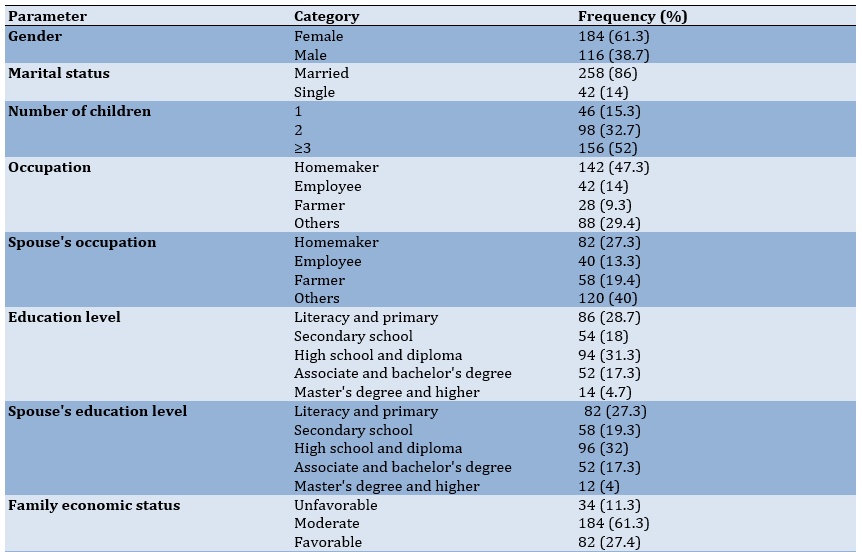
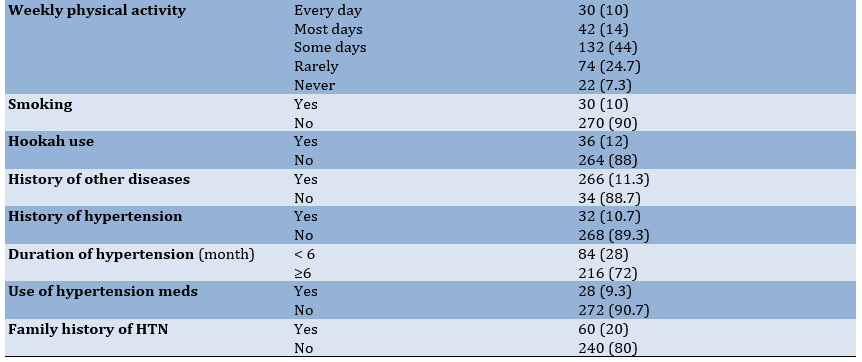
A total of 300 rural residents were examined (response rate: 100%). Among them, 61.3% (n=184) were female, 86% (n=258) were married, and 10.7% (n=32) had a past history of hypertension (Table 1). The mean age and BMI among the participating rural residents were 37.67±14.33 years and 23.28± 3.14kg/m², respectively. Furthermore, the mean score for adopting preventive behaviors for hypertension among them was 15.18±1.21 out of a possible 32, which was at an unfavorable level.
Table 1. Demographic and background characteristics of rural residents
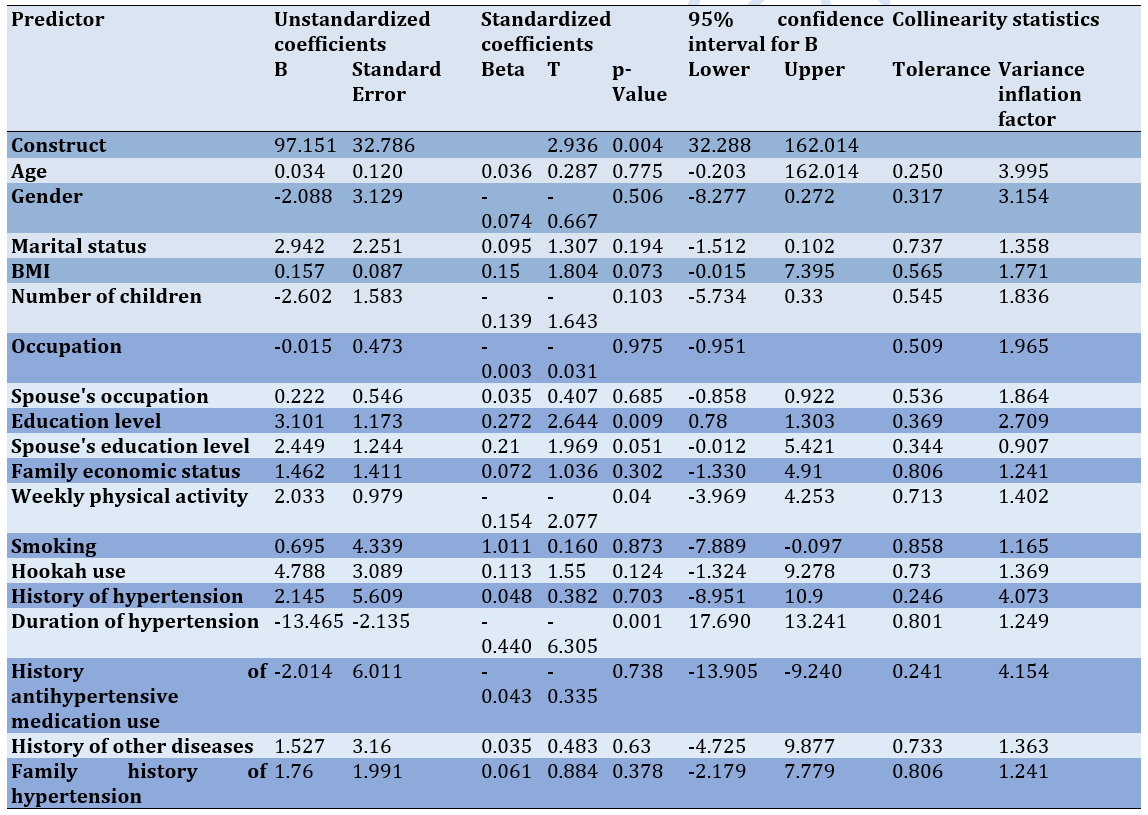
Education level, weekly physical activity, and duration of hypertension were significant predictors of preventive behavior adoption. Specifically, a higher level of education emerged as a strong predictor: for each incremental increase in education level, the likelihood of adopting preventive behaviors against hypertension increased by a factor of 3.10. Similarly, weekly physical activity was positively associated with the adoption of preventive behaviors, such that each additional unit of weekly physical activity resulted in a 2.03-fold increase in the likelihood of engaging in such behaviors. In contrast, the duration of hypertension demonstrated a negative effect. For every additional unit of time living with hypertension, the likelihood of adopting preventive behaviors decreased by a fastatistctor of 13.46. Other demographic and background parameters assessed did not exhibit ically significant associations with the adoption of preventive behaviors for hypertension (p>0.05; Table 2).
Table 2. Factors influencing the adoption of preventive behaviors against hypertension in multiple linear regression
Discussion
The present study aimed to assess the adoption of preventive behaviors against hypertension and the factors influencing it among rural residents. The adoption of preventive behaviors for hypertension was unfavorable. This finding may be explained by unfavorable knowledge and attitudes toward hypertension, since knowledge and attitude are prerequisites for behavior change [15,16]. Consistent with this, Koohi & Khalili [17] also report a low level of preventive-behavior adoption. By contrast, Ramezankhani et al. found that mothers aged 20 to 49 years living in urban areas have an average level of adoption of preventive behaviors for hypertension [13]. Possible reasons for this discrepancy include differences between the present study and the aforementioned study in factors such as age, gender, and educational level of the participants. Another important reason could be differences in access to healthcare centers between urban and rural populations.
Education level was one of the factors affecting the adoption of preventive behaviors against hypertension. This may reflect that science and knowledge contribute to individuals’ intellectual growth and excellence, and influence health-related behaviors. In addition, people with higher educational qualifications are likely to have more favorable knowledge and attitudes, and as a result, the adoption of preventive behaviors against hypertension is likely to be higher among them. Similarly, Babaei et al. [18], Rezaee Aderiani et al. [19], Sohng et al. [20], and Azadbakht et al. [21] report a significant relationship between education level and the adoption of preventive behaviors. In contrast, Panahi et al. [22] report no relationship between education level and the adoption of communicative behavior. Possible reasons for this discrepancy include differences between this study and the present study in terms of factors, such as the subject of the study, age, and gender of the participants.
Weekly physical activity was one of the factors affecting the adoption of preventive behaviors for hypertension. Physical activity, like adopting preventive behaviors for hypertension, is itself a form of preventive behavior. Therefore, physical activity can be said to influence a parameter of its own kind. Moreover, several studies have shown that physical activity can have a substantial effect on lowering blood pressure in individuals [23, 24]. Consistent with this, the review by Rêgo et al. show that physical activity is an effective and complementary tool for managing hypertension [25].
The duration of hypertension was another significant factor influencing the adoption of preventive behaviors against hypertension. This may be explained by the argument that as the duration of hypertension increases, individuals’ motivation and willingness to adopt behaviors aimed at controlling and reducing high blood pressure may decrease.
To our knowledge, this study is the first to examine the adoption of preventive behaviors against hypertension and the related demographic and contextual factors among the Iranian population, which constitutes an innovation of the present research. Limitations include self-reporting in questionnaire completion by rural residents, which may have led to inaccurate information. Other limitations include the small sample size, the limited number of studies on this topic—especially among rural residents—and the lack of access to rural residents who had traveled to urban areas. Additionally, because this study was conducted only among rural residents living in the villages of Qayenat City, the results cannot be generalized to rural residents in other regions of the country. Therefore, it is recommended that similar studies be conducted on a larger scale among rural populations in this city and extended to other parts of the country, including urban areas.
In general, the adoption of preventive behaviors against hypertension among the studied villagers was at an undesirable level. Also, education level, physical activity level per week, and duration of hypertension were effective factors on the adoption of preventive behaviors against hypertension. Therefore, it is suggested that more attention be paid to the aforementioned villagers in designing educational programs to promote the adoption of preventive behaviors against hypertension among the villagers.
Conclusion
The adoption of preventive behaviors for hypertension is lower among rural residents with lower education levels, less physical activity per week, and a longer duration of hypertension.
Acknowledgments: This study was conducted with the support of the Vice Chancellor for Research and Technology at Birjand University of Medical Sciences, in collaboration with the rural residents of Qayenat County. The authors sincerely thank all the rural residents and officials who assisted the researchers in implementing this study.
Ethical Permissions: The ethical code for this study, according to the approval of the Ethics Committee at Birjand University of Medical Sciences, is IR.BUMS.REC.1402.537.
Conflicts of Interests: There are no conflicts of interests.
Authors' Contribution: Panahi R (First Author), Introduction Writer/Main Researcher/Statistical Analyst (40%); Shokhmgar Z (Second Author), Methodologist/Discussion Writer/Statistical Analyst (15%); Sarvari MH (Third Author), Discussion Writer (10%); Hosseini SH (Fourth Author), Introduction Writer/Statistical Analyst (15%); Ghorbani S (Fifth Author), Methodologist/Assistant Researcher/Discussion Writer (20%)
Funding/Support: This study received no funding.
Hypertension is considered one of the major health and treatment problems worldwide. With significant progress made in controlling communicable diseases, the focus today has shifted more toward the control and treatment of non-communicable diseases [1]. It is a chronic condition in which the pressure of blood within the arteries is elevated. As a result of this increased pressure, the heart must work harder than normal to maintain blood circulation throughout the blood vessels. Blood pressure consists of two readings, systolic and diastolic, which correspond to the contraction and relaxation of the heart muscles between beats, respectively [2]. High blood pressure is defined as systolic blood pressure of 140mmHg or higher, diastolic blood pressure of 90mmHg or higher, or both [3].
Hypertension is one of the most significant risk factors for cardiovascular diseases. Its most important characteristic is its asymptomatic nature, which has led to it being called “the silent killer”. Additionally, diagnosing hypertension does not require advanced medical equipment, and it can be effectively managed through lifestyle changes and pharmacological treatments [4]. People with hypertension may experience a variety of symptoms, including headache, blurred vision, nausea, vomiting, seizures, heart failure, and oliguria (reduced urine output) [5].
More than 90% of hypertension cases are classified as primary (essential) hypertension, for which the exact cause is not fully understood. Nonetheless, both genetic and environmental factors are believed to play a role in its development. In contrast, secondary hypertension arises from identifiable conditions such as kidney and adrenal disorders, hormonal imbalances, and coarctation of the aorta, and can often be managed by treating the underlying cause [6]. If left untreated, approximately 50% of people with hypertension will die from coronary artery disease and congestive heart failure, 33% from stroke, and 10–15% from kidney complications. Other organs, including the eyes and major blood vessels, may also be affected [2]. Additionally, hypertension contributes to disability, increased mortality, and imposes significant economic burdens on society [7].
Azizi et al. found that the prevalence of hypertension in Iran is 22%, highlighting the high burden of this condition in the country [8]. While the significance of hypertension as a chronic disease and a major contributor to mortality is well established in developed countries, its importance is less widely recognized in developing nations [9]. In Iran, various studies have reported the prevalence of hypertension as 20.88% in Gonabad, 14% in Kermanshah, 20.82% in Tabriz, and 22% in Tehran [7]. According to research by Vazifeh et al., nearly 60% of people up to the age of 60 years have hypertension, and by the age of 70, approximately 65% of men and 75% of women are affected [10].
According to the National Survey of Risk Factors for Non-Communicable Diseases conducted in 2016, approximately 30% of Iran’s population over the age of 30 suffers from hypertension, which equates to more than 15 million individuals. Notably, only 60% of affected individuals are aware of their condition, just half of those diagnosed receive treatment with medication, and blood pressure is adequately controlled in only 19% of patients [11].
Some studies have reported a lower prevalence of hypertension and awareness in rural communities compared with urban populations, whereas others have noted a higher prevalence of hypertension in rural areas than in urban settings. For instance, in a study conducted in a major Iranian city (Isfahan), the prevalence of hypertension is higher among the urban population than among their rural counterparts [12].
The rising prevalence of hypertension worldwide serves as a serious warning of the need for increased attention to this disease. Evidence suggests that, in recent years, hypertension has become the leading cause of mortality among non-communicable diseases globally. Furthermore, it is projected that by 2025, approximately 1.5 billion people worldwide will be affected by hypertension [2].
Regarding the adoption of preventive behaviors for hypertension, limited studies have been conducted in Iran. For example, the results of a study by Ramezankhani et al. showed that mothers aged 20 to 49 years have a moderate level of engagement in preventive behaviors for hypertension [13].
Given the limited number of studies assessing preventive behaviors for hypertension among the adult population [13], the recognized importance of compliance with blood pressure-related behaviors in preventing the complications associated with hypertension [14], and the need to specifically evaluate these behaviors among rural residents, the present study was conducted to assess the extent to which preventive behaviors for hypertension are adopted and identify the factors influencing these behaviors among rural residents.
Instrument and Methods
The present descriptive-analytical, cross-sectional study was conducted on 300 rural residents of Qayenat County in 2024.
Sampling was conducted using a multi-stage random sampling approach. Initially, a comprehensive list of all villages, their associated health houses, and the respective covered populations was compiled. Subsequently, three villages were randomly selected from this list. Within each selected village, families were randomly selected, and from each family, one individual aged between 18 and 65 years was randomly recruited for participation.
The sample size was determined based on the prevalence of hypertension reported by Safari Moradabadi et al. (20%) [7], using the Cochran sample size formula with a precision level (d) of 0.05. Accordingly, the minimum required sample size was calculated to be 246 participants. Taking into account expert statistical opinion and accounting for a potential 20% attrition rate, the final sample size was increased to 300 individuals.
Eligibility criteria for participation included willingness to take part in the study, current residence in a rural area, having a registered health record in the SIB system, and possessing at least basic literacy (reading and writing skills). Exclusion criteria encompassed incomplete responses to the study questionnaires.
The data collection tools included a comprehensive questionnaire comprising two distinct sections.
The first section was designed to gather detailed information on the participants’ demographic and personal backgrounds. This section included items pertaining to age, gender, marital status, number of children, occupation, spouse’s occupation, level of education, spouse’s education level, economic status, body mass index (BMI), the average amount of weekly physical activity, cigarette and hookah (waterpipe) smoking habits, history of comorbid diseases, family history of hypertension, duration of hypertension (if present), history of antihypertensive medication use, and whether the participant had relatives or acquaintances suffering from hypertension.
The second section was dedicated to evaluating the adoption of preventive behaviors for hypertension, utilizing the questionnaire developed by Ramezankhani et al. [13]. This validated instrument comprised 8 items specifically focused on preventive behaviors. Response options for each item were scored on a 4-point Likert scale (ranging from 1 to 4), resulting in a total score range between 8 and 32, with higher scores indicating greater engagement in preventive behaviors.
The validity of this questionnaire was established through rigorous face and content validity procedures, referencing relevant scientific literature and reputable sources. The questionnaire underwent expert review by a panel consisting of five faculty members: two specialists in health education and promotion, one epidemiologist, one internal cardiologist, and two researchers with experience in the field of hypertension prevention. Modifications were made to address identified ambiguities and errors, and the final version was confirmed as valid. Reliability was ensured through both test-retest methodology and measurement of internal consistency (Cronbach’s alpha), with satisfactory results reported in the original development [13]. The instrument was pilot-tested on a sample of 30 individuals to further assess its reliability in the current context. The Cronbach’s alpha coefficient for the entire questionnaire was 0.93, indicating excellent internal consistency.
The study was conducted after approval from the Vice-Chancellor for Research and Technology at Birjand University of Medical Sciences. All necessary permissions and coordination were obtained with the selected rural health centers (health houses) prior to data collection. Before enrollment, the purpose and objectives of the study were fully explained to all prospective participants, and written informed consent was obtained from each individual. Participation in the study was entirely voluntary. Questionnaires were completed using a self-report method, with participants explicitly instructed to answer all items honestly and based on their own experiences. Participants were also assured that the information provided would be kept strictly confidential and analyzed anonymously, with no identifiers or names attached.
Upon completion, the collected data were entered into SPSS 23 software for analysis. Statistical analysis included multiple linear regression to identify predictors of preventive behaviors.
Findings
A total of 300 rural residents were examined (response rate: 100%). Among them, 61.3% (n=184) were female, 86% (n=258) were married, and 10.7% (n=32) had a past history of hypertension (Table 1). The mean age and BMI among the participating rural residents were 37.67±14.33 years and 23.28± 3.14kg/m², respectively. Furthermore, the mean score for adopting preventive behaviors for hypertension among them was 15.18±1.21 out of a possible 32, which was at an unfavorable level.
Table 1. Demographic and background characteristics of rural residents
Education level, weekly physical activity, and duration of hypertension were significant predictors of preventive behavior adoption. Specifically, a higher level of education emerged as a strong predictor: for each incremental increase in education level, the likelihood of adopting preventive behaviors against hypertension increased by a factor of 3.10. Similarly, weekly physical activity was positively associated with the adoption of preventive behaviors, such that each additional unit of weekly physical activity resulted in a 2.03-fold increase in the likelihood of engaging in such behaviors. In contrast, the duration of hypertension demonstrated a negative effect. For every additional unit of time living with hypertension, the likelihood of adopting preventive behaviors decreased by a fastatistctor of 13.46. Other demographic and background parameters assessed did not exhibit ically significant associations with the adoption of preventive behaviors for hypertension (p>0.05; Table 2).
Table 2. Factors influencing the adoption of preventive behaviors against hypertension in multiple linear regression
Discussion
The present study aimed to assess the adoption of preventive behaviors against hypertension and the factors influencing it among rural residents. The adoption of preventive behaviors for hypertension was unfavorable. This finding may be explained by unfavorable knowledge and attitudes toward hypertension, since knowledge and attitude are prerequisites for behavior change [15,16]. Consistent with this, Koohi & Khalili [17] also report a low level of preventive-behavior adoption. By contrast, Ramezankhani et al. found that mothers aged 20 to 49 years living in urban areas have an average level of adoption of preventive behaviors for hypertension [13]. Possible reasons for this discrepancy include differences between the present study and the aforementioned study in factors such as age, gender, and educational level of the participants. Another important reason could be differences in access to healthcare centers between urban and rural populations.
Education level was one of the factors affecting the adoption of preventive behaviors against hypertension. This may reflect that science and knowledge contribute to individuals’ intellectual growth and excellence, and influence health-related behaviors. In addition, people with higher educational qualifications are likely to have more favorable knowledge and attitudes, and as a result, the adoption of preventive behaviors against hypertension is likely to be higher among them. Similarly, Babaei et al. [18], Rezaee Aderiani et al. [19], Sohng et al. [20], and Azadbakht et al. [21] report a significant relationship between education level and the adoption of preventive behaviors. In contrast, Panahi et al. [22] report no relationship between education level and the adoption of communicative behavior. Possible reasons for this discrepancy include differences between this study and the present study in terms of factors, such as the subject of the study, age, and gender of the participants.
Weekly physical activity was one of the factors affecting the adoption of preventive behaviors for hypertension. Physical activity, like adopting preventive behaviors for hypertension, is itself a form of preventive behavior. Therefore, physical activity can be said to influence a parameter of its own kind. Moreover, several studies have shown that physical activity can have a substantial effect on lowering blood pressure in individuals [23, 24]. Consistent with this, the review by Rêgo et al. show that physical activity is an effective and complementary tool for managing hypertension [25].
The duration of hypertension was another significant factor influencing the adoption of preventive behaviors against hypertension. This may be explained by the argument that as the duration of hypertension increases, individuals’ motivation and willingness to adopt behaviors aimed at controlling and reducing high blood pressure may decrease.
To our knowledge, this study is the first to examine the adoption of preventive behaviors against hypertension and the related demographic and contextual factors among the Iranian population, which constitutes an innovation of the present research. Limitations include self-reporting in questionnaire completion by rural residents, which may have led to inaccurate information. Other limitations include the small sample size, the limited number of studies on this topic—especially among rural residents—and the lack of access to rural residents who had traveled to urban areas. Additionally, because this study was conducted only among rural residents living in the villages of Qayenat City, the results cannot be generalized to rural residents in other regions of the country. Therefore, it is recommended that similar studies be conducted on a larger scale among rural populations in this city and extended to other parts of the country, including urban areas.
In general, the adoption of preventive behaviors against hypertension among the studied villagers was at an undesirable level. Also, education level, physical activity level per week, and duration of hypertension were effective factors on the adoption of preventive behaviors against hypertension. Therefore, it is suggested that more attention be paid to the aforementioned villagers in designing educational programs to promote the adoption of preventive behaviors against hypertension among the villagers.
Conclusion
The adoption of preventive behaviors for hypertension is lower among rural residents with lower education levels, less physical activity per week, and a longer duration of hypertension.
Acknowledgments: This study was conducted with the support of the Vice Chancellor for Research and Technology at Birjand University of Medical Sciences, in collaboration with the rural residents of Qayenat County. The authors sincerely thank all the rural residents and officials who assisted the researchers in implementing this study.
Ethical Permissions: The ethical code for this study, according to the approval of the Ethics Committee at Birjand University of Medical Sciences, is IR.BUMS.REC.1402.537.
Conflicts of Interests: There are no conflicts of interests.
Authors' Contribution: Panahi R (First Author), Introduction Writer/Main Researcher/Statistical Analyst (40%); Shokhmgar Z (Second Author), Methodologist/Discussion Writer/Statistical Analyst (15%); Sarvari MH (Third Author), Discussion Writer (10%); Hosseini SH (Fourth Author), Introduction Writer/Statistical Analyst (15%); Ghorbani S (Fifth Author), Methodologist/Assistant Researcher/Discussion Writer (20%)
Funding/Support: This study received no funding.
References
1. Mostafavi HA, Zare N, Dabaghmanesh H. Blood pressure levels, risk factors and hypertension control status in adult population of Shiraz. Hormozgan Med J. 2007;11(1):41-9. [Persian] [Link]
2. Gheirati GhasemAbadi A, Mousavi Bazaz M. Quality of life and its related factors in hypertensive patients. J North Khorasan Univ Med Sci. 2020;12(2):80-7. [Persian] [Link] [DOI:10.52547/nkums.12.2.80]
3. Dehvan F, Moradi B, Rouhi M, Ghanei Gheshlagh R. The relationship between health literacy and selfcare ability in patients with hypertension. Health Adm J. 2023;25(4):152-9. [Persian] [Link]
4. Azdaki N, Kazemi T. National project of blood pressure control: Do's and don't's. J Birjand Univ Med Sci. 2019;26(2):95-7. [Persian] [Link] [DOI:10.32592/JBirjandUnivMedSci.2019.26.2.100]
5. Fakhri M, Salami T, Mahmoudian S, Fatahi S, Amiri F, Gol Anbar Zardoi SH. A survey of initial symptom of hypertension in hypertensive patients referred to special clinics of Kermanshah University of Medical Sciences in 2014. J Clin Res Paramed Sci. 2015;4(3):e82042. [Persian] [Link]
6. Mouhebati M, Darroudi S, Heydari Bakavoli A, Ebrahimi M, Esmaili HA, Ghayor Mobarhan M. Prevalence of hypertension and its control in population aged 35-65 between 1386-1388 in Mashhad. Med J Mashhad Univ Med Sci. 2022;65(3):1093-104. [Persian] [Link]
7. Safari Moradabadi A, Qanbaranjad A, Nik Parvar M, Dadipour S, Falahi S. Prevalence of hypertension and respective risk factors in adults in Bandar Abbas, Iran. Hormozgan Med J. 2013;18(3):219-27. [Persian] [Link]
8. Azizi F, Ghanbariyan A, Majid M, Rahmani M, Sarafzade A. Distribution of blood pressure and prevalence of hypertension in Tehran adult population: Tehran lipid and glucose study. Iran J Endocrinol Metab. 2004;5(Suppl 4):425-35. [Persian] [Link]
9. Sotodeh Asl N, Avazabadian M, Ghorbani R, Malek F. Quality of life in patients with hypertension and type 2 diabetes mellitus. Koomesh. 2020;22(2):e153177. [Persian] [Link] [DOI:10.29252/koomesh.22.2.263]
10. Vazifeh S, Jafari N, Mehdizade S, Ahmadi F. Health literacy f hypertensive patients and related factors: A cross sectional study. PAYESH. 2023;22(5):639-48. [Persian] [Link] [DOI:10.61186/payesh.22.5.639]
11. Poorhoseini H, Shafiee A. A general report of the national plan for high blood pressure control at Tehran heart center in 2019. J Community Health. 2020;7(3):340-4. [Persian] [Link]
12. Barati M, Bayat F, Asadi Z, Afshari-Moshir F, Afshari M. Relationship between health literacy and self-care behaviors in hypertensive patients. J Educ Community Health. 2020;7(2):89-96. [Persian] [Link] [DOI:10.29252/jech.7.2.89]
13. Ramezankhani A, Pooresmaeili A, Rakhshandehrou S, Khodakarim S. Impact of educational intervention on high blood pressure-related knowledge, attitude and preventive bahavior among women in Islamshahr city. J Health Field. 2016;4(2). [Persian] [Link]
14. Shojaeefar H, Sobhani A, Shojaeefar S. The effect of educational intervention based on health belief model on blood pressure control in patients with hypertension referring to the clinic of Shariati Hospital in Isfahan 2017-2018. Jundishapur J Med Sci. 2022;20(6):506-17. [Persian] [Link] [DOI:10.32598/JSMJ.20.6.1889]
15. Jalilian N, Tavafian SS, Aghamolaei T, Ahmadi S. The effects of health education program on knowledge and attitudes of people suffering from hypertention. Iran J Health Educ Health Promot. 2014;1(4):37-44. [Persian] [Link] [DOI:10.5812/jhs.8397]
16. Koohi F, Amiri P, Mehrabi Y, Karimi M, Khalili D. Development and validation of a knowledge, attitude, and practice questionnaire regarding cardiovascular diseases in an Iranian general population. BMC Public Health. 2021;21(1):2050. [Link] [DOI:10.1186/s12889-021-12135-3]
17. Koohi F, Khalili D. Knowledge, attitude, and practice regarding cardiovascular diseases in adults attending health care centers in Tehran, Iran. Int J Endocrinol Metab. 2020;18(3):e101612. [Link] [DOI:10.5812/ijem.101612]
18. Babaei V, Babazadeh T, Kiani A, Garmaroodi G, Batebi A. The role of effective factors in preventive behaviors of brucellosis in stockbreeder of Charaoymaq County: A health belief model. J Adv Biomed Sci. 2015;5(4):470-8. [Persian] [Link]
19. Rezaee Aderiani E, Soltani T, Mazloumi Mahmoud Abad SS, Madidizadeh F, Sharif Yazdi M. Preventive Covid-19 behavior among youth using the health belief model in Khomeyni Shahr, Isfahan. TOLOO-E-BEHDASHT. 2023;22(1):32-46. [Persian] [Link] [DOI:10.18502/tbj.v22i1.12778]
20. Sohng KY, Sohng S, Yeom HA. Health‐promoting behaviors of elderly korean immigrants in the United States. Public Health Nurs. 2002;19(4):294-300. [Link] [DOI:10.1046/j.1525-1446.2002.19409.x]
21. Azadbakht M, Garmaroudi Gh, Taheri Tanjani P, Sahaf R, Shojaeijadeh D, Gheisvandi E. Health promoting self-care behaviors and its related factors in elderly: Application of health belief model. J Educ Community Health. 2014;1(2):20-9. [Link] [DOI:10.20286/jech-010220]
22. Panahi R, Dehghankar L, Hosseini N, Hasania E. Factors related to adoption of osteoporosis preventive behaviors among females' high school students; A case study of Qazvin City. J Educ Community Health. 2020;7(2):105-12. [Persian] [Link] [DOI:10.29252/jech.7.2.105]
23. Sherwood A, Smith PJ, Hinderliter AL, Georgiades A, Blumenthal JA. Effects of exercise and stress management training on nighttime blood pressure dipping in patients with coronary heart disease: A randomized, controlled trial. Am Heart J. 2017;183:85-90. [Link] [DOI:10.1016/j.ahj.2016.10.011]
24. Niazi M, Malekyian Fini E, Shafaiei Moghadam E. Physical activity and quality of life of the elderly. Iran J Cult Health Promot. 2022;6(3):457-63. [Persian] [Link]
25. Rêgo ML, Cabral DA, Costa EC, Fontes EB. Physical exercise for individuals with hypertension: It is time to emphasize its benefits on the brain and cognition. Clin Med Insights Cardiol. 2019;13:1179546819839411. [Link] [DOI:10.1177/1179546819839411]
Send email to the article author