

TMU
Owner
Tarbiat Modares University (TMU) is the owner of HEHP.

0.8
Cite Score 2025
Volume 13, Issue 4 (2025)
Health Educ Health Promot 2025, 13(4): 661-667 |
Back to browse issues page


History
Received: 2025/09/27 | Accepted: 2025/11/8 | Published: 2025/11/15
Received: 2025/09/27 | Accepted: 2025/11/8 | Published: 2025/11/15
How to cite this article
Sabaghinejad Z, Parsaei-Mohammadi P, Mohammadian M. Relationship between Mental Health Literacy and Personal Knowledge Management in Medical University Students. Health Educ Health Promot 2025; 13 (4) :661-667
URL: http://hehp.daneshafarand.org/article-4-83005-en.html
URL: http://hehp.daneshafarand.org/article-4-83005-en.html
Download citation:
BibTeX | RIS | EndNote | Medlars | ProCite | Reference Manager | RefWorks
Send citation to:


Rights and permissions
BibTeX | RIS | EndNote | Medlars | ProCite | Reference Manager | RefWorks
Send citation to:


1- Department of Medical Library and Information Science, Faculty of Allied Medical Sciences, Ahvaz Jundishapur University of Medical Sciences, Ahvaz, Iran
Keywords:
| Abstract (HTML) (991 Views)
Full-Text: (121 Views)
Introduction
Mental health literacy (MHL) can be comprehensively defined as the collective body of knowledge, prevailing attitudes, and deeply ingrained beliefs concerning mental disorders. These elements collectively facilitate the identification of symptoms, the effective management of these conditions, and the implementation of preventive measures aimed at mitigating their impact [1]. Extensive research has consistently demonstrated that the general populace, particularly the youth demographic, exhibits a markedly low level of MHL. This phenomenon has been widely recognized as a significant impediment to the effective treatment and management of various psychological disorders. In stark contrast, studies have shown that enhancing MHL through meticulously designed educational initiatives specifically targeted at adolescents and young adults can significantly alleviate the adverse effects associated with mental illnesses while concurrently elevating the overall standard of healthcare provided within the community. A comparative analysis of public awareness regarding mental illnesses and physical ailments reveals a significant disparity in awareness and understanding of mental health issues among the general population [2].
The existing literature provides substantial evidence that the comprehensive enhancement of knowledge, along with the adept management of information relevant to mental health and various mental disorders, is of paramount importance. This includes not only facilitating the early diagnosis of these disorders but also promoting heightened awareness regarding the appropriate methods for seeking assistance and treatment options for individuals afflicted by such conditions. Furthermore, it is imperative to address the alleviation of symptoms associated with mental illness across multiple levels, including individual, social, and institutional dimensions. Collectively, these actions contribute to the attainment of improved mental health outcomes and foster a significant increase in the utilization of psychological services by individuals in need [3].
Personal knowledge management (PKM) is defined as a comprehensive array of daily activities and intricate processes in which individuals actively participate with the objective of systematically gathering, meticulously organizing, efficiently storing, effectively searching for, promptly retrieving, and ultimately disseminating invaluable knowledge across various contexts [4]. In their scholarly work, Cheong and Tsui meticulously delineate four fundamental components that encapsulate the essential skills required for proficient PKM. These components include personal information management, the process of internalization, the generation of individual wisdom, and the facilitation of interpersonal knowledge transfer, highlighting the multifaceted nature of knowledge management practices [5].
Several critical factors are inherently associated with the broader field of knowledge management, encompassing the vital concepts of information literacy [6, 7], as well as health literacy [8, 9]. These two concepts are crucial for effective engagement in PKM practices. In their empirical research, Kim et al. convincingly indicate the existence of a direct and significant correlation between health literacy and the overall effectiveness of PKM strategies employed by individuals [8].
A foundational aspect of the overarching concept of health literacy is MHL, as evidenced by scholarly citation [10] and empirical investigations conducted by esteemed researchers Akgün et al. [11]. These investigations have elucidated a significant and direct correlation between these two critical parameters. In light of the paramount importance of MHL in fostering and improving the overall health and well-being of communities, it becomes imperative to undertake in-depth research within this particular domain and systematically identify and examine the various factors that influence and correlate with these essential parameters. This pressing necessity underscores the recognition by healthcare systems of the indispensable and pivotal role that MHL plays in shaping and influencing patterns of health service utilization within diverse populations [12].
Considering that students represent an effective demographic for advocating a healthy lifestyle across various societal segments [13], it is prudent to select them as the focal group for this research. Investigating MHL in this group is instrumental in identifying gaps in awareness, attitudes, and beliefs that may impede the timely recognition and management of mental disorders. Concurrently, exploring PKM practices provides insight into how students organize, process, and apply information relevant to their mental well-being and academic success. Consequently, these research domains lay the foundation for the development of targeted interventions and educational programs designed to enhance students’ capacity to maintain mental health, improve resilience, and optimize learning outcomes. Ultimately, these efforts contribute to the creation of healthier campus communities and facilitate better long-term personal and professional development.
Understanding the factors that contribute to students’ adherence to healthy behaviors and the mitigation of high-risk behaviors is crucial. This understanding can inform targeted interventions that promote hygiene and health education, ultimately fostering a culture of wellness among students. The promotion of hygiene education within the student demographic has been shown to enhance awareness and practices, leading to improved health outcomes and behaviors in the broader community. These educational initiatives must be meticulously designed to actively engage students, ensuring that they not only acquire knowledge about health but also consistently apply it in their daily lives. The implementation of structured health education programs by universities can play a pivotal role in shaping students’ attitudes toward cleanliness and health, which can, in turn, benefit their respective communities. Such programs should incorporate interactive elements to maintain student interest and encourage lifelong habits of cleanliness and health.
The integration of practical activities has been shown to serve as an effective pedagogical strategy for reinforcing these lessons and engendering enduring behavioral modifications. This knowledge will empower health planners and implementers to take meaningful actions toward advancing health promotion initiatives and optimizing the utilization of health services [14, 15]. Addressing this disparity in mental health awareness is crucial for fostering a more informed and supportive society. By integrating MHL initiatives with physical health education, communities can enhance early detection, reduce stigma, and promote timely intervention, ultimately leading to improved mental health outcomes and a more resilient population. The aim of this study was to explain the relationship between MHL and PKM in university students.
Instrument and Methods
The present descriptive study utilized a quantitative and cross-sectional approach, employing a correlational research design through a survey-based methodology conducted in 2024. The participant group comprised 7,500 students enrolled at Ahvaz Jundishapur University of Medical Sciences (AJUMS) during the year 2024. To gather data from a wide range of academic levels, a proportional stratified sampling method was implemented, which included undergraduate (BA), master’s (MA), professional doctorate (MD), and PhD students. The sample size, calculated using the Krejcie and Morgan formula, was determined to be 367. To qualify for participation, individuals were required to be currently enrolled at the university and to express a willingness to engage in the research study. Regarding education, 139 participants (38.6%) has a BA, 159 (44.2%) held an MD, 47 (13.1%) possessed an MA, and 15 (4.2%) had a PhD. In terms of gender, 208 participants (57.8%) were female, while 152 (42.2%) were male
The questionnaires on “PKM” and “MHL” were used to collect data. In 2017, Bjørnsen et al. [16] developed a questionnaire aimed at assessing MHL. This instrument is a single-construct questionnaire comprising 10 items. The scoring system for the questionnaire utilizes a six-point Likert scale ranging from zero to 5. The response options range from “Don’t know” (score=0) to “Completely correct” (score=5). The creators established a cut-off score of 4 to identify individuals with inadequate awareness. Consequently, individuals who score below 4 are deemed to have insufficient MHL. The normalization and validation of this questionnaire in Iran in 2021 confirmed its validity and reliability, achieving a Cronbach’s alpha of 0.81 [17]. Given that this questionnaire had not previously been utilized within the student population, it was administered to a sample of 50 students from Ahvaz Jundishapur University of Medical Sciences (AJUMS) for validation (with the stipulation that they would not participate again in the main research). The findings revealed a Cronbach’s alpha of 0.77, indicating a high level of desirability for the tool’s application within this community.
The PKM questionnaire, which comprises 94 questions, has been utilized in numerous studies [5, 18, 19], and its validity has been established. Given the extensive number of questions and the potential for diminished accuracy in responses, a condensed version of this instrument was developed. Initially, 50 questionnaires were distributed among the students of AJUMS, with the stipulation of non-participation in subsequent rounds. In light of the findings from the Cronbach’s alpha analysis, questions that, if omitted, would result in an increase in the alpha coefficient were eliminated, leading to the creation of a shortened version of the PKM questionnaire. This revised version was then redistributed to another group of 50 students from the same university, and the outcomes revealed a Cronbach’s alpha value of 0.948, signifying the tool’s high suitability for application in this research. The abbreviated version of the PKM questionnaire encompasses 4 factors and 44 items. The first factor, “PKM skills,” consists of 12 items (questions 1 to 12); the second factor, “Personal knowledge internalization skills,” includes 9 questions (questions 13 to 21); the third factor, “Individual wisdom creation skills,” comprises 10 items (questions 22 to 31); and the fourth factor, “Interpersonal knowledge transfer skills,” contains 13 questions (questions 32 to 44).
The printed questionnaires were enclosed in sealed envelopes and distributed to participants. Respondents were instructed to complete the questionnaires, reseal them in the original envelopes, and submit them to their respective faculty libraries. Upon collection, the questionnaires were examined for completeness and subsequently entered into statistical analysis software for data processing.
Data analysis was conducted using correlation tests, independent t-tests, one-way ANOVA, LSD post-hoc tests, and SPSS 21, with all analyses performed at a 95% confidence level.
Findings
A total of 112 students (31.1%) has a sufficient level of MHL, whereas, 248 students (68.9%) were classified as having insufficient MHL. Total mean MHL score was 1.69±0.46. The mean MHL scores were significantly higher in women compared to men. Additionally, there was a significant difference in the average MHL scores among students across various academic levels, with PhD students achieving the highest scores. There was a significant difference in the average MHL scores of MA students (p=0.001), MS students (p=0.03), and MD students (p=0.005) when compared to the scores of PhD students (Table 1).
Table 1. Mental health literacy status in students

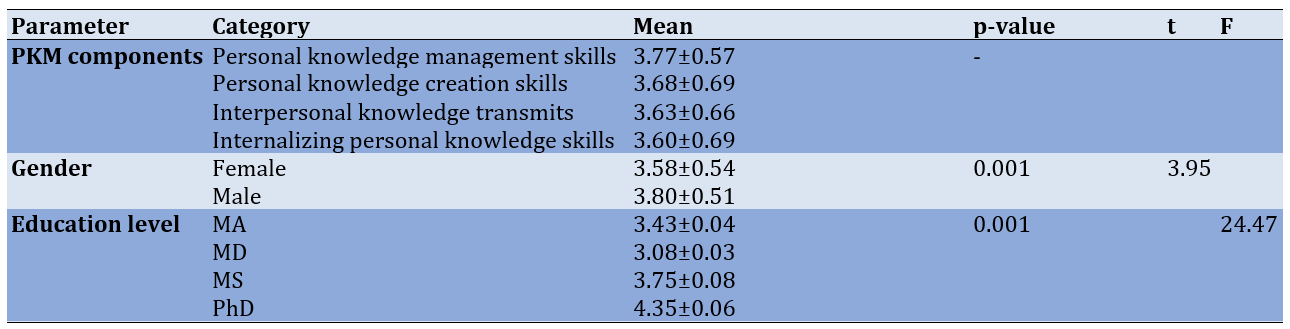
PKM has been elucidated through four key components: “PKM skills,” “skills for internalizing personal knowledge,” “skills for generating individual wisdom,” and “skills for transferring knowledge interpersonally.” Male participants exhibited significantly higher mean PKM scores than females. PhD students achieved the highest mean PKM scores, whereas MA students showed the lowest mean scores. Furthermore, there was a significant difference in mean PKM scores among students across various educational levels. PhD students had significantly higher mean PKM scores compared to MA, MS, and MD students (Table 2).
Table 2. Personal knowledge management status
The relationship between MHL and PKM was analyzed using Spearman’s correlation and linear regression. There was a significant relationship between MHL and PKM (r=0.483; p=0.001) at a 99% significance level. Additionally, MHL could predict 23% of the variation in PKM (r=0.487, R2=0.237, adjusted R2=0.233, and F=55.56). There were also significant correlations between gender and MHL (r=0.137; p=0.009) and PKM (r=0.205; p=0.001) and also between educational level and MHL (r=0.113; p=0.03) and PKM (r=0.39; p=0.001).
Discussion
The aim of this study was to explain the relationship between MHL and PKM in university students. MHL denotes the capacity of individuals to comprehend, access, and utilize information pertinent to mental health in a manner that fosters well-being. Here, 68.9% of students lacked adequate MHL, while 31.1% achieved sufficient scores. This outcome aligns with the findings of Jorm’s study [1]. The low level of MHL among students may be due to a lack of education or insufficient social awareness. This outcome may suggest that students either lack access to adequate information for mental self-care or fail to utilize it effectively.
The mean MHL score for females was significantly higher than that for males. This disparity may stem from the fact that women tend to focus more on mental health concerns or engage more actively in self-care practices, a trend also noted in the research conducted by Wei et al. [20]. Conversely, MHL correlated with educational level. This observation aligns with the findings of Kutcher et al. [21], which relate higher education levels to improved literacy. Females may possess enhanced awareness due to their social roles or heightened sensitivity to psychological matters. In contrast, PhD students likely have a superior capacity to comprehend and utilize mental health information, attributed to their extensive experience and training.
Nevertheless, the overall mean suggests that a significant portion of the sample population did not achieve an adequate level of MHL. This situation may stem from a deficiency in educational initiatives at the university level or a lack of focus on MHL. The comprehensive research conducted by Kelly et al. [22] demonstrate that specialized training can enhance MHL and bolster coping mechanisms, revealing a notable correlation between MHL and various predictors, such as self-efficacy [23]. A diminished level of MHL can adversely impact psychological self-efficacy, as individuals might lack the requisite knowledge and skills to identify and effectively manage their mental health needs. This deficiency can impede their confidence in seeking assistance and addressing mental health challenges, ultimately influencing their overall well-being. Conversely, MHL can contribute to alleviating the burden on healthcare systems. O’Cathain et al. [24] indicate that possessing higher levels of health literacy may empower patients to independently manage minor issues.
MHL in this sample required further examination. Variations in gender and education underscore the influence of contextual elements. It appears that the availability of educational materials or health services pertinent to mental health, the sufficiency of educational initiatives or workshops focused on MHL, and the presence of favorable attitudes towards seeking information and assistance in mental health can facilitate the promotion of health-oriented behaviors. Conversely, physical activity and meditation were also linked to MHL in the research conducted by Wei et al. [20]. These results underscore the imperative for educational interventions.
The level of PKM components among students was higher than average. Notably, the highest mean was found in PKM skills, indicating that students possessed a strong capability to filter and utilize information. These research findings align with those reported by Yousefi et al. [18].
Our investigation regarding the superior performance of males compared to females within the domain of PKM substantiates the conclusions drawn by Ackerman et al. [25]. Furthermore, Taylor’s scholarly work [26] suggests that males exhibit higher engagement with knowledge management systems than females. Razi et al. [27] assert that gender constitutes a significant factor in knowledge management processes and necessitates particular attention to ensure the successful execution of knowledge management initiatives. López Vicent et al. [28] reveal that females demonstrate enhanced capabilities in the selection and processing of information, whereas males are inclined to utilize more straightforward formats and structures for the dissemination of information. Kucharska [29] highlights the prevalence of gender stereotypes within the realms of science, technology, engineering, and mathematics, which may influence experiences, opportunities for utilization, acceptance of errors, and overall learning.
PKM was also correlated with the level of educational attainment. These results align with the findings of studies conducted by Vashisth & Mehta [30], Karageorgou [31], and Teague & Billbrough [32], which demonstrated that education and knowledge management competencies are interconnected and play a significant role in enhancing the overall quality of education. Students exhibited subpar performance in the domain of internalizing personal knowledge. This observation implies that students show inadequacies in translating information into actionable insights or deeper levels of comprehension, despite achieving higher averages in PKM competencies. This discrepancy may arise from the notion that the processes of collecting and storing information are less complex than those involved in its application. Furthermore, as noted by Pauleen [33], PKM encompasses a variety of skills that do not necessarily develop uniformly; hence, this finding underscores the necessity for educational frameworks to place greater emphasis on the practical application of knowledge.
Students possessed substantial awareness of the information they require and exhibited a commendable capacity for knowledge dissemination. An elevated degree of knowledge management has the potential to mitigate instances of information overload. Gopinath et al. [34] have articulated that knowledge management may exacerbate stress attributed to an excessive volume of information. Conversely, Biolchini et al. [35] report that organized methodologies in knowledge management can alleviate stress linked to the navigation of substantial information quantities, thereby facilitating informed decision-making and effectively addressing informational exigencies.
There was a noteworthy and positive correlation between PKM and MHL. This implies that students possessing enhanced MHL also demonstrate proficiency in PKM. A thorough examination of the elements constituting PKM reveals a relationship between knowledge internalization and MHL, underscoring the significance of MHL in transforming information into actionable insights, as highlighted by Kutcher et al. [21], Jorm [36], and Sampaio et al. [37].
Students exhibiting above-average capabilities in MHL demonstrated superior performance in knowledge organization. El-Mougy & Mouftah [38] and Manuti & De Palma [39] have similarly asserted that an individual’s foundational awareness facilitates effective resource management. Disparities in gender and educational attainment are critical factors in this dynamic. While women possessed elevated levels of MHL, men exhibited enhanced performance in knowledge management. This observation implies that the interplay between these two constructs may vary across distinct demographic cohorts. For instance, men who display heightened knowledge management skills may utilize their literacy in a more applied manner, whereas women with advanced literacy are more adept at comprehending the underlying knowledge. The results substantiate that individuals holding a PhD achieve optimal performance in both domains, suggesting that advanced levels of education strengthen this relationship.
The level of MHL among medical students fell short of the established benchmark, with a considerable fraction of this population demonstrating inadequate proficiency in comprehending and effectively applying pertinent information. This situation may adversely influence self-care practices, the propensity to seek assistance, and ultimately the overall mental well-being of the students. Conversely, notable disparities attributable to gender and academic standing suggest that contextual and educational determinants significantly contribute to enhancing MHL. Specifically, it appears that female students and those enrolled in advanced levels of education exhibit superior performance in this domain.
MHL among medical students was suboptimal and inadequate. This may lead to poor personal mental health management, reluctance to seek help, and reduced well-being. Higher levels of MHL were observed among female students and those in advanced stages of their programs. These findings highlight the need for tailored educational interventions. The recommendations encompass interdisciplinary programs, experiential workshops, access to credible resources, and supportive university environments. These measures are designed to enhance cognitive and behavioral capacities, alleviate stress, and optimize academic-professional outcomes. The absence of longitudinal data necessitates the undertaking of future research employing structural modeling to investigate causal relationships across diverse groups.
Conclusion
There is a direct and meaningful relationship between MHL and PKM.
Acknowledgments: We would like to express our gratitude to all individuals who contributed to the completion of this study. This article is based on an MA thesis in Medical Library and Information Sciences (Moloud Mohammadian).
Ethical Permissions: This research adhered to the ethical principles outlined in the Declaration of Helsinki for studies involving human subjects. Ethical code IR.AJUMS.REC.1402.714 was obtained from Ahvaz Jundishapur University of Medical Sciences (AJUMS).
Conflicts of Interests: The authors reported no conflicts of interests.
Authors' Contribution: Sabaghinejad Z (First Author), Introduction Writer/Methodologist/Main Researcher/Discussion Writer/Statistical Analyst (50%); Parsaei-Mohammadi P (Second Author), Introduction Writer/Assistant Researcher (25%); Mohammadian M (Third Author), Introduction Writer/Assistant Researcher/Discussion Writer (25%)
Funding/Support: Ahvaz Jundishapur University of Medical Sciences funded this study.
Mental health literacy (MHL) can be comprehensively defined as the collective body of knowledge, prevailing attitudes, and deeply ingrained beliefs concerning mental disorders. These elements collectively facilitate the identification of symptoms, the effective management of these conditions, and the implementation of preventive measures aimed at mitigating their impact [1]. Extensive research has consistently demonstrated that the general populace, particularly the youth demographic, exhibits a markedly low level of MHL. This phenomenon has been widely recognized as a significant impediment to the effective treatment and management of various psychological disorders. In stark contrast, studies have shown that enhancing MHL through meticulously designed educational initiatives specifically targeted at adolescents and young adults can significantly alleviate the adverse effects associated with mental illnesses while concurrently elevating the overall standard of healthcare provided within the community. A comparative analysis of public awareness regarding mental illnesses and physical ailments reveals a significant disparity in awareness and understanding of mental health issues among the general population [2].
The existing literature provides substantial evidence that the comprehensive enhancement of knowledge, along with the adept management of information relevant to mental health and various mental disorders, is of paramount importance. This includes not only facilitating the early diagnosis of these disorders but also promoting heightened awareness regarding the appropriate methods for seeking assistance and treatment options for individuals afflicted by such conditions. Furthermore, it is imperative to address the alleviation of symptoms associated with mental illness across multiple levels, including individual, social, and institutional dimensions. Collectively, these actions contribute to the attainment of improved mental health outcomes and foster a significant increase in the utilization of psychological services by individuals in need [3].
Personal knowledge management (PKM) is defined as a comprehensive array of daily activities and intricate processes in which individuals actively participate with the objective of systematically gathering, meticulously organizing, efficiently storing, effectively searching for, promptly retrieving, and ultimately disseminating invaluable knowledge across various contexts [4]. In their scholarly work, Cheong and Tsui meticulously delineate four fundamental components that encapsulate the essential skills required for proficient PKM. These components include personal information management, the process of internalization, the generation of individual wisdom, and the facilitation of interpersonal knowledge transfer, highlighting the multifaceted nature of knowledge management practices [5].
Several critical factors are inherently associated with the broader field of knowledge management, encompassing the vital concepts of information literacy [6, 7], as well as health literacy [8, 9]. These two concepts are crucial for effective engagement in PKM practices. In their empirical research, Kim et al. convincingly indicate the existence of a direct and significant correlation between health literacy and the overall effectiveness of PKM strategies employed by individuals [8].
A foundational aspect of the overarching concept of health literacy is MHL, as evidenced by scholarly citation [10] and empirical investigations conducted by esteemed researchers Akgün et al. [11]. These investigations have elucidated a significant and direct correlation between these two critical parameters. In light of the paramount importance of MHL in fostering and improving the overall health and well-being of communities, it becomes imperative to undertake in-depth research within this particular domain and systematically identify and examine the various factors that influence and correlate with these essential parameters. This pressing necessity underscores the recognition by healthcare systems of the indispensable and pivotal role that MHL plays in shaping and influencing patterns of health service utilization within diverse populations [12].
Considering that students represent an effective demographic for advocating a healthy lifestyle across various societal segments [13], it is prudent to select them as the focal group for this research. Investigating MHL in this group is instrumental in identifying gaps in awareness, attitudes, and beliefs that may impede the timely recognition and management of mental disorders. Concurrently, exploring PKM practices provides insight into how students organize, process, and apply information relevant to their mental well-being and academic success. Consequently, these research domains lay the foundation for the development of targeted interventions and educational programs designed to enhance students’ capacity to maintain mental health, improve resilience, and optimize learning outcomes. Ultimately, these efforts contribute to the creation of healthier campus communities and facilitate better long-term personal and professional development.
Understanding the factors that contribute to students’ adherence to healthy behaviors and the mitigation of high-risk behaviors is crucial. This understanding can inform targeted interventions that promote hygiene and health education, ultimately fostering a culture of wellness among students. The promotion of hygiene education within the student demographic has been shown to enhance awareness and practices, leading to improved health outcomes and behaviors in the broader community. These educational initiatives must be meticulously designed to actively engage students, ensuring that they not only acquire knowledge about health but also consistently apply it in their daily lives. The implementation of structured health education programs by universities can play a pivotal role in shaping students’ attitudes toward cleanliness and health, which can, in turn, benefit their respective communities. Such programs should incorporate interactive elements to maintain student interest and encourage lifelong habits of cleanliness and health.
The integration of practical activities has been shown to serve as an effective pedagogical strategy for reinforcing these lessons and engendering enduring behavioral modifications. This knowledge will empower health planners and implementers to take meaningful actions toward advancing health promotion initiatives and optimizing the utilization of health services [14, 15]. Addressing this disparity in mental health awareness is crucial for fostering a more informed and supportive society. By integrating MHL initiatives with physical health education, communities can enhance early detection, reduce stigma, and promote timely intervention, ultimately leading to improved mental health outcomes and a more resilient population. The aim of this study was to explain the relationship between MHL and PKM in university students.
Instrument and Methods
The present descriptive study utilized a quantitative and cross-sectional approach, employing a correlational research design through a survey-based methodology conducted in 2024. The participant group comprised 7,500 students enrolled at Ahvaz Jundishapur University of Medical Sciences (AJUMS) during the year 2024. To gather data from a wide range of academic levels, a proportional stratified sampling method was implemented, which included undergraduate (BA), master’s (MA), professional doctorate (MD), and PhD students. The sample size, calculated using the Krejcie and Morgan formula, was determined to be 367. To qualify for participation, individuals were required to be currently enrolled at the university and to express a willingness to engage in the research study. Regarding education, 139 participants (38.6%) has a BA, 159 (44.2%) held an MD, 47 (13.1%) possessed an MA, and 15 (4.2%) had a PhD. In terms of gender, 208 participants (57.8%) were female, while 152 (42.2%) were male
The questionnaires on “PKM” and “MHL” were used to collect data. In 2017, Bjørnsen et al. [16] developed a questionnaire aimed at assessing MHL. This instrument is a single-construct questionnaire comprising 10 items. The scoring system for the questionnaire utilizes a six-point Likert scale ranging from zero to 5. The response options range from “Don’t know” (score=0) to “Completely correct” (score=5). The creators established a cut-off score of 4 to identify individuals with inadequate awareness. Consequently, individuals who score below 4 are deemed to have insufficient MHL. The normalization and validation of this questionnaire in Iran in 2021 confirmed its validity and reliability, achieving a Cronbach’s alpha of 0.81 [17]. Given that this questionnaire had not previously been utilized within the student population, it was administered to a sample of 50 students from Ahvaz Jundishapur University of Medical Sciences (AJUMS) for validation (with the stipulation that they would not participate again in the main research). The findings revealed a Cronbach’s alpha of 0.77, indicating a high level of desirability for the tool’s application within this community.
The PKM questionnaire, which comprises 94 questions, has been utilized in numerous studies [5, 18, 19], and its validity has been established. Given the extensive number of questions and the potential for diminished accuracy in responses, a condensed version of this instrument was developed. Initially, 50 questionnaires were distributed among the students of AJUMS, with the stipulation of non-participation in subsequent rounds. In light of the findings from the Cronbach’s alpha analysis, questions that, if omitted, would result in an increase in the alpha coefficient were eliminated, leading to the creation of a shortened version of the PKM questionnaire. This revised version was then redistributed to another group of 50 students from the same university, and the outcomes revealed a Cronbach’s alpha value of 0.948, signifying the tool’s high suitability for application in this research. The abbreviated version of the PKM questionnaire encompasses 4 factors and 44 items. The first factor, “PKM skills,” consists of 12 items (questions 1 to 12); the second factor, “Personal knowledge internalization skills,” includes 9 questions (questions 13 to 21); the third factor, “Individual wisdom creation skills,” comprises 10 items (questions 22 to 31); and the fourth factor, “Interpersonal knowledge transfer skills,” contains 13 questions (questions 32 to 44).
The printed questionnaires were enclosed in sealed envelopes and distributed to participants. Respondents were instructed to complete the questionnaires, reseal them in the original envelopes, and submit them to their respective faculty libraries. Upon collection, the questionnaires were examined for completeness and subsequently entered into statistical analysis software for data processing.
Data analysis was conducted using correlation tests, independent t-tests, one-way ANOVA, LSD post-hoc tests, and SPSS 21, with all analyses performed at a 95% confidence level.
Findings
A total of 112 students (31.1%) has a sufficient level of MHL, whereas, 248 students (68.9%) were classified as having insufficient MHL. Total mean MHL score was 1.69±0.46. The mean MHL scores were significantly higher in women compared to men. Additionally, there was a significant difference in the average MHL scores among students across various academic levels, with PhD students achieving the highest scores. There was a significant difference in the average MHL scores of MA students (p=0.001), MS students (p=0.03), and MD students (p=0.005) when compared to the scores of PhD students (Table 1).
Table 1. Mental health literacy status in students
PKM has been elucidated through four key components: “PKM skills,” “skills for internalizing personal knowledge,” “skills for generating individual wisdom,” and “skills for transferring knowledge interpersonally.” Male participants exhibited significantly higher mean PKM scores than females. PhD students achieved the highest mean PKM scores, whereas MA students showed the lowest mean scores. Furthermore, there was a significant difference in mean PKM scores among students across various educational levels. PhD students had significantly higher mean PKM scores compared to MA, MS, and MD students (Table 2).
Table 2. Personal knowledge management status
The relationship between MHL and PKM was analyzed using Spearman’s correlation and linear regression. There was a significant relationship between MHL and PKM (r=0.483; p=0.001) at a 99% significance level. Additionally, MHL could predict 23% of the variation in PKM (r=0.487, R2=0.237, adjusted R2=0.233, and F=55.56). There were also significant correlations between gender and MHL (r=0.137; p=0.009) and PKM (r=0.205; p=0.001) and also between educational level and MHL (r=0.113; p=0.03) and PKM (r=0.39; p=0.001).
Discussion
The aim of this study was to explain the relationship between MHL and PKM in university students. MHL denotes the capacity of individuals to comprehend, access, and utilize information pertinent to mental health in a manner that fosters well-being. Here, 68.9% of students lacked adequate MHL, while 31.1% achieved sufficient scores. This outcome aligns with the findings of Jorm’s study [1]. The low level of MHL among students may be due to a lack of education or insufficient social awareness. This outcome may suggest that students either lack access to adequate information for mental self-care or fail to utilize it effectively.
The mean MHL score for females was significantly higher than that for males. This disparity may stem from the fact that women tend to focus more on mental health concerns or engage more actively in self-care practices, a trend also noted in the research conducted by Wei et al. [20]. Conversely, MHL correlated with educational level. This observation aligns with the findings of Kutcher et al. [21], which relate higher education levels to improved literacy. Females may possess enhanced awareness due to their social roles or heightened sensitivity to psychological matters. In contrast, PhD students likely have a superior capacity to comprehend and utilize mental health information, attributed to their extensive experience and training.
Nevertheless, the overall mean suggests that a significant portion of the sample population did not achieve an adequate level of MHL. This situation may stem from a deficiency in educational initiatives at the university level or a lack of focus on MHL. The comprehensive research conducted by Kelly et al. [22] demonstrate that specialized training can enhance MHL and bolster coping mechanisms, revealing a notable correlation between MHL and various predictors, such as self-efficacy [23]. A diminished level of MHL can adversely impact psychological self-efficacy, as individuals might lack the requisite knowledge and skills to identify and effectively manage their mental health needs. This deficiency can impede their confidence in seeking assistance and addressing mental health challenges, ultimately influencing their overall well-being. Conversely, MHL can contribute to alleviating the burden on healthcare systems. O’Cathain et al. [24] indicate that possessing higher levels of health literacy may empower patients to independently manage minor issues.
MHL in this sample required further examination. Variations in gender and education underscore the influence of contextual elements. It appears that the availability of educational materials or health services pertinent to mental health, the sufficiency of educational initiatives or workshops focused on MHL, and the presence of favorable attitudes towards seeking information and assistance in mental health can facilitate the promotion of health-oriented behaviors. Conversely, physical activity and meditation were also linked to MHL in the research conducted by Wei et al. [20]. These results underscore the imperative for educational interventions.
The level of PKM components among students was higher than average. Notably, the highest mean was found in PKM skills, indicating that students possessed a strong capability to filter and utilize information. These research findings align with those reported by Yousefi et al. [18].
Our investigation regarding the superior performance of males compared to females within the domain of PKM substantiates the conclusions drawn by Ackerman et al. [25]. Furthermore, Taylor’s scholarly work [26] suggests that males exhibit higher engagement with knowledge management systems than females. Razi et al. [27] assert that gender constitutes a significant factor in knowledge management processes and necessitates particular attention to ensure the successful execution of knowledge management initiatives. López Vicent et al. [28] reveal that females demonstrate enhanced capabilities in the selection and processing of information, whereas males are inclined to utilize more straightforward formats and structures for the dissemination of information. Kucharska [29] highlights the prevalence of gender stereotypes within the realms of science, technology, engineering, and mathematics, which may influence experiences, opportunities for utilization, acceptance of errors, and overall learning.
PKM was also correlated with the level of educational attainment. These results align with the findings of studies conducted by Vashisth & Mehta [30], Karageorgou [31], and Teague & Billbrough [32], which demonstrated that education and knowledge management competencies are interconnected and play a significant role in enhancing the overall quality of education. Students exhibited subpar performance in the domain of internalizing personal knowledge. This observation implies that students show inadequacies in translating information into actionable insights or deeper levels of comprehension, despite achieving higher averages in PKM competencies. This discrepancy may arise from the notion that the processes of collecting and storing information are less complex than those involved in its application. Furthermore, as noted by Pauleen [33], PKM encompasses a variety of skills that do not necessarily develop uniformly; hence, this finding underscores the necessity for educational frameworks to place greater emphasis on the practical application of knowledge.
Students possessed substantial awareness of the information they require and exhibited a commendable capacity for knowledge dissemination. An elevated degree of knowledge management has the potential to mitigate instances of information overload. Gopinath et al. [34] have articulated that knowledge management may exacerbate stress attributed to an excessive volume of information. Conversely, Biolchini et al. [35] report that organized methodologies in knowledge management can alleviate stress linked to the navigation of substantial information quantities, thereby facilitating informed decision-making and effectively addressing informational exigencies.
There was a noteworthy and positive correlation between PKM and MHL. This implies that students possessing enhanced MHL also demonstrate proficiency in PKM. A thorough examination of the elements constituting PKM reveals a relationship between knowledge internalization and MHL, underscoring the significance of MHL in transforming information into actionable insights, as highlighted by Kutcher et al. [21], Jorm [36], and Sampaio et al. [37].
Students exhibiting above-average capabilities in MHL demonstrated superior performance in knowledge organization. El-Mougy & Mouftah [38] and Manuti & De Palma [39] have similarly asserted that an individual’s foundational awareness facilitates effective resource management. Disparities in gender and educational attainment are critical factors in this dynamic. While women possessed elevated levels of MHL, men exhibited enhanced performance in knowledge management. This observation implies that the interplay between these two constructs may vary across distinct demographic cohorts. For instance, men who display heightened knowledge management skills may utilize their literacy in a more applied manner, whereas women with advanced literacy are more adept at comprehending the underlying knowledge. The results substantiate that individuals holding a PhD achieve optimal performance in both domains, suggesting that advanced levels of education strengthen this relationship.
The level of MHL among medical students fell short of the established benchmark, with a considerable fraction of this population demonstrating inadequate proficiency in comprehending and effectively applying pertinent information. This situation may adversely influence self-care practices, the propensity to seek assistance, and ultimately the overall mental well-being of the students. Conversely, notable disparities attributable to gender and academic standing suggest that contextual and educational determinants significantly contribute to enhancing MHL. Specifically, it appears that female students and those enrolled in advanced levels of education exhibit superior performance in this domain.
MHL among medical students was suboptimal and inadequate. This may lead to poor personal mental health management, reluctance to seek help, and reduced well-being. Higher levels of MHL were observed among female students and those in advanced stages of their programs. These findings highlight the need for tailored educational interventions. The recommendations encompass interdisciplinary programs, experiential workshops, access to credible resources, and supportive university environments. These measures are designed to enhance cognitive and behavioral capacities, alleviate stress, and optimize academic-professional outcomes. The absence of longitudinal data necessitates the undertaking of future research employing structural modeling to investigate causal relationships across diverse groups.
Conclusion
There is a direct and meaningful relationship between MHL and PKM.
Acknowledgments: We would like to express our gratitude to all individuals who contributed to the completion of this study. This article is based on an MA thesis in Medical Library and Information Sciences (Moloud Mohammadian).
Ethical Permissions: This research adhered to the ethical principles outlined in the Declaration of Helsinki for studies involving human subjects. Ethical code IR.AJUMS.REC.1402.714 was obtained from Ahvaz Jundishapur University of Medical Sciences (AJUMS).
Conflicts of Interests: The authors reported no conflicts of interests.
Authors' Contribution: Sabaghinejad Z (First Author), Introduction Writer/Methodologist/Main Researcher/Discussion Writer/Statistical Analyst (50%); Parsaei-Mohammadi P (Second Author), Introduction Writer/Assistant Researcher (25%); Mohammadian M (Third Author), Introduction Writer/Assistant Researcher/Discussion Writer (25%)
Funding/Support: Ahvaz Jundishapur University of Medical Sciences funded this study.
References
1. Jorm AF. Mental health literacy: Empowering the community to take action for better mental health. Am Psychol. 2012;67(3):231-43. [Link] [DOI:10.1037/a0025957]
2. Hart LM, Mason RJ, Kelly CM, Cvetkovski S, Jorm AF. Teen Mental Health First Aid: A description of the program and an initial evaluation. Int J Ment Health Syst. 2016;10(1):3. [Link] [DOI:10.1186/s13033-016-0034-1]
3. Jafari F, Zarebi A, Abdollahi A, Hosseinian S. Psychometric properties of the Persian version of the Mental Health Literacy Scale (MHLS) in Iranian students. J Psychol. 2021;25(3):311-28. [Persian] [Link]
4. Tsui E. Technologies for personal and peer-to-peer (p2p) knowledge management. CSC Leading Edge Forum Technology Grant Report. 2002;1-53. [Link]
5. Cheong RK, Tsui E. The roles and values of personal knowledge management: An exploratory study. Vine. 2010;40(2):204-27. [Link] [DOI:10.1108/03055721011050686]
6. Ferguson KS. Information literacy and its relationship to knowledge management: A theoretical study. J Inf Lit. 2009;3(2):6-24. [Link] [DOI:10.11645/3.2.188]
7. Singh J. Sense-making: Information literacy for lifelong learning and knowledge management. DESIDOC J Libr Inf Technol. 2008;28(2):13-7. [Link] [DOI:10.14429/djlit.28.2.161]
8. Kim S, Syn SY, Sinn D. Exploratory study of personal health information management using health literacy model. Aslib J Inf Manag. 2018;70(1):104-22. [Link] [DOI:10.1108/AJIM-03-2017-0062]
9. Wong JYH, Wai AKC, Zhao S, Yip F, Lee JJ, Wong CKH, et al. Association of individual health literacy with preventive behaviours and family well-being during COVID-19 pandemic: Mediating role of family information sharing. Int J Environ Res Public Health. 2020;17(23):8838. [Link] [DOI:10.3390/ijerph17238838]
10. Furnham A, Swami V. Mental health literacy: A review of what it is and why it matters. Int Perspect Psychol. 2018;7(4):240-57. [Link] [DOI:10.1037/ipp0000094]
11. Akgün Ş, Tokur Kesgin M, Hançer Tok H. The correlation between health literacy and mental health literacy in Turkish Society. Perspect Psychiatr Care. 2022;58(4):2950-61. [Link] [DOI:10.1111/ppc.13146]
12. McCray AT. Promoting health literacy. J Am Med Inform Assoc. 2005;12(2):152-63. [Link] [DOI:10.1197/jamia.M1687]
13. Ramezankhani A, Ghafari M, Rakhshani F, Ghanbari S, Azimi S. Comparison of health literacy between medical and non-medical students in Shahid Beheshti Universities in the academic year 92-93. PAJOOHANDEH. 2015;20(2):78-85. [Persian] [Link]
14. Afshari M, Teimori G, Afshari M, Kohnavard B, Esmailpour H, Kangavari M. Workers' health literacy in a car spare parts factory: A cross-sectional study. Iran Occup Health. 2017;14(2):147-55. [Persian] [Link]
15. Sahm LJ, Wolf MS, Curtis LM, McCarthy S. Prevalence of limited health literacy among Irish adults. J Health Commun. 2012;17(Suppl 3):100-8. [Link] [DOI:10.1080/10810730.2012.718041]
16. Bjørnsen HN, Eilertsen MEB, Ringdal R, Espnes GA, Moksnes UK. Positive mental health literacy: Development and validation of a measure among Norwegian adolescents. BMC Public Health. 2017;17:717. [Link] [DOI:10.1186/s12889-017-4733-6]
17. Mahmoodi MH, Ahmadzad-Asl M, Rasoulian M. Mental health positive knowledge questionnaire: translation and cultural adaptation and psychometric properties. Soc Welf Q. 2021;21(82):245-73. [Persian] [Link]
18. Yousefi R, Haidari G, Khademizadeh S. Evaluation of the use of graduate students of Shahid Chamran University of Ahvaz from personal knowledge management skills based on cheong and tsui models. Acad Librariansh Inf Res. 2022;56(1):43-58. [Persian] [Link]
19. Khademizadeh S, Abdolahi F, Bigdeli Z. The study of personal knowledge management status of Shahid Chamran University (of Ahvaz) staff. Acad Librariansh Inf Res. 2019;53(1):51-74. [Persian] [Link]
20. Wei Y, McGrath PJ, Hayden J, Kutcher S. Mental health literacy measures evaluating knowledge, attitudes and help-seeking: A scoping review. BMC Psychiatry. 2015;15(1):291. [Link] [DOI:10.1186/s12888-015-0681-9]
21. Kutcher S, Wei Y, Coniglio C. Mental health literacy: Past, present, and future. Can J Psychiatry. 2016;61(3):154-8. [Link] [DOI:10.1177/0706743715616609]
22. Kelly CM, Jorm AF, Wright A. Improving mental health literacy as a strategy to facilitate early intervention for mental disorders. Med J Aust. 2007;187(S7):S26-30. [Link] [DOI:10.5694/j.1326-5377.2007.tb01332.x]
23. Suwanwong C, Jansem A, Intarakamhang U, Prasittichok P, Tuntivivat S, Chuenphittayavut K, et al. Modifiable predictors of mental health literacy in the educational context: A systematic review and meta-analysis. BMC Psychol. 2024;12(1):378. [Link] [DOI:10.1186/s40359-024-01878-4]
24. O'Cathain A, Foster A, Carroll C, Preston L, Ogden M, Clowes M, et al. Health literacy interventions for reducing the use of primary and emergency services for minor health problems: A systematic review. Health Soc Care Deliv Res. 2022;10(38):1-222. [Link] [DOI:10.3310/IVQJ9044]
25. Ackerman PL, Bowen KR, Beier ME, Kanfer R. Determinants of individual differences and gender differences in knowledge. J Educ Psychol. 2001;93(4):797-825. [Link] [DOI:10.1037/0022-0663.93.4.797]
26. Taylor WA. Computer-mediated knowledge sharing and individual user differences: An exploratory study. Eur J Inf Syst. 2004;13(1):52-64. [Link] [DOI:10.1057/palgrave.ejis.3000484]
27. Razi MJM, Karim NSA, Mohamed N. Gender difference effects on contributing factors of intention to be involved in knowledge creation and sharing. Asian Econ Financ Rev. 2014;4(7):893-907. [Link]
28. López Vicent P, Serrano JL, Gutiérrez Porlán I. Personal management of digital information in university students from a gender perspective. J New Approaches Educ Res. 2022;11(1):114-29. [Link] [DOI:10.7821/naer.2022.1.734]
29. Kucharska W. Self-perceived personal brand equity of knowledge workers by gender in light of knowledge-driven organizational culture: Evidence from poland and the united states. SAGE Open. 2024;14(1). [Link] [DOI:10.1177/21582440241227280]
30. Vashisth R, Mehta A. Factors influencing knowledge management in Indian b-schools: An empirical evidence. IUP J Knowl Manag. 2013;11(2):19-45. [Link]
31. Karageorgou Z. The impact of knowledge management processes on teachers'digital skills. Eur J Educ Stud. 2022;9(7). [Link] [DOI:10.46827/ejes.v9i7.4383]
32. Teague R, Billbrough TJ. Knowledge management in education: Often the missing link in developing a robust learning organization. Int J Infonomics. 2023;16(1). [Link] [DOI:10.20533/iji.1742.4712.2023.0224]
33. Pauleen D. Personal knowledge management: Putting the 'person' back into the knowledge equation. Online Inf Rev. 2009;33(2):221-4. [Link] [DOI:10.1108/14684520910951177]
34. Gopinath R, Chitra A, Kalpana R. A study on relationship between knowledge management and occupational stress. J Contemp Issues Bus Gov. 2021;27(3):2021. [Link] [DOI:10.47750/cibg.2021.27.03.186]
35. Biolchini J, Gomes EA, Dias ECF, Figueiredo T. Coping with the infodemic with scientific knowledge management: A case study of COVID-19 scientific evidence observatory. In: Handbook of research on essential information approaches to aiding global health in the one health context. Palmdale: IGI Global Scientific Publishing; 2022. p. 14-35. [Link] [DOI:10.4018/978-1-7998-8011-0.ch002]
36. Jorm AF. The concept of mental health literacy. In: International handbook of health literacy. Bristol: Bristol University Press; 2019. p. 53-66. [Link] [DOI:10.56687/9781447344520-007]
37. Sampaio F, Gonçalves P, Sequeira C. Mental health literacy: It is now time to put knowledge into practice. Int J Environ Res Public Health. 2022;19(12):7030. [Link] [DOI:10.3390/ijerph19127030]
38. El-Mougy A, Mouftah H. On resource management and context-awareness in LTE-based networks for Public Safety. Proceedings of the 38th Annual IEEE Conference on Local Computer Networks-Workshops. Sydney: IEEE; 2013. [Link] [DOI:10.1109/LCNW.2013.6758540]
39. Manuti A, De Palma PD. The people-based approach in human resource management and the challenges of the new normal scenario. In: Digital HR. Cham: Springer; 2023. p. 7-29. [Link] [DOI:10.1007/978-3-031-43563-8_2]