

TMU
Owner
Tarbiat Modares University (TMU) is the owner of HEHP.

0.8
Cite Score 2025
Volume 14, Issue 1 (2026)
Health Educ Health Promot 2026, 14(1): 69-75 |
Back to browse issues page
Article Type:




History
Received: 2025/11/11 | Accepted: 2026/02/3 | Published: 2026/01/29
Received: 2025/11/11 | Accepted: 2026/02/3 | Published: 2026/01/29
How to cite this article
Asri A, SUSWANI A, Safruddin S, Muriyati M, AB A. Effect of Self-Efficacy-Based Intervention on Stress, Anxiety, Depression, and Quality of Life in Heart Failure Patients. Health Educ Health Promot 2026; 14 (1) :69-75
URL: http://hehp.daneshafarand.org/article-4-82966-en.html
URL: http://hehp.daneshafarand.org/article-4-82966-en.html
Download citation:
BibTeX | RIS | EndNote | Medlars | ProCite | Reference Manager | RefWorks
Send citation to:


Rights and permissions
BibTeX | RIS | EndNote | Medlars | ProCite | Reference Manager | RefWorks
Send citation to:


1- Community and Family Nursing Department, Panrita Husada College of Health Sciences Bulukumba, South Sulawesi, Indonesia
2- Medical Surgical Nursing Department, Panrita Husada College of Health Sciences Bulukumba, South Sulawesi, Indonesia
2- Medical Surgical Nursing Department, Panrita Husada College of Health Sciences Bulukumba, South Sulawesi, Indonesia
Keywords:
| Abstract (HTML) (1007 Views)
Full-Text: (127 Views)
Introduction
Heart failure (HF) is a major global public health problem and one of the leading causes of morbidity, mortality, and impaired quality of life among adults worldwide. The World Health Organization (WHO, 2023) predicts that over 64 million individuals globally suffer from heart failure, with prevalence increasing particularly in nations with low or middle incomes [1]. Beyond its physiological consequences, heart failure is increasingly recognized as a condition with profound psychological and psychosocial implications. Patients commonly experience chronic stress, anxiety, and depressive symptoms, which may exacerbate disease progression, reduce adherence to treatment regimens, impair self-care behaviors, and ultimately worsen clinical outcomes [2].
Accumulating evidence indicates that psychological distress in heart failure patients is not merely a comorbidity but a critical determinant of prognosis. Depression and anxiety have been consistently associated with increased hospital readmissions, poorer functional capacity, reduced health-related quality of life, and higher mortality rates [3]. Despite advances in pharmacological and device-based therapies, conventional management strategies often fail to adequately address the psychosocial dimensions of heart failure [4]. This gap underscores the need for integrative, non-pharmacological approaches that target both emotional well-being and functional adaptation, particularly within nursing practice [5].
Self-efficacy, defined as an individual’s belief in their capacity to perform behaviors necessary to achieve desired health outcomes, has emerged as a key psychological construct in chronic disease management. In heart failure, higher self-efficacy has been linked to better symptom monitoring, medication adherence, lifestyle modification, and emotional regulation [6]. Nursing interventions that enhance self-efficacy through patient education, skills training, goal setting, and supportive counseling have shown promise in improving self-care behaviors and psychological resilience in various chronic conditions [7]. However, existing studies in heart failure populations have largely focused on isolated outcomes, such as self-care adherence or depressive symptoms, and are predominantly conducted in hospital-based settings.
To date, empirical evidence examining the comprehensive impact of self-efficacy-based nursing interventions on multiple psychological outcomes (stress, anxiety, and depression), alongside quality of life and functional independence, remains limited, particularly in community-based care contexts. Moreover, the specific contribution of nurse-led interventions in empowering patients to manage both the physical and psychological burden of heart failure has not been sufficiently elucidated.
Therefore, this study aimed to evaluate the effectiveness of a self-efficacy-based nursing intervention in reducing psychological distress—specifically stress, anxiety, and depression—while simultaneously improving quality of life and functional independence among patients with heart failure in community settings. By addressing both psychosocial and functional domains, this study sought to strengthen the evidence base for holistic, nurse-led interventions as an essential component of comprehensive heart failure management.
Materials and Methods
Design and sample
This study, conducted in 2024 across 21 community health centers in the Bulukumba district, employed a quasi-experimental pre-post design with both an intervention group and a control group, in accordance with the CONSORT 2021 extension for non-randomized trials. A quasi-experimental design was selected because randomization was challenging in the community-based setting, and this approach ensured group comparability through matched demographic and clinical characteristics.
The research approach utilized the self-efficacy theory of behavior change as its conceptual framework, focusing on four primary sources of efficacy: mastery experience, vicarious experience, verbal persuasion, and physiological regulation [8]. This theoretical framework guided the development of the intervention modules, tools, and assessment methods.
Eligible participants were individuals aged 40 years or older who were diagnosed with chronic heart failure (categorized as New York Heart Association [NYHA] Class II–III), were clinically stable, and were competent in communication [9]. The exclusion criteria included substantial cognitive impairment (mini-mental state examination score <24), unstable current health conditions (e.g., acute myocardial infarction, renal failure), or ongoing mental health treatment.
A total of 252 participants were recruited using purposive sampling and allocated into two equivalent groups: the intervention group (n=126) and the control group (n=126). The sample size was calculated using G*Power 3.1 software, employing a medium effect size (0.30), an alpha level (α) of 0.05, and a statistical power of 0.80. This calculation indicated a minimum requirement of 120 participants per group, accounting for an anticipated 5% dropout rate. Following the selection of research participants, 7 individuals in the control group were lost to follow-up, 2 were categorized as discontinued, 2 withdrew, and 2 declined to proceed with the intervention. In the intervention group, 9 participants were lost to follow-up, one was classified as discontinued, two withdrew, and one declined to continue.
Instrument
The Depression Anxiety Stress Scale-21 (DASS-21) was employed to analyze psychological distress, encompassing stress, anxiety, and depression. The assessment consists of 21 items rated on a 4-point Likert scale (0=did not apply to me at all; 3=applied to me very much or most of the time) [10].
The World Health Organization Quality of Life-BREF (WHOQOL-BREF) was utilized to analyze participants’ quality of life across four domains: physical, psychological, social, and environmental [11].
The Functional Independence Measure (FIM) was used to assess participants’ level of functional independence in performing daily activities. It comprises 18 items evaluated on a 7-point ordinal scale, covering both motor and cognitive domains [12].
The Self-Efficacy Questionnaire for Chronic Disease (SE-QCD) was employed to evaluate self-efficacy levels at baseline and post-intervention [13].
Procedure
The self-efficacy-based nursing intervention (SEBNI) was administered to the intervention group over a period of 12 consecutive weeks, incorporating both individual and group sessions. The intervention comprised three modules structured in accordance with Bandura’s four sources of efficacy: mastery experience, vicarious experience, verbal persuasion, and physiological regulation.
The SEBNI consisted of three fundamental modules aligned with the theoretical principles of self-efficacy.
Module 1 was knowledge and mastery experience (weeks 1–4), which involved participants attending two instructional sessions, each lasting 60 to 90 minutes. These sessions addressed heart failure pathophysiology, medication adherence, dietary management, fluid restriction, symptom monitoring, and energy conservation. Practical exercises and return demonstrations were conducted to foster mastery experiences. Participants received printed self-care pamphlets and daily monitoring checklists.
Module 2 was motivation and verbal persuasion (weeks 5-8), which concentrated on enhancing psychological confidence through nurse-led motivational counseling. Participants were encouraged to identify individual goals and challenges. Group sharing sessions were held to facilitate peer learning and vicarious experiences, during which participants discussed success stories and coping strategies. Nurses employed verbal encouragement and constructive feedback to reinforce participants’ confidence in their ability to manage symptoms effectively.
Module 3 was self-monitoring and emotional regulation (weeks 9-12), where participants documented daily activities related to medication adherence, dietary habits, physical activity, and symptom management in individualized logbooks. Individual weekly feedback meetings (15–20 minutes each) were conducted to assess progress and provide supplementary guidance. Participants were instructed in relaxation techniques, including deep breathing, mindfulness, and positive self-talk, to effectively manage stress and physiological arousal.
Participants in the control group received standard care in accordance with local clinical practice standards for heart failure. This care encompassed a brief consultation with a physician, the prescription of medication, and routine health education during outpatient visits; however, it lacked systematic self-efficacy reinforcement or behavioral monitoring elements.
All intervention sessions were conducted by community nurses possessing postgraduate training in chronic care nursing and were overseen weekly by the primary investigator to ensure the fidelity of the intervention.
Data analysis
Data were analyzed using SPSS 26.0 (IBM Corp., Armonk, NY, USA). Missing data were managed using pairwise deletion, as the proportion of missing values was under 5% across all parameters. The normality of continuous data was assessed using the Shapiro-Wilk test, in addition to visual inspection of histograms and Q-Q plots. Given the non-normal distribution of the majority of the data, non-parametric statistical tests were employed. The Mann-Whitney U test was utilized to verify baseline equivalence for continuous parameters, while the Chi-square test was applied to categorical data. To evaluate the effects of the intervention, differences between the intervention and control groups at post-test were analyzed using Mann-Whitney U tests for continuous parameters (DASS-21, WHOQOL-BREF, FIM, and SE-QCD), Chi-square tests for categorical parameters (levels of stress, anxiety, and depression), and Wilcoxon signed-rank tests for within-group comparisons (pre- to post-intervention).
Findings
A total of 252 participants completed the study, comprising 126 individuals in the intervention group and 126 in the control group. The mean age of participants was 59.07±10.34 years in the intervention group and 56.50±13.50 years in the control group (p-value=0.036). The majority were female (72.2% and 83.3%, respectively) and primarily housewives (69.8% versus 74.6%). Body weight was 60.77±11.96 in the intervention group and 63.05±9.20 in the control group (p=0.022). At baseline, both groups exhibited similar demographic and clinical characteristics, with slight differences in blood pressure and functional status. The intervention group demonstrated a decrease in mean systolic and diastolic blood pressure (144.25±20.04 vs. 152.40±15.00mmHg, p=0.005; 84.67±9.49 vs. 90.44±10.13mmHg, p<0.001) and an increase [in functional independence].
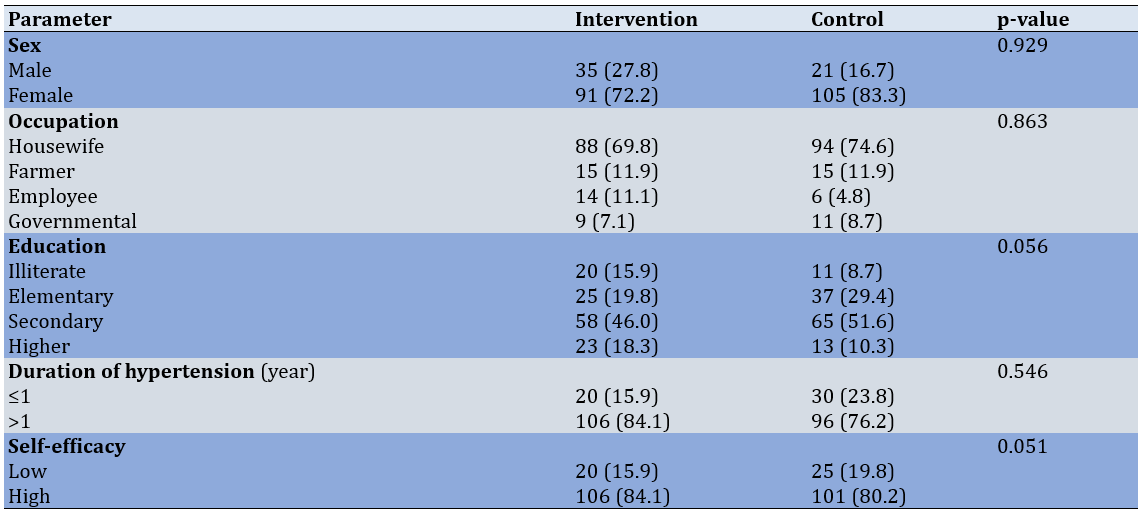
FIM scores demonstrated significant improvements in the intervention group (mean 106.02±12.63) compared to the control group (98.10±20.70; p=0.002). This indicates that participants included in the self-efficacy-based program demonstrated increased physical autonomy and improved performance of daily activities. The mean duration of hypertension (exceeding one year on average) and the distribution of educational backgrounds were analogous between groups (p>0.05), indicating general baseline equivalence. After the intervention, participants showed an improvement in self-efficacy scores (mean 7.8±1.2 versus 6.4±1.3 in the control group; p=0.001; Table 1).
Table 1. Comparison of the frequency of baseline characteristics of the intervention and control groups
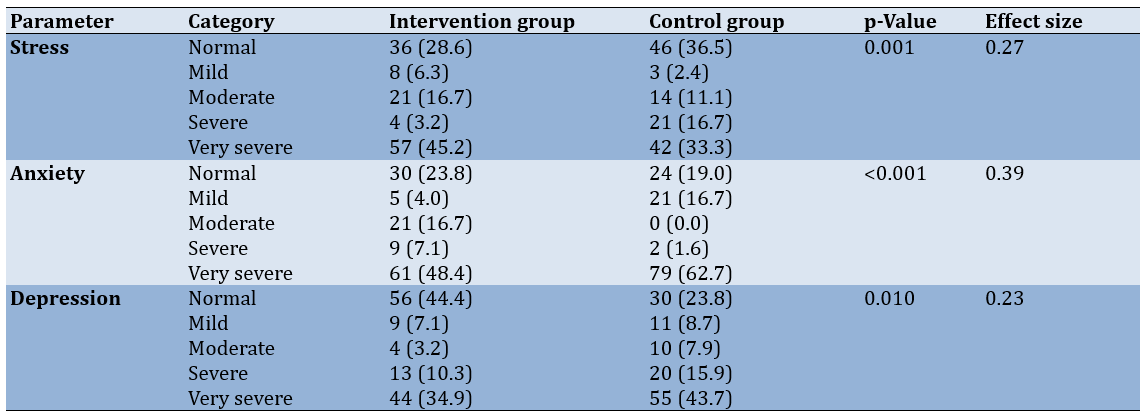
After a twelve-week intervention, significant reductions in stress, anxiety, and depression levels were observed in the intervention group compared to the control group. The percentage of participants exhibiting normal stress levels increased from 28.6% at baseline to 56.3% following the intervention, while the instances of severe and very severe stress decreased from 48.4% to 18.3%. Group comparison revealed significant gains (p=0.001). The intervention group reported a notable reduction in moderate to severe anxiety levels, moving toward the normal range (23.8% versus 62.7% in the control group). Statistical analysis revealed a significant difference (p<0.001). The prevalence of depressive symptoms increased significantly to 44.4% in the intervention group, compared to 23.8% in the control group (p=0.010; Table 2).
Table 2. Comparison of the frequency of stress, anxiety, and depression levels in participants
Following a twelve-week intervention, participants in the intervention exhibited significantly higher quality of life scores compared to the control group. The mean disparity in WHOQOL-BREF domains ranged from 3.62 to 5.52 points, consistently favoring the intervention group. Statistically substantial improvements were observed in the physical domain (p=0.017), psychological domain (p=0.010), and social domain (p=0.048). The environmental domain exhibited a positive, though statistically insignificant, trend (p=0.075). The findings demonstrate that the self-efficacy-based intervention markedly enhanced multidimensional well-being in heart failure patients, especially in physical and psychological functioning. The three domains of WHOQOL-BREF (physical, psychological, and social) showed significant improvements in the intervention group compared to the control group, with a small-to-moderate effect size (r=0.12-0.16; Table 3).
Table 3. Comparison of the quality of life domains in participants based on the World Health Organization Quality of Life-BREF

Discussion
This study aimed to assess the effect of a SEBNI on stress, anxiety, depression, and quality of life in patients with heart failure. A SEBNI significantly improved psychological well-being, self-efficacy, quality of life, and functional independence in patients with heart failure. Participants who engaged in the structured intervention showed significantly reduced levels of stress, anxiety, and depression (as measured by DASS-21), along with improved quality-of-life assessments across physical, psychological, and social domains (WHOQOL-BREF). In addition, they demonstrated enhanced functional independence (FIM) and higher self-efficacy (SE-QCD) levels compared to those who received standard therapy.
A 12-week, nurse-led program focusing on self-efficacy led to significant reductions in stress, anxiety, and depression, while improving three WHOQOL-BREF domains and functional independence in patients with heart failure. Our findings align with another research [14], which highlights recent syntheses showing that nurse-led self-care interventions enhance health-related quality of life (HRQoL), reduce anxiety and symptom burden, and strengthen self-efficacy in heart failure patients. Two contemporary assessments are especially pertinent: a 2024 update illustrating the positive impacts of nurse-led heart failure self-care on quality of life and anxiety levels [15], and a 2025 meta-analysis confirming that nursing interventions significantly improve self-care for heart failure patients at home, which supports our findings and highlights the critical role of nurses in behavior-change initiatives [16].
Our results mechanistically confirm that self-efficacy directly drives emotional regulation and engagement in adaptive self-care. Improvements in self-efficacy likely contributed to the reduction in DASS-21 distress and enhancements in HRQoL, which is consistent with existing studies linking self-care confidence to improved symptoms, mood, and daily functioning in heart failure patients [17]. Recent trials and implementation research, encompassing interventions from nurse-led psychoeducation to counseling based on common-sense models, demonstrate combined improvements in illness perceptions, self-care efficacy, and self-care behaviors. These findings illustrate the mastery, vicarious experience, and verbal persuasion components central to our program.
Our significant impact across all three realms of quality of life aligns with recent studies indicating that focused nursing and personalized treatment strategies can improve health-related quality of life (HRQoL) in heart failure patients. This finding also echoes current assessments that emphasize HRQoL as a crucial, patient-centered outcome in contemporary heart failure management [18]. Revised narratives on heart failure quality of life specifically highlight the interrelation of symptom relief, physical and social functioning, and self-efficacy—components that our intervention directly addressed [19].
The environmental domain exhibited a positive trend, although it was not statistically significant. This pattern appears plausible, considering the literature that underscores the influence of structural determinants (such as income security, access to services, and neighborhood pressures) which are less amenable to individual-level modifications in the short term [20]. Recent analyses employing the WHOQOL-BREF and tele-care studies suggest that environmental constraints may hinder improvements in quality of life, even when self-care and symptom management are enhanced. These findings indicate the need for comprehensive approaches that integrate nurse-led empowerment with systemic support, including navigation, social services, and digital monitoring [21].
The observed reduction in stress, anxiety, and depression underscores the growing recognition that psychological morbidity is prevalent and amenable to therapeutic intervention in cardiovascular disease [22]. An updated assessment from 2024 concludes that psychological treatments may decrease anxiety and depression while potentially improving mental health-related quality of life in cardiac populations [23]. Furthermore, 2025 studies using the DASS-21 confirm the scale’s capability to detect clinically significant changes, thereby supporting our choice of tools and the validity of the observed mental health improvements [24].
From an implementation perspective, our community-focused delivery, organizational system, and brief follow-ups align with recent research suggesting that blended approaches—incorporating nurse-led instruction, remote feedback, or app-assisted self-monitoring—are both practical and efficient [25]. A 2024 meta-analysis on mobile health applications in heart failure demonstrates improvements in relevant outcomes [26], indicating that the integration of low-intensity digital reinforcement may sustain or amplify the observed effects [27]. Additional iterations could employ tele-interventions to enhance accessibility and the sustainability of outcomes, particularly in resource-limited areas [28].
Ultimately, our findings provide data from a lower-middle-income context, addressing the need for culturally adapted, nurse-led interventions to improve self-care in heart failure patients. Reviews from 2025 indicate that self-care habits are shaped by patient, familial, and systemic factors, suggesting that adaptations tailored to local resources, family dynamics, and health literacy needs may improve efficacy [29]. The fidelity monitoring and cadre-supported delivery employed in this study represent practical elements that could facilitate expansion across district health systems [30].
The intervention effectively reduced stress, anxiety, and depression through education, motivation, and self-monitoring, grounded in Bandura’s Self-Efficacy Theory. Concurrently, it enhanced the physical, psychological, and social dimensions of quality of life, as well as functional independence.
Conclusion
A nursing intervention focused on self-efficacy significantly improves psychological well-being, self-efficacy, and quality of life in patients with heart failure.
Acknowledgments: Gratitude is extended to the community nurses, health personnel, and heart failure patients in Bulukumba Regency who willingly participated in and facilitated this study.
Ethical Permissions: Ethical clearance was obtained from the Ethics Committee of Stikes Panrita Husada Bulukumba (001927/KEP/2024, dated July 16, 2024).
Conflicts of Interests: The authors declared no conflicts of interests.
Authors' Contribution: Asri A (First Author), Introduction Writer/Methodologist/Main Researcher/Discussion Writer/Statistical Analyst (40%); Suswani A (Second Author), Methodologist/Assistant Researcher/Discussion Writer/Statistical Analyst (15%); Safruddin S (Third Author), Assistant Researcher/Statistical Analyst (15%); Muriyati M (Fourth Author), Introduction Writer/Assistant Researcher/Discussion Writer (15%); Aszrul AB (Fifth Author), Introduction Writer/Assistant Researcher/Discussion Writer (15%)
Funding/Support: This study was supported by the Ministry of Education, Culture, Research, and Technology of the Republic of Indonesia and Panrita Husada College of Health Sciences.
Heart failure (HF) is a major global public health problem and one of the leading causes of morbidity, mortality, and impaired quality of life among adults worldwide. The World Health Organization (WHO, 2023) predicts that over 64 million individuals globally suffer from heart failure, with prevalence increasing particularly in nations with low or middle incomes [1]. Beyond its physiological consequences, heart failure is increasingly recognized as a condition with profound psychological and psychosocial implications. Patients commonly experience chronic stress, anxiety, and depressive symptoms, which may exacerbate disease progression, reduce adherence to treatment regimens, impair self-care behaviors, and ultimately worsen clinical outcomes [2].
Accumulating evidence indicates that psychological distress in heart failure patients is not merely a comorbidity but a critical determinant of prognosis. Depression and anxiety have been consistently associated with increased hospital readmissions, poorer functional capacity, reduced health-related quality of life, and higher mortality rates [3]. Despite advances in pharmacological and device-based therapies, conventional management strategies often fail to adequately address the psychosocial dimensions of heart failure [4]. This gap underscores the need for integrative, non-pharmacological approaches that target both emotional well-being and functional adaptation, particularly within nursing practice [5].
Self-efficacy, defined as an individual’s belief in their capacity to perform behaviors necessary to achieve desired health outcomes, has emerged as a key psychological construct in chronic disease management. In heart failure, higher self-efficacy has been linked to better symptom monitoring, medication adherence, lifestyle modification, and emotional regulation [6]. Nursing interventions that enhance self-efficacy through patient education, skills training, goal setting, and supportive counseling have shown promise in improving self-care behaviors and psychological resilience in various chronic conditions [7]. However, existing studies in heart failure populations have largely focused on isolated outcomes, such as self-care adherence or depressive symptoms, and are predominantly conducted in hospital-based settings.
To date, empirical evidence examining the comprehensive impact of self-efficacy-based nursing interventions on multiple psychological outcomes (stress, anxiety, and depression), alongside quality of life and functional independence, remains limited, particularly in community-based care contexts. Moreover, the specific contribution of nurse-led interventions in empowering patients to manage both the physical and psychological burden of heart failure has not been sufficiently elucidated.
Therefore, this study aimed to evaluate the effectiveness of a self-efficacy-based nursing intervention in reducing psychological distress—specifically stress, anxiety, and depression—while simultaneously improving quality of life and functional independence among patients with heart failure in community settings. By addressing both psychosocial and functional domains, this study sought to strengthen the evidence base for holistic, nurse-led interventions as an essential component of comprehensive heart failure management.
Materials and Methods
Design and sample
This study, conducted in 2024 across 21 community health centers in the Bulukumba district, employed a quasi-experimental pre-post design with both an intervention group and a control group, in accordance with the CONSORT 2021 extension for non-randomized trials. A quasi-experimental design was selected because randomization was challenging in the community-based setting, and this approach ensured group comparability through matched demographic and clinical characteristics.
The research approach utilized the self-efficacy theory of behavior change as its conceptual framework, focusing on four primary sources of efficacy: mastery experience, vicarious experience, verbal persuasion, and physiological regulation [8]. This theoretical framework guided the development of the intervention modules, tools, and assessment methods.
Eligible participants were individuals aged 40 years or older who were diagnosed with chronic heart failure (categorized as New York Heart Association [NYHA] Class II–III), were clinically stable, and were competent in communication [9]. The exclusion criteria included substantial cognitive impairment (mini-mental state examination score <24), unstable current health conditions (e.g., acute myocardial infarction, renal failure), or ongoing mental health treatment.
A total of 252 participants were recruited using purposive sampling and allocated into two equivalent groups: the intervention group (n=126) and the control group (n=126). The sample size was calculated using G*Power 3.1 software, employing a medium effect size (0.30), an alpha level (α) of 0.05, and a statistical power of 0.80. This calculation indicated a minimum requirement of 120 participants per group, accounting for an anticipated 5% dropout rate. Following the selection of research participants, 7 individuals in the control group were lost to follow-up, 2 were categorized as discontinued, 2 withdrew, and 2 declined to proceed with the intervention. In the intervention group, 9 participants were lost to follow-up, one was classified as discontinued, two withdrew, and one declined to continue.
Instrument
The Depression Anxiety Stress Scale-21 (DASS-21) was employed to analyze psychological distress, encompassing stress, anxiety, and depression. The assessment consists of 21 items rated on a 4-point Likert scale (0=did not apply to me at all; 3=applied to me very much or most of the time) [10].
The World Health Organization Quality of Life-BREF (WHOQOL-BREF) was utilized to analyze participants’ quality of life across four domains: physical, psychological, social, and environmental [11].
The Functional Independence Measure (FIM) was used to assess participants’ level of functional independence in performing daily activities. It comprises 18 items evaluated on a 7-point ordinal scale, covering both motor and cognitive domains [12].
The Self-Efficacy Questionnaire for Chronic Disease (SE-QCD) was employed to evaluate self-efficacy levels at baseline and post-intervention [13].
Procedure
The self-efficacy-based nursing intervention (SEBNI) was administered to the intervention group over a period of 12 consecutive weeks, incorporating both individual and group sessions. The intervention comprised three modules structured in accordance with Bandura’s four sources of efficacy: mastery experience, vicarious experience, verbal persuasion, and physiological regulation.
The SEBNI consisted of three fundamental modules aligned with the theoretical principles of self-efficacy.
Module 1 was knowledge and mastery experience (weeks 1–4), which involved participants attending two instructional sessions, each lasting 60 to 90 minutes. These sessions addressed heart failure pathophysiology, medication adherence, dietary management, fluid restriction, symptom monitoring, and energy conservation. Practical exercises and return demonstrations were conducted to foster mastery experiences. Participants received printed self-care pamphlets and daily monitoring checklists.
Module 2 was motivation and verbal persuasion (weeks 5-8), which concentrated on enhancing psychological confidence through nurse-led motivational counseling. Participants were encouraged to identify individual goals and challenges. Group sharing sessions were held to facilitate peer learning and vicarious experiences, during which participants discussed success stories and coping strategies. Nurses employed verbal encouragement and constructive feedback to reinforce participants’ confidence in their ability to manage symptoms effectively.
Module 3 was self-monitoring and emotional regulation (weeks 9-12), where participants documented daily activities related to medication adherence, dietary habits, physical activity, and symptom management in individualized logbooks. Individual weekly feedback meetings (15–20 minutes each) were conducted to assess progress and provide supplementary guidance. Participants were instructed in relaxation techniques, including deep breathing, mindfulness, and positive self-talk, to effectively manage stress and physiological arousal.
Participants in the control group received standard care in accordance with local clinical practice standards for heart failure. This care encompassed a brief consultation with a physician, the prescription of medication, and routine health education during outpatient visits; however, it lacked systematic self-efficacy reinforcement or behavioral monitoring elements.
All intervention sessions were conducted by community nurses possessing postgraduate training in chronic care nursing and were overseen weekly by the primary investigator to ensure the fidelity of the intervention.
Data analysis
Data were analyzed using SPSS 26.0 (IBM Corp., Armonk, NY, USA). Missing data were managed using pairwise deletion, as the proportion of missing values was under 5% across all parameters. The normality of continuous data was assessed using the Shapiro-Wilk test, in addition to visual inspection of histograms and Q-Q plots. Given the non-normal distribution of the majority of the data, non-parametric statistical tests were employed. The Mann-Whitney U test was utilized to verify baseline equivalence for continuous parameters, while the Chi-square test was applied to categorical data. To evaluate the effects of the intervention, differences between the intervention and control groups at post-test were analyzed using Mann-Whitney U tests for continuous parameters (DASS-21, WHOQOL-BREF, FIM, and SE-QCD), Chi-square tests for categorical parameters (levels of stress, anxiety, and depression), and Wilcoxon signed-rank tests for within-group comparisons (pre- to post-intervention).
Findings
A total of 252 participants completed the study, comprising 126 individuals in the intervention group and 126 in the control group. The mean age of participants was 59.07±10.34 years in the intervention group and 56.50±13.50 years in the control group (p-value=0.036). The majority were female (72.2% and 83.3%, respectively) and primarily housewives (69.8% versus 74.6%). Body weight was 60.77±11.96 in the intervention group and 63.05±9.20 in the control group (p=0.022). At baseline, both groups exhibited similar demographic and clinical characteristics, with slight differences in blood pressure and functional status. The intervention group demonstrated a decrease in mean systolic and diastolic blood pressure (144.25±20.04 vs. 152.40±15.00mmHg, p=0.005; 84.67±9.49 vs. 90.44±10.13mmHg, p<0.001) and an increase [in functional independence].
FIM scores demonstrated significant improvements in the intervention group (mean 106.02±12.63) compared to the control group (98.10±20.70; p=0.002). This indicates that participants included in the self-efficacy-based program demonstrated increased physical autonomy and improved performance of daily activities. The mean duration of hypertension (exceeding one year on average) and the distribution of educational backgrounds were analogous between groups (p>0.05), indicating general baseline equivalence. After the intervention, participants showed an improvement in self-efficacy scores (mean 7.8±1.2 versus 6.4±1.3 in the control group; p=0.001; Table 1).
Table 1. Comparison of the frequency of baseline characteristics of the intervention and control groups
After a twelve-week intervention, significant reductions in stress, anxiety, and depression levels were observed in the intervention group compared to the control group. The percentage of participants exhibiting normal stress levels increased from 28.6% at baseline to 56.3% following the intervention, while the instances of severe and very severe stress decreased from 48.4% to 18.3%. Group comparison revealed significant gains (p=0.001). The intervention group reported a notable reduction in moderate to severe anxiety levels, moving toward the normal range (23.8% versus 62.7% in the control group). Statistical analysis revealed a significant difference (p<0.001). The prevalence of depressive symptoms increased significantly to 44.4% in the intervention group, compared to 23.8% in the control group (p=0.010; Table 2).
Table 2. Comparison of the frequency of stress, anxiety, and depression levels in participants
Following a twelve-week intervention, participants in the intervention exhibited significantly higher quality of life scores compared to the control group. The mean disparity in WHOQOL-BREF domains ranged from 3.62 to 5.52 points, consistently favoring the intervention group. Statistically substantial improvements were observed in the physical domain (p=0.017), psychological domain (p=0.010), and social domain (p=0.048). The environmental domain exhibited a positive, though statistically insignificant, trend (p=0.075). The findings demonstrate that the self-efficacy-based intervention markedly enhanced multidimensional well-being in heart failure patients, especially in physical and psychological functioning. The three domains of WHOQOL-BREF (physical, psychological, and social) showed significant improvements in the intervention group compared to the control group, with a small-to-moderate effect size (r=0.12-0.16; Table 3).
Table 3. Comparison of the quality of life domains in participants based on the World Health Organization Quality of Life-BREF
Discussion
This study aimed to assess the effect of a SEBNI on stress, anxiety, depression, and quality of life in patients with heart failure. A SEBNI significantly improved psychological well-being, self-efficacy, quality of life, and functional independence in patients with heart failure. Participants who engaged in the structured intervention showed significantly reduced levels of stress, anxiety, and depression (as measured by DASS-21), along with improved quality-of-life assessments across physical, psychological, and social domains (WHOQOL-BREF). In addition, they demonstrated enhanced functional independence (FIM) and higher self-efficacy (SE-QCD) levels compared to those who received standard therapy.
A 12-week, nurse-led program focusing on self-efficacy led to significant reductions in stress, anxiety, and depression, while improving three WHOQOL-BREF domains and functional independence in patients with heart failure. Our findings align with another research [14], which highlights recent syntheses showing that nurse-led self-care interventions enhance health-related quality of life (HRQoL), reduce anxiety and symptom burden, and strengthen self-efficacy in heart failure patients. Two contemporary assessments are especially pertinent: a 2024 update illustrating the positive impacts of nurse-led heart failure self-care on quality of life and anxiety levels [15], and a 2025 meta-analysis confirming that nursing interventions significantly improve self-care for heart failure patients at home, which supports our findings and highlights the critical role of nurses in behavior-change initiatives [16].
Our results mechanistically confirm that self-efficacy directly drives emotional regulation and engagement in adaptive self-care. Improvements in self-efficacy likely contributed to the reduction in DASS-21 distress and enhancements in HRQoL, which is consistent with existing studies linking self-care confidence to improved symptoms, mood, and daily functioning in heart failure patients [17]. Recent trials and implementation research, encompassing interventions from nurse-led psychoeducation to counseling based on common-sense models, demonstrate combined improvements in illness perceptions, self-care efficacy, and self-care behaviors. These findings illustrate the mastery, vicarious experience, and verbal persuasion components central to our program.
Our significant impact across all three realms of quality of life aligns with recent studies indicating that focused nursing and personalized treatment strategies can improve health-related quality of life (HRQoL) in heart failure patients. This finding also echoes current assessments that emphasize HRQoL as a crucial, patient-centered outcome in contemporary heart failure management [18]. Revised narratives on heart failure quality of life specifically highlight the interrelation of symptom relief, physical and social functioning, and self-efficacy—components that our intervention directly addressed [19].
The environmental domain exhibited a positive trend, although it was not statistically significant. This pattern appears plausible, considering the literature that underscores the influence of structural determinants (such as income security, access to services, and neighborhood pressures) which are less amenable to individual-level modifications in the short term [20]. Recent analyses employing the WHOQOL-BREF and tele-care studies suggest that environmental constraints may hinder improvements in quality of life, even when self-care and symptom management are enhanced. These findings indicate the need for comprehensive approaches that integrate nurse-led empowerment with systemic support, including navigation, social services, and digital monitoring [21].
The observed reduction in stress, anxiety, and depression underscores the growing recognition that psychological morbidity is prevalent and amenable to therapeutic intervention in cardiovascular disease [22]. An updated assessment from 2024 concludes that psychological treatments may decrease anxiety and depression while potentially improving mental health-related quality of life in cardiac populations [23]. Furthermore, 2025 studies using the DASS-21 confirm the scale’s capability to detect clinically significant changes, thereby supporting our choice of tools and the validity of the observed mental health improvements [24].
From an implementation perspective, our community-focused delivery, organizational system, and brief follow-ups align with recent research suggesting that blended approaches—incorporating nurse-led instruction, remote feedback, or app-assisted self-monitoring—are both practical and efficient [25]. A 2024 meta-analysis on mobile health applications in heart failure demonstrates improvements in relevant outcomes [26], indicating that the integration of low-intensity digital reinforcement may sustain or amplify the observed effects [27]. Additional iterations could employ tele-interventions to enhance accessibility and the sustainability of outcomes, particularly in resource-limited areas [28].
Ultimately, our findings provide data from a lower-middle-income context, addressing the need for culturally adapted, nurse-led interventions to improve self-care in heart failure patients. Reviews from 2025 indicate that self-care habits are shaped by patient, familial, and systemic factors, suggesting that adaptations tailored to local resources, family dynamics, and health literacy needs may improve efficacy [29]. The fidelity monitoring and cadre-supported delivery employed in this study represent practical elements that could facilitate expansion across district health systems [30].
The intervention effectively reduced stress, anxiety, and depression through education, motivation, and self-monitoring, grounded in Bandura’s Self-Efficacy Theory. Concurrently, it enhanced the physical, psychological, and social dimensions of quality of life, as well as functional independence.
Conclusion
A nursing intervention focused on self-efficacy significantly improves psychological well-being, self-efficacy, and quality of life in patients with heart failure.
Acknowledgments: Gratitude is extended to the community nurses, health personnel, and heart failure patients in Bulukumba Regency who willingly participated in and facilitated this study.
Ethical Permissions: Ethical clearance was obtained from the Ethics Committee of Stikes Panrita Husada Bulukumba (001927/KEP/2024, dated July 16, 2024).
Conflicts of Interests: The authors declared no conflicts of interests.
Authors' Contribution: Asri A (First Author), Introduction Writer/Methodologist/Main Researcher/Discussion Writer/Statistical Analyst (40%); Suswani A (Second Author), Methodologist/Assistant Researcher/Discussion Writer/Statistical Analyst (15%); Safruddin S (Third Author), Assistant Researcher/Statistical Analyst (15%); Muriyati M (Fourth Author), Introduction Writer/Assistant Researcher/Discussion Writer (15%); Aszrul AB (Fifth Author), Introduction Writer/Assistant Researcher/Discussion Writer (15%)
Funding/Support: This study was supported by the Ministry of Education, Culture, Research, and Technology of the Republic of Indonesia and Panrita Husada College of Health Sciences.
References
1. Khan MS, Shahid I, Bennis A, Rakisheva A, Metra M, Butler J. Global epidemiology of heart failure. Nat Rev Cardiol. 2024;21(10):717-34. [Link] [DOI:10.1038/s41569-024-01046-6]
2. Rashid S, Qureshi AG, Noor TA, Yaseen K, Sheikh MAA, Malik M, et al. Anxiety and depression in heart failure: An updated review. Curr Probl Cardiol. 2023;48(11):101987. [Link] [DOI:10.1016/j.cpcardiol.2023.101987]
3. Veskovic J, Cvetkovic M, Tahirovic E, Zdravkovic M, Apostolovic S, Kosevic D, et al. Depression, anxiety, and quality of life as predictors of rehospitalization in patients with chronic heart failure. BMC Cardiovasc Disord. 2023;23(1):525. [Link] [DOI:10.1186/s12872-023-03500-8]
4. Tsatsou I. From prognosis to palliation: A holistic framework for heart failure management. J Nurs Holist Healthc. 2025;1(1). [Link]
5. Bibi N, Tabassum A, Tabassum A, Tabassum N, Sultania B, Akbar S. The role of self-efficacy in predicting psychological well-being and physical recovery among patients with burn injuries in Peshawar, Pakistan. Dialog Soc Sci Rev. 2024;2(4):658-84. [Link]
6. Jones T. Impact of self-management education on the self-efficacy of people with chronic pain [dissertation]. Jonesboro: Arkansas State University; 2023. [Link]
7. Chen X, Qin Y, Chaimongkol N. Effectiveness of a phone-based support program on self-care self-efficacy, psychological distress, and quality of life among women newly diagnosed with breast cancer: A randomized controlled trial. Eur J Oncol Nurs. 2024;71:102643. [Link] [DOI:10.1016/j.ejon.2024.102643]
8. Cao H, Leerkes EM, Zhou N. Origins and development of maternal self-efficacy in emotion-related parenting during the transition to parenthood: Toward an integrative process framework beyond Bandura's model. Psychol Rev. 2023;130(6):1612-52. [Link] [DOI:10.1037/rev0000382]
9. Singh RB, Sozzi FB, Fedacko J, Elkilany GN, Hristova K, Visen SS, et al. Classification of chronic heart failure as per New York Heart Association. In: Pathophysiology, risk factors, and management of chronic heart failure. Cambridge: Academic Press; 2024. p. 95-100. [Link] [DOI:10.1016/B978-0-12-822972-9.00018-3]
10. NovoPsych. Depression Anxiety Stress Scales Short Form Scoring (DASS-21) [Internet]. Melbourne: NovoPsych [cited 2025 Oct 8]. Available from: https://novopsych.com/assessments/depression/depression-anxiety-stress-scales-short-form-dass-21/ [Link]
11. WHO. WHOQOL: Measuring quality of life [Internet]. Geneva: World Health Organization [cited 2025 Oct 8]. Available from: https://www.who.int/tools/whoqol/whoqol-bref [Link]
12. Kono Y, Sakurada K, Iida Y, Iwata K, Kato M, Kamiya K, et al. Real-world evidence of feasible assessment and intervention in cardiovascular physical therapy for older patients with heart failure-insight from the J-Proof HF of the Japanese Society of Cardiovascular Physical Therapy. Circ Rep. 2024;6(10):441-7. [Link] [DOI:10.1253/circrep.CR-24-0058]
13. Cudris-Torres L, Alpi SV, Barrios-Núñez Á, Arrieta NG, Campuzano MLG, Olivella-López G, et al. Psychometric properties of the self-efficacy scale for chronic disease management (SEMCD-S) in older Colombian adults. BMC Psychology. 2023;11(1):301. [Link] [DOI:10.1186/s40359-023-01347-4]
14. Huang Z, Liu T, Gao R, Chair SY. Effects of nurse‐led self‐care interventions on health outcomes among people with heart failure: A systematic review and meta‐analysis. J Clin Nurs. 2024;33(4):1282-94. [Link] [DOI:10.1111/jocn.16947]
15. Al Zaidy MH, Almotairi ST, Al-Dawsari AA, Badri MO, Alruwaili LN, Almuteri LR, et al. Effects of nurse-led selfcare interventions on health outcomes among people with heart failure. J Int Crisis Risk Commun Res. 2024;7(8):105-14. [Link]
16. Longhini J, Gauthier K, Konradsen H, Palese A, Kabir ZN, Waldréus N. The effectiveness of nursing interventions to improve self-care for patients with heart failure at home: A systematic review and meta-analysis. BMC Nurs. 2025;24(1):286. [Link] [DOI:10.1186/s12912-025-02867-7]
17. Hill EA. Self-care usage and effectiveness in managing depression, anxiety, and stress in a community sample. 2024. [Link]
18. White MS, Bush N, Hennion M, Bush B. Promoting health and improving quality of life in heart failure patients. Clin Integr Care. 2024;25:100215. [Link] [DOI:10.1016/j.intcar.2024.100215]
19. Zhang X, Gao S, Wei S. Efficacy of comprehensive nursing intervention on nursing outcomes and prognostic quality of life in elderly patients with chronic heart failure. Pak J Med Sci. 2024;40(11):2613-8. [Link] [DOI:10.12669/pjms.40.11.9241]
20. Thimm‐Kaiser M, Benzekri A, Guilamo‐Ramos V. Conceptualizing the mechanisms of social determinants of health: A heuristic framework to inform future directions for mitigation. Milbank Q. 2023;101(2):486-526. [Link] [DOI:10.1111/1468-0009.12642]
21. Eslami Jahromi M, Ayatollahi H. Impact of telecare interventions on quality of life in older adults: A systematic review. Aging Clin Exp Res. 2023;35(1):9-21. [Link] [DOI:10.1007/s40520-022-02294-7]
22. Acoba EF. Social support and mental health: The mediating role of perceived stress. Front Psychol. 2024;15:1330720. [Link] [DOI:10.3389/fpsyg.2024.1330720]
23. Ski CF, Taylor RS, McGuigan K, Long L, Lambert JD, Richards SH, et al. Psychological interventions for depression and anxiety in patients with coronary heart disease, heart failure or atrial fibrillation. Cochrane Database Syst Rev. 2024;4(4):CD013508. [Link] [DOI:10.1002/14651858.CD013508.pub3]
24. Murphy B, Le Grande M, Jackson A. Supporting mental health recovery in patients with heart disease: A commentary. Eur J Cardiovasc Nurs. 2025;24(2):205-6. [Link] [DOI:10.1093/eurjcn/zvae126]
25. Ngamvitroj A, Pitthayapong S, Dhippayom T. Theory-based self-management to improve blood pressure control in stroke survivors: A systematic review and meta-analysis. J Stroke Cerebrovasc Dis. 2025;34(11):108455. [Link] [DOI:10.1016/j.jstrokecerebrovasdis.2025.108455]
26. Li D, Huang LT, Zhang F, Wang JH. Comparative effectiveness of ehealth self-management interventions for patients with heart failure: A Bayesian network meta-analysis. Patient Educ Couns. 2024;124:108277. [Link] [DOI:10.1016/j.pec.2024.108277]
27. Scholte NT, Gürgöze MT, Aydin D, Theuns DA, Manintveld OC, Ronner E, et al. Telemonitoring for heart failure: a meta-analysis. Eur Heart J. 2023;44(31):2911-26. [Link] [DOI:10.1093/eurheartj/ehad280]
28. Guo Y, Romiti GF, Corica B, Proietti M, Bonini N, Zhang H, et al. Mobile health-technology integrated care in atrial fibrillation patients with heart failure: A report from the mAFA-II randomized clinical trial. Eur J Intern Med. 2023;107:46-51. [Link] [DOI:10.1016/j.ejim.2022.11.002]
29. Davis S. Understanding the care transition needs of black and African Americans with heart failure: A qualitative study. University of Colorado Anschutz Medical Campus ProQuest Dissertations & Theses. 2025; 32170848. [Link]
30. Minja NW, Pulle J, Rwebembera J, De Loizaga SR, Fall N, Ollberding N, et al. Evaluating the implementation of a dynamic digital application to enable community-based decentralisation of rheumatic heart disease case management in Uganda: Protocol for a hybrid type III effectiveness-implementation study. BMJ Open. 2023;13:e071540. [Link] [DOI:10.1136/bmjopen-2022-071540]
Send email to the article author